
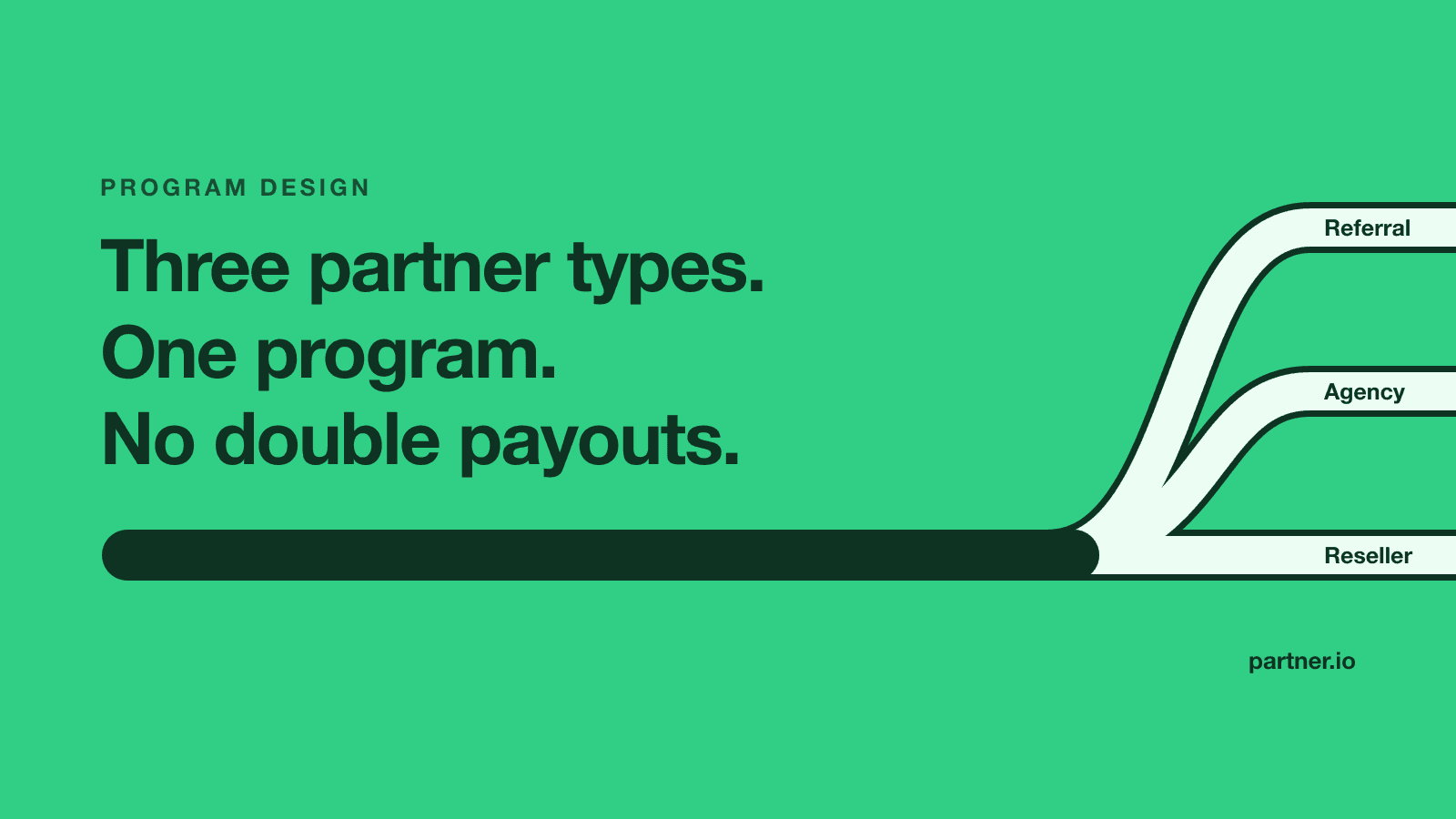
How to run referral, reseller and agency partners in one program: share the record, the rules and the portal, split the pay and the playbook, and never pay twice.
Referral, Reseller and Agency Partners Don't Need Three Programs. They Need One Spine.
Nobody sets out to run three partner types. You collect them.
A customer's consultant sends you a referral.
An agency asks if it can implement you for its clients.
A reseller in Germany wants to buy at a discount and bill the customer itself.
A year later you're running referral, reseller and agency partners out of three spreadsheets, two contract templates and one partner manager's memory.
Then the agency and the consultant both claim the same deal. Finance pays them both. Nobody notices until the quarter closes.
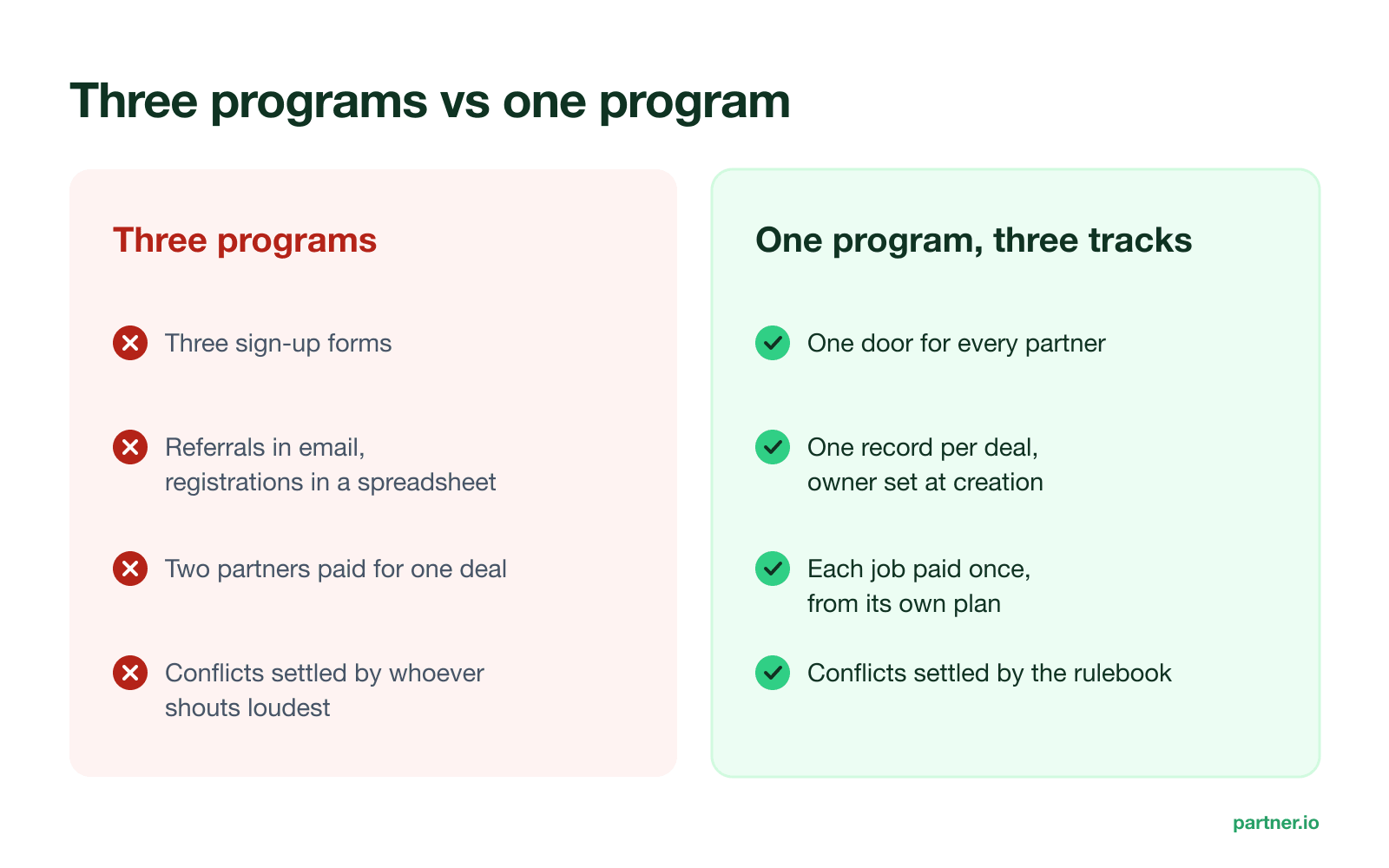
The fix isn't three programs. It's one program with one record, one rulebook and one front door, and separate economics for each track. Here's how to build it, what to share, what to split, and the rules that stop partners fighting over the same account.
"Different partners need different programs"
That's the strongest objection, and it comes with good research behind it.
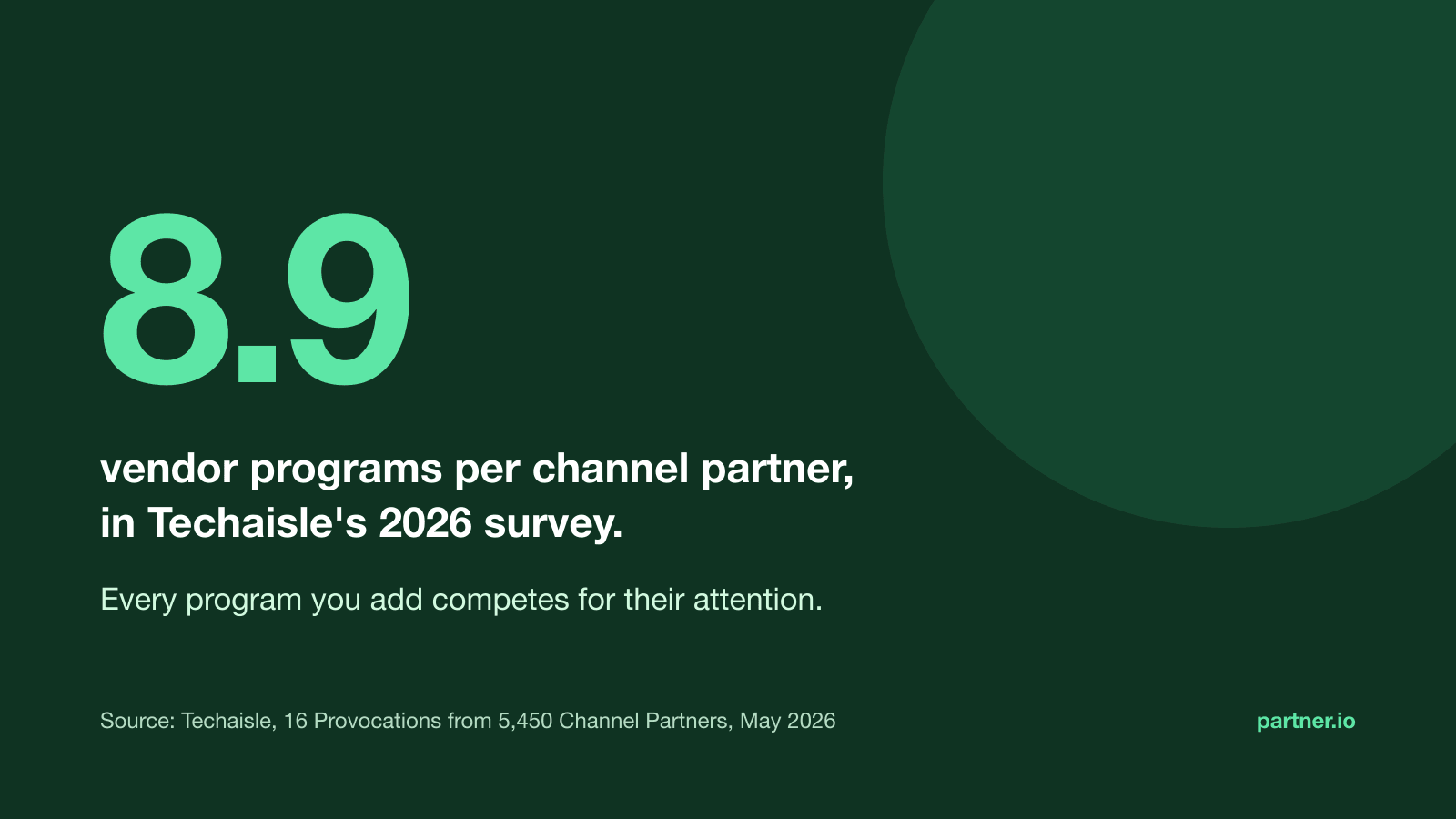
Techaisle surveyed 5,450 channel partner firms for its 2026 study. In 16 provocations drawn from that research, Anurag Agrawal argues the channel has split into economies that want different things from vendors.
“You cannot serve both with one incentive model, one tier structure, one co-sell motion, or one measurement framework.
”
He's right. It's also an argument for separate tracks, not separate programs.
A consultant who makes one introduction a quarter shouldn't sit on the same commission plan as an agency that spends six weeks implementing you. A reseller who owns the invoice needs a margin, not a referral fee. Split those.
What you can't split is the ledger. Give each partner type its own system and three questions go unanswered.
Who sourced this account? Who has already been paid on it? Which partners are working the same buyer?
The biggest ecosystems in SaaS learned this the hard way. HubSpot runs separate affiliate and Solutions Partner programs. Its affiliate program policies spell out that a partner in both is paid by one, "depending on whether you registered the lead or the customer went through your affiliate link."
Shopify's Partner Program Agreement does the same for a merchant referred by more than one partner. Fees come from one plan or the other, "but not both."
If they needed a written rule to stop paying twice across their own programs, so will you. It's just far easier to enforce when every deal sits in one record.
Sort partners by the job, not the label
Partner labels are loose. One company's "agency" is another's "solution partner". Before you design anything, sort partners by where the work changes hands, the same test we use in our guide to partner program models.
| Type | Sells | Bills | Pay |
|---|---|---|---|
| Referral | You | You | Flat fee |
| Agency | Both | You | Rev share |
| Reseller | Them | Them | Margin |
"Agency" here means a partner that implements for the customer, while you keep the contract and the billing. A partner that buys from you and invoices the customer is a reseller, whatever it calls itself.
Referral partners introduce, then step back
Consultants, advisors, fractional executives, happy customers. They make the introduction and your team runs the demo, the trial and the close. Their job ends at the handoff, so their pay should be simple and fast. More on the motion on our referral partners page.
Agency partners implement, and sometimes source
Agencies configure, migrate, integrate and train. Some bring you the deal. Others get called in after you've won it.
That difference is the whole design problem. An agency that sources and implements a customer has done more than one that only implements, and the plan has to say so. HubSpot pays Solutions Partners 20% of MRR for up to three years, but only on deals the partner registers. In HubSpot's words, "Creating and closing a shared deal is required to receive credit." See how agency partners fit a SaaS program.
Reseller partners own the customer
Resellers buy from you and sell on, usually at a discount. They own billing, first-line support and often the relationship. You see their pipeline only if they show it to you, which is why reseller partners need a deal pipeline more than a referral link.
The three overlap more than anyone likes. An agency starts reselling in one region. A referral partner wants to implement. Your structure has to absorb a partner moving tracks without a rebuild.
The Spine and Tracks model for referral, reseller and agency partners
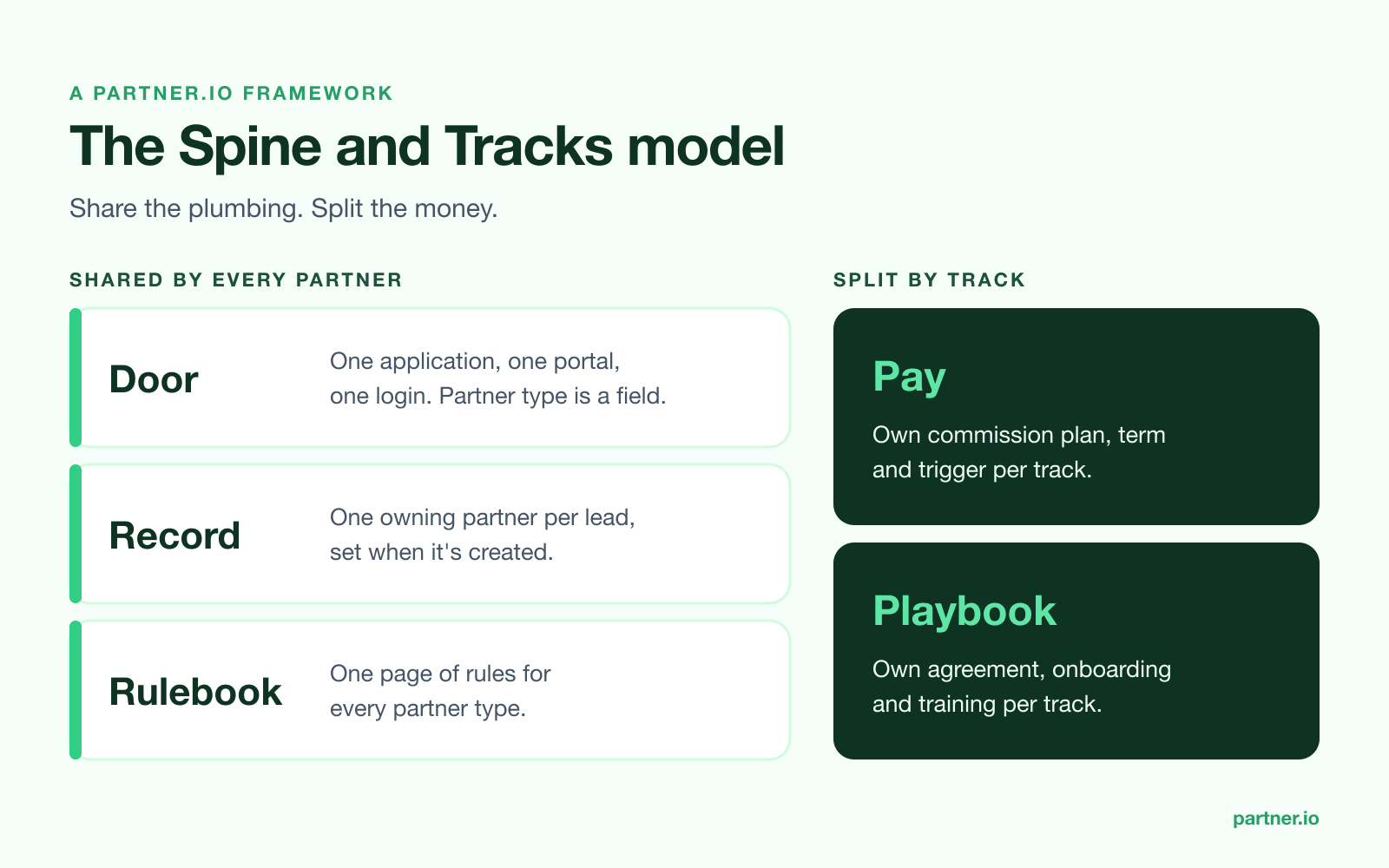
Here's the model we'd use. Three things every partner shares. Two things every track gets its own version of.
Shared: one door
One application form, one portal, one login. Partner type is a field on the application. When a referral partner becomes an agency, you change a field. You don't migrate them to another system.
Shared: one record
Every lead and every deal has exactly one owning partner, set when it's created. Attribution, commission and reporting all hang off that record. If a consultant and an agency both touched the account, the record shows who registered it and when.
Shared: one rulebook
One page of rules of engagement covering every partner type. Who wins a tie, how long a registration protects a deal, what happens when your own sales team already has an open opportunity.
Keep it to one page because partners are reading yours alongside everyone else's. Techaisle's 2026 figure is 8.9 vendor programs per partner, and the line after that number is worth pinning above your desk:
“Every rule you add costs attention that flows to competitors who demand less.
”
Split: pay
Each track gets its own commission plan, term and trigger. Referral partners get a flat fee after onboarding, or a short revenue share. Agencies get a share for a fixed term, triggered by registered deals. Resellers get a margin, plus SPIFFs or MDF when you want a push.
We've costed nine options on the same customer in SaaS partner commission structures, and argued term and timing in recurring vs one-time referral fees.
Split: playbook
Agreement, onboarding, training and comms, per track. A referral partner needs a two-minute explainer and a tracked link. An agency needs implementation certification. A reseller needs a price list, a deal pipeline and a quarterly business review.
Don't make the consultant sit through the reseller course.
“Share the plumbing. Split the money.
”
Want to run this in a real portal? Try Partner.io free for 7 days, no credit card needed.
One partner, one track, and what to do with the exceptions
The awkward case is the partner who does two jobs.
Our own answer sits in the FAQ on our partner program page. Can you be more than one kind of partner? "Not at the moment. Pick the track that covers most of what you would do with us."
Referral partners earn $250 flat once the client is through onboarding. Implementation partners earn $250 plus 20% of what the client spends with us for 24 months. Nobody stacks both on one client.
That's strict on purpose, and it won't suit every program. Here's the decision rule:
If one job clearly dominates, put the partner on that track and let the other job ride along under the same terms.
If they do both in roughly equal measure, keep one partner record and let the deal decide the plan. A registered deal they'll implement pays on the agency plan. A straight introduction pays on the referral plan. That's HubSpot's rule in plainer words.
Whatever you choose, never let a partner pick the plan after the deal has closed.
Rules of engagement between partner types
Conflict in a mixed program comes from two directions: partner against your sales team, and partner against partner. The second is the one mixed programs underestimate, because an agency and a consultant often know the same buyer.
Good rules settle the common cases without a meeting. These are defaults to adapt to your own program:
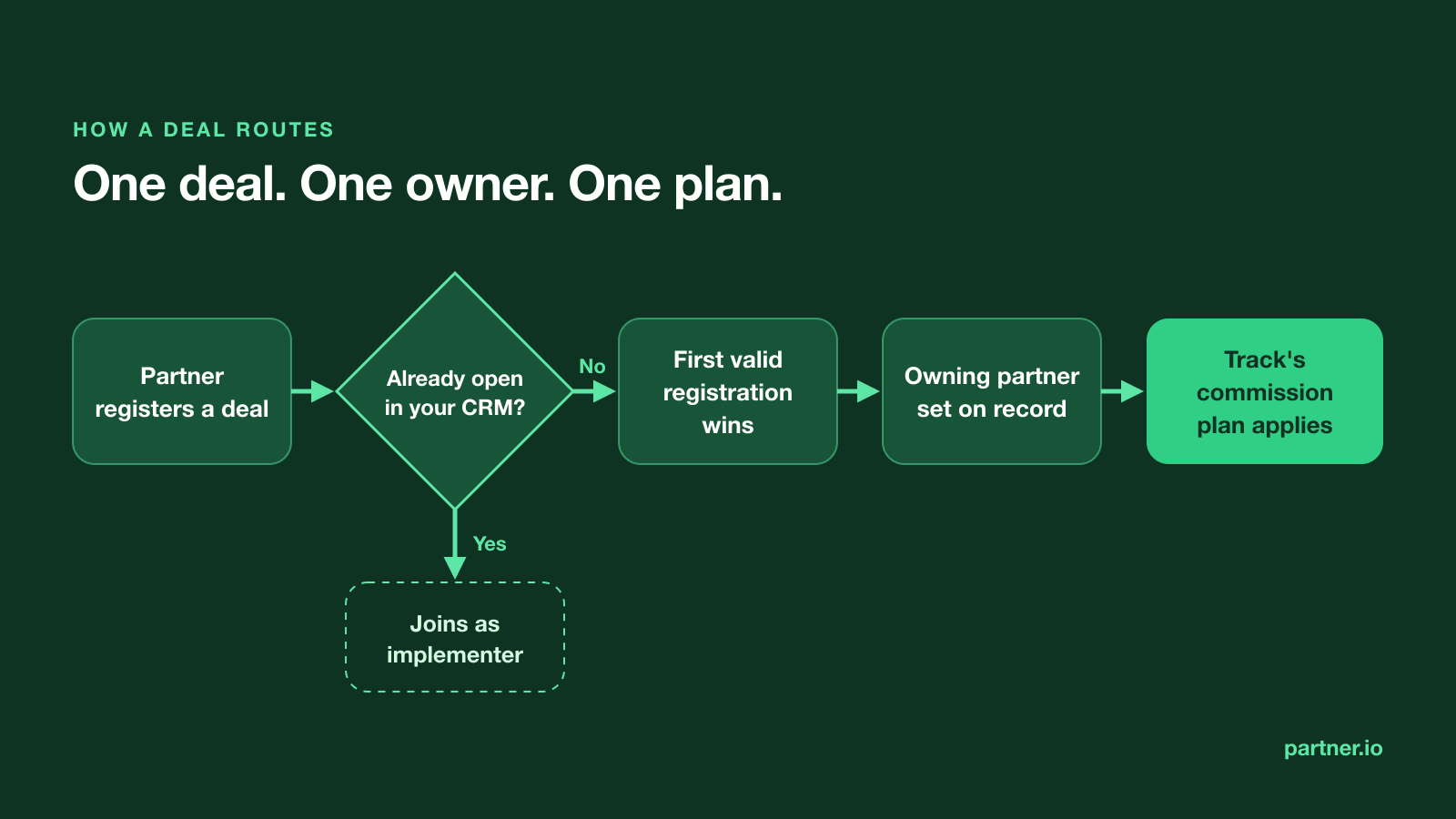
- First valid registration wins. Valid means the account isn't already in an open opportunity in your CRM.
- A registration protects the deal for 90 days. If nothing moves, protection lapses, and the partner hears before it does.
- Open direct pipeline beats a new registration. The partner can still join as implementer and earn on that basis.
- Resellers keep the accounts they bill. Renewals and expansion route through them unless the customer asks otherwise in writing.
- One commission per job. A sourcing partner and an implementing partner can both earn on one customer, for different work, from different plans, agreed up front.
Rule five is where agencies and consultants make peace. The consultant gets the referral fee for the introduction. The agency gets its share for the implementation. Neither is paid for the other's work.
How to set up a mixed partner program in two weeks
You don't need a quarter. You need ten working days and a partner list.
- Days 1 to 2: tag every partner by the job they do. Introduce, implement or resell. Ignore what their contract calls them.
- Day 3: write the one-page rulebook. Start from the five rules above.
- Days 4 to 5: set one commission plan per track. One sentence each. If you can't say it in a sentence, partners won't remember it.
- Day 6: draft one agreement per track. Same base terms, a different commercial schedule.
- Days 7 to 8: build one application form with partner type as a required field, and route each type to its own tier and agreement.
- Day 9: move every open lead into one record, each with a single owning partner.
- Day 10: tell partners. One short email per track, covering what changed for them and nothing else.
If you have fewer than ten partners, most of this collapses into an afternoon. Structuring a program under 10 partners covers the lighter version.
One program or three: the trade-off
| One program | Three programs | |
|---|---|---|
| Sign-up | One door | Three forms |
| Attribution | One record | By hand |
| Double pay | Blocked | Found late |
| Setup | Slower | Faster |
| Upkeep | Lighter | Heavier |
Separate programs are quicker to launch, and that's a real advantage. If you're opening a reseller channel in a market your referral partners will never touch, a standalone program can be the right call.
Most SaaS companies under $25M ARR don't have that separation. Their agencies, consultants and resellers all know the same buyers, so every extra program becomes another place for a deal to be claimed twice. Barb Huelskamp, writing for ITPro's ChannelPro, names the habit behind the sprawl:
“the channel has started to mistake complexity for sophistication
”
Three programs feel thorough. They mostly mean three times the reconciliation, the same mess we priced in the hidden cost of managing partners in spreadsheets.
When a mixed program breaks
The failures are predictable, which means they're fixable.
What this looks like in the real world
The company below is made up. The argument it ends in is one we hear all the time.
A 35-person SaaS company sells scheduling software to clinics. It has 18 referral partners (practice consultants and a few loyal customers), four agencies that implement it alongside the clinics' other systems, and one reseller in the Netherlands.
In March a practice consultant introduces a 12-site clinic group. Two weeks later, one of the agencies, already rebuilding that group's CRM, registers the same account.
Under the old setup, the consultant's referral lived in an email thread and the agency's registration in a form that wrote to a spreadsheet. Both partners were told "we'll sort it out".
The partner manager lost a week to it. The consultant got paid. Three months later, so did the agency, for the same introduction.
With one record, the answer is on the screen in seconds. The consultant's lead came first, so the consultant owns sourcing and earns the referral fee. The agency is added as implementer and earns its share for the build. Both partners see the outcome in their portal that afternoon.
Nobody pays twice, and nobody needs a call to find out why.
Where Partner.io fits
We built Partner.io for programs with more than one kind of partner, and we run our own referral, implementation and technology partner program on it.
One door. The partner portal runs on your own domain with one application form, where partner type is a field you control. Each partner type can carry its own agreement, and new partners land on the tier set for their type.
One record. Leads and deal registration fixes the partner and rep on a lead when it's created, because commission is attributed to them. Lead auto-approval can approve referrals based on the referring partner or the form answers, and approved leads sync to HubSpot, Salesforce or Pipedrive with the partner attached.
Reseller pipelines. With reseller management, reseller reps create deals and move them through your pipeline themselves. Each deal carries its own message thread, and won deals sync to your CRM attributed to the rep.
Pay per track. Tiers, commissions and payouts give each tier its own commission perks, add SPIFFs on top, and bundle everything a partner earned into one self-billed invoice per cycle, paid through Stripe.
Playbook per track. The Engagement Hub targets announcements and newsletters by partner type and tier. Automation flows branch on partner type, so a consultant and a reseller get different onboarding from the same program.
Build the spine once
Most mixed programs weren't designed. They piled up, one partner type at a time.
You can keep adding a spreadsheet for every new kind of partner, or you can build the shared spine once and add tracks as they show up. One costs a week of design now. The other costs a week of untangling every quarter, forever.
Try Partner.io free for 7 days → No credit card, no setup fee, cancel anytime.
Prefer a walkthrough first? Book a demo and we'll map it to your program.
- [partner-led-growth]
- [prm]
- [referrals]
Published November 18, 2026