
Recurring vs one-time referral fees, settled with real maths: what each costs by year five, the four-question TAIL test, and what we pay our own partners.
Recurring vs One-Time Referral Fees Is Two Decisions, Not One
Every partner program has this argument once, usually the week before launch.
Finance wants one-time: a fixed cost per customer, booked and forgotten.
The partner lead wants recurring: partners who care whether the customer stays.
The founder wants whatever their last company did.
All three are arguing about the wrong thing.
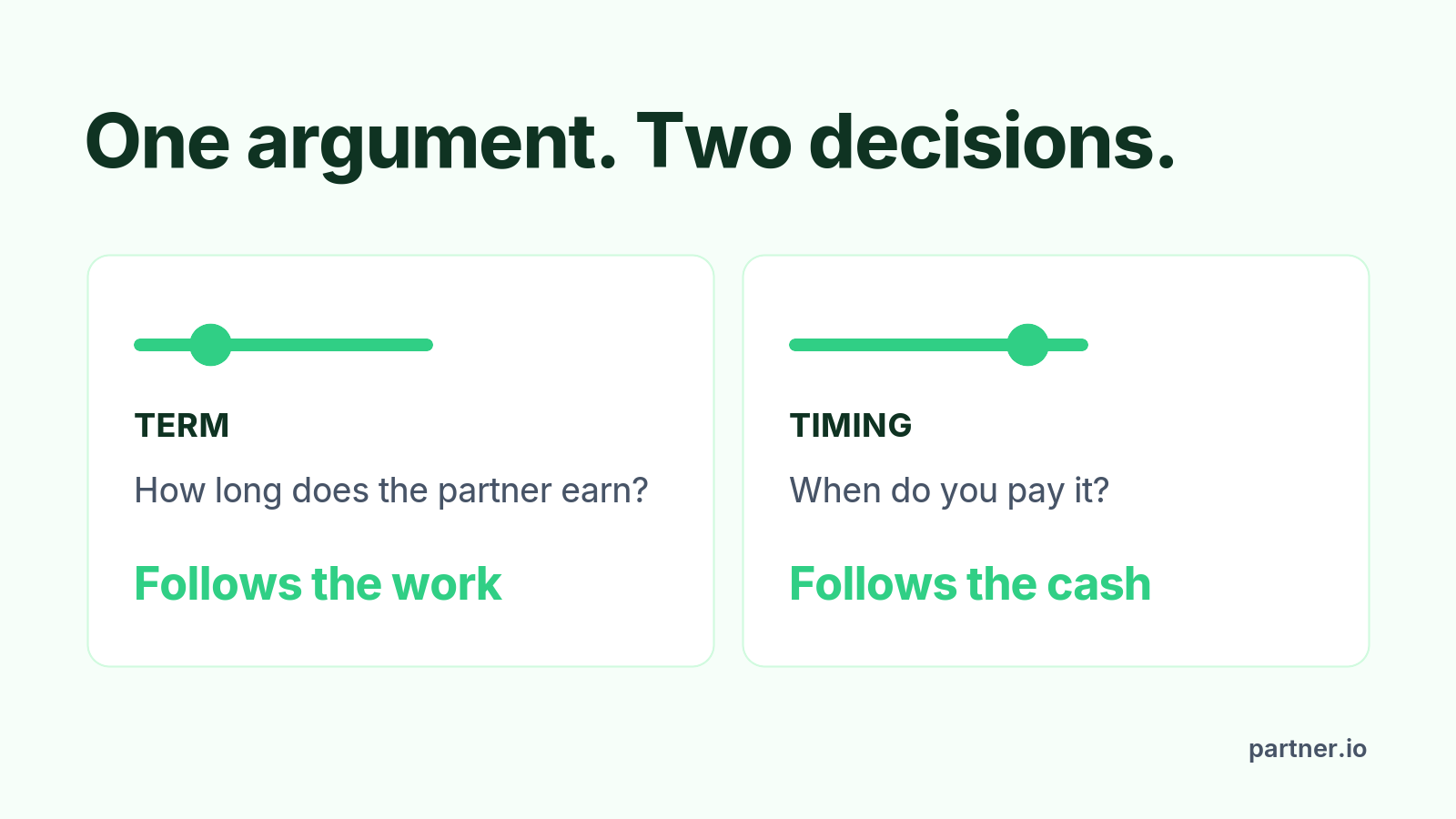
Recurring vs one-time referral fees is two decisions folded into one. How long does the partner earn? And when do you pay it? Pull them apart and our answer fits on a sticky note:
Term follows the work. Timing follows the cash.
Below is what that means in practice, what we pay our own partners, and the maths that got us there.
What we pay our own partners
We had to answer this for ourselves, so here's the answer in public.
Our partner program has two paid tracks. Referral partners make the introduction, and we run the trial, onboarding and close. They get $250, paid once, after the client has been through onboarding.
Implementation partners deploy, migrate, integrate and train. They get $250 plus 20% of what the client spends with us for 24 months. On a ten-seat client at $79 a seat, that's around $4,000 over the two years.
One fee is one-time. The other is recurring. Same company, same product.
“The 20% is for the work.
”
That line is on our partner page, and it's the whole argument. The referral partner's job ends at the introduction. The implementation partner's job starts there.
We're not the only ones who split it this way. HubSpot pays affiliates 30% recurring for up to one year. Its Solutions Partners, the agencies that sell and implement HubSpot for clients, earn 20% of monthly recurring revenue for up to three years. Two partner types, two terms, one vendor.
The best case for recurring, and where it breaks
Here's the strongest argument against us: pay everyone recurring, because recurring keeps every partner invested in retention.
There's data behind that. Techaisle's 2026 survey of 5,450 channel partner firms found that, by partners' account, 72% of vendor incentive spend lands at the close. Yet 40% of partners say renewals and consumption growth are their most profitable motion. Its advice to vendors is blunt:
“Move variable money from the close into adoption, renewal, and the services partners deliver under their own name.
”
Read the last eight words again. "The services partners deliver." That's an argument for paying recurring to partners who keep working. It says nothing in favour of paying a monthly fee to someone who made one introduction.
The same report draws the line itself. Consultants, SIs and ISVs invest before the sale. MSPs and VARs earn after it, through deployment, renewal and expansion.
Retention alignment is worth paying for when the partner can change the outcome. A fractional CFO who introduced you to a client can't stop that client churning in month 11. Paying them 20% of every invoice for life doesn't buy alignment. It buys a pension for one email.
A one-time fee is only cheap if you pay it late enough
The usual objection to one-time fees is that you pay for customers who leave. That's true if you pay at signature, and it's a timing problem, not a term problem.
Take ten referred customers at $1,000 a month. You promise 20% of first-year revenue, paid when the contract is signed. That's $2,400 each, $24,000 in total.
Two cancel after four months. They paid you $8,000 between them. You paid their partners $4,800.
Now pay the same 20%, but as a share of each payment, for 12 months. The eight who stay cost exactly what they did before: $19,200. The two who left cost $800 each, because the fee stopped when the payments did. Total: $20,800 instead of $24,000.
So a 12-month recurring referral commission is a one-time fee paid in instalments that stops if the customer does. Same economics for the partner when the deal is good. Less exposure for you when it isn't.
Plenty of programs go the other way and keep it simple. Semrush pays affiliates $100 to $300 per sale, up to $450 at higher tiers, tied to the referral's first purchase. A flat fee works when the referrer's job is done at the sale and most customers buy the same plan.
Either way, the rule is the same. Pay on cash received, after a hold of 30 to 60 days, and the "we paid for churn" problem mostly disappears. Our glossary entry on clawbacks covers the cases a hold can't.
Lifetime recurring: the bill you meet in year five
Lifetime commission looks cheap at launch because the first cheque is small. The cost arrives later, and it compounds.
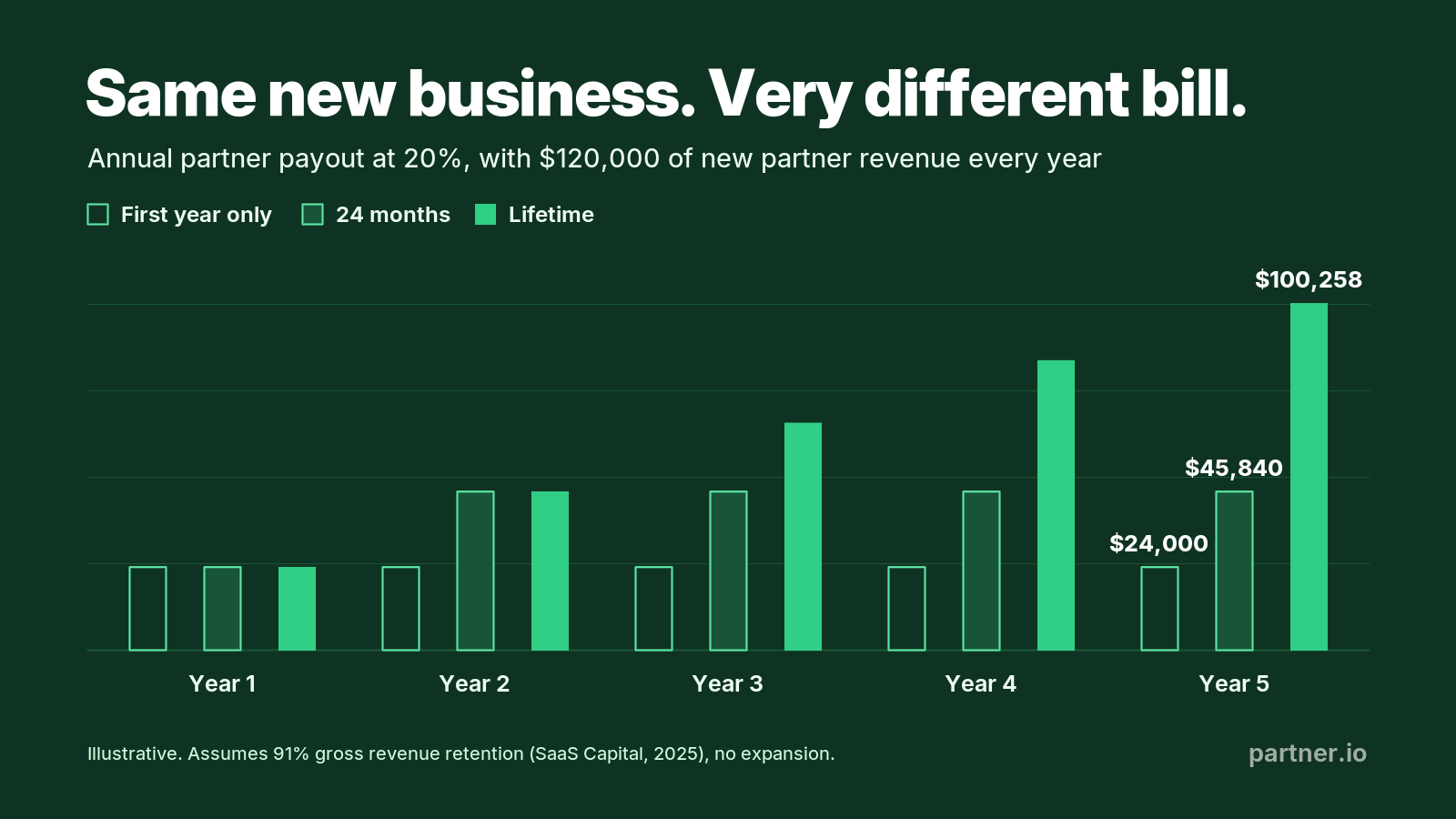
Here's an illustrative model. Partners bring $120,000 of new annual revenue every year, and you pay 20%. Gross revenue retention is 91%, about the median for private B2B SaaS companies with contracts under $250,000 a year in SaaS Capital's 2025 retention benchmarks. No expansion, rounded to the dollar.
| Year | First year only | 24 months | Lifetime |
|---|---|---|---|
| 1 | $24,000 | $24,000 | $24,000 |
| 2 | $24,000 | $45,840 | $45,840 |
| 3 | $24,000 | $45,840 | $65,714 |
| 4 | $24,000 | $45,840 | $83,800 |
| 5 | $24,000 | $45,840 | $100,258 |
Partners send exactly the same new business every year. By year five, the lifetime line costs more than four times the first-year line. The 24-month line levels off at under half the lifetime figure.
Your real number is probably worse. The best-known study of referred customers, Schmitt, Skiera and Van den Bulte in the Journal of Marketing, tracked about 10,000 customers of a German bank for almost three years. Referred customers had a higher retention rate, and that gap persisted. Their higher contribution margin, though, eroded over time.
It's a bank, not a SaaS company, so treat it as a direction rather than a benchmark. But the direction matters. If referred customers stay longer than average, a lifetime fee runs longer than your blended churn rate predicts. And if the extra value of a referral fades, you're paying the most in the years the referral mattered least.
The TAIL test: four questions that set the term
Every referral fee has a tail: the stretch of months after the close when you're still paying. The TAIL test decides how long it should be.
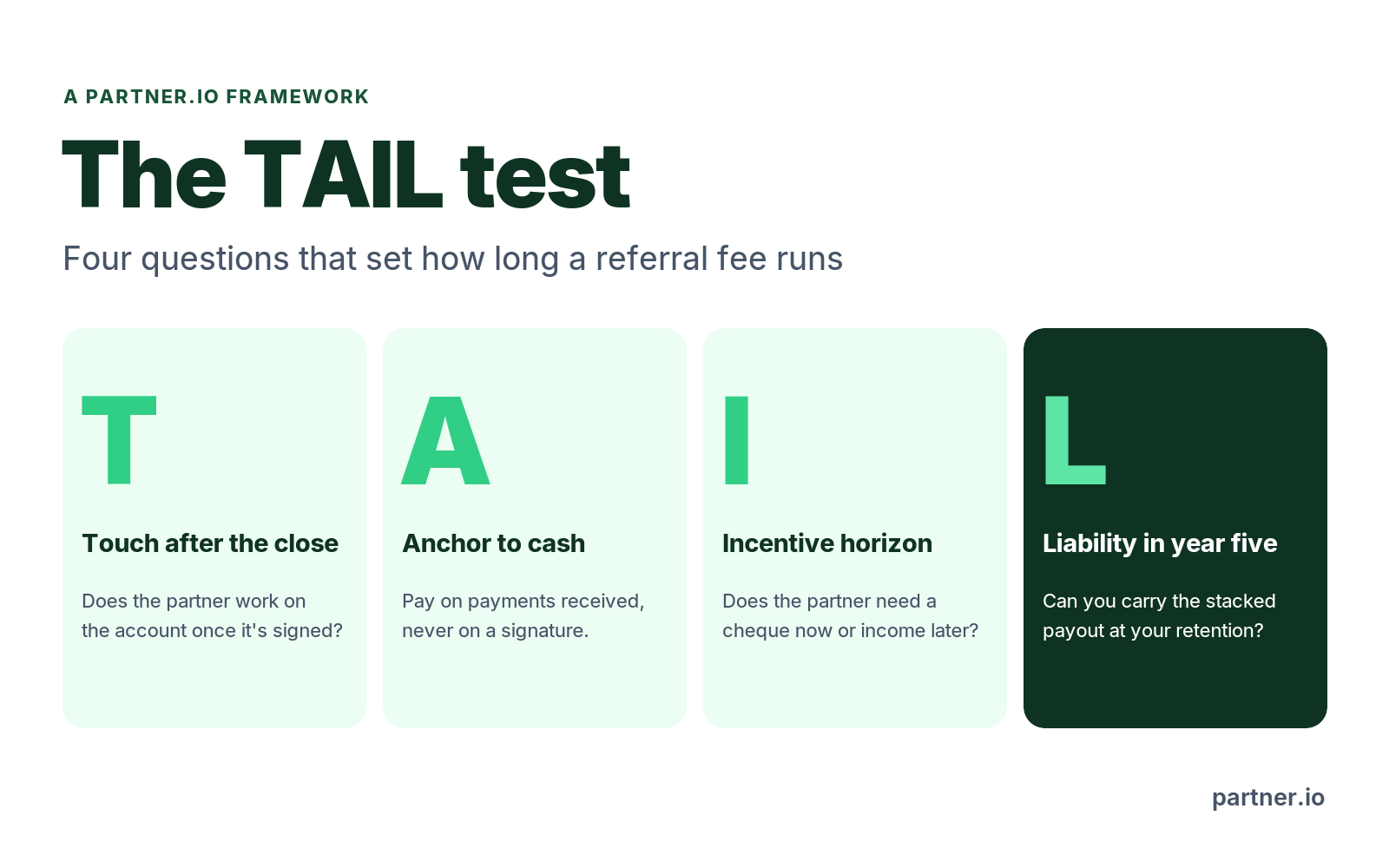
T: Touch after the close
Does the partner do any work on the account once it's signed? Onboarding, integration, training, support, quarterly reviews.
If not, pay first-year value and stop. If they do, pay for as long as that work lasts, which for most implementation partners is 12 to 24 months.
A: Anchor to cash
Pay on payments received, never on a signed contract. For a customer billed monthly, that makes the fee recurring by default. For a customer who pays annually up front, 12 months of recurring commission is one payment anyway.
I: Incentive horizon
Ask what the partner's business runs on. A consultant who refers four clients a year wants a cheque worth mentioning. An agency building a retainer business wants income it can forecast. Paying the consultant $40 a month makes a decent fee feel like nothing.
L: Liability in year five
Run your own version of the table above, using your retention and your realistic partner volume. If the year-five number makes your finance lead wince, shorten the term now. The day you launch is the only day shortening it costs nothing.
Want to run the TAIL test on a live program? Try Partner.io free for 7 days, no credit card needed.
What we'd choose, partner by partner
Put the four questions together and most programs need two or three structures, not one.
| Partner | Term | Paid when |
|---|---|---|
| Referral | First year | After cash plus hold |
| Affiliate | 12 months | Monthly, on cash |
| Implementer | 24 months | Monthly, on cash |
| Reseller | Margin | On their invoice |
| Technology | None | Co-sell instead |
Three rules sit behind that table.
If the partner's job ends at the introduction, pay first-year value once, after the customer pays and the hold clears.
When they keep working on the account, pay recurring for as long as the work lasts, and put an end date on it.
If they own the customer's billing, you're in reseller margin territory, and a referral fee is the wrong tool.
Notice what's missing: lifetime. We'd only pay it to a partner who services the account for its whole life, and only at a rate we'd still be glad to pay in year six.
The trade-off doesn't go away. A one-time fee gives you a known cost and a partner with no reason to stay involved. A recurring fee buys that involvement and makes your cost depend on retention. Pay for involvement only where it changes the outcome.
For the full menu of options beyond these two, including step-down and milestone fees, see 9 SaaS partner commission structures, with the maths. If you haven't separated your partner types yet, start with the seven partner program models.
How to set referral fee terms in a week
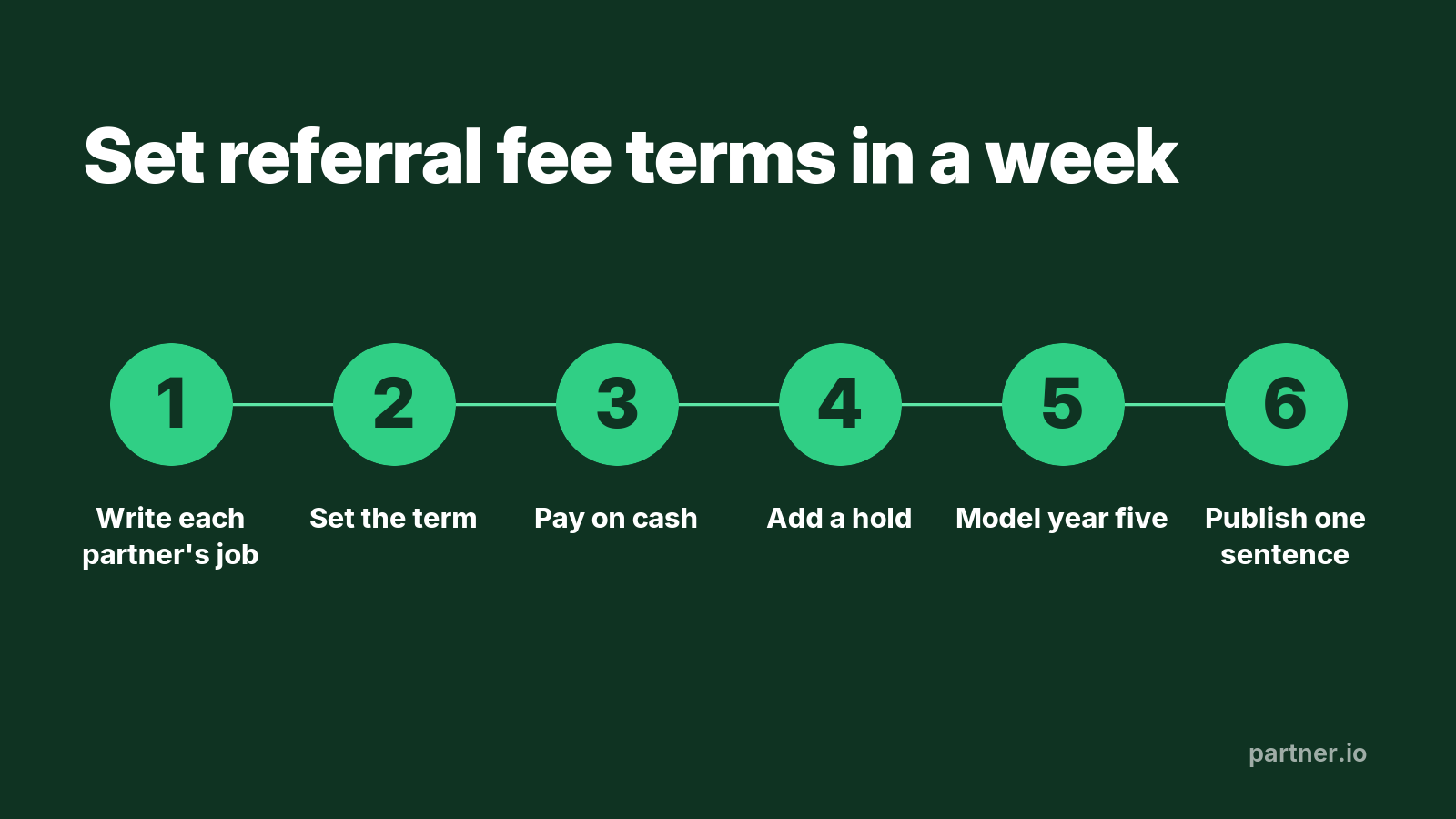
- Write each partner type's post-close job in one sentence. "None" is a valid answer, and a common one.
- Set the term from that sentence. No job means first-year value. A job means its length, capped.
- Make cash the trigger. A recorded payment, not a closed-won stage.
- Add a hold. Thirty to 60 days after the customer pays, long enough to clear your refund window.
- Model year five. Your retention, your volume, every partner type stacked.
- Publish the rule as one sentence per partner type. Then leave it alone for a year.
On that last step, Techaisle's survey has a line worth pinning above the commission spreadsheet:
“Partners will accept thinner margins in exchange for rules that hold for a year.
”
Before you publish, check the terms against this list:
- Each partner type has its own term, written down.
- No recurring fee runs without an end date, unless you've costed year six.
- Fees are triggered by cash received, not a signature.
- A hold period covers your refund window.
- New terms apply to new referrals only.
What this looks like in the real world
An illustrative example, not a customer story.
A 30-person SaaS company sells at $600 a month. Its partner lead launches with one rule for everyone: 20% recurring, for life.
Eight months in, the program has two kinds of partner. Three fractional RevOps consultants introduce a client or two a quarter and never touch the account again. One HubSpot agency introduces fewer clients but does every onboarding and most of the support.
Both get $120 a month per client. To the consultants that's a rounding error, so they stop thinking about the program. Meanwhile the agency does the most work for the same rate, and asks why.
The partner lead rewrites the terms for new referrals.
Consultants get 20% of first-year revenue, $1,440, in one payment 60 days after the client's first invoice is paid.
The agency gets 20% of every payment for 24 months, with a written list of what it owns in that time.
Existing clients keep the lifetime rate they were promised.
Year-one cost per customer doesn't change. What changes is that each partner is now paid for the job they do.
Where Partner.io fits
Both kinds of fee are easy to describe and fiddly to run. A one-time fee needs someone to spot the first payment and wait out the hold. A recurring fee needs every payment matched to a partner, every month, until a date someone has to remember.
Tiers, commissions and payouts in Partner.io handle both:
- One-time fees: a Monetary or Percentage reward on a perk, with a payout delay in days, weeks or months to cover your hold.
- Recurring fees: the Revenue generated trigger creates a commission every time a payment is recorded against a referred lead, capped at the months you choose. Revenue arrives from Stripe or Chargebee, so nobody types it in.
- Different terms per partner type: conditions on partner type keep referral terms off agency deals, and the reverse.
- Partners can check their own numbers: every commission shows as pending or paid in the partner portal, so a fee that ends at month 24 never arrives as a surprise.
Approvals run by hand or by rule in automation. Payouts go through Stripe, and US partners file a W-9 in the portal and get a 1099-NEC at year end through tax compliance. Partner.io takes 0% of partner payouts.
Our own partner program runs on the same portal, with both fees above. If you're still matching payments to partners by hand, the hidden cost of managing partners in spreadsheets puts a number on it. Setting the rate itself is a separate question, covered in our guide to referral fee percentages.
Pay for the work, on the cash
The recurring vs one-time debate drags on because both sides are right about different partners.
So stop choosing one for everybody. Pay introducers once, well, and after the money arrives. Pay the partners who keep working for as long as they keep working, and write the end date down before anyone signs.
Lifetime can wait until a partner earns it.
Try Partner.io free for 7 days → No credit card, no setup fee, cancel anytime.
Prefer a walkthrough first? Book a demo and we'll map it to your program.
- [referrals]
- [prm]
Published November 17, 2026