
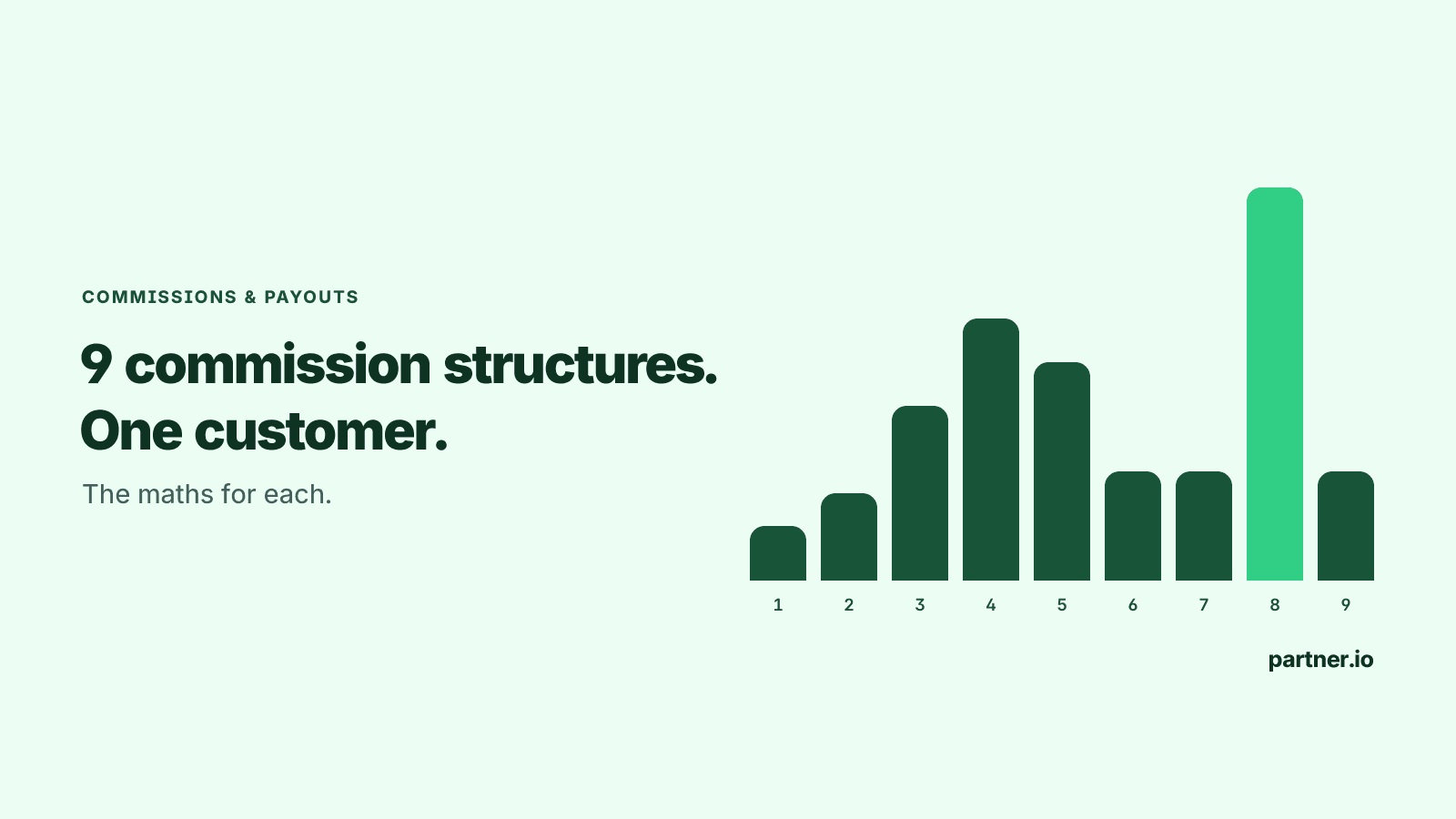
Nine partner commission structures for SaaS, each costed on the same $12,000-a-year customer, with a four-part check for choosing yours.
"20%" Is Not a Partner Commission Structure
Ask a founder what they pay partners and you'll get a number.
"Twenty percent."
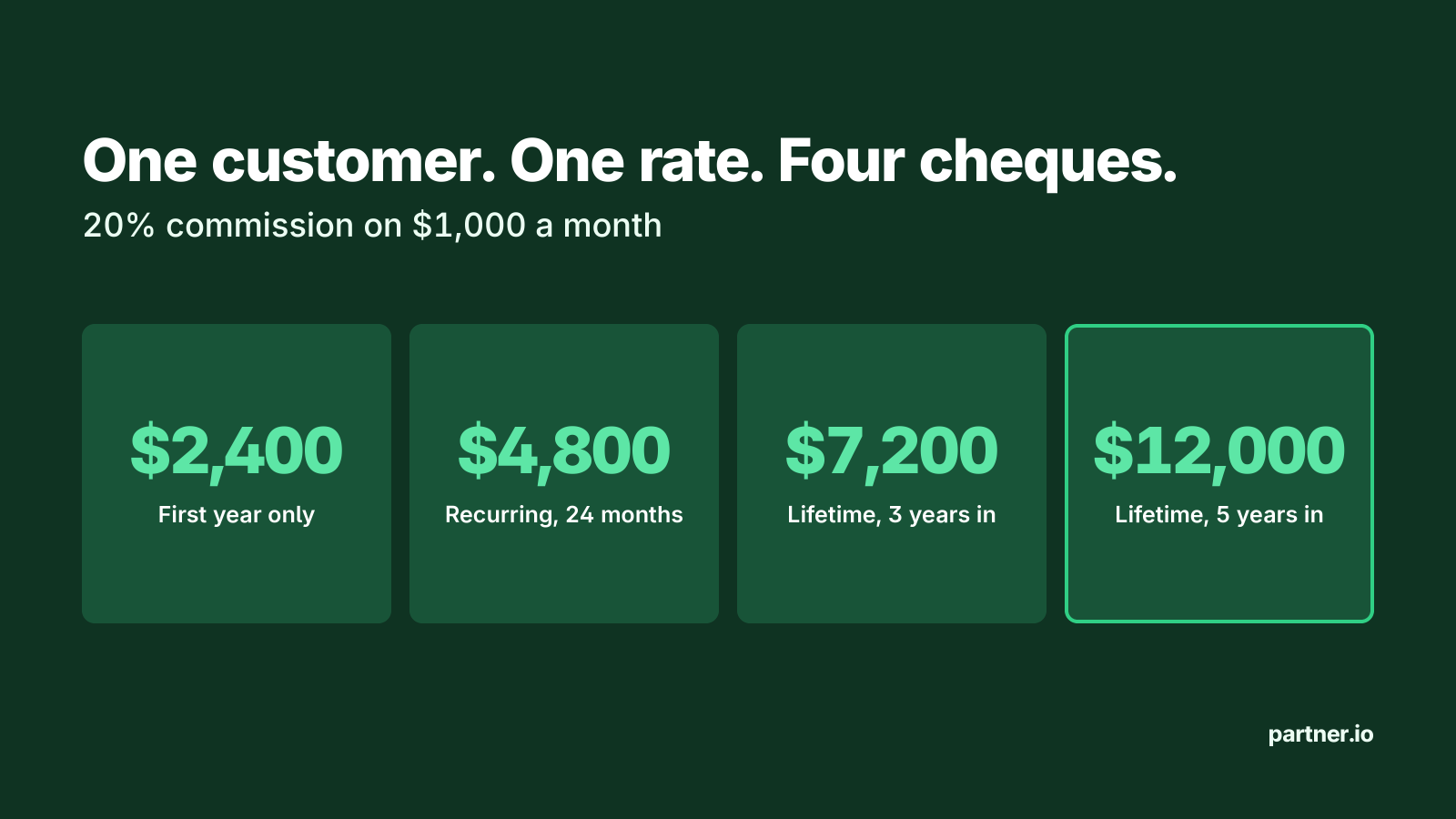
Twenty percent of what, for how long, paid when? Take one customer paying $1,000 a month who stays three years. Depending on the answer, that same 20% is a cheque for:
$2,400, if it's a share of the first year.
$4,800, if it recurs for 24 months.
$7,200, if it recurs for as long as the customer stays.
$12,000, if the customer stays five years and nobody capped it.
Same rate. Same customer. A fivefold spread.
Most partner commission structures get copied from a bigger company's partner page and costed for the first time when finance asks why the payout line doubled. This post does the costing first: nine structures, one customer, the arithmetic for each, and what it takes to run them without a spreadsheet.
"Just pick one and keep it simple"
That's the best objection, and it's half right.
Techaisle's 2026 survey of 5,450 channel partner firms found partners name simplicity as the top place vendor programs fall short, at 71%. And 79% of MSPs rate transparency in incentive calculations as critical or very important. A partner who can't work out their own commission won't trust yours.
So yes, run one structure per partner type and make it readable in one sentence.
But simple for the partner doesn't mean unexamined by you. The same survey shows what an unchecked design costs:
“By partners' account, 72% of vendor incentive spend is concentrated at transaction close, yet 40% of partners say renewals and consumption growth are their most profitable motion.
”
Vendors pay at the close. Partners make their money after it. That gap is a structure problem, and a higher rate won't fix it.
The RATE check: four dials behind every commission structure
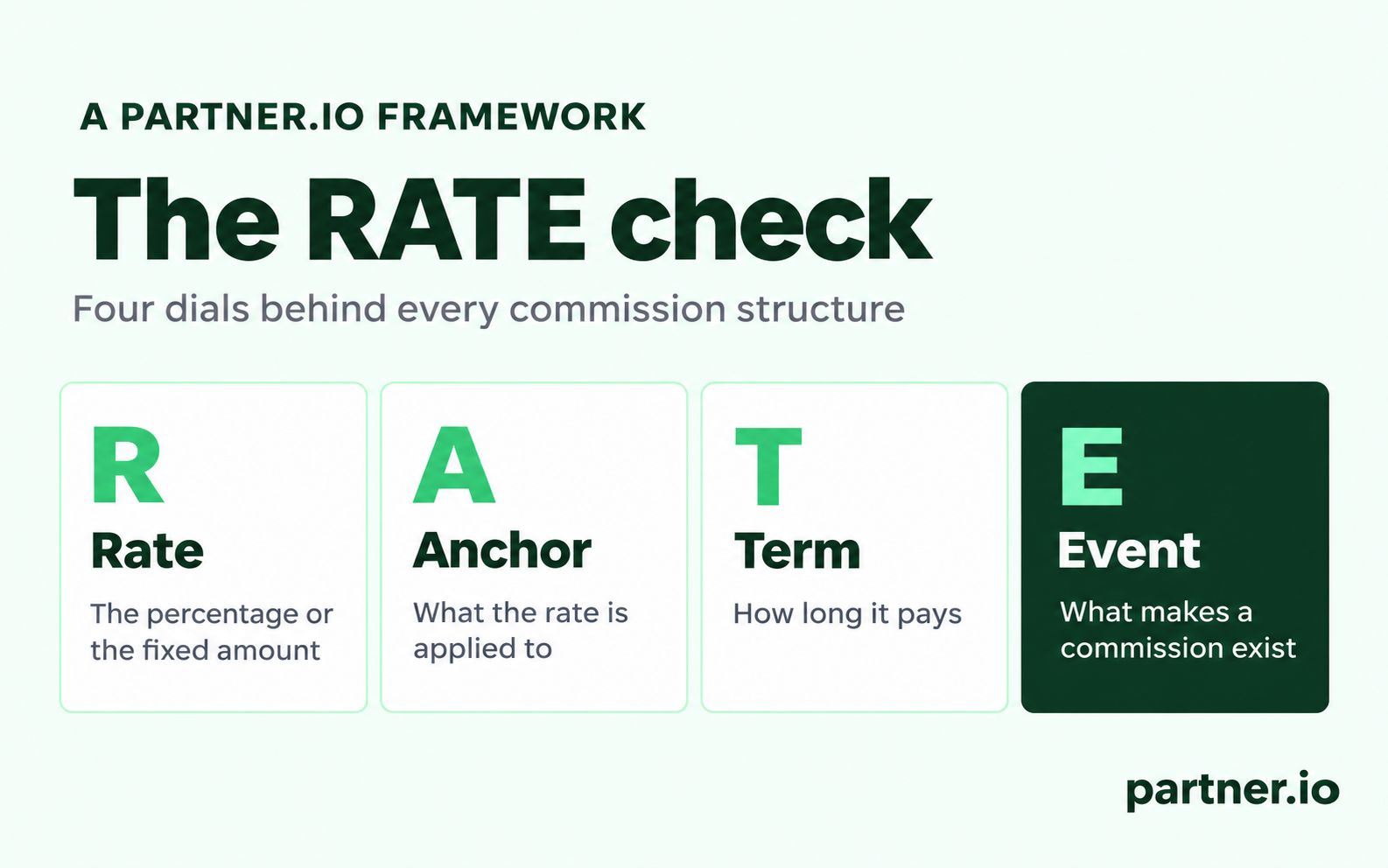
Every structure below is the same four decisions set to different values.
The RATE check:
- Rate: the percentage or the fixed amount.
- Anchor: what the rate is applied to. Contract value, cash collected, list price or another partner's commission.
- Term: how long it pays. Once, 12 months, 36 months, for life.
- Event: what makes a commission exist. A signed contract, a cleared payment, a meeting held, a tier reached.
Most arguments about commission are about the first dial. Most of the cost sits in the other three.
One customer runs through all nine: $1,000 a month, $12,000 a year, three years, $36,000 in total. Our guide to referral fee percentages covers how to set the rate itself from your margin and acquisition cost.
Three one-time and fixed-term structures
1. Flat bounty
A fixed amount per customer won.
The maths: $1,500 per customer. That's 12.5% of year one and 4.2% of three-year revenue.
Now change the deal. A $4,000-a-year customer earns the partner the same $1,500, which is 37.5% of year one. A $40,000 customer also earns $1,500, under 4%. Partners spot this in a month, send you the small accounts and take the large ones elsewhere.
Use it when nearly every customer buys the same plan.
In Partner.io: a Monetary reward on a perk, fired when a referred lead reaches the pipeline stage you choose, with an optional payout delay.
2. Percentage of first-year revenue
One payment, a share of the first 12 months.
The maths: 20% × $12,000 = $2,400. That's 6.7% of three-year revenue, and your cost per customer is capped the day the deal closes.
The weakness is the Term dial. The partner earns nothing for a renewal, so they have no reason to care about one. It suits a consultant who makes the introduction and steps back.
In Partner.io: a Percentage reward calculated on deal value. Add a condition so it applies only above a minimum deal size or to one partner type.
3. Recurring commission for a fixed term
A share of every payment, for a set number of months.
The maths: 20% × $1,000 × 24 months = $4,800, or 13.3% of three-year revenue. If the customer churns in month nine, you've paid $1,800 and owe nothing more.
HubSpot runs the largest public example. Its deal-based commission page gives the arithmetic: sell an $890-a-month deal and you accrue $178 a month, paid as $534 a quarter, for as long as the customer keeps paying, up to three years.
It pays the partner while the customer is new enough for their help to matter, then stops. Start here unless you have a reason not to.
In Partner.io: the Revenue generated trigger creates a commission each time a payment is recorded against a referred lead, using the payment amount as the base. Cap it at the number of months you choose, and it stops paying when the term ends. Revenue arrives from Stripe or Chargebee, so nobody types it in.
Three structures that reward what happens after the close
4. Lifetime recurring commission
The same share, with no end date.
The maths: 20% × $1,000 × 36 months = $7,200, a clean 20% of revenue. At five years it's $12,000. At seven, $16,800.
It's the easiest structure to sell and the hardest to undo. Each year's partner-sourced customers stack on top of the last, so the payout line grows even in a year when partners send you nothing new.
Choose it on purpose: for agencies and MSPs who keep servicing the account, at a rate you can afford in year six.
In Partner.io: this is the starting point. Every account begins with a Standard tier paying 5% lifetime commission on revenue generated, and you edit the rate from there.
5. Step-down recurring commission
A high share early, falling each year.
The maths: 30% in year one, 15% in year two, 5% in year three. That's $3,600 + $1,800 + $600 = $6,000, or 16.7% of three-year revenue.
You pay $1,200 less than lifetime 20% over three years, yet the partner gets $1,200 more in year one, when they did the work. The tail stays long enough that they still pick up the phone when the customer has a problem.
The cost is explanation: three rates, three lines in the agreement, and a statement the partner can check.
In Partner.io: each rate is its own perk, with a condition on how long the customer has been paying. The same payment trigger pays 30% in year one, 15% in year two and 5% in year three, and nobody tracks which month a customer is in. Partners see every commission in their partner portal as pending or paid, so a falling rate never arrives as a surprise.
6. Volume-tiered commission
The rate rises as the partner brings more customers.
The maths: 15% for a partner's first five customers in a year, 20% for the next five, 25% after that, all on first-year revenue. A partner who brings 12 customers earns:
5 × $1,800 = $9,000
5 × $2,400 = $12,000
2 × $3,000 = $6,000
$27,000 on $144,000, a blended 18.75%.
Read your own wording before you publish it. If the agreement says a partner who reaches 11 customers earns 25% "on all customers", the 11th deal costs $3,000 plus a $9,000 top-up on the first ten. That's $12,000 of commission on a $12,000 deal.
Marginal tiers reward growth. Retroactive tiers produce one very expensive customer and a partner who holds deals back until January.
The platforms use marginal bands for the same reason. Shopify's revenue share for app developers is 0% on the first $1,000,000 of lifetime revenue and 15% above it. Atlassian's 2026 Marketplace update takes nothing on a partner's first $1 million of lifetime Forge revenue.
In Partner.io: tiers are bundles of perks, each with its own rate. Move a partner up from their page, one at a time or in bulk, and new commissions follow the new tier. Our guide to the 10 partner tier structures covers how many levels to run.
Want to cost these on your own numbers? Try Partner.io free for 7 days, no credit card needed.
Three structures for co-sell, resale and networks
7. Milestone commission
Pay for progress as well as the close.
The maths: $300 when a referred lead reaches a qualified meeting, plus 15% of first-year revenue on a win. One customer earns the partner $300 + $1,800 = $2,100.
That isn't your cost, though. If one meeting in four closes, each customer won carries four meeting fees: 4 × $300 + $1,800 = $3,000, or 25% of year one. Drop to one in eight and it's $4,200.
Milestones suit long sales cycles, where a partner waits nine months for a first cheque and loses interest in six. They break when "qualified" is a matter of opinion.
In Partner.io: the Pipeline stage entered trigger fires when a referred lead moves into a stage synced from your CRM. Your sales team's stage decides "qualified", not a form the partner fills in. Leads and deal registration keeps the record both sides see.
8. Reseller margin
The partner buys at a discount and bills the customer.
The maths: a 30% discount on a $12,000 list price. You receive $8,400 a year and the reseller keeps $3,600. Over three years that's $10,800, or 30% of list.
It's the most expensive line in this post, and it can still be the cheapest deal you do. A reseller who owns billing, collections and first-line support has taken real cost off your books. One who forwards your invoice with a markup has not.
Before you grant margin, write down which of those jobs moves to the partner.
In Partner.io: reseller partners get their own partner type, tier and agreement, and registered deals carry their value and status. Conditions on partner type keep reseller terms from leaking into referral deals.
9. Two-tier override
A parent partner earns on the partners beneath it.
The maths: a sub-partner earns 20% of first-year revenue, $2,400. The parent, a distributor or an agency network that recruited them, earns an override worth 25% of that commission, $600. Total: $3,000, or 25% of year one.
You're buying recruitment. The override is worth paying while the parent finds, trains and chases partners you'd never reach, and wasted once they've signed up three firms and gone quiet.
In Partner.io: add a perk to the parent's tier with the Sub partner earns commission trigger. It fires every time a partner beneath them earns, so the override is created alongside the sub-partner's commission and nobody reconciles two ledgers at month end.
The nine structures side by side
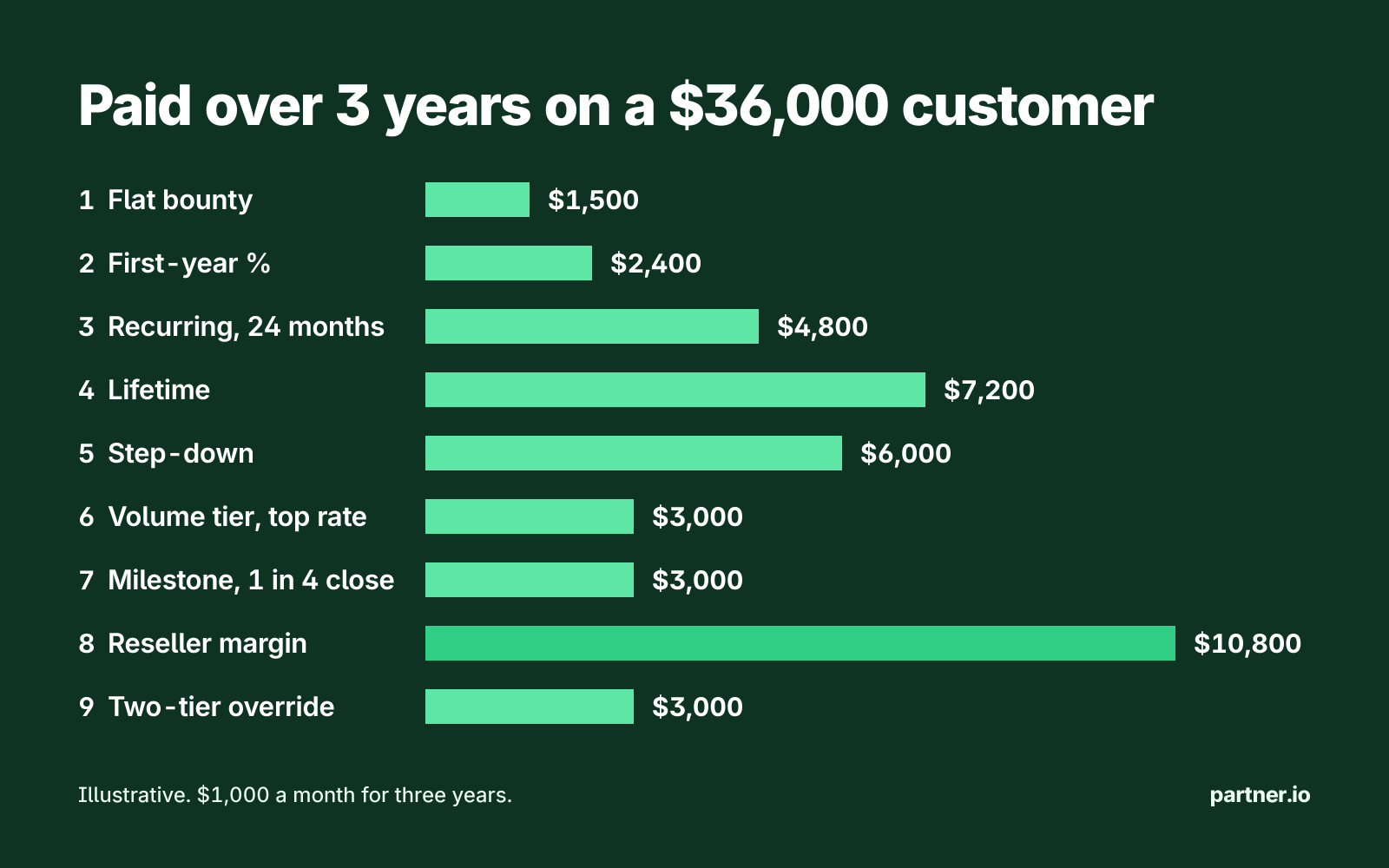
| Structure | Paid over 3 years | Share |
|---|---|---|
| 1. Flat bounty | $1,500 | 4.2% |
| 2. First-year % | $2,400 | 6.7% |
| 3. Recurring, 24 mo | $4,800 | 13.3% |
| 4. Lifetime | $7,200 | 20% |
| 5. Step-down | $6,000 | 16.7% |
| 6. Volume tier (top) | $3,000 | 8.3% |
| 7. Milestone, 1 in 4 | $3,000 | 8.3% |
| 8. Reseller margin | $10,800 | 30% |
| 9. Two-tier override | $3,000 | 8.3% |
A seven-times spread between the first row and the eighth, on one customer.
The trade-off: cost certainty against partner attention. Structures 1 and 2 tell you your cost on day one and give the partner no reason to stay involved. Structures 3 to 5 keep the partner around and make your cost depend on retention. You can't have both.
Does the partner's job end at the introduction? Use 1 or 2.
If they implement or support the customer, use 3 or 5.
When they own the billing relationship, use 8.
Can't say which? You haven't defined the partner type yet. Start with the seven partner program models.
How to cost a commission structure before you publish it
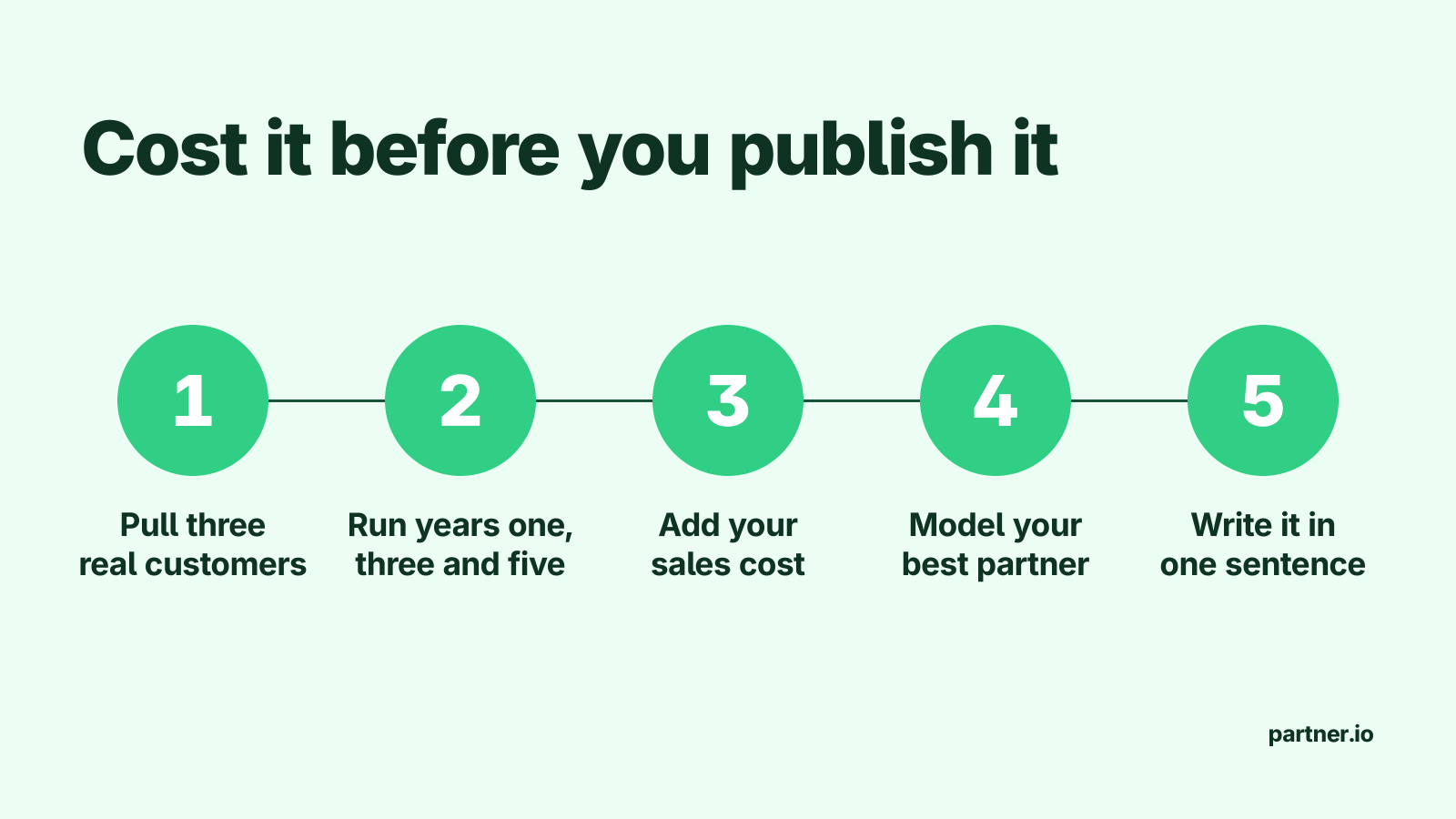
- Pull three real customers. Your smallest, your median and your largest by annual revenue.
- Run each through the structure. Year one, year three, year five. Use your actual retention, not the plan.
- Add your sales cost. A referred deal still needs demos. Commission plus sales time must stay under your direct acquisition cost.
- Model your best partner. Twelve customers in a year, every tier threshold crossed. Is the top cheque one you'd be glad to sign?
- Write it in one sentence. "20% of every payment for 24 months, paid monthly, 30 days after the customer pays." If it needs a second sentence, simplify it.
On the fourth tick: a 30 to 60 day hold after the customer pays lets most refunds happen before any commission goes out. Our glossary entry on clawbacks explains when you need the clause as well.
What this looks like in the real world
An illustrative example, not a customer story.
A 45-person SaaS company promised its first referral partners 20% for life in 2023. It was an easy yes: the first cheque was $200.
Three years on, partner-sourced revenue is $1.5M a year and the commission line is $300,000. More than half goes to partners who haven't referred anyone in 18 months. The four agencies doing implementation work earn the same rate as a consultant who made one introduction in 2023.
The partner lead does three things.
Existing customers keep the lifetime rate. A promise is a promise.
New referrals earn 20% for 24 months.
Agencies that implement move to a tier paying 30%, then 15%, then 5%.
Nobody's past earnings change. Techaisle's advice to program owners, from the same survey, is five words long:
“Never recalculate incentives already paid.
”
Microsoft's partners learned why. Techaisle reports that it applied new CSP incentive rates back to July 2025, then in February 2026 reversed and reissued earnings partners had already received.
Where Partner.io fits
Each of these nine is easy to describe and tedious to run. Recurring commission means matching every payment to a partner. Milestone fees depend on someone watching the CRM stage, and tiered rates on someone counting.
In a spreadsheet, that someone is you, on the last Friday of the month.
“A commission structure you can't calculate on time is a pay cut your partners haven't noticed yet.
”
We built tiers, commissions and payouts in Partner.io around the same four dials:
- Rate: Percentage or Monetary rewards, set per tier, with SPIFFs for one-off bonuses.
- Anchor: deal value or the payment itself, with revenue recorded from Stripe and Chargebee and deals synced from HubSpot, Pipedrive or Salesforce.
- Term: a commission for every recorded payment, for life or capped at the months you set, with a payout delay in days, weeks, months or years to cover your refund window.
- Event: seven triggers, including revenue generated, lead approved and pipeline stage entered, narrowed by conditions on deal value, partner type or any custom field.
Then the part partners care about. Commissions are approved by hand or by rule in automation, bundled into a self-billed invoice on your schedule, and paid through Stripe, including ACH to US bank accounts. US partners complete a W-9 in the portal and get a 1099-NEC at year end through tax compliance.
Partner.io takes 0% of partner payouts. You pay per seat for your own team, and partners are free and unlimited. Pricing has the detail.
Still reconciling by hand? The hidden cost of managing partners in spreadsheets puts a number on it. And if the rate isn't your real problem, read 12 partner benefits that cost almost nothing.
Pick the structure, then make it boring
The best commission structure is the one a partner can calculate in their head and you can pay on the same day every month.
Run your three customers through the nine. Choose one structure per partner type. Write it in a sentence, publish it, and leave it alone for a year.
Partners forgive a modest rate. They don't forgive a late, wrong or rewritten one.
Try Partner.io free for 7 days → No credit card, no setup fee, cancel anytime.
Prefer a walkthrough first? Book a demo and we'll map it to your program.
- [prm]
- [referrals]
- [partner-tiers]
Published November 16, 2026