
Seven partner program models for B2B SaaS, from customer referrals to resellers and full channel, with real economics and a simple test to pick your next one.
7 Partner Program Models, From Referral-Only to Full Channel
Most B2B SaaS companies never choose between partner program models. They drift into one.
A happy customer asks for a referral link.
A consultant asks what you pay for an intro.
An agency asks for a reseller discount, and someone says yes on a call.
Eighteen months later you're running three models on one contract template, one spreadsheet tab and a commission rate somebody made up in a Slack thread. Nobody can say which of them makes money.
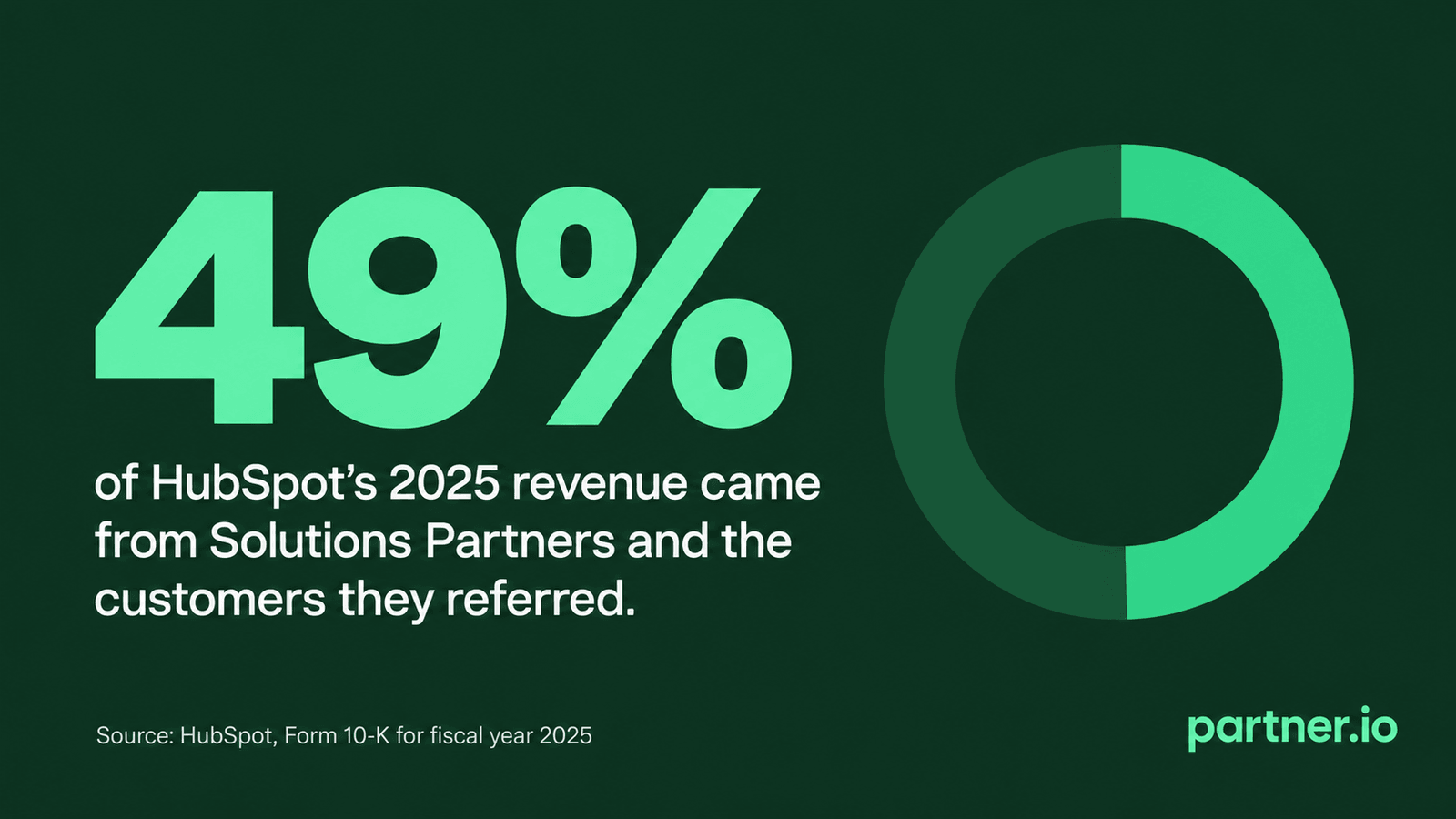
The companies that win with partners make the choice on purpose. HubSpot built its program around agencies that implement the product, and its 2025 annual report says Solutions Partners and the customers they referred brought in about 49% of its revenue.
That isn't a referral link. It's a model matched to what HubSpot's buyers needed.
Here are the seven models, what each costs to run, where each breaks, and a test for picking your next one.
"Just launch a referral program. Models are a big-company problem."
That's the strongest objection, and half of it is right.
Under $25M ARR, you should run one model, not seven. Partners hate complexity. In Techaisle's 2026 survey of 5,450 channel partner firms, 71% named simplicity as the place vendor programs fall short.
But "just launch referrals" is still a model choice. It decides what your partner agreement says, which fields you add to the CRM, how commission is calculated and who talks to the customer after the deal closes. Change any of those a year in and you've broken the rules partners signed up for.
“Partners will accept thinner margins in exchange for rules that hold for a year.
”
The wrong default has a second, slower cost. If your best partners are agencies that set the product up, a referral fee pays them for the intro and nothing for the work that keeps the customer. They'll implement whichever product pays for that work.
So yes, start simple. Start with the model that matches how your buyers already buy.
The Handoff Line: what separates one partner program model from another
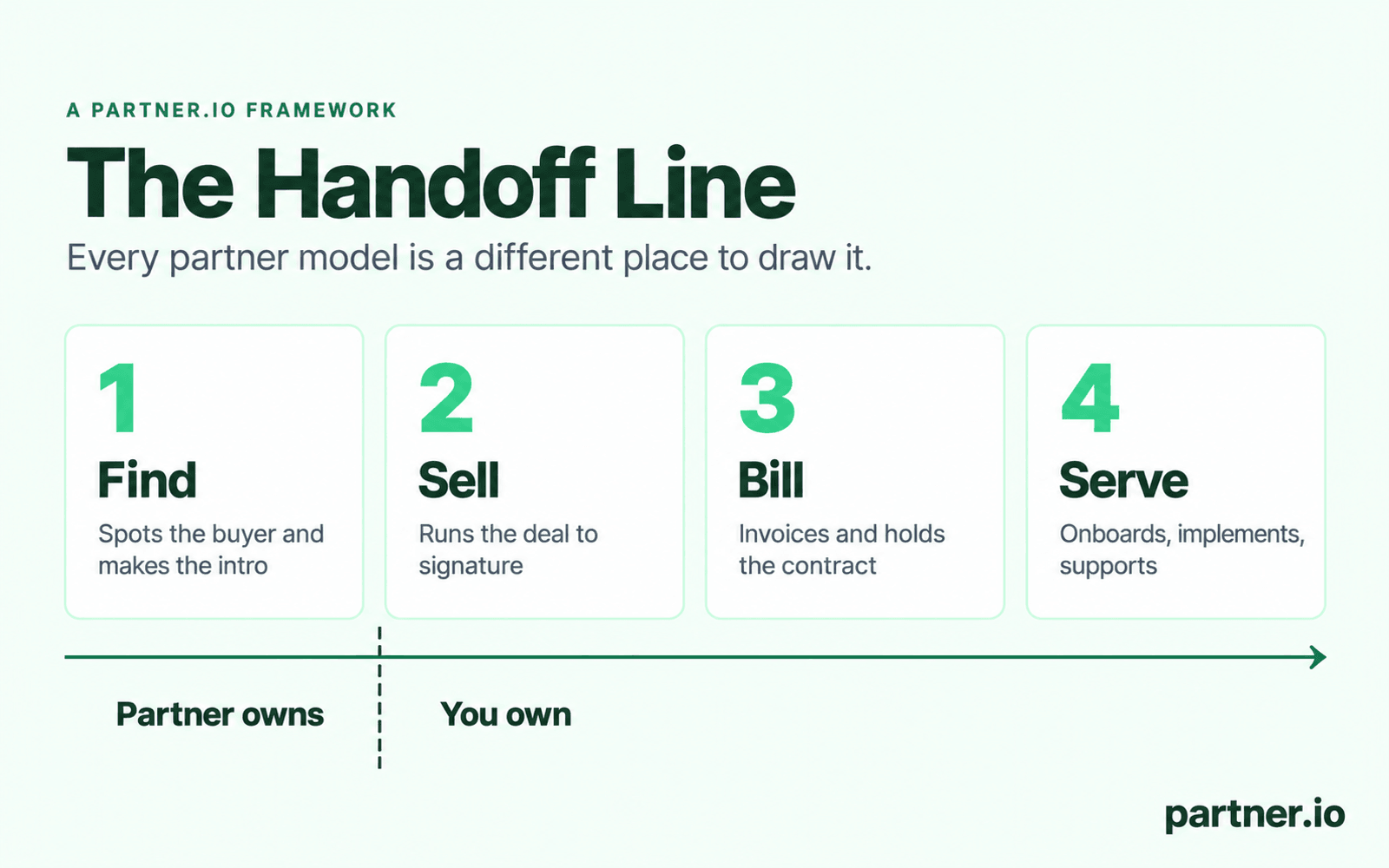
Every B2B deal has four jobs: find the buyer, sell the deal, bill the customer and serve them after signature. A partner can own any of them.
The Handoff Line is the point where the partner's jobs stop and yours start. Every partner program model is a different position for that line.
Find
The partner spots the need and makes the introduction. Every model includes this job, which is why somebody calls every model "referral".
Sell
The partner runs or shapes the deal: discovery, demos, pricing, the push to signature. Once a partner sells, you need rules for who owns the deal.
Bill
The partner invoices the customer, collects the money and holds the contract. This is the border between referral economics (you pay a fee) and resale economics (they keep a margin).
Serve
The partner onboards, implements, supports or manages the customer. It's the job that decides retention, and the one most programs forget to pay for.
Move the line to the right and you get reach at the cost of control. Move it left and you keep the customer, but you do more of the work.
The 7 partner program models for B2B SaaS
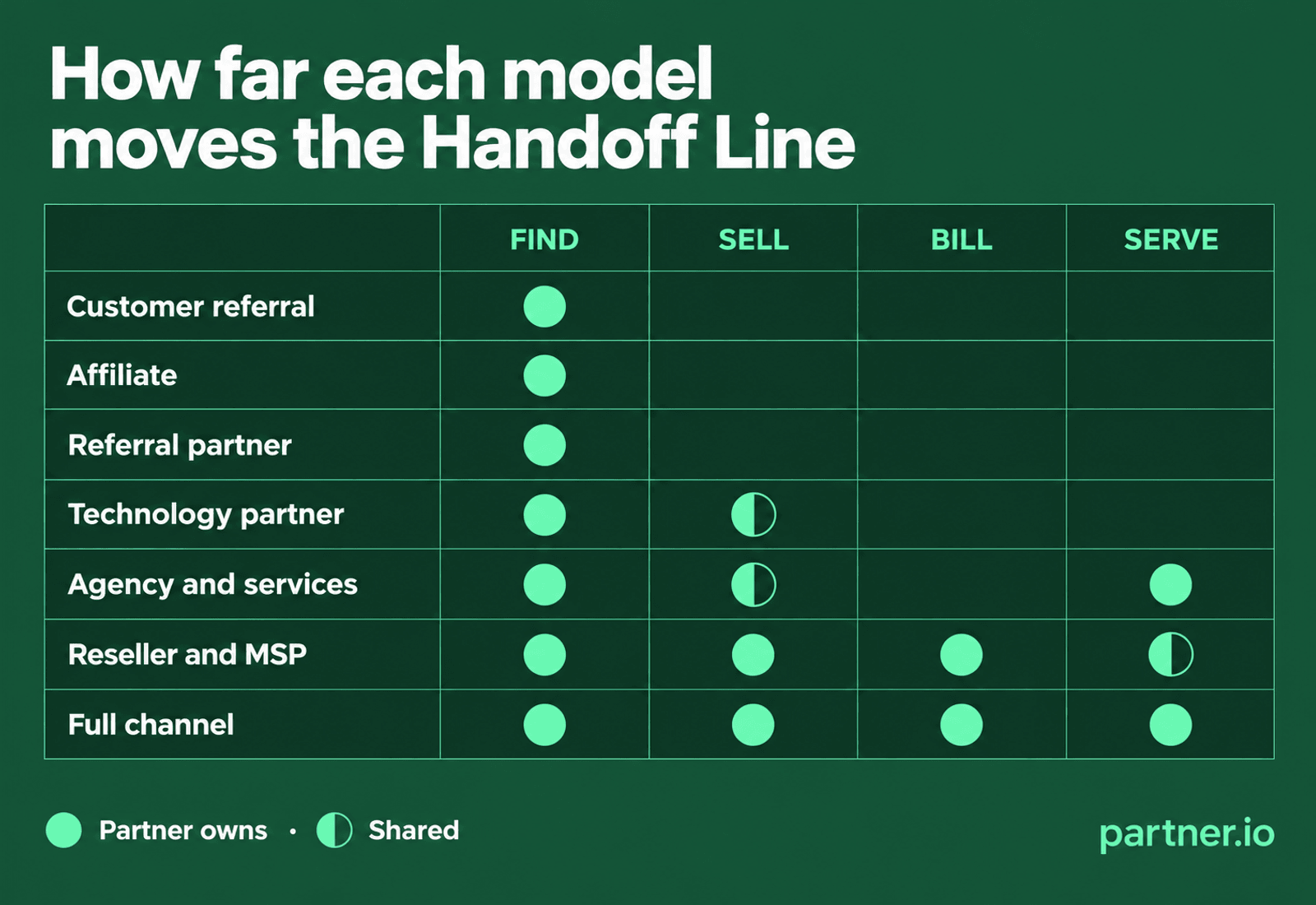
Here they are in order, from the shortest Handoff Line to the longest.
1. Customer referral program
Handoff Line: after Find. The partner is your own user.
Customers share a link or fill in a form inside your product, and earn account credit, cash or a gift card when the referral converts. No contract, no enablement, no partner manager.
Fits: self-serve or low-touch products where users talk to peers in the same job. A scheduling tool passed between practice managers. A dev tool shared in a team Slack.
Breaks when: the reward is buried in a settings page nobody opens, or you pay out on signups that churn in month one. Pay on first payment, not first login. Our post on turning loyal customers into your best acquisition channel covers the mechanics, and user referrals puts the referral form inside your app.
2. Affiliate program
Handoff Line: after Find, at scale. The partner never meets you.
Newsletter writers, YouTubers, comparison sites and template sellers send traffic through tracked links and earn a percentage of the first payment or first year. You never speak to most of them.
Fits: products with a self-serve plan, sold to buyers who research through content before they talk to anyone.
Breaks when: your sales cycle outlasts the tracking window. A click that becomes a demo request, then a 90-day sales cycle, rarely gets credited, and affiliates work that out fast. If a demo stands between the click and the sale, you want model 3. The affiliate vs referral vs reseller guide works one deal through each.
3. Referral partner program
Handoff Line: after Find, with a warm introduction.
Consultants, fractional executives, accountants and advisors introduce a prospect they know. Your team sells and bills. The partner gets a fee, usually a percentage of first-year revenue.
This is where most sales-led SaaS companies should start. The partner's job is small, the economics fit on one line and you keep the customer. It's how teams replace cold prospecting with referrals.
Breaks when: the referral lands in an inbox, sits for a week and the partner never hears what happened. One silent referral costs you the next five.
Every referral needs a registered record, a status the partner can see and an owner in your CRM, which is what leads and deal registration is for. For rates, see how to set a referral fee percentage.
4. Technology and integration partners
Handoff Line: Find, plus a hand in Sell. The partner's product sits next to yours.
You build an integration with a platform your buyers already use, list in its marketplace and co-sell with its team. Marketplaces bring their own economics. Shopify takes 0% of a developer's first $1M in lifetime app revenue and 15% above that.
Fits: products worth more when connected to a CRM, ecommerce platform, accounting tool or data warehouse that's already in the buyer's stack.
Breaks when: the integration ships and nobody sells it. The listing goes live, the partner's sales team never hears your name, and the partnership becomes a logo on two websites. Co-selling starts with knowing which of your target accounts already run the partner's product. Account mapping and Deal Surround shows you that, and our co-selling guide covers the joint motion.
5. Agency and services partners
Handoff Line: Find, a strong say in Sell, and most of Serve.
Agencies and consultancies recommend your product, configure it and often run it for the client. They're closest to the buyer before the sale and after it. As Techaisle's Agrawal puts it, "Consultants, SIs and ISVs invest before the sale in design, architecture and IP."
HubSpot is the model to study. Its deal-based commission terms pay Solutions Partners a 20% revenue share for up to three years, and that program sits behind the 49% figure above.
Fits: products that need setup, data migration or ongoing strategy before they deliver value. If customers fail without help in month one, you need this model.
Breaks when: you pay only for sourcing. Agencies influence far more deals than they source, and they'll recommend whichever product pays for implementation. Pay for the work you need, certify the people doing it with training and certification, and give agencies their own track, as our post on partner tier structures explains.
6. Resellers and MSPs
Handoff Line: Find, Sell, Bill and often first-line Serve.
The reseller buys from you at a discount, sells at a price they set, invoices the customer and owns the contract. Managed service providers go further and bundle your product into a monthly service.
Fits: buyers who already buy software through an IT provider, markets where you have no entity or local language, and products that need local support.
Breaks when: your own sales team meets a reseller on the same account. Without deal registration and written rules of engagement, you get undercutting and two quotes on one prospect's desk.
You also lose sight of the customer. If renewal dates and usage data stay with the reseller, churn arrives as a surprise. Read the channel conflict guide before you sign the first agreement, and start from a SaaS reseller agreement template.
7. Full channel: distributors and marketplaces
Handoff Line: all four jobs sit with partners, often across two tiers.
A distributor or cloud marketplace sits between you and a network of resellers. You sell to the distributor, and the distributor's resellers sell to the customer. On a cloud marketplace, the customer buys through AWS, Azure or Google Cloud and draws down spend they've already committed. AWS Marketplace charges a 3% listing fee on SaaS public offers, plus 0.5% when a channel partner makes the private offer.
A lot of the growth is here. Forrester's 2025 partner ecosystem research found the highest expected growth in technology partners, distribution partners and digital routes to market. Canalys forecasts that channel partners will generate 59% of hyperscaler marketplace spend by 2030.
Fits: mid-market and enterprise buyers with cloud commitments, MSP-heavy markets, and products sold as a clear, repeatable package.
Breaks when: you can't say who the end customer is or which reseller sold them. Two tiers means two layers of lost data. It also needs partner account managers who build business through partners, and few get trained for that. Forrester found that 62% of sales leaders give partner account managers nothing beyond basic sales training.
“Basic sales training produces PAMs who manage partner relationships.
”
Which partner program model should you run next?
Ask one question first: what does your buyer need help with that you can't give them yourself?
- If buyers fail without help in their first 60 days, start with agency and services partners.
- If buyers buy software through their IT provider, add resellers or MSPs.
- If your product only makes sense next to another platform, start with technology partners.
- If none of those apply, start with referral partners, and add a customer referral program once you have a self-serve plan.
Then look at what you're trading. Each step to the right on the Handoff Line buys reach and costs control.
| Moving right | You gain | You give up |
|---|---|---|
| Reach | Buyers you'd never find | What they hear about you |
| Cost of sale | Less of your sales time | A share of every deal |
| Customer data | Local knowledge | Usage and renewal visibility |
| Admin | Partners do more | More rules to enforce |
Pick the step you can operate this quarter, not the one with the biggest reach on paper.
How to add your next model without breaking the first
- Write the Handoff Line down. For the new model, name who owns Find, Sell, Bill and Serve. If you can't fill a job, you're not ready to launch.
- Pay for the jobs the partner does. A referral fee for Find, a margin for Bill, a services rate or revenue share for Serve.
- Add a partner type, not a new spreadsheet. Give the model its own partner type, agreement, commission rule and default tier, so its numbers never mix with the first model's.
- Write rules of engagement before the first deal. Decide who wins when your rep and a partner reach the same account, and how long a registration holds.
- Pilot with three partners for one quarter. Track registered deals, win rate and days to first deal. Then open the model up, or kill it.
When a partner program model breaks
Most failures trace back to a Handoff Line nobody wrote down.
What this looks like in the real world
Here's an illustrative example, not a customer story.
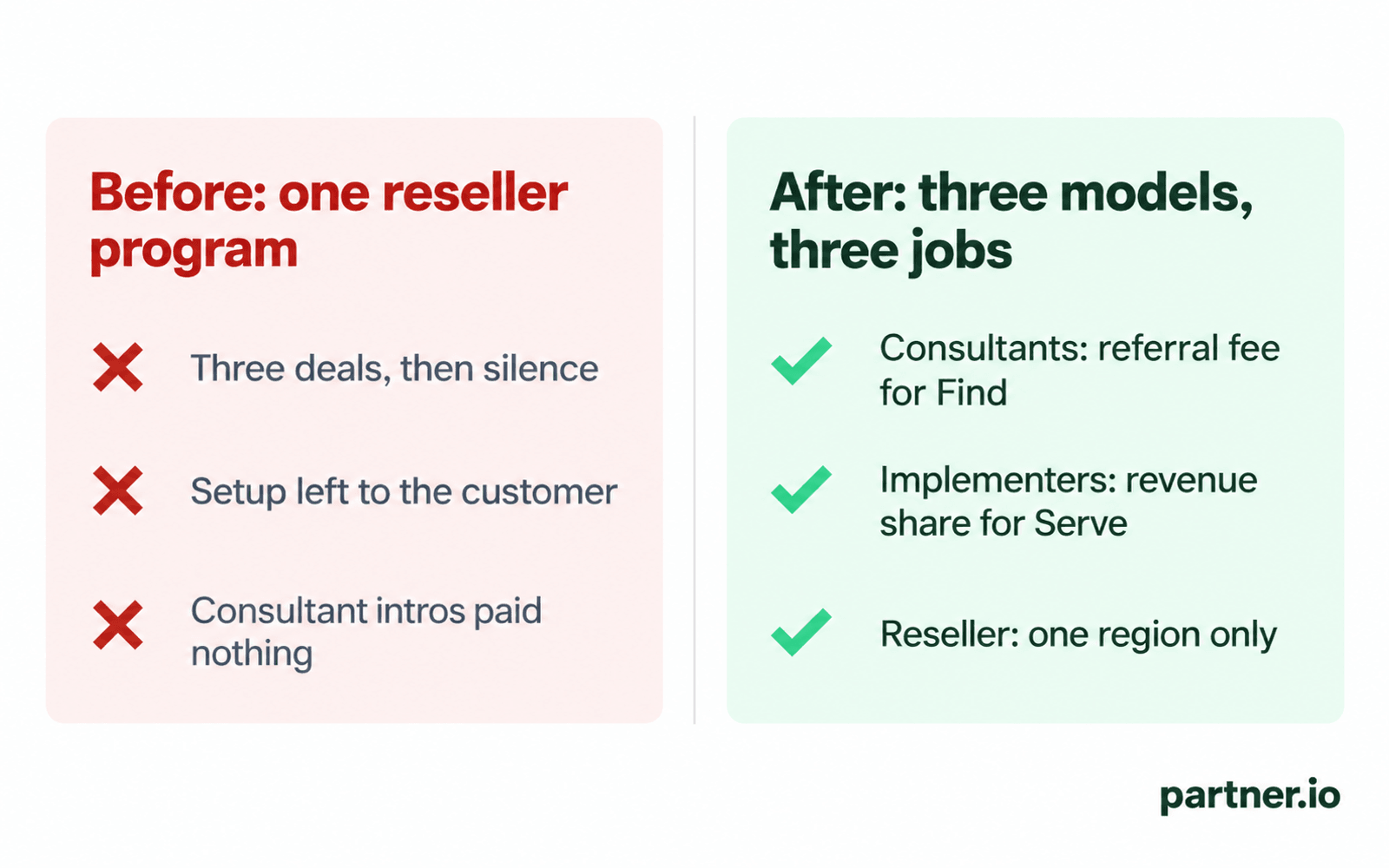
A 35-person SaaS company sells compliance software to mid-size accounting firms. Its first partner move was a reseller program, because a large IT provider asked for one.
Two quarters later, the reseller had closed three deals and gone quiet. Its customers churned faster than direct ones, because the reseller sold the licence and left setup to the customer. Meanwhile, two bookkeeping consultants were sending warm introductions every month and earning nothing, because there was no referral program to pay them through.
The company redrew its Handoff Line. The consultants became referral partners with a fee on first-year revenue. Two implementation firms became agency partners, paid a revenue share on customers they set up and kept live. The reseller stayed, limited to one region where the company had no team.
Same partners, different jobs, each one paid for on purpose.
Want to run more than one partner model in one portal? Try Partner.io free for 7 days, no credit card needed.
Where Partner.io fits
Your second model is where spreadsheets give out. Each model needs its own rules, rates and records, and partners still expect one login.
Partner.io runs every model on this list from one account:
- One portal for every partner type. The partner portal runs on your own domain, with a partner type and default tier per model, and a profile for each partner listing their reps and sub-partners.
- Referrals and deal registration. Leads and deal registration gives partners referral links, forms and registration, syncs deals with HubSpot, Salesforce or Pipedrive, and shows each partner where their deals stand.
- Commission rules per model. Tiers, commissions and payouts calculates referral fees and revenue shares by rule, approves them by hand or automatically, and pays through Stripe. We take 0% of payouts.
- Customer referrals inside your app. User referrals adds a referral form and personal links to your product.
- Co-sell targets. Deal Surround and account mapping shows which partner can open a target account.
- Certified agencies. Training and certification gives services partners courses, certificates and badges.
It's $79 per seat for your team. Partners use the portal free, in unlimited numbers.
Pick the model your buyers already use
You don't need seven models. Most SaaS companies under $25M ARR need two: one that matches how buyers find you, and one that matches how they get value.
Draw your Handoff Line. Pay for the jobs partners do. Then put every partner, deal and commission in one system, so the second model doesn't break the first.
Still deciding whether partners belong in your plan? Read should you build out a partnership channel. Already have partners but no program? The difference between having partners and running a partner program is your next read.
Try Partner.io free for 7 days → No credit card, no setup fee, cancel anytime.
Prefer a walkthrough first? Book a demo and we'll map it to your program.
- [partner-led-growth]
- [prm]
- [referrals]
Published October 29, 2026