
How to structure a partner program with fewer than 10 partners: one tier, written rules, a commission you can say in one sentence, and one record of everything.
You Don't Need Tiers to Structure a Partner Program. You Need a Record.
You have seven partners.
Two of them send deals.
One agency thinks it sourced a deal that a consultant introduced.
The commission sheet lives in your partner manager's Google Drive.
And somewhere there's a deck with Gold, Silver and Platinum tiers, although nobody would qualify for Silver.
That's what most programs look like before partner number ten. Plenty of goodwill, a few real deals, and structure that's either missing or borrowed from a company fifty times your size.
This is how to structure a partner program at that size: what to decide now, what to leave for later, and the one thing you can't put off. That's a single record of every partner, referral, deal and payout, kept somewhere other than a person's memory.
"Structure can wait until we have more partners"
That's the strongest objection, and for the relationships it's right.
You can hold seven partners in your head. You know who's busy, who's annoyed, and whose biggest client just raised a round. A tier ladder and a 40-page partner guide would add nothing except reading.
The record is a different story. It breaks well before the relationships do, and it breaks at moments you can't schedule:
- the first time two partners claim the same deal
- the first time a partner asks why last month's commission was smaller
- the first time your partner manager resigns and the spreadsheet goes with them
Small teams feel this hardest. In Convert Commerce's Partnerships Benchmark 2026, a survey of 102 partnership professionals, 43% run partnerships with a team of one to three people, and 13% work alone. Thirty percent already spend more time on operations than on relationships.
Every hour spent rebuilding a commission sheet is an hour not spent with the two partners who send deals. And the data you capture at seven partners becomes the only history you'll have at seventy. Skip it now and you can't get it back.
The Five Rs: how to structure a partner program under 10 partners
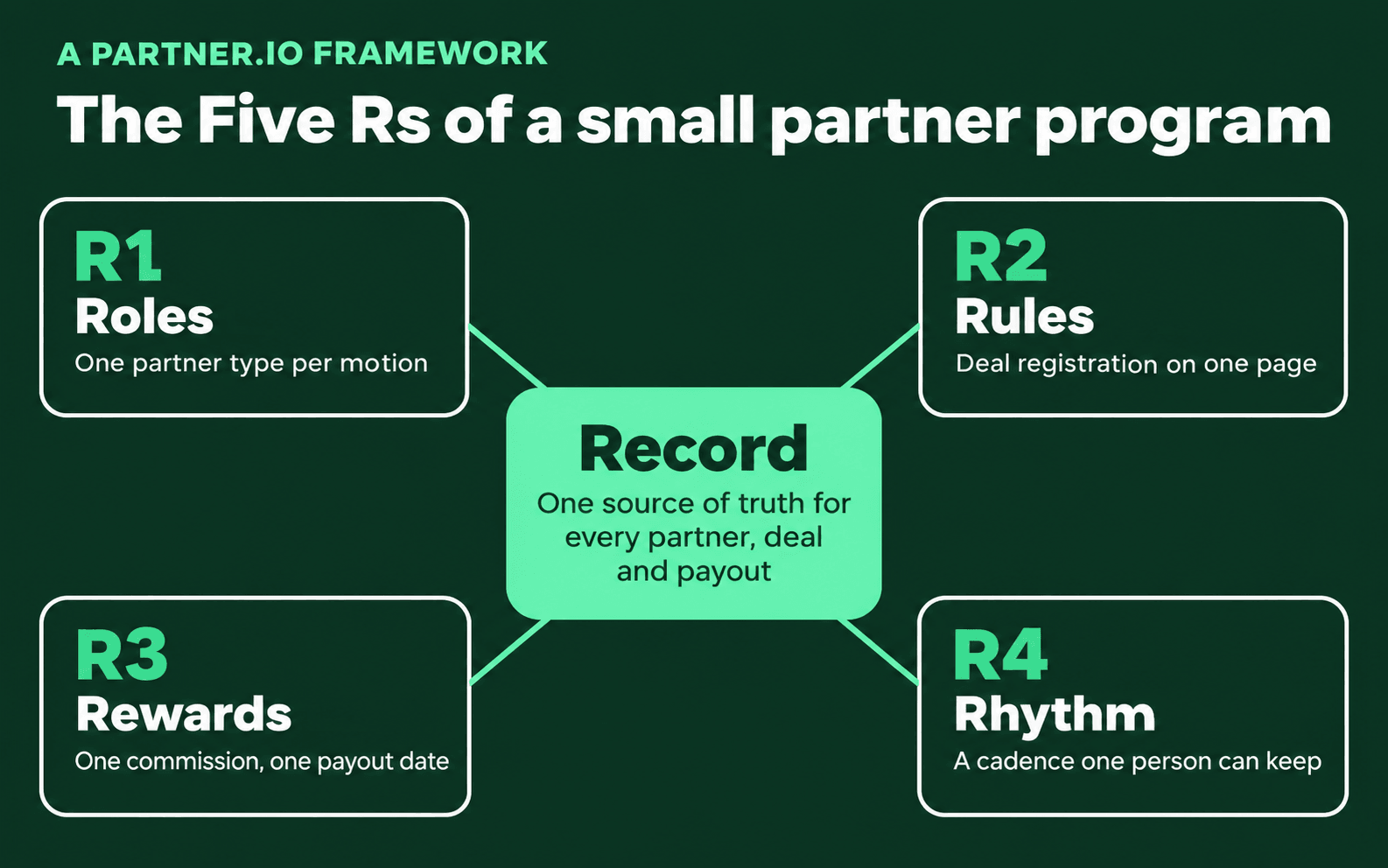
A small program needs five decisions, written down once. We call them the Five Rs.
Four of them fit on a page each: Roles, Rules, Rewards and Rhythm. The fifth, Record, is where the other four live, so it sits in the middle.
Roles: sort partners by motion, not by tier
With seven partners you don't have a hierarchy. You have different jobs.
A referral consultant introduces a client and steps back. An agency implements, and wants the deal protected while it scopes the work. An integration partner wants its customers to hit the limit your product removes. A reseller owns the customer and bills them.
Give each motion one partner type, one agreement and one commission rule. That's your whole structure for now. If you're not sure which motions you need, our guide to seven partner program models sorts them by what you sell and who already reaches your buyers.
Rules: write them before the second deal arrives
Rules of engagement feel premature at five partners. They aren't. They're cheapest to write before anyone has a stake in the answer.
Convert Commerce found that 51% of teams settle multi-partner attribution by giving credit to the first touch, and another 21% decide case by case. Case by case is what you're doing now, if nothing's written down. It works until two partners who both think they sourced a deal compare notes.
One page covers it:
- What counts as a registered deal: a named company and contact that isn't already an open opportunity in your CRM.
- How long protection lasts: 90 days from approval, extendable once if the deal is moving.
- Who wins a conflict: the first approved registration. Nobody gets paid twice for the same deal.
- How fast you answer: approve or reject within two working days.
- When commission is earned: when the customer pays, not when the contract is signed.
Those numbers are a starting point, not a standard. What matters is that the rules exist before the dispute does, and that deal registration timestamps every claim so the rule can be applied without an argument.
Record: make Partner.io the source of truth, and your CRM its mirror
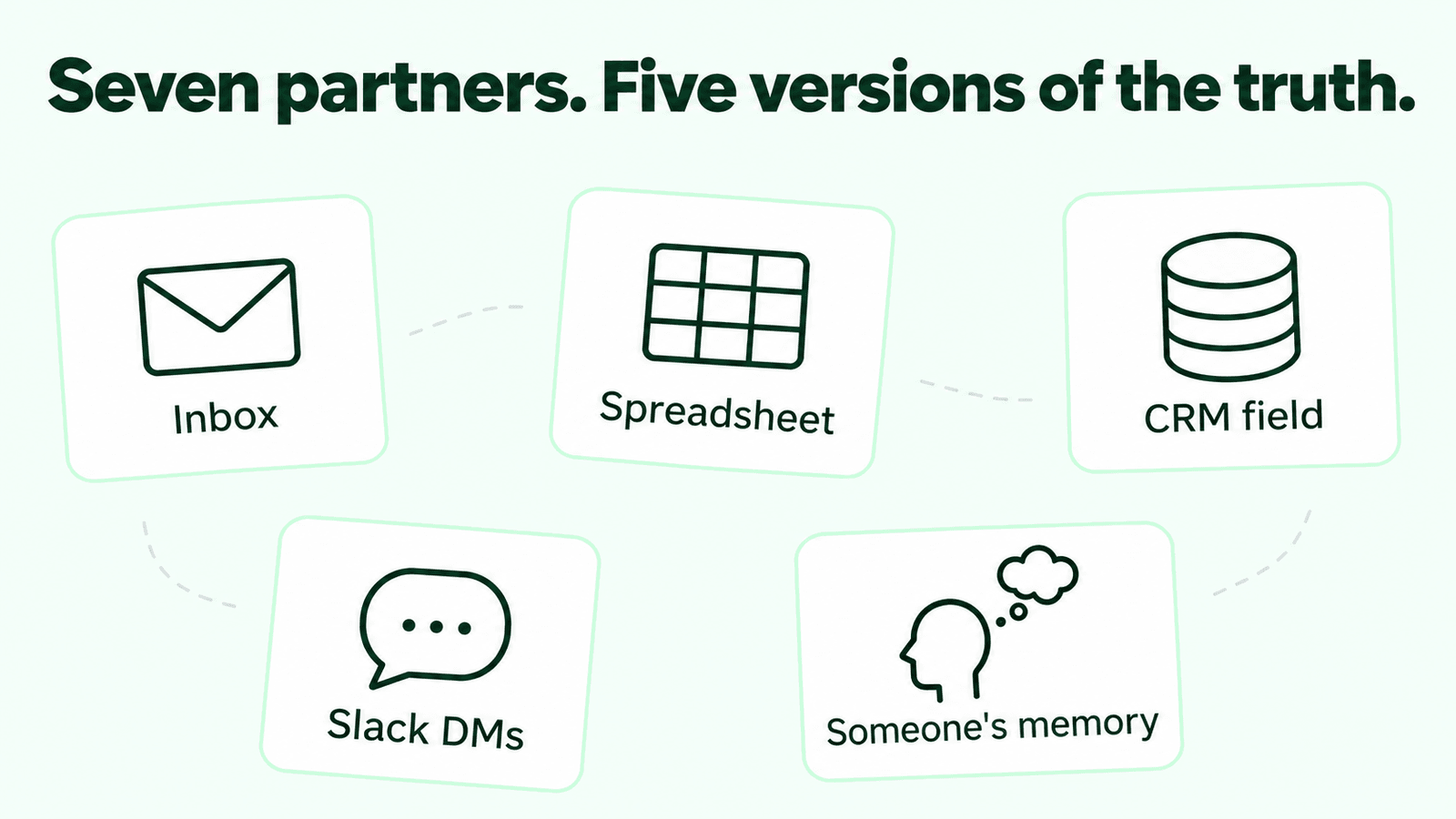
Rules only hold if there's one place to check them against. This is where most small programs go wrong. They don't lack data. They have it in five places.
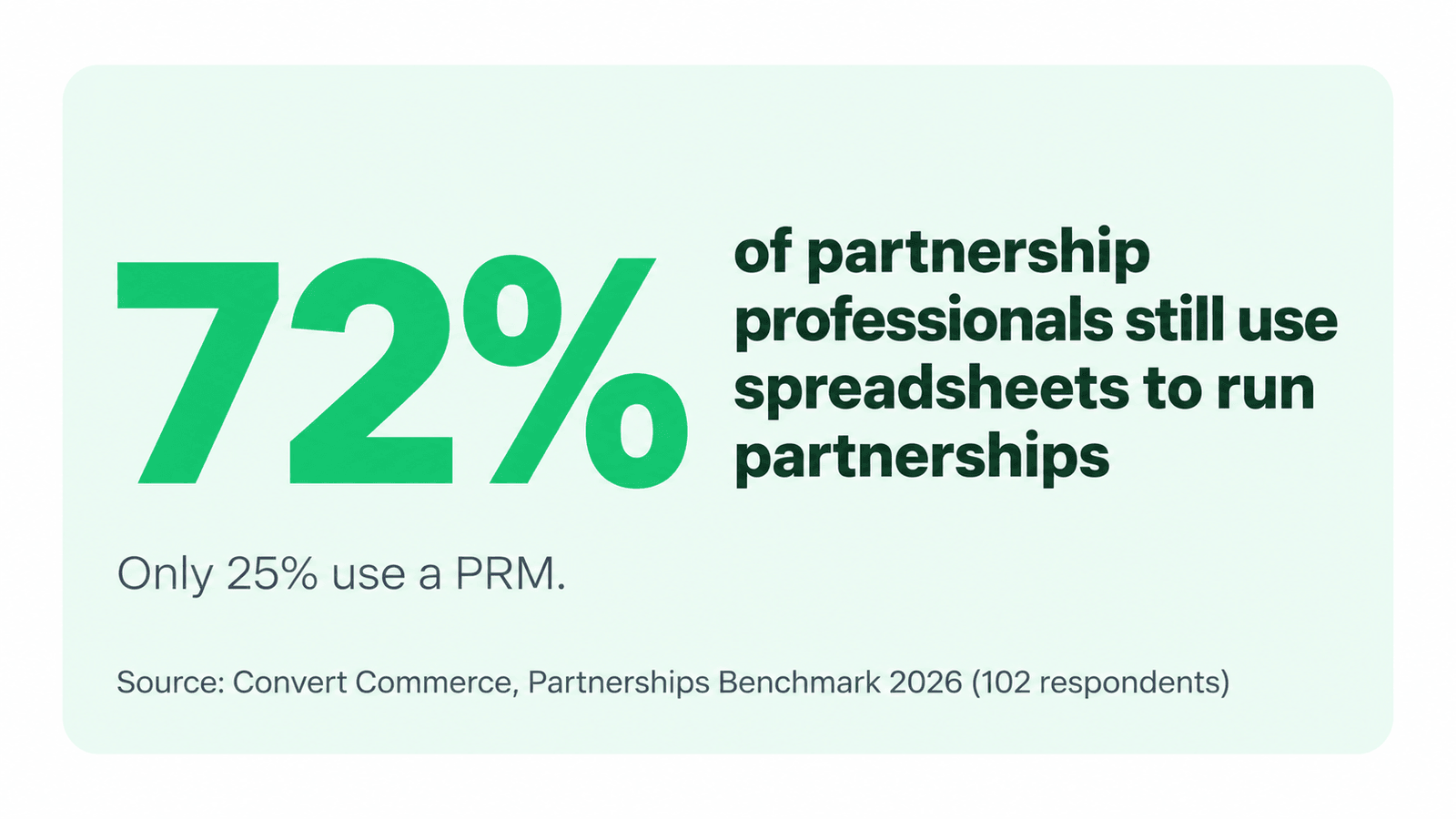
The Convert Commerce survey let respondents pick every tool they used: 86% run partnerships through the CRM, 72% still use spreadsheets, and only 25% use a PRM. Most teams stack all three, and each one holds a different version of the truth.
Your CRM is very good at deals. It knows the stage, the value and the close date. It doesn't know which version of the agreement the agency signed, which rep at the consultancy made the introduction, or whether the commission on that deal is approved, invoiced or paid.
“Your CRM knows the deal. It doesn't know the partner.
”
So split the jobs and make the split explicit:
- Partner.io holds the partner side: each partner and their reps, partner type, signed agreement, every referral with its status, and every commission from earned to paid.
- The CRM holds the deal: once a referral is approved, it syncs to HubSpot, Pipedrive or Salesforce with the partner and rep attached. Stage, value and products flow back to Partner.io.
- One rule ties them together: if a referral isn't registered in Partner.io, it doesn't count. No DMs, no forwarded emails, no "I mentioned it on the call".
That last rule sounds strict. It's also the only one that protects a partner when your team changes.
Rewards: one commission you can say in one sentence
If a partner can't repeat your commission plan to a colleague, it's too complicated for seven partners.
"20% of first-year revenue on every deal you register, paid monthly after the customer pays" is a plan. A matrix of rates by product, tier and deal size is a spreadsheet you'll have to defend every month.
Put the rate on your one tier, let revenue trigger the commission, and pay on a fixed date. Commissions and payouts turn each paid invoice into a pending commission, bundle approved ones into a self-billed invoice on your schedule, and pay the partner through Stripe.
Rhythm: a cadence you can keep with one person
Convert Commerce asked what stops a new partner sending a first lead. The top answer, at 42%, was competing priorities, well ahead of product knowledge at 23%. Communication cadence was the biggest operational challenge, at 35%.
Most partners don't go quiet because they lost interest. Your product just isn't on this week's list. A small program can fix that with a rhythm one person can sustain:
- a 30-minute monthly call with each partner who's sent a deal in the last quarter
- a quarterly plan with your top two or three: target accounts, the moments their clients need you, one joint activity
- one update a month to every partner, sent as a portal announcement or newsletter
- an automated nudge for everyone else, so nobody waits on your memory
The nudge is where automation earns its keep. A Flow can welcome a new partner, wait a few days, then branch on whether they've signed in or sent a lead, and create a task for you when they haven't.
Want to run the Five Rs in a real portal? Try Partner.io free for 7 days, no credit card needed.
Back the two partners who already produce
Partner revenue concentrates, and it does so even in small programs. Larry Walsh of The 2112 Group put the split at five percent or less of partners generating 90% of revenue, in a ChannelWeb piece on the channel's 80/20 rule. The figure is from 2018, but his point about scale still holds:
“Even in smaller, more focused channel programs, vendors find a great disparity between the high performers and the laggards.
”
Jason Lemkin's SaaStr advice on first partner programs is to begin with "a handful of partners", ideally five to ten. Within that handful, find the one or two who'll "likely drive the majority of your partner revenue". He's blunt about the timeline, too:
“Partnerships take time to deliver material revenue. It's not a quick win.
”
So give your producers the quarterly plan, the fastest approvals and your best hours.
Don't cut the rest. John DeSarbo of ZS Associates warned in the same ChannelWeb piece that writing off the long tail assumes it "does not include the diamonds in the rough". At seven partners, the quiet ones cost you almost nothing if the nudges are automated, and one of them may be next year's producer.
Should you add tiers yet?
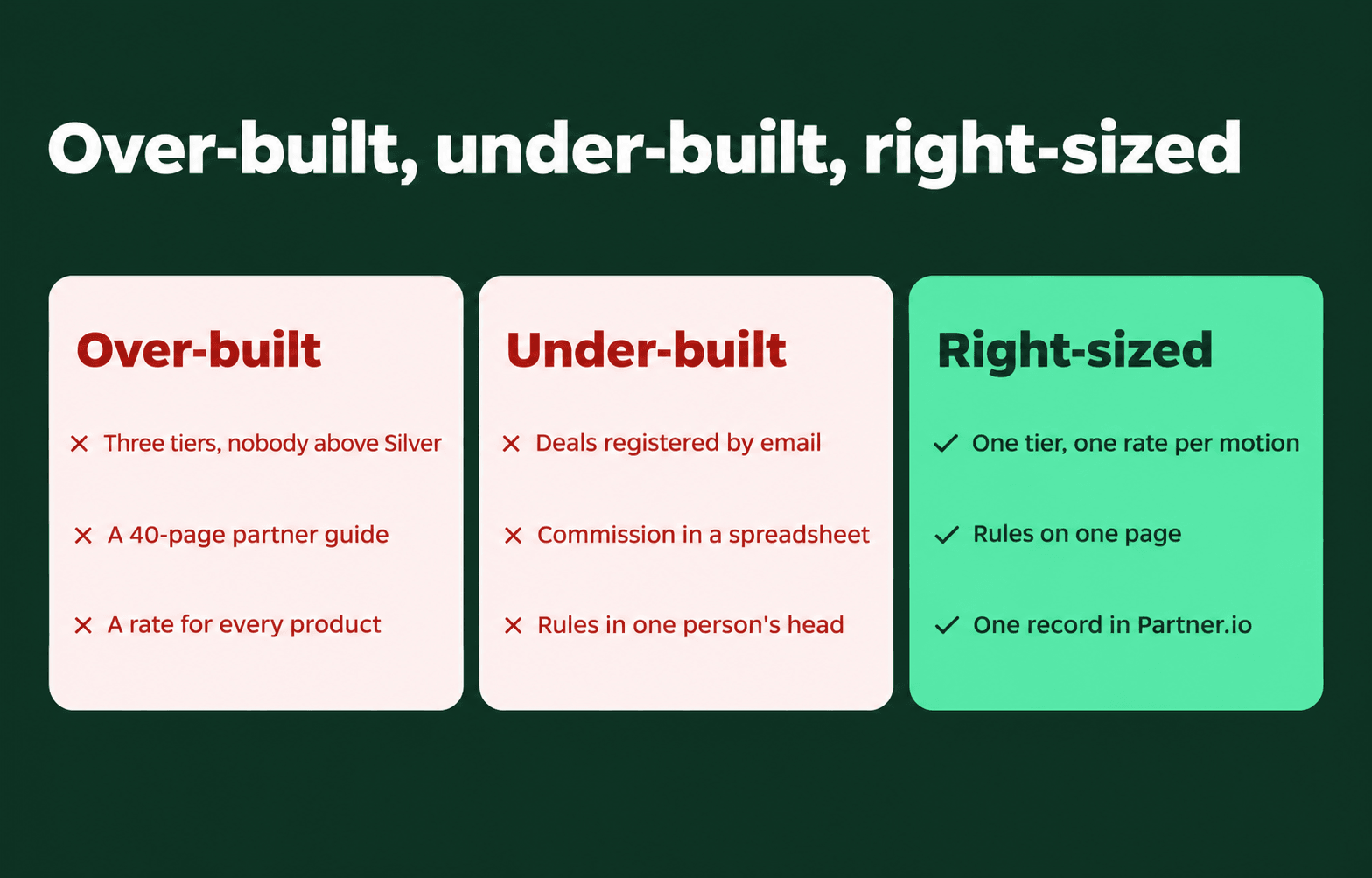
Tiers reward differences you can measure. Below ten partners you usually can't measure them yet.
If you have fewer than ten partners, or less than two quarters of deal data, run one tier and spend the effort on activation.
If you've passed ten partners, three or more send deals every quarter, and you can see a clear gap between them, add a second tier with one extra perk, such as a higher rate or faster payouts.
If you're adding tiers because a bigger company has them, don't. Our breakdown of ten partner tier structures covers which ones suit a young program once you get there.
Brent Nixon, who built partner programs at Adobe Workfront and is now a venture partner at Companyon Ventures, describes the same mistake from the founder's side on the Companyon blog:
“The first thing founders misunderstand is the complexity of it.
”
Tiers add complexity. Records reduce it.
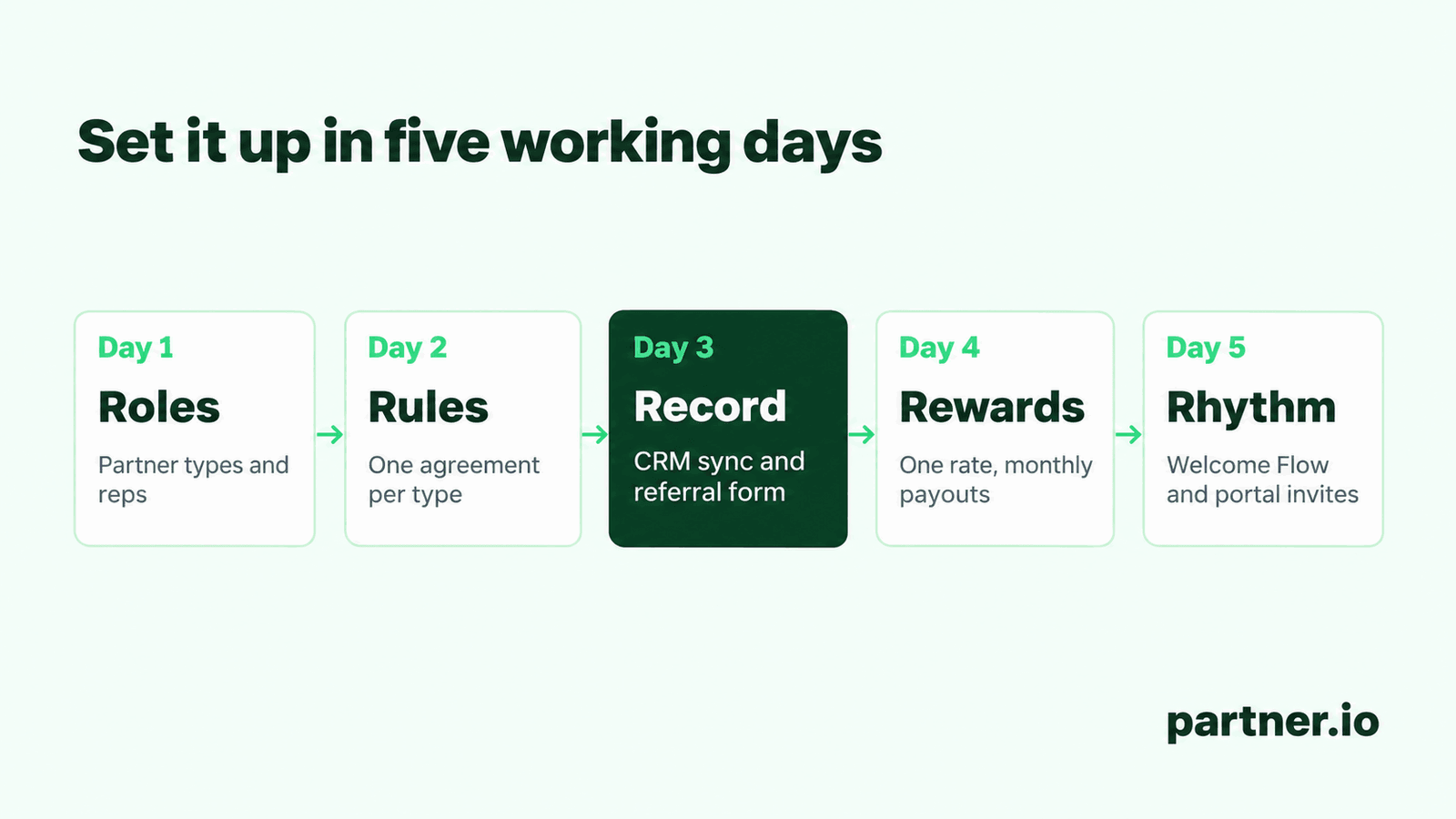
How to set up a small partner program in five working days
Here's the Five Rs set up in Partner.io. Every account starts with a default program tier, a referral form, a partner application form and a setup checklist, so you're editing, not building.
- Day 1, Roles. Create a partner type for each motion, then add your partners and their reps. Load sample data first if you want to rehearse, and clear it in one step.
- Day 2, Rules. Start from the built-in agreement template, write your rules of engagement into it, and assign one agreement per partner type. Change the terms later and partners are asked to sign again.
- Day 3, Record. Connect your CRM, turn on lead sync, and set the referral form's required fields. Add lead auto-approval rules for referrals that clearly qualify, and enter the referrals that are still open.
- Day 4, Rewards. Set the commission on your one tier, choose a monthly invoice schedule, and ask partners to connect Stripe in the portal.
- Day 5, Rhythm. Build a welcome Flow, schedule a monthly announcement, put the partner portal on your own domain, and invite everyone.
Spreadsheet or PRM at seven partners: the trade-off
A spreadsheet is free and takes an afternoon. That's a real advantage, and it's why most programs start there.
| Spreadsheet | Partner.io | |
|---|---|---|
| Cost | Free | $79 per team seat a month |
| Partner logins | None | Free, unlimited |
| Setup | An afternoon | About a week |
| Deal ownership | Whoever argues best | First approved claim |
| Partner sees status | By email | In their portal |
| Manager leaves | History leaves | History stays |
You're trading a week of setup and one seat for every argument, reconciliation and handover you'd otherwise have later. At seven partners that week is short. At forty, migrating two years of half-filled tabs takes a quarter. See pricing for the details, and the hidden cost of managing partners in spreadsheets for the longer version of this argument.
What this looks like in the real world
This is an illustrative example, not a customer story.
Picture a 35-person SaaS company selling scheduling software to physiotherapy clinics. It has six partners: two practice-management consultants, an accountancy firm, a marketing agency, an integration partner and a former customer who now advises clinics.
In month eight, the partner manager leaves.
Version one: the replacement spends three weeks rebuilding a commission sheet from email threads. An AE picks up one of the agency's protected deals as inbound. The agency hears about it from the client and stops referring.
Version two: the replacement opens Partner.io on day one. Every partner's agreement, open referral and pending commission is there, and the agency's deal is already in HubSpot with the agency attached. The first partner call happens that week.
Same six partners in both versions. Only the record is different, and so is the next year. It's the scenario our piece on why goodwill doesn't scale a partner program warns about, caught early.
Where Partner.io fits
Partner.io is a PRM built to be the source of truth for a partner program, whether it has seven partners or seven hundred. Partners use it free and in unlimited numbers, so a small program pays for its own team's seats and nothing else.
- Partner portal: a branded portal on your own domain with the application form, agreements and each partner's referrals, deals and commissions.
- Leads and deal registration: timestamped referrals, auto-approval rules, and CRM sync with the partner and rep attached.
- Tiers, commissions and payouts: commission created from paid revenue, self-billed invoices on your schedule, payouts through Stripe, and 0% taken from them.
- Automation: Flows that welcome, nudge and branch on whether a partner has signed in or sent a lead.
- Engagement Hub: announcements, newsletters, surveys and a Partner Room for signed agreements and assets.
Start with one partner, one deal, one clean record
The temptation at seven partners is to build the program you'll need at seventy. Resist it. Build the record you'll need at seventy, and keep everything else small.
Pick your partner types, write one page of rules, and register the next referral in a system that will still remember it after your team changes.
Try Partner.io free for 7 days → No credit card, no setup fee, cancel anytime.
Prefer a walkthrough first? Book a demo and we'll map it to your program.
- [partner-led-growth]
- [prm]
Published November 4, 2026