
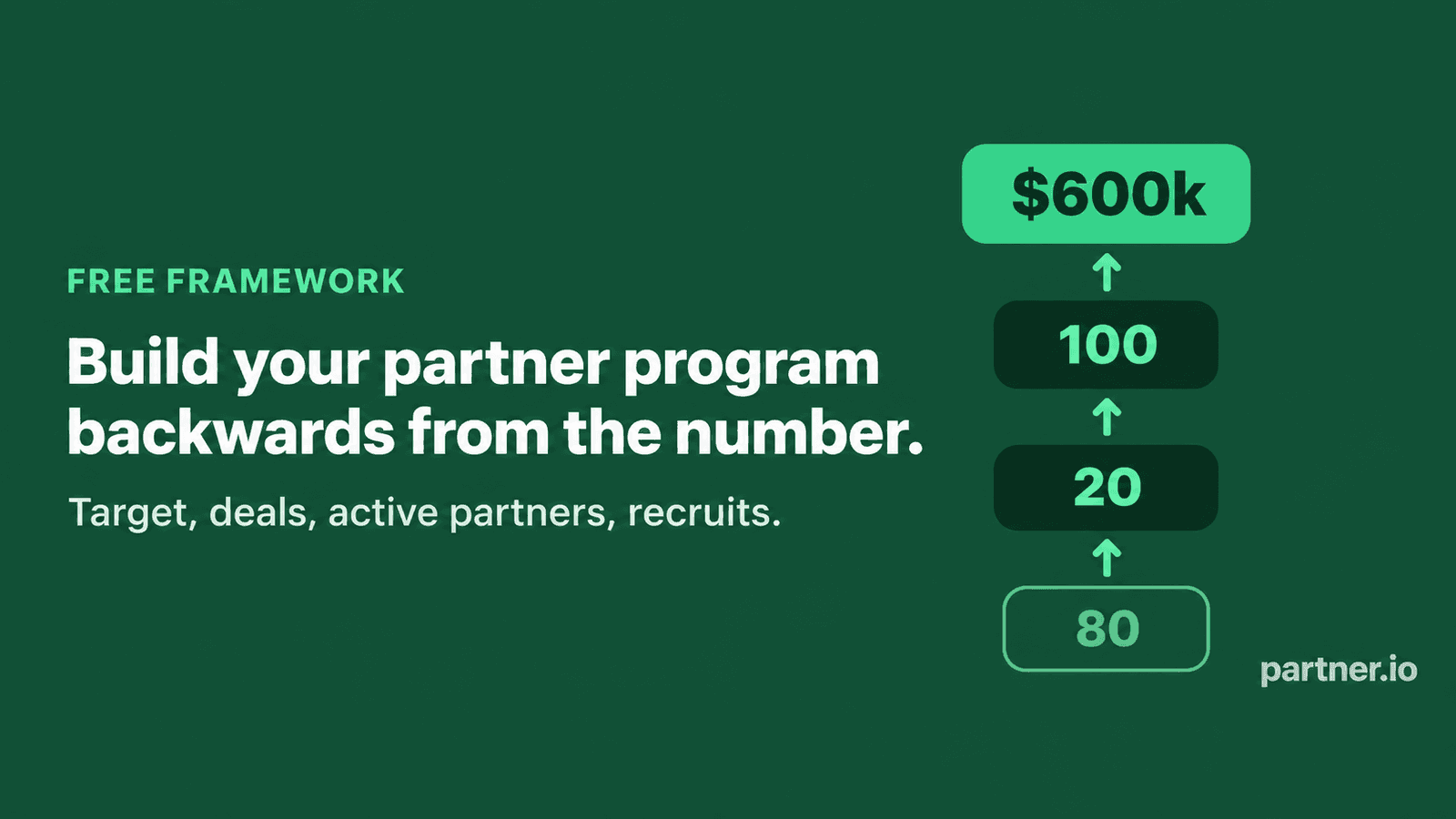
How to build a partner program that generates revenue: start with a number, work back to the deals and active partners it needs, then build the system that hits it.
How to Build a Partner Program That Generates Revenue: Start With the Number
Forty partners signed in year one.
One launch webinar.
Twelve logos on the website.
A Slack channel called #partners that went quiet in March.
Partner revenue at year end: two deals, both from the same consultant, who would have sent them anyway.
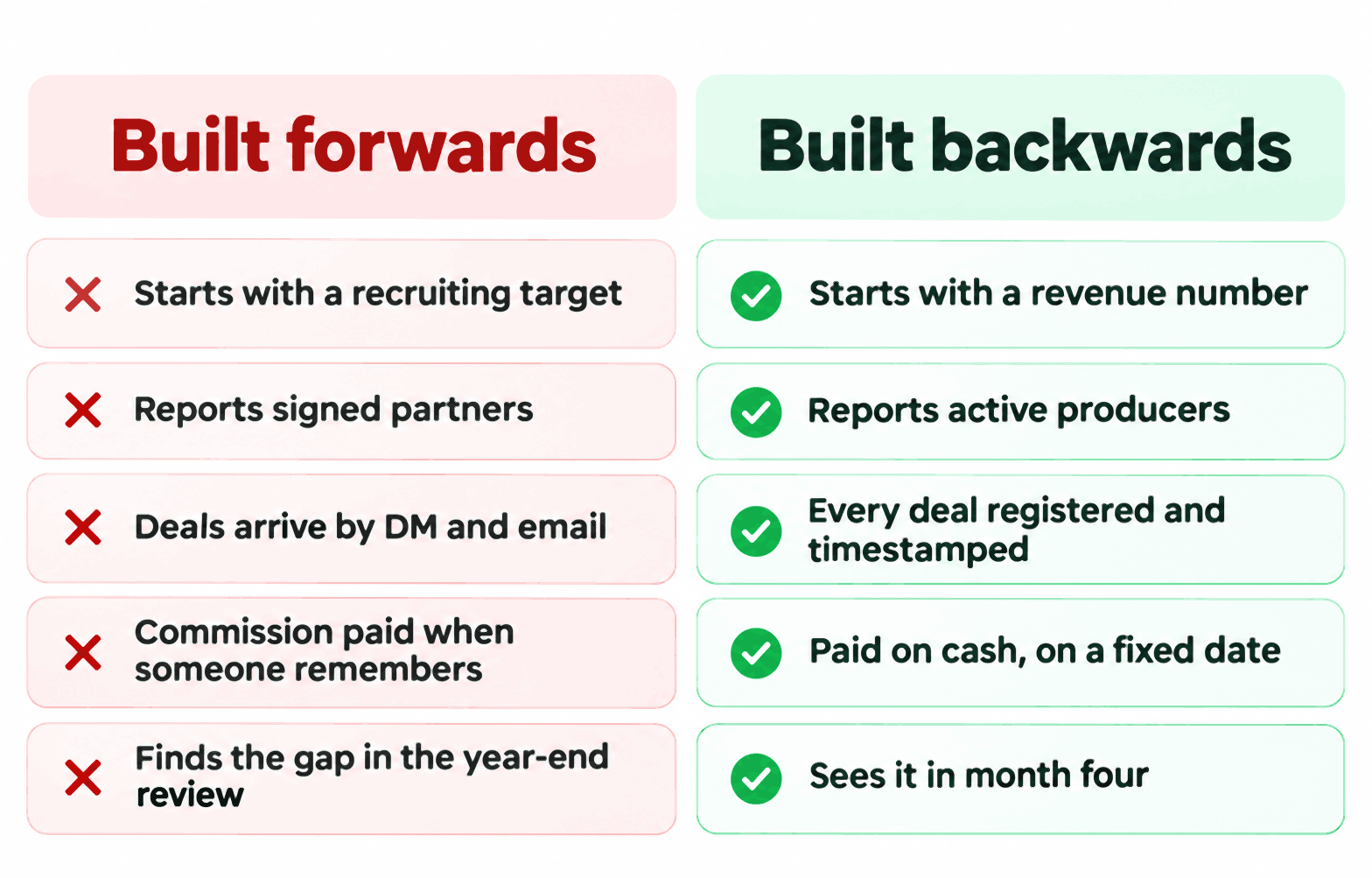
Nobody did anything wrong, exactly. The program was built forwards: recruit partners, enable them, hope revenue arrives.
This post shows how to build a partner program the other way round. Start with a revenue number, then work back to the deals, the active partners and the system each one needs. It's a free framework you can run on a whiteboard this week.
"You can't forecast partner revenue"
That's the strongest objection. It has a grain of truth: partner deals arrive in lumps. Jason Lemkin's SaaStr advice on first partner programs tells founders to expect the sales cycle to double when partners are involved, and he doesn't sugar-coat the timeline:
“Partnerships take time to deliver material revenue. It's not a quick win.
”
Fine. You can't forecast the exact quarter a reseller's biggest client signs.
You can plan the inputs, though. How many deals the target needs, how many partners must be sending them, how long a new partner takes to send a first lead.
Those are numbers you control, and the slow cycle is the reason to set them early. A program that starts counting in month ten has already lost the year.
Lemkin's own advice points the same way: treat it like a sales pipeline. Nobody runs a sales team without a number.
Why most partner programs never generate revenue
In Convert Commerce's Partnerships Benchmark 2026, a survey of 102 partnership professionals, 86% named revenue among their top two measures of success.
Yet the same survey found partner activation was the single biggest partner-management challenge, named by 25%. Teams measure revenue and then manage something else: sign-ups, logos, webinar attendance, partner NPS.
That gap is the forwards-built program. It optimises for the first step of the funnel and treats everything after it as the partner's job.
Forrester sees the same split inside partner teams. Stephanie Sissler found that 62% of sales leaders give partner account managers nothing beyond basic sales training.
The companies that hit their partner targets trained differently: 51% of them invested in specialised training, against 29% of those that missed. Her summary is worth pinning above your desk:
“Basic sales training produces PAMs who manage partner relationships. Comprehensive PAM enablement creates revenue architects who can build lasting growth.
”
Relationship managers recruit. Revenue architects work backwards.
The Revenue Back-Plan: a free partner program framework
The Revenue Back-Plan has five parts. Each one answers a question the part before it raises, so you build them in order:
- Number: what revenue, and how many deals does that take?
- Producers: how many partners must be actively sending those deals?
- Path: what route does every partner deal take from introduction to closed-won?
- Pay: what does a partner earn, and when do they see it?
- Proof: how do you know which partners produce, so you can back them?
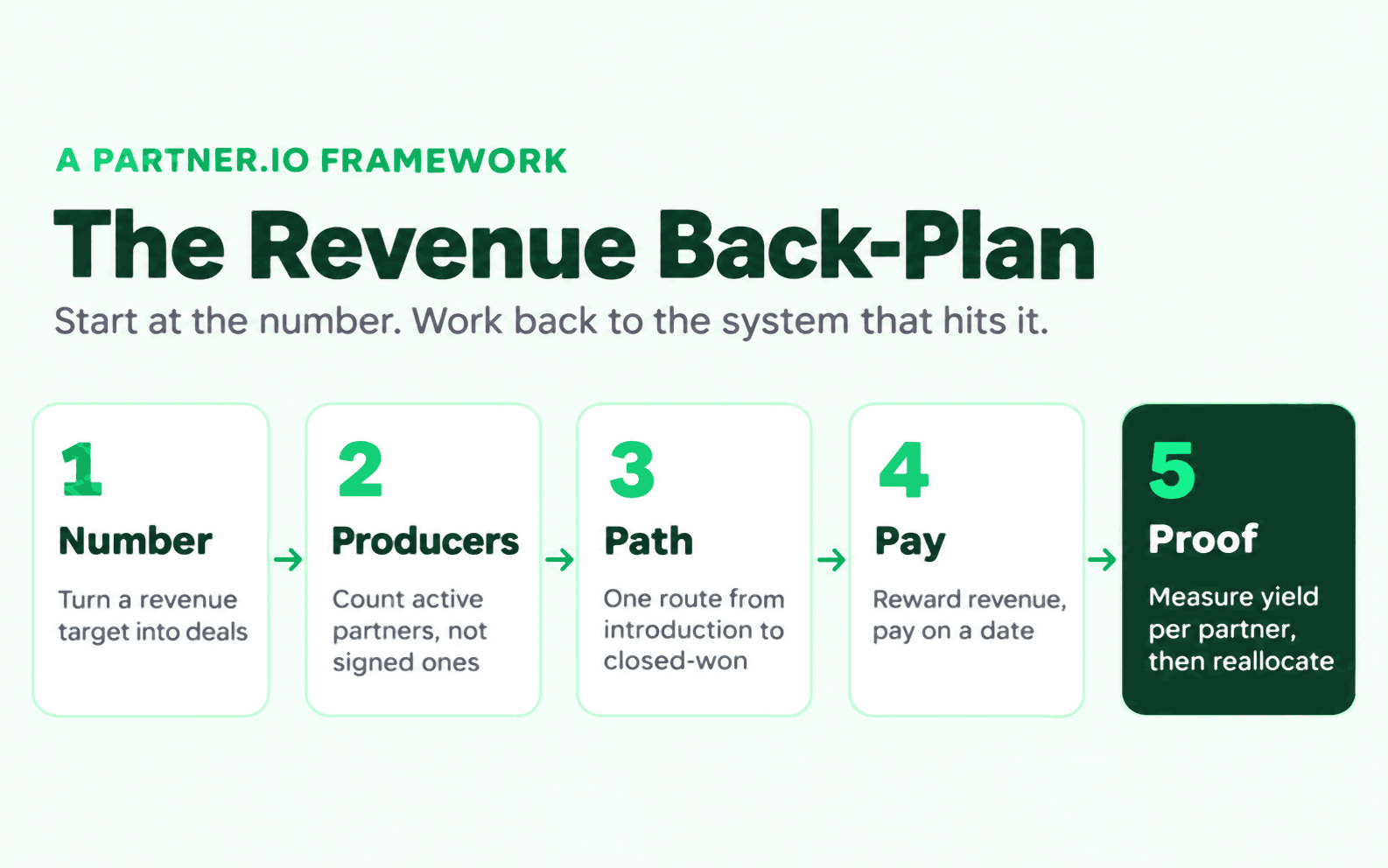
Skip one and the rest fail quietly. A number with no path produces a forecast nobody can hit. A path with no pay produces registrations that stop after month two.
Number: turn a partner revenue target into deals
Start with a figure you'd defend in a board meeting, then divide it until it becomes something a partner manager can act on by Monday.
Here's an illustrative example. Swap every assumption for numbers from your own CRM.
| Step | Sum | Result |
|---|---|---|
| Target new ARR from partners | Set by you | $600,000 |
| Deals needed | ÷ $20,000 ACV | 30 deals |
| Partner opportunities needed | ÷ 30% win rate | 100 opps |
| Active partners needed | ÷ 5 opps each a year | 20 partners |
| Partners to recruit | ÷ 25% activation | 80 partners |
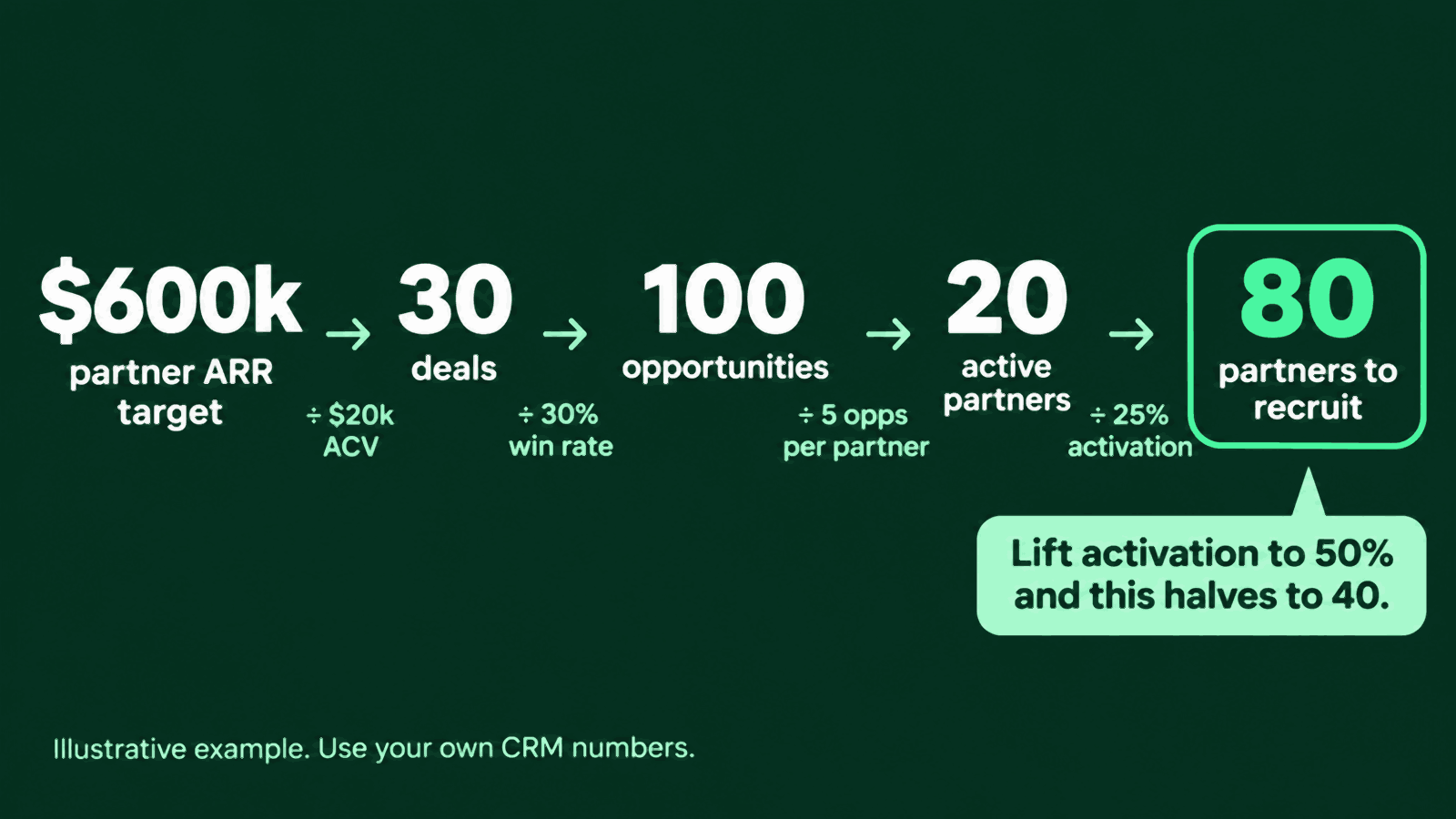
Look at the last row. Your recruiting target is an activation problem.
Lift activation from 25% to 50% and you need 40 recruits, not 80. Half the onboarding calls, half the agreements, and a manager with time for the partners who matter.
Don't have win rates for partner deals yet? Use your direct win rate and mark it as a guess.
It's a cautious guess. Ebsta's 2025 GTM Benchmarks found partner referrals were 1.3x more efficient than other channels across $48 billion of opportunities. Efficiency there means win rate times deal size, divided by cycle length. Our breakdown of partner referrals' share of pipeline versus revenue explains how to run that sum on your own data.
Producers: count active partners, not signed ones
A partner who signed an agreement is a cost. A partner who sent a deal this quarter is a producer. Report the second number.
Define "active" before you start: at least one registered opportunity in the last 90 days. Then design the first 90 days of every partnership around getting there.
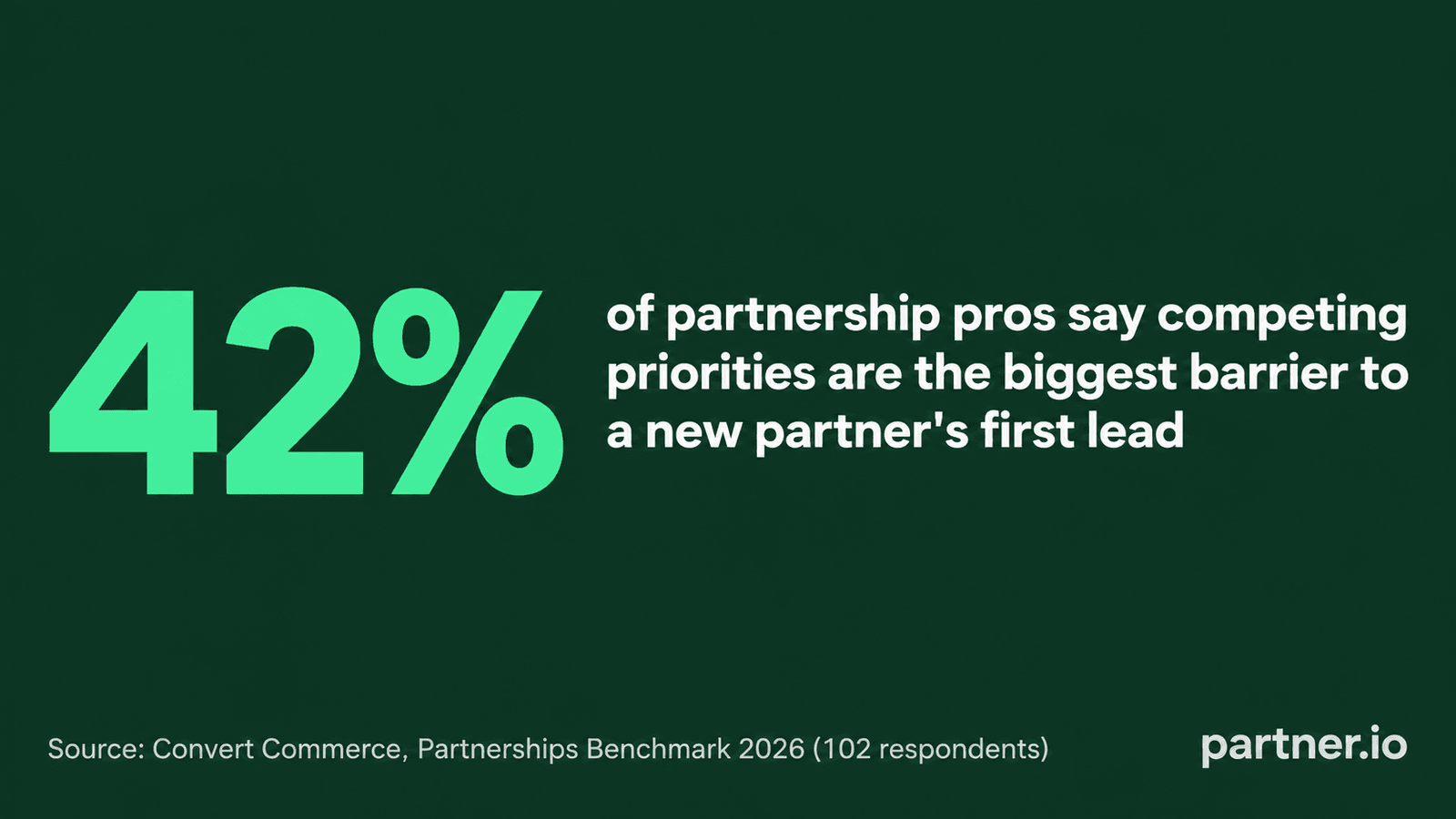
Convert Commerce asked what stops a new partner sending a first lead. Competing priorities came top at 42%, well ahead of product knowledge (23%) and no clear process (12%).
Your product isn't on their list this week. More training decks won't fix that. Being easy to remember will.
So give each new partner three things before the welcome call ends:
- One target account list, built from overlap with their clients. Account mapping and Deal Surround show where your targets and their clients meet, so the first conversation starts with real names.
- One referral moment: the point in their own work where your product solves the next problem. For an agency, it's the post-launch review. For an accountant, year-end.
- One short course they can finish in a sitting, with a certificate at the end. Training and certification keeps it in the same portal they register deals in.
If a partner hasn't registered anything by day 60, call them and rebuild the target list together.
If they still haven't by day 120, move them to a quarterly newsletter and stop spending manager hours there.
That second rule feels harsh. It's what frees time for the partners already sending deals.
Path: one route from introduction to closed-won
Every partner deal should take the same path, and the path should be visible to both sides. When it isn't, deals leak in ways nobody reports: a referral sits in a shared inbox, an AE logs an agency's deal as inbound, the partner hears nothing for three weeks and stops sending.
A working path has four stations:
- Register. The partner submits the deal in a portal. If it isn't registered, it doesn't count. No DMs, no "I mentioned it on the call".
- Decide. Approve or reject within two working days. Auto-approve anything that doesn't match an open opportunity.
- Sync. The approved deal lands in your CRM with the partner and rep attached, and stage and value flow back.
- Protect. The partner owns the deal for a set window, 90 days for example, extendable once if it's moving.
Leads and deal registration runs the first three in Partner.io and timestamps every claim, so your protection rule settles conflicts without an argument. Approved deals sync to HubSpot, Salesforce and Pipedrive. The partner sees the same status your AE sees, without asking.
“A partner who can't see their deal assumes you've stolen it.
”
Pay: reward revenue, and pay on a date
Commission plans fail in two ways. They're too complicated to repeat, or they're paid late and in silence.
Fix the first with a plan that fits in one sentence: "20% of first-year revenue on every deal you register, paid monthly after the customer pays."
Fix the second by triggering commission from paid invoices. Then pay on the same day every month.
There's a trade-off here worth stating. Paying on signature feels generous and gets partners excited early. Paying on cash protects you from clawbacks and keeps the program honest. For most B2B SaaS teams under $25M ARR, cash wins, as long as the partner can watch the commission move from pending to approved to paid.
Tiers, commissions and payouts turns each paid invoice into a pending commission, bundles approved ones into a self-billed invoice and pays through Stripe. If you're weighing tiers on top, start with partner tier criteria before you build a ladder nobody can climb.
Proof: measure yield per partner, then reallocate
The last part closes the loop back to the number. Once a month, pull four figures for every active partner:
- registered opportunities
- win rate
- revenue closed and paid
- days from approval to close
Then reallocate. Partner revenue concentrates in a few producers, so give them the joint plans, the fastest approvals and your best hours. Our partner scorecard template is a free way to start; the joint business plan template covers the quarterly plan for your top three.
This is where the forwards-built program finally shows up on paper. Eighty logos, twelve producers, two of them sending half the revenue. Better to see it in month four than in the year-end review.
Want the Revenue Back-Plan running in a real portal? See how Partner.io operationalises this with a 7-day free trial, no credit card needed.
Plan backwards in time, too
Working back from the number tells you how much. The calendar tells you when, and it's where most annual plans fall apart.
Say your target is for the calendar year and your partner deals take about 90 days to close. December's deals need registering by September. September's registrations need partners who were active by summer.
Convert Commerce found 76% of teams finish partner onboarding within two months, and 24% take three months or longer. So the partners who deliver your Q4 revenue have to be recruited in Q1.
Built as a sequence, your year looks like this:
- Q1: recruit and onboard. Every new partner gets a target list and a referral moment.
- Q2: activate. Chase first registrations, run the day-60 calls, cut the silent ones loose.
- Q3: pipeline. Joint plans with the producers, a registration push on named accounts.
- Q4: close and pay. Protect every registered deal and pay every commission on time, because next year's recruits will ask your partners how it went.
Build your partner revenue plan in one afternoon
You need your CRM, a spreadsheet and two hours.
- Pull last year's partner deals from the CRM: count, average deal size, win rate, days to close. If you have fewer than ten, use direct numbers and say so.
- Set the number for partner-sourced new ARR next year.
- Run the Back-Plan sums to get deals, opportunities, active partners and recruits.
- Count your current producers: partners with a registered opportunity in the last 90 days.
- Write down the gap between producers today and producers needed. That's the real target for your partner team.
- Map the calendar backwards from your close dates.
- Pick the station on the path that leaks most and fix it first.
Recruit more partners or activate the ones you have?
Most programs get this wrong, because recruiting feels like progress and activation feels like nagging.
If fewer than a third of your signed partners registered a deal last quarter, stop recruiting. Spend the next 90 days on activation, and only add partners who share a named buyer with your best producers.
If most of your partners are active and your producers are at capacity, recruit, and recruit lookalikes of the producers rather than whoever applies. Partner discovery helps you find them by account overlap.
If you can't tell which situation you're in, that's your answer. Fix the record before you do either. See the hidden cost of managing partners in spreadsheets for why.
What this looks like in the real world
This is an illustrative example, not a customer story.
A 60-person SaaS company sells field-service software to HVAC contractors. It has 45 signed partners: trade associations, two software resellers, a handful of agencies and a dozen consultants. Last year they produced $180,000 of new ARR, almost all from three of them.
Nobody recruits in January. The partner team runs the Back-Plan first.
The board wants $540,000. At a $15,000 ACV and a 35% win rate, that's 36 deals and about 103 opportunities. At six opportunities a year per producer, the program needs 17 active partners. It has five.
So Q1 isn't about new logos. Every one of the 40 quiet partners gets a call, a target list of HVAC contractors they already serve, and a 20-minute course.
Fourteen register something by March. Nine keep going. Only then does the team recruit, and it goes looking for consultants who look like the three producers.
Same program, same product. The difference is that the plan started at the number and worked back.
Where Partner.io fits
Every part of the Revenue Back-Plan needs a place to live. In most programs it's spread across a CRM, three spreadsheets, an inbox and one person's memory. Partner.io puts it in one system, built for the partner side of revenue:
- Number and Proof: partner revenue, registrations and commissions in one record, with stage and value synced back from your CRM. Ask for a yield report in plain language through the Partner.io MCP server.
- Producers: Deal Surround and partner discovery for target lists, training and certification for ramp, and automation Flows that nudge partners who haven't sent a first lead.
- Path: deal registration with timestamped claims, auto-approval rules and CRM sync.
- Pay: commissions and payouts triggered by paid revenue and sent through Stripe.
- The partner's side: a branded partner portal on your own domain where they register, learn, and watch every deal and commission move.
Partners use it free and in unlimited numbers, so the program can grow to 80 recruits without the bill growing with it. See pricing for the details.
Start with the number. Build the system that hits it.
A partner program that generates revenue isn't a bigger program. It's one where every partner, every deal and every commission traces back to a number someone signed off. Recruit fewer partners, activate more of them, and make the path from introduction to payout impossible to lose.
Run the sums this week. Then put them somewhere that won't forget them.
See how Partner.io operationalises this → Free for 7 days. No credit card, no setup fee, cancel anytime.
Prefer a walkthrough first? Book a demo and we'll map the Back-Plan to your program.
- [partner-led-growth]
- [prm]
Published November 10, 2026