
Points, revenue or certification? How each way of deciding who moves up a tier works, where it breaks, and how HubSpot, AWS and Atlassian combine them.
Your Partner Tier Criteria Are a Budget Decision in Disguise
Every tier review ends at the same spreadsheet.
One partner had a great quarter and holds no certifications.
Another certified six people and sent nothing.
A third registered forty leads, and thirty-eight were junk.
Who moves up?
Whatever you decide, you've just told every partner what you pay for. Partner tier criteria look like admin. In practice they steer your commission budget, your partner manager's calendar and your co-marketing money for the next twelve months.
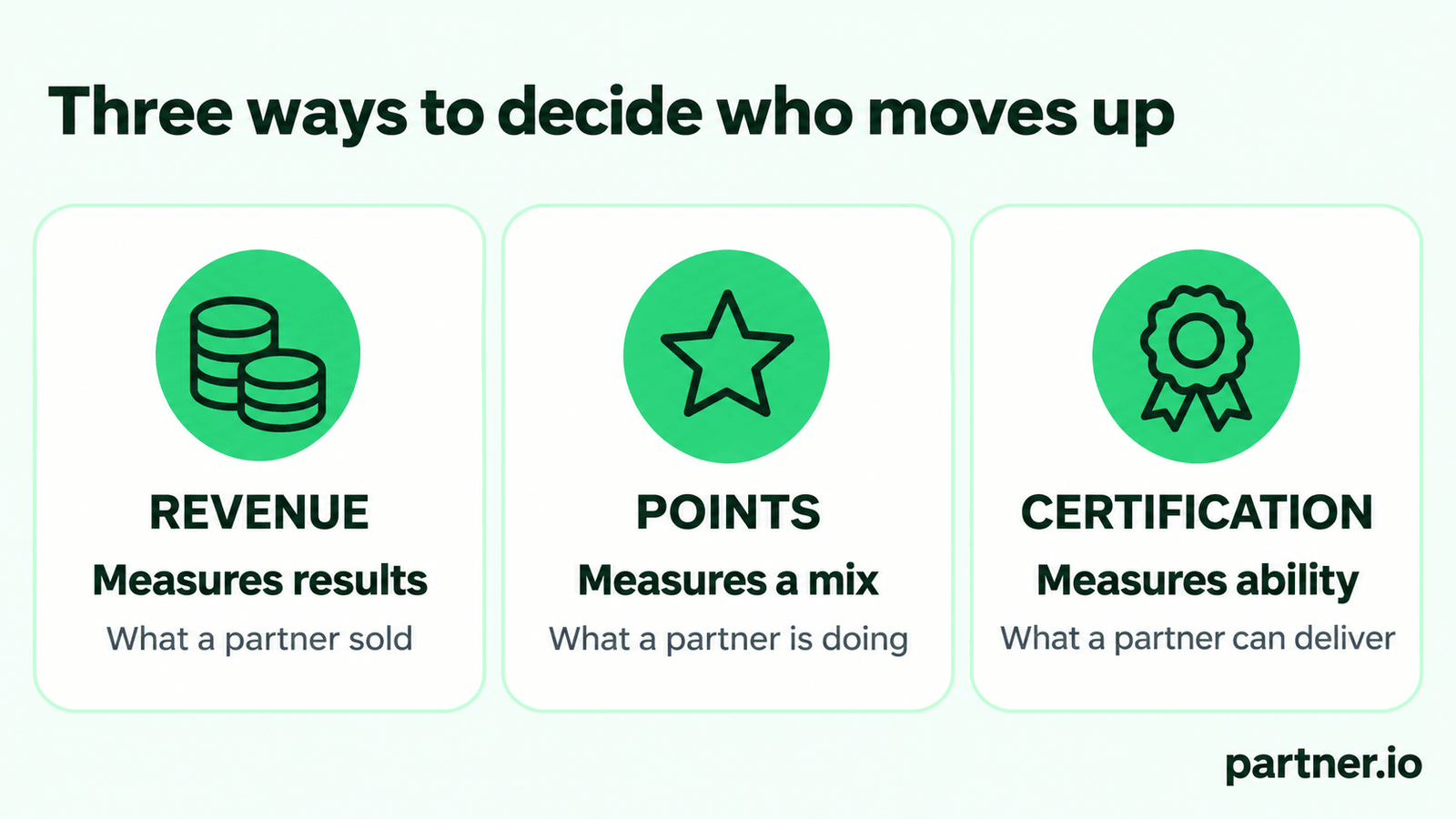
There are three ways to decide who moves up a tier: revenue, points and certification. Most programs pick one out of habit. The good ones pick on purpose, and usually run two.
"Just pay commission and skip the tiers"
The strongest objection to everything below is that tier criteria do more harm than good.
There's data behind it. Techaisle's 2026 survey of channel partner firms found that only 24% of partners actively manage to the composite scores vendors use to set tiers, and 65% can't see how the score is calculated. More partners said index-style scoring cut their incentive earnings (39%) than raised them (31%).
That's a fair indictment of complicated criteria. It isn't a case for having none.
Without written criteria you still promote people. The agency you like gets faster approvals and a better rate in a Slack DM, and everyone else finds out at renewal. Unwritten tiers are still tiers, just ones nobody can aim at.
The fix is criteria a partner can check on a Tuesday afternoon without emailing you. If you haven't settled the structure itself (flat, ladder, parallel tracks), start with our breakdown of 10 partner tier structures. This post is about the rule that moves a partner from one level to the next.
Way 1: revenue-based partner tiers
Revenue is the default, and for good reason. Forrester's Stephanie Sissler, writing on whether to tier partners at all, describes where most programs sit:
“Revenue attainment is still the primary criterion, however, for moving up to a higher tier in most partner programs.
”
Atlassian's Marketplace Partner Program is a clean public example. Silver, Gold and Platinum need $150K, $750K and $3M in annual cloud gross sales, measured from July 1 to June 30 and reviewed once a year in July.
Where revenue works
A deal closed or it didn't. If partner-sourced deals sync from your CRM, nobody spends review week disputing the number.
It fits referral partners and resellers whose job is to bring you customers. A consultant who introduced eight accounts that closed at $18K ACV has a number you can both see.
Where revenue breaks
Sissler makes the catch plain in the same piece: revenue is a lagging indicator. It tells you who sold last year and nothing about who's about to.
It also misses work that never shows up as sourced revenue. An implementation agency that rescues three of your enterprise rollouts may source nothing at all. On a pure revenue ladder, it sits at the bottom next to a partner who signed up and vanished. If you haven't split sourced from influenced deals in your CRM, our guide to partner-sourced vs partner-influenced revenue sets out the rules.
Long sales cycles distort it too. One $90K deal can promote a partner who never sends another lead.
Use revenue when partners source deals, you can attribute them without argument, and sourced revenue is the thing you want more of.
Way 2: points-based partner programs
Points let you reward more than one behaviour without pretending they're worth the same.
HubSpot's Solutions Partner Program is the reference design. Per HubSpot's tier rules, partners earn 5 points per $100 of MRR they source, 3 per $100 they assist and 1 per $100 they manage. From January 2027, Gold needs 345 total points and Platinum 1,275. Diamond and Elite add a floor of 75% and 80% average gross revenue retention.
Look at the weights. Sourcing is worth five times managing. A points system is a statement of priorities with numbers attached.
Where points work
Points suit a partner type that does more than one job: an agency that refers some clients, co-sells on others and manages a book of existing accounts.
They also let you steer. Want more co-sell? Raise the assist weight for two quarters and watch the registrations move.
Where points break
Every weight is an exchange rate, and partners will trade at it. Anthropologist Marilyn Strathern gave Goodhart's law the wording most people quote:
“When a measure becomes a target, it ceases to be a good measure.
”
Award 10 points per registered lead and you'll get registered leads. Plenty of them won't be real.
Points also go opaque fast. In the same Techaisle survey, 73% of MSPs worried their scores could drop without warning. A partner who can't work out their position stops chasing it.
Use points when you need to reward two or three distinct behaviours, you can publish the weights, and every point comes from an outcome (an approved lead, a recorded payment) instead of an activity.
Way 3: certification-based partner tiers
Certification measures something revenue can't: whether the partner can deliver.
The AWS Services Path leans on it hard. Select needs two foundational and two technical certifications alongside 3 launched opportunities. Premier needs 25 technical certifications, ten of them professional or specialty, plus 50 launched opportunities and $50,000 in monthly recurring revenue.
Where certification works
It's a leading indicator. A partner who certifies three consultants this month is building a practice you'll see in revenue next year.
There's some evidence the link holds. Gusto's data science team estimated that certified partner firms brought in 40% more clients in the 90 days after certification, according to a case study from its training platform. Treat it as one company's estimate, with an obvious catch: firms keen enough to certify may have been growing anyway.
Certification fits agencies, implementers and MSPs, where a botched rollout loses you the customer and a good one sets up the renewal.
Where certification breaks
It breaks when the course becomes the goal. A four-hour quiz anyone can pass with the slides open is a toll booth. Partners certify staff to reach the tier, then sell nothing.
It also costs partners time with no promised return. A two-person referral consultancy won't spend a week on coursework for a program that sends it three leads a year.
Use certification when partners deliver or support your product, poor delivery costs you customers, and your course tests something a customer would notice.
Revenue vs points vs certification: the trade-off
| Criterion | Measures | Easy to game? | Lag |
|---|---|---|---|
| Revenue | Results | Hard | 6 to 12 months |
| Points | A mix | Yes, if weights reward activity | Weeks |
| Certification | Ability | Yes, if the test is soft | None |
Revenue is honest but late. Certification is early but soft. Points sit in between and are only as good as their weights.
That's why the best-known programs combine them. HubSpot runs points, a certification requirement and a retention floor. AWS runs certifications, launched opportunities and MRR. Atlassian runs revenue plus support and security standards.
None of them trusts a single number.
The RAMP model for combining partner tier criteria
You don't need HubSpot's complexity. You need a clear answer to four questions, asked in order. We call it the RAMP model.
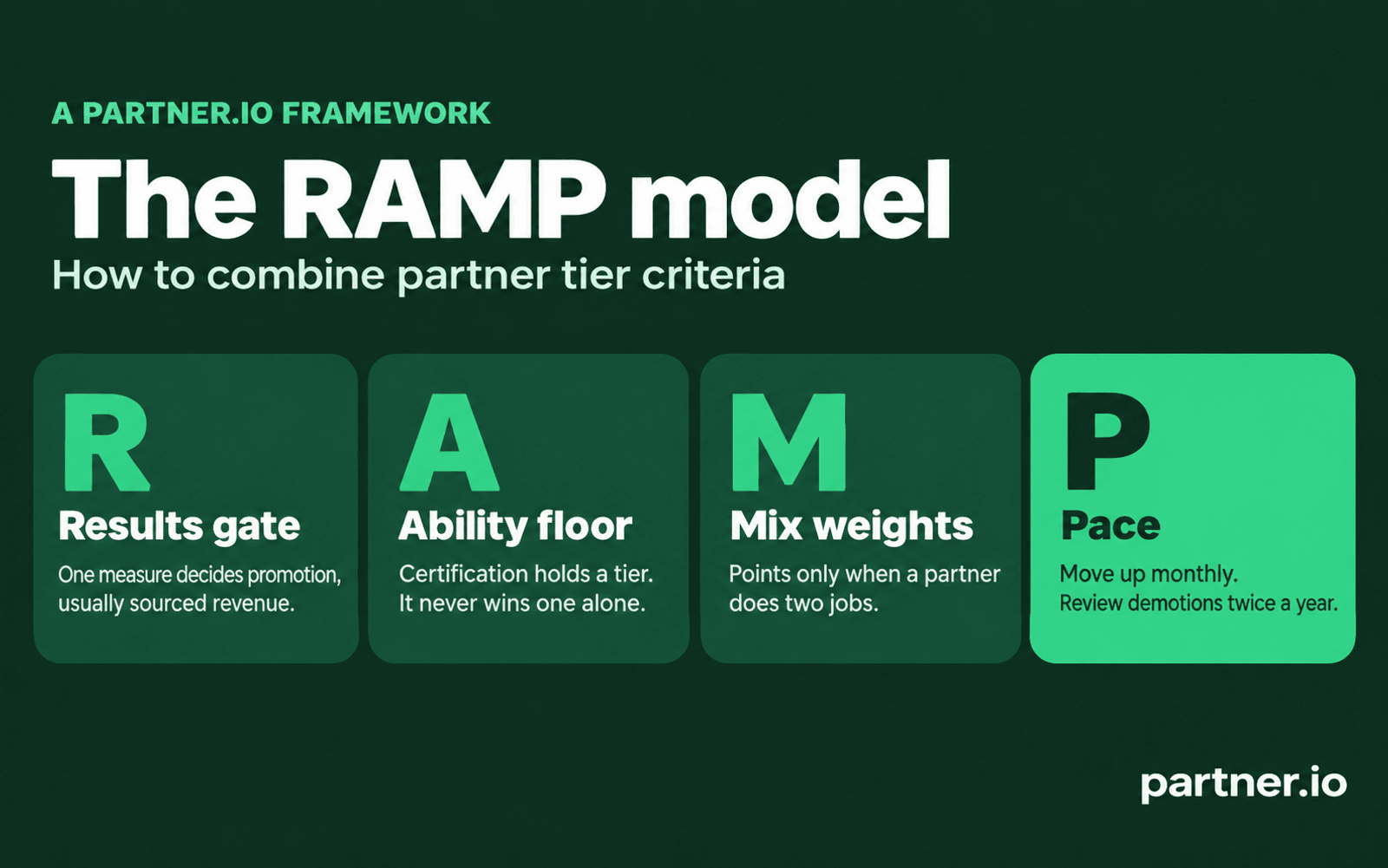
R: Results gate
One results measure decides promotion. For most programs, that's sourced revenue over a trailing twelve months. For an agency track, it can be launched customers or retained revenue.
Pick one per track. Two results gates on the same tier leave partners guessing which one you meant.
A: Ability floor
Certification works best as a floor. Require it to hold a tier, and never let it win one on its own.
HubSpot does exactly this. At least one employee must pass the partner certification exam every 25 months, and an expired certification at recalibration means a down-tier. Certification doesn't earn Platinum. It keeps you eligible for it.
M: Mix weights, only if you need them
Add points only when one partner type does two jobs you want to reward. Cap it at three behaviours, and tie each one to an outcome.
If every partner in a track does one job, skip this step. Points you don't need are a second spreadsheet.
P: Pace
Decide when the rules run. Partners feel this more than any threshold.
HubSpot's rhythm is worth copying. Partners can move up once a month. Reviews happen twice a year. A new tier holds for at least six months, and a partner who falls short for the whole period drops to their best performance in that window, not to the bottom.
Fast up, slow down. A partner who earns a promotion should get it this month. A partner having one bad quarter shouldn't lose their rate halfway through a deal.
“Promote on results, hold on ability, and never surprise a partner with a demotion.
”
Want tier rules your partners can see? Try Partner.io free for 7 days, no credit card needed.
Which criterion should decide your next promotion?
If your partners refer deals and never touch delivery, use a revenue gate with no ability floor. Certification will only slow them down.
If they implement, resell or manage customers, use a revenue or launched-customer gate, with a certification floor on every tier above entry level.
If one partner type both sources and influences deals, add points, and publish the weights in the portal on day one.
Can't measure the results gate without an argument? Fix attribution before you build tiers. And if you have fewer than ten active partners, you may not need tiers yet: read how to structure a program with fewer than 10 partners first.
How to set partner tier promotion rules in six steps
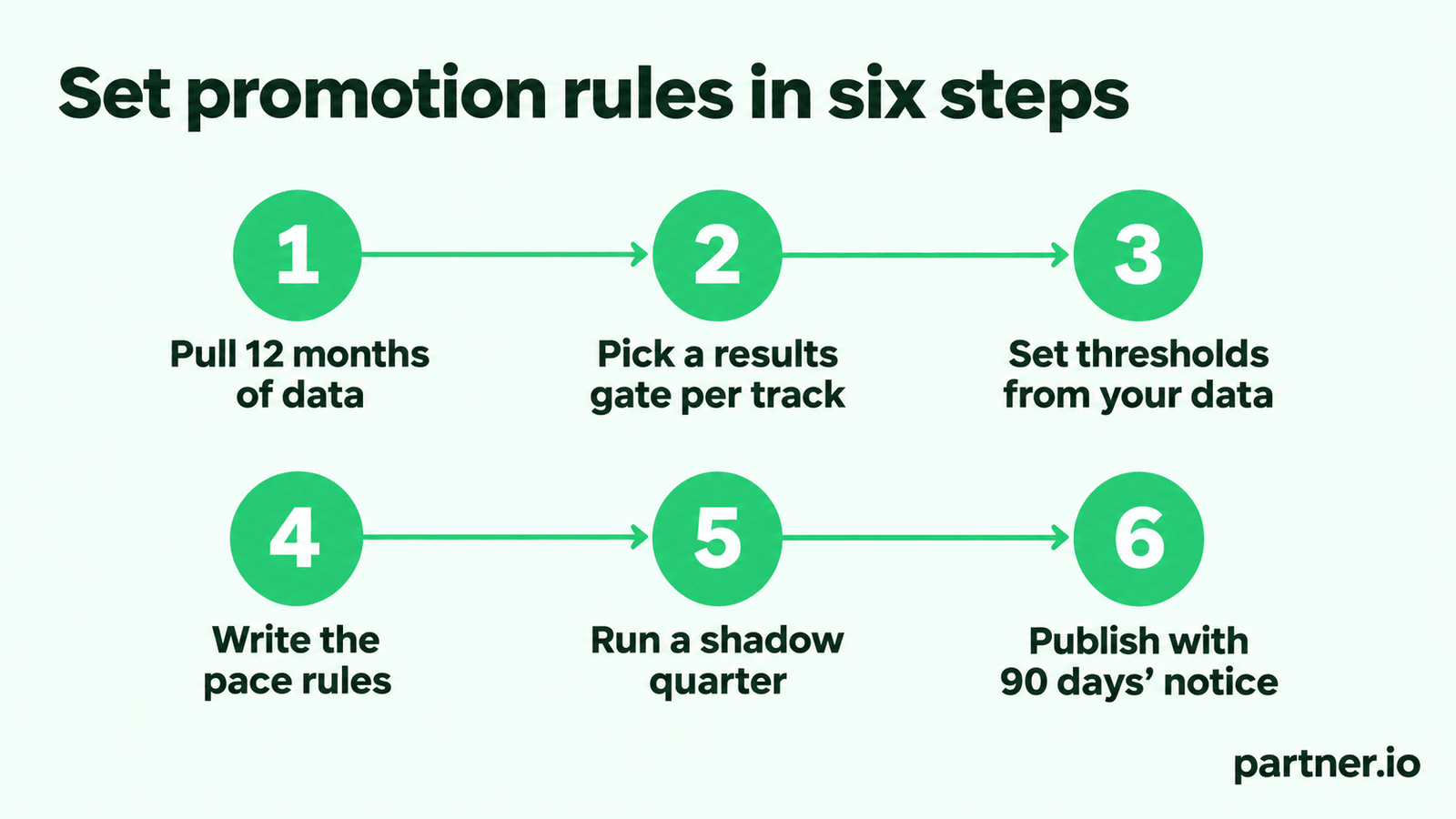
- Pull twelve months of partner data. Sourced revenue, approved leads, certifications and retention per partner, from your CRM and PRM.
- Choose a results gate per track. Referral partners and agencies rarely share one.
- Set thresholds from your own distribution. Rank partners on the gate and put the top tier where your best handful sit today, whatever a big vendor's program says.
- Write the pace rules. The measurement window, how often partners can move up, review dates and the grace period before a demotion.
- Run a shadow quarter. Calculate tiers under the new rules without changing anyone's rate. If your best agency lands at the bottom, the rules are wrong.
- Publish with notice. Techaisle recommends giving partners 90 days' notice of tier changes and holding existing status until then. That's a sensible default for a small program too.
Our partner scorecard template gives you a quarterly sheet to run the review, and the partner program tiers guide has a three-level matrix to start from.
What this looks like in the real world
Here's an illustrative example, not a customer story.
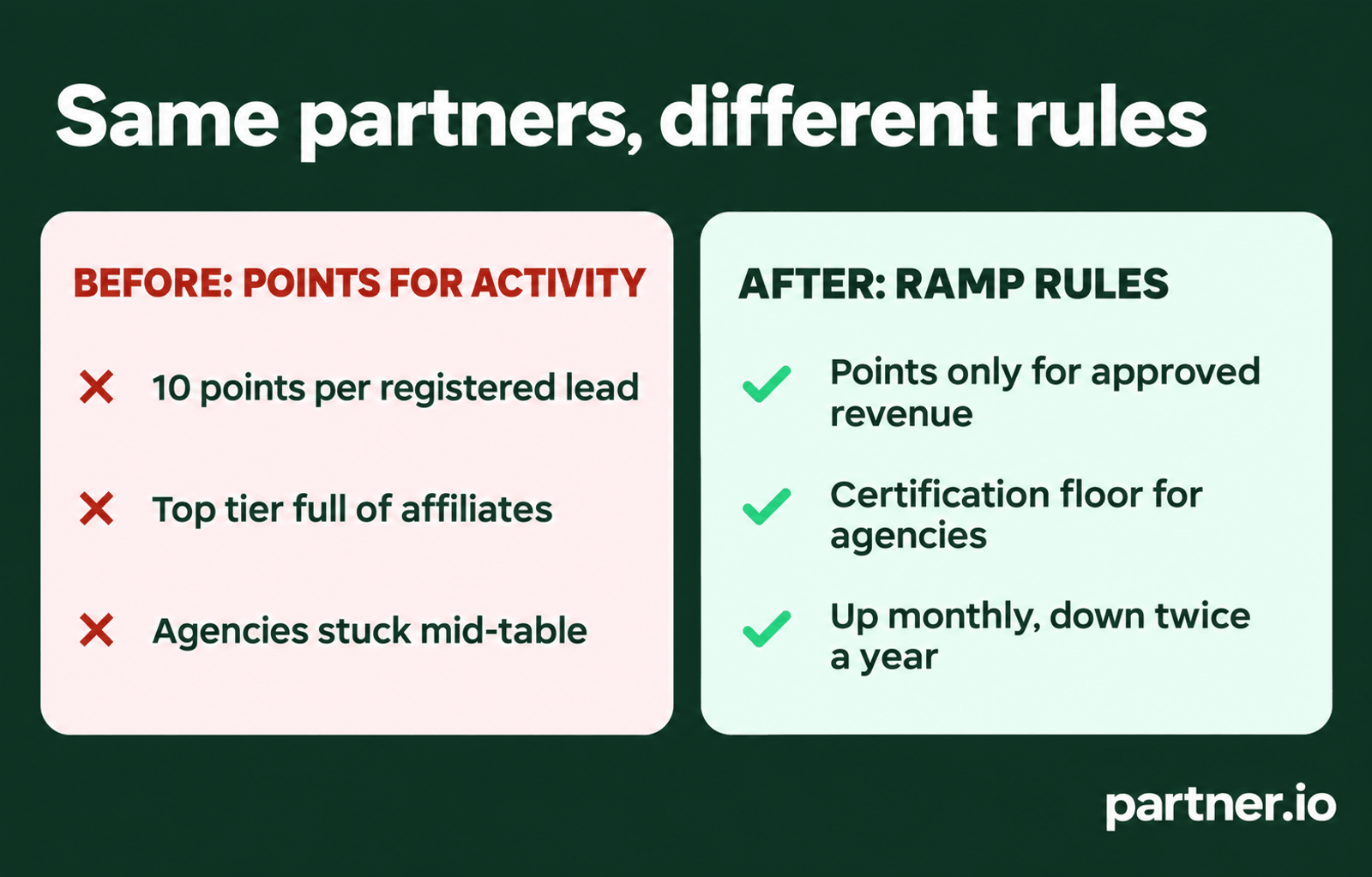
A 35-person SaaS company runs a points program for 70 partners: 50 referral partners and 20 agencies. It awards ten points per registered lead, five per course completed and one per $100 of closed revenue.
By the second quarter, the top tier is full of affiliates registering every contact they've ever met. The agencies, who close most of the revenue, sit mid-table, because closed revenue earns the fewest points. Two of them ask why a partner with zero closed deals gets a better rate. Nobody has an answer.
The fix takes one review cycle. Registered leads stop earning points; only approved leads and recorded payments do.
Referral partners move to a plain revenue gate. Agencies get a revenue gate plus a certification floor: one certified consultant to hold the middle tier, three for the top. Promotions run monthly, and demotions are reviewed twice a year with a six-month hold.
At the next review, nobody asks for an exception.
Where Partner.io fits
Every model above fails the same way in a spreadsheet: someone has to do the counting. Revenue lives in the CRM, certifications in a training tool, points in a tab nobody trusts, and the partner sees none of it.
Partner.io keeps all three on the partner record, which is why we think it's the best PRM for running tier criteria at this size. We're biased, so here's what it does.
- Revenue gates from real payments. Leads and deal registration syncs partner-referred deals with HubSpot, Salesforce or Pipedrive, and commission is calculated from payments recorded against those leads. Your results gate reads the same revenue your finance team does.
- Certification as a floor. Training and certification gives courses a pass mark, issues verifiable certificates and awards badges, and those badges can drive tiers, perks and Flows.
- Perks that check the floor. In tiers, commissions and payouts, every perk is a trigger, a reward and optional conditions. Conditions read deal value, partner type, partner score, courses completed and your own custom fields, so a higher rate can depend on certification as well as tier.
- Promotion reviews that happen. Automation Flows branch on partner score, total leads or course badge and create a review task for your team. You approve the move, one partner at a time or in bulk. A person signs off every promotion; the software does the counting.
- Progress partners can see. The partner portal shows each partner their tier and its perks, plus leads, revenue and commission for any date range.
It's one plan at $79 per seat on your team, with unlimited partners, so adding a tier never adds a bill. For rewards beyond commission, read how Partner.io handles partner rewards. If your tiers live in a spreadsheet today, the hidden cost of managing partners in spreadsheets explains why they rarely survive a second review.
Pick the rule your partners can aim at
Revenue, points and certification measure different things: what happened, what a partner is doing and what they're able to do.
Choose the one that decides promotion. Put certification under it if delivery matters. Add points only when a partner does two jobs. Then publish the rules and let partners watch themselves climb.
A partner who can see the next tier will work for it. One who can't will negotiate for it.
Try Partner.io free for 7 days → No credit card, no setup fee, cancel anytime.
Prefer a walkthrough first? Book a demo and we'll map it to your program.
- [partner-led-growth]
- [prm]
- [partner-tiers]
Published November 6, 2026