
Twelve partner benefits you can offer without new budget, grouped by visibility, access, speed and trust, with a simple filter for picking yours.
The Best Partner Benefits Are Already Paid For
When partner engagement drops, the first idea is always money.
Raise the commission.
Add a bonus.
Ask for a marketing fund nobody has time to run.
The request dies in a finance meeting, and the program stays exactly as it was.
Meanwhile a referral partner has waited six days for someone to approve a lead. An agency can't find a current deck. Your best consultant has no idea whether last quarter's commission was paid.
None of that needs budget. The partner benefits that change how partners feel about your program are mostly things your company already owns and has never priced: your audience, your product, your response time and your word.
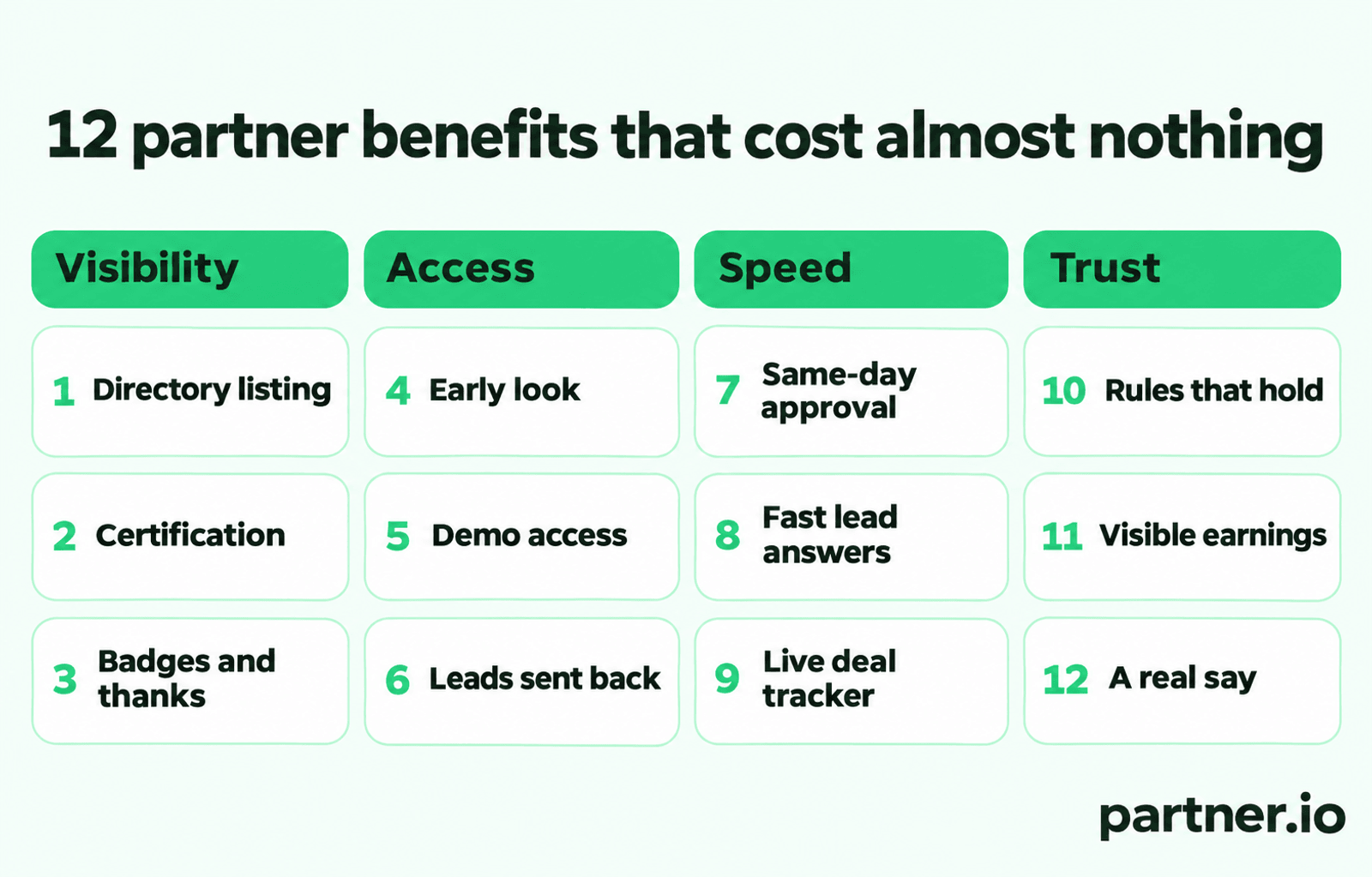
Here are twelve of them, a filter for choosing between them, and what each one takes to run.
"Partners want margin, not perks"
That's the strongest objection, and the data backs it.
Techaisle's 2026 survey of 5,450 channel partner firms found that 88% rate profitability as critical or very important. Among resellers, 78% name higher discounts and margins as the benefit they value most from a higher tier.
So no, a badge won't rescue a 5% commission in a market paying 20%. Fix the rate first. Our guide to setting a referral fee percentage covers that.
But read the rest of the same survey. Asked where programs fall short, partners name simplicity first (71%) and predictability second (61%). The most common complaint about partner experience is manual, slow administration, at 67%. The average partner takes part in 8.9 vendor programs.
That last number is the one to sit with. Your partner has eight other vendors paying a similar rate.
Techaisle's Anurag Agrawal draws the conclusion in 16 provocations from the same survey. His advice to vendors: "Treat partner attention as a fixed resource you must compete for, not an unlimited budget you can spend."
Money gets you into the set of programs a partner considers. Everything below decides which of the nine they open on Monday.
The VAST filter: four kinds of low-cost partner benefits
Most lists of partner perks are a jumble of swag and discounts. A better way to sort them is by what you're lending the partner.
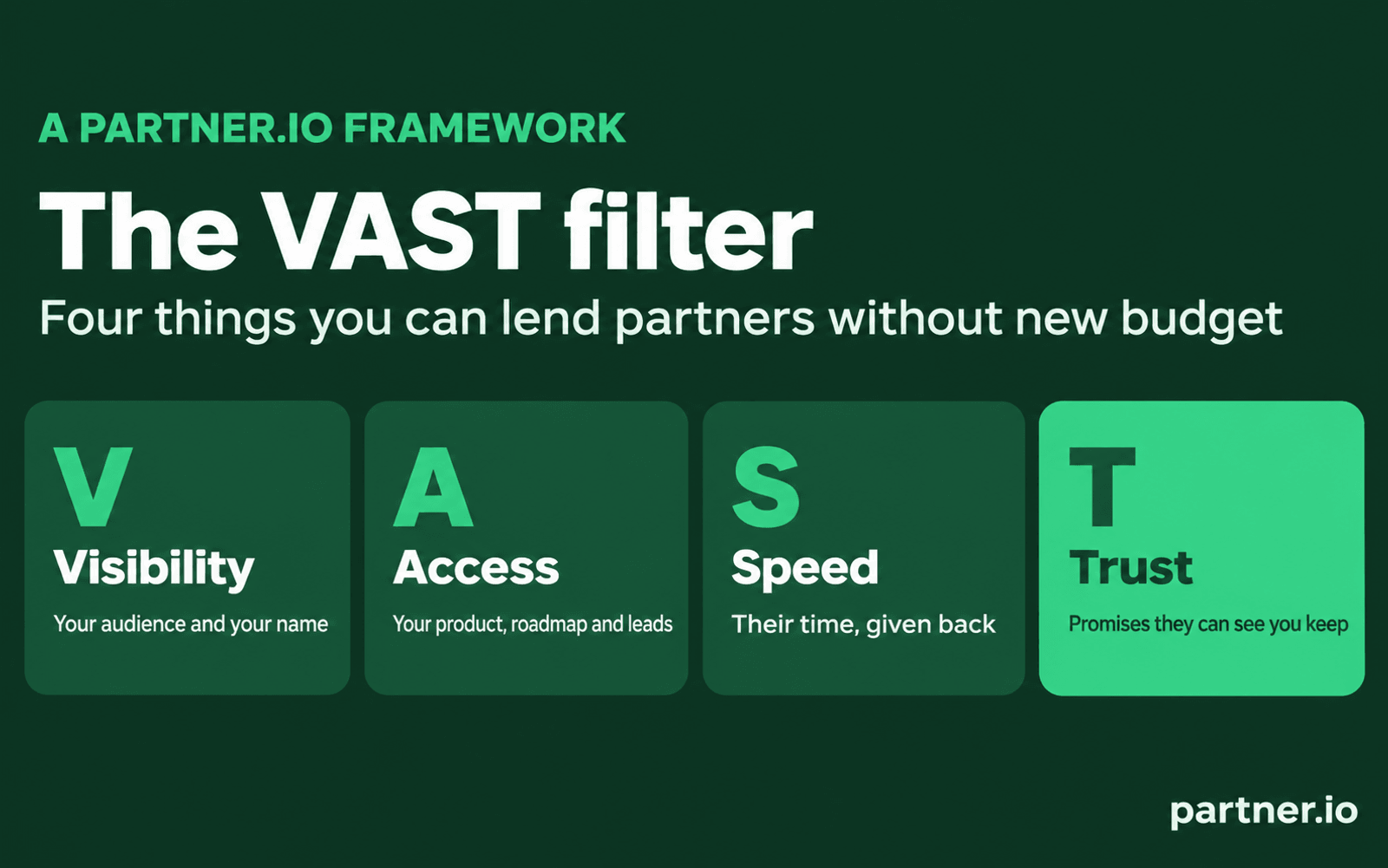
The VAST filter has four parts:
- Visibility: you lend partners your audience and your name.
- Access: you share things only you have, such as your product, your roadmap and your leads.
- Speed: you give partners their time back.
- Trust: you make your promises visible and keep them.
A benefit passes the filter when a partner can't buy it anywhere else and it costs you setup time once, not cash every month. Three benefits sit under each part.
Visibility: lend partners your audience
1. A listing in your partner directory
A page on your site that says "these firms know our product" is worth more to a 12-person agency than a rate bump. It sends them clients.
The big programs treat it as a headline benefit. HubSpot's Solutions Partner page lists a directory listing "with partner badge and greater visibility in search results". Shopify's partner tiers open directory eligibility at Silver.
In Partner.io, partners publish a Spotlight profile with their logo, description, clients and gallery. You approve it, then embed the searchable directory on your website with a widget, filtered by partner type and tier. A contact request from the directory reaches the partner as an introduction in their partner portal.
2. A certification they can show clients
Writing a course costs you a few days. A certificate the partner can put in a proposal keeps paying them back.
It has to travel, though. A PDF nobody can check is decoration. Partner.io's training and certification gives every certificate a public verification page showing the learner, course, score and completion date, and partners can add it to a LinkedIn profile in one click.
Keep the course short. If it takes four hours and nobody's delivery improves, partners will treat it as a toll booth. Our comparison of points, revenue and certification as tier criteria covers when certification deserves to gate a tier.
3. Badges and a named thank-you
Recognition is free, and most programs still get it wrong by being vague. "Thanks to all our partners for a great quarter" recognises nobody.
Name the partner, the client type and what they did, in the place other partners will see it.
Salesforce's guide to channel partner incentives makes the commercial case. Highlighting top partners in blogs, newsletters or live events "can boost morale and market credibility."
In Partner.io a badge is a reward type, so a perk can grant one when a lead is approved or a course is passed, and it shows on the partner's profile. Announcements in the Engagement Hub can be targeted by partner type and tier, with read tracking. There's no leaderboard, and for a program under 100 partners a specific thank-you does more than a ranking.
Access: share what only you have
4. An early look at what's shipping
Partners sell your product to clients who ask "what's coming?" A partner who knows the answer looks like an insider. One who learns it from your public changelog looks like everyone else.
“Early access can build long-term trust and create deeper investment in your success.
”
A 30-minute preview call once a quarter is enough. Record it, and put the deck where partners can find it.
Partner.io covers the delivery: a branded event page with invitations for the call, a scheduled announcement to the tier you choose, and the deck in a Partner Room folder limited to those partners.
5. Free product access for demos
A partner who can't open your product can't demo it, and a screenshot deck loses to a live click-through every time. The marginal cost of one more account on software you already host is close to zero. Atlassian's partner program lists free development instances among its Marketplace Partner benefits.
This is the one benefit on the list that Partner.io can't deliver for you, because the licence lives in your product. What it can do is hold the promise: add it to a tier as an off-platform perk, and it's tracked from unfulfilled to fulfilled, so the account gets created.
6. Leads sent back to them
Every week your team talks to prospects who need work you don't do: a migration, a custom build, a managed service. Passing those to a partner costs you nothing and is the benefit agencies remember longest.
It's also where small partners feel most ignored. Techaisle measured it in its analysis of the small partner growth gap. Of partners above $500M in revenue, 20% rate the leads their vendors send as excellent. Among partners under $10M, 6% do.
Partner.io's leads and deal registration runs in both directions. Your team refers a lead to a partner, and the partner accepts or declines it from their portal. If you don't know which partner fits an account, Deal Surround ranks the partners most likely to open it.
Speed: give partners their time back
7. Same-day approval and sign-in
A partner's enthusiasm peaks the day they apply. Leave the application in a queue for a week and you've spent it.
Write down who you'd approve without thinking, then stop making those people wait. Partner.io's automation admits applications that match your rules the moment they arrive and emails the partner a sign-in link. The agreement is e-signed in the portal. Everything that doesn't match waits for a human, because auto-approval rules can only approve.
8. A fast answer on every lead
To a partner, a referral that sits unanswered looks like a referral that was ignored. They've often told their client to expect your call.
The same rules work here. Matching referrals are approved on arrival, your team is notified in-app, by email and in Slack, and approved leads sync to HubSpot, Pipedrive or Salesforce. A promise of "an answer within one working day" is a benefit you can print on your partner page.
9. A live deal tracker
"Any update on the Acme deal?" is the most common email in partnerships, and nobody enjoys sending or answering it.
Give partners the answer without asking. In the Partner.io portal, every referred lead shows its status, deal value and commission, with a timeline and a message thread with your team. Once a lead syncs, the CRM owns the status, so the partner sees what your sales team sees.
Trust: make your word visible
10. Rules that hold for a year
Predictability costs nothing and partners price it higher than you'd expect. From the same Techaisle research:
“Partners will accept thinner margins in exchange for rules that hold for a year.
”
Publish your tiers, rates and review date. Promise that changes happen once a year and that deals in flight keep the rate they came in under.
In Partner.io, partners see their tier and the perks it carries on their dashboard. Agreements are assigned per partner type, and changing the terms forces a re-sign, so nobody finds out about new rules from a payout.
11. An earnings statement they can check
A partner who has to ask what they're owed assumes the answer is "less than it should be".
Partner.io's tiers, commissions and payouts show each partner what is pending and what is paid, next to leads, leads won and revenue for any date range. Partner.io takes 0% of partner payouts.
12. A real say in the program
Ask partners what's broken twice a year, then publish what you changed because of it. That second step is the benefit.
The Engagement Hub has survey templates for NPS, onboarding feedback and quarterly business reviews, with responses charted by partner. For your top five partners, add a 45-minute call. A survey won't tell you why your best agency stopped registering deals.
“A benefit is a promise with a delivery date. Offer twelve you can't keep and you've built twelve reasons to leave.
”
Want to set these up in a real portal? Try Partner.io free for 7 days, no credit card needed.
The trade-off: free to give isn't free to run
None of these twelve needs a purchase order. Several need a scarce thing: your team's hours, your sales leads, a slot in your newsletter.
So split them with one rule. If a benefit costs the same whether you have 20 partners or 200, give it to everyone. If it draws on something scarce, gate it by tier.
| Benefit | What it uses up | Who gets it |
|---|---|---|
| Speed and trust (7 to 12) | Setup time, once | Every partner |
| Directory, certification (1, 2) | Review time | Every active partner |
| Recognition, early look (3, 4) | Team hours | Mid tier and up |
| Demo access, leads back (5, 6) | Seats and pipeline | Top tier first |
With fewer than ten partners, skip the gating and do all of it by hand. Our guide to structuring a program under 10 partners explains why. Choosing tiers at the same time? Start with the 10 partner tier structures.
How to launch low-cost partner benefits in two weeks
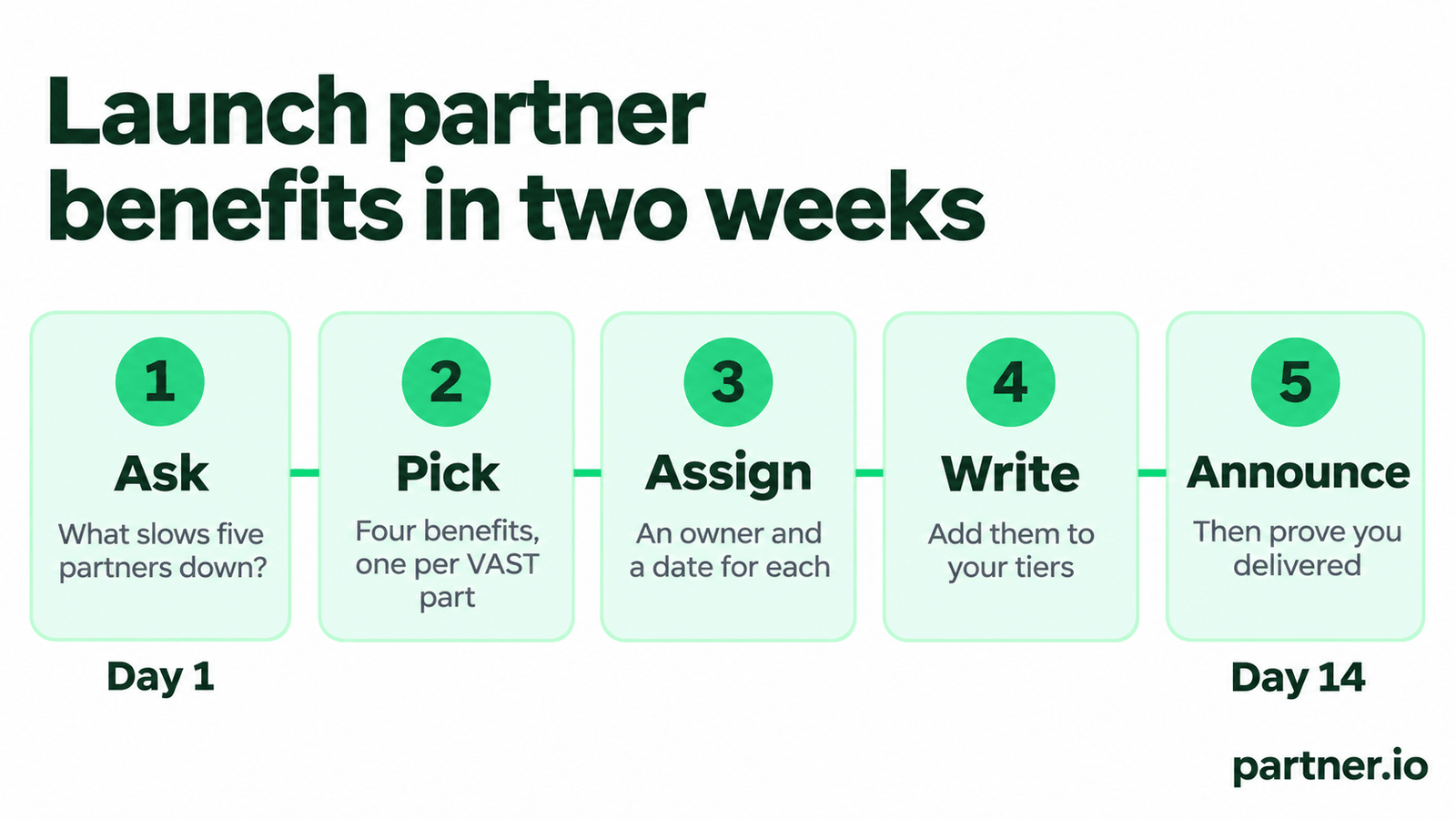
- Ask five partners what slows them down. Not what they want. You'll hear "leads" and "status updates" more than "a higher rate".
- Pick four benefits, one per VAST part. Twelve at once is a launch you won't finish.
- Assign an owner and a deadline to each. "Directory live by the 14th, owned by marketing" is a benefit. "We should do a directory" isn't.
- Write them into your tiers. Benefits that live in a slide get forgotten by February.
- Announce once, then prove it. Send one message listing the four benefits. Follow it a month later with what was delivered.
For the first-30-days version of this, see our partner onboarding guide.
What this looks like in the real world
Here's an illustrative example, not a customer story.
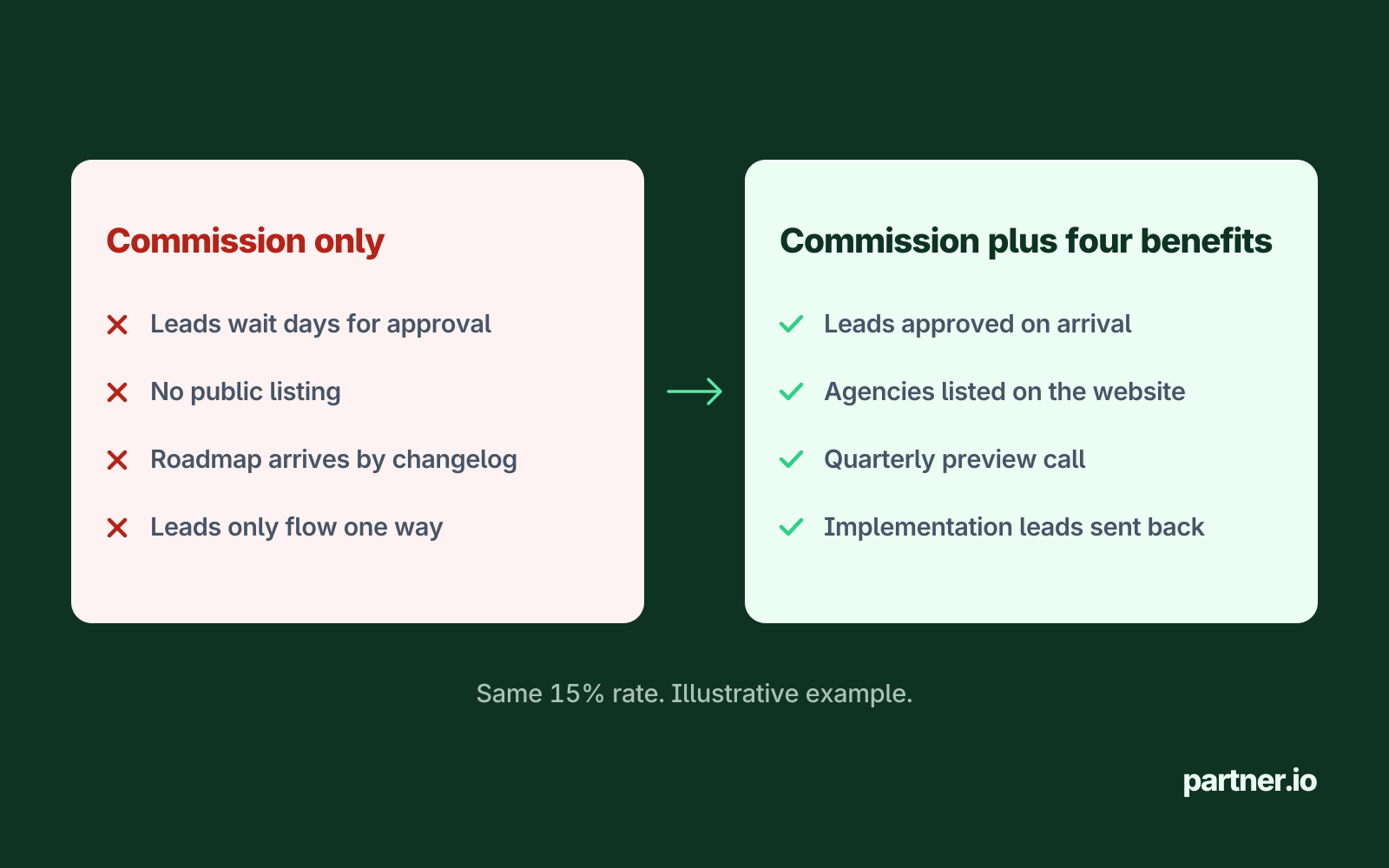
A 30-person SaaS company has 35 referral partners and 6 agencies on a flat 15% commission. Registrations have slowed. The partner manager asks for 20% and gets a no.
So they spend two weeks on four things instead.
Leads from partners with a signed agreement are approved on arrival.
The six agencies get a directory page on the website.
Top partners get a quarterly preview call.
Sales starts handing implementation requests to the agencies.
The rate never moves. What changes is the inbox: the "any update?" emails stop, because the tracker answers them, and two agencies send their first lead in months after receiving one.
Where Partner.io fits
Every benefit above is cheap to give and easy to drop. A directory in a Notion page goes stale. A "one working day" promise lasts until the person who made it goes on holiday. That's the argument in goodwill doesn't scale a partner program, and it applies doubly to benefits with no budget line to defend them.
We built Partner.io to be the best place to run them, and the count is the evidence: eleven of these twelve run inside it. The twelfth, demo access to your own product, is tracked there.
- Visibility: Spotlight profiles and the embeddable directory in the partner portal, verifiable certificates in training, badges and targeted announcements in the Engagement Hub.
- Access: events, newsletters and a Partner Room for previews, plus leads sent to partners through leads and deal registration.
- Speed: auto-approval for partners and leads in automation, and a deal tracker partners can read without emailing you.
- Trust: tiers, perks, commission and payouts that partners can see, in tiers, commissions and payouts.
The pricing fits the theme. Partners use the portal free, in unlimited numbers, and you pay per seat for your own team. Adding your 200th partner costs what adding your 20th did. See pricing for the detail.
If these benefits currently live across a spreadsheet, a shared drive and someone's memory, the hidden cost of managing partners in spreadsheets shows what that's costing you.
Stop asking for budget. Start with what you already own.
A higher rate is the benefit every competitor can match by Friday.
Your audience, your roadmap, your leads and a same-day answer are harder to copy, because they need a company that's organised enough to deliver them. Pick four. Put a name and a date on each. Tell your partners, then keep the promise where they can watch you do it.
Try Partner.io free for 7 days → No credit card, no setup fee, cancel anytime.
Prefer a walkthrough first? Book a demo and we'll map it to your program.
- [partner-led-growth]
- [prm]
- [partner-tiers]
Published November 12, 2026