
Ten partner tier structures, from flat rates to points, tracks and invite-only tiers, with real examples and a four-question test to pick the right one.
Your Partner Tier Structure Is Probably Copied From Someone Bigger
Most SaaS partner programs get their tiers the same way.
Someone opens a big vendor's partner page.
They see Silver, Gold and Platinum.
They swap in their own numbers and ship it.
Six months later, nobody has reached Gold. The agencies doing the real implementation work sit in Silver next to a consultant who sent one lead in March. Your best partner asks for a better rate, and you negotiate it in a Slack DM, outside the tiers you just published.
Your partner tier structure decides who gets your time, your money and your attention. Copy one built for 10,000 partners and you inherit rules written for problems you don't have.
There are at least ten ways to structure partner tiers. Here's each one, who runs it well, where it breaks, and a short test to pick yours.
"Tiers are big-company theatre. We should skip them."
That's the strongest objection, and it has evidence behind it.
Techaisle's 2026 survey of 5,450 channel partner firms found that 65% of partners can't see how their tier score is calculated.
The gap by size is worse. Only 2.4% of partners under $10M in revenue hold the top tier in their main vendor program. For partners above $500M, it's 41%.
“Most partners are scored by a system they do not actively manage, and that system is moving incentive money toward the largest firms.
”
So tiers can punish the small, fast-moving partners a young SaaS company needs most.
But skipping structure entirely doesn't fix that. It just moves tiering into your head. You still give your best agency more time, faster approvals and the odd bonus. You just do it without rules that partners can see.
Forrester's Stephanie Sissler makes the same point in her piece on whether to tier at all:
“it is unwise and unrealistic to support all partners in your ecosystem equally.
”
The question isn't whether to tier. It's which structure your partners can understand, and which one rewards the behaviour you need right now.
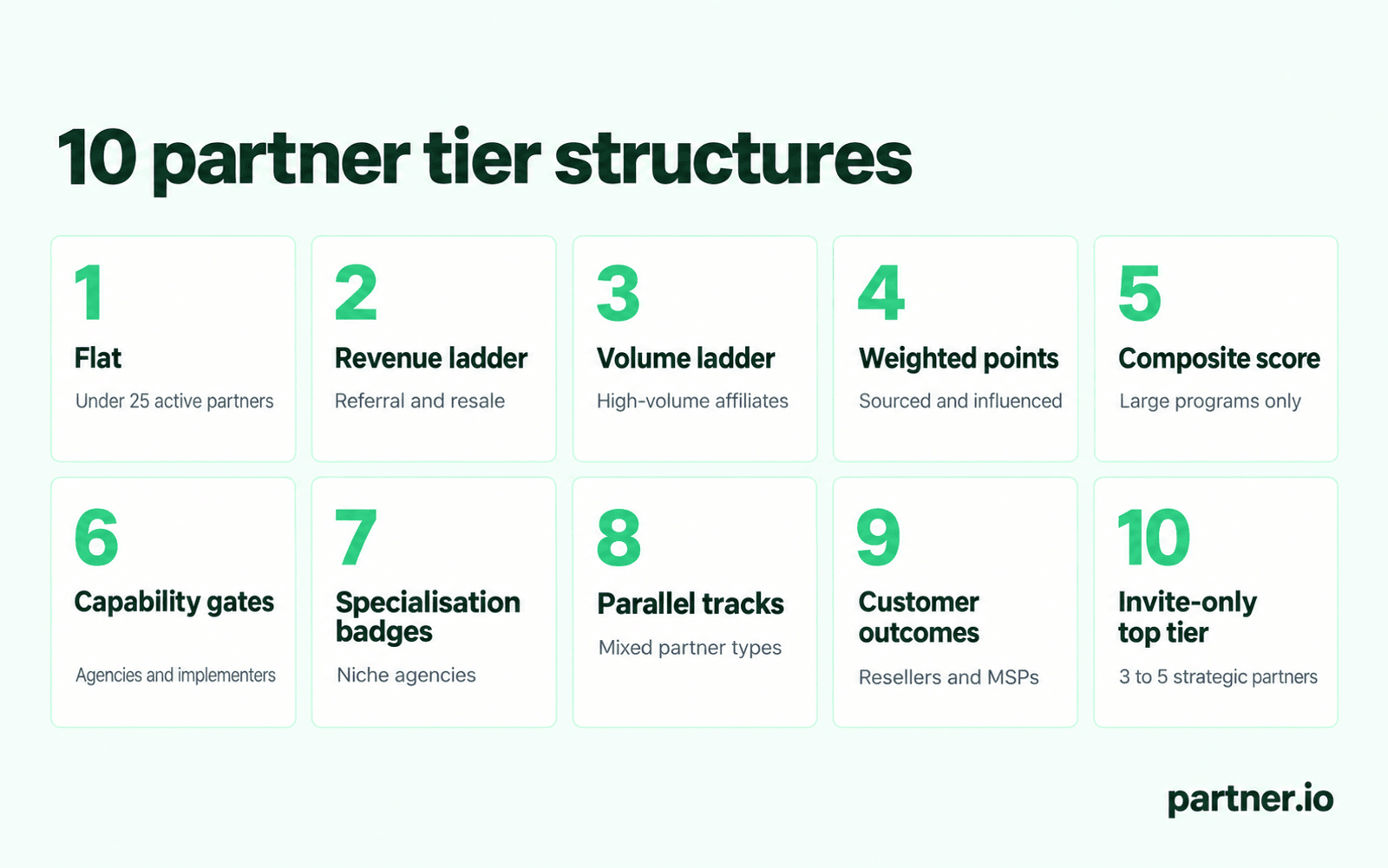
The 10 partner tier structures
Each structure below covers how it works, a real example where one exists, who it fits and where it breaks. Several can be combined, and most good programs end up running two.
1. Flat: one rate, no tiers
Every partner gets the same commission and the same support. No levels, no reviews.
Cisco went partway here in 2026. Its partner designations FAQ says all previous partner levels were retired on January 24, 2026, and every enrolled company is now a registered Cisco Partner, with designations earned on top.
Fits: fewer than about 25 active partners, or a program in its first year. You can manage each relationship by hand, and you don't yet know which behaviour predicts revenue.
Breaks when: your top five partners start asking for exceptions. That's your signal to add a second level.
2. The revenue ladder (Registered, Silver, Gold)
The classic. Partners move up by sourcing more revenue over a trailing twelve months, and each level pays a higher rate.
It's still the default. Forrester found tiers are used by 98% of the top IT partner programs, with an average of three levels, and revenue is still the main criterion for moving up. Atlassian's Marketplace Partner Program runs a clean version: Silver, Gold and Platinum at $150K, $750K and $3M of annual cloud sales.
Fits: referral and reseller programs where sourced revenue is easy to attribute and is the one thing you want more of.
Breaks when: your partners create value that never shows up as sourced revenue, such as implementation, retention or influence on deals your sales team sourced. Sissler's point holds here too: revenue is a lagging indicator. Our partner program tiers guide has a full three-level matrix if this is your model.
3. The volume commission ladder
The rate steps up with volume inside a period, then resets. There is no status to keep, just a better rate this month for more deals this month.
SiteGround's affiliate program is a clear public example. It pays £30 per sale for 1 to 5 sales a month, £50 for 6 to 10 and up to £65 for 11 to 20. Above that, it's a custom deal.
Fits: self-serve referral and affiliate partners with many small deals and short sales cycles.
Breaks when: deals are large and lumpy. A partner who closes one $40,000 deal a quarter never climbs a monthly ladder.
4. Weighted points
Partners earn points for different kinds of contribution, weighted by how much you value each one. Tiers are set by point totals.
HubSpot's Solutions Partner Program is the best-known example. Per HubSpot's tier rules, partners earn 5 points per $100 of MRR they source, 3 per $100 they assist and 1 per $100 they manage.
Fits: programs where partners both source and influence deals, and you want to reward both without pretending they're worth the same.
Breaks when: the weights are hidden or change every year. Partners stop chasing a number they can't calculate.
5. The composite score
A step beyond points. Partners are scored across several categories, and they must clear a threshold overall and a minimum in each category.
Microsoft's partner capability score runs to 100 points per solution area across performance, skilling and customer success. A partner needs at least 70, and every metric must be above zero.
Fits: large programs with lots of data and a team to run it. Very few SaaS companies under $25M ARR are that.
Breaks when: partners can't see the inputs. That's exactly the Techaisle finding above: only 24% of partners actively manage to these scores.
6. Capability gates
Levels need proof of skill as well as results: certified people, completed implementations or launched customers.
The AWS Services Path works this way. Select needs 3 launched opportunities and $1,500 in monthly recurring revenue. Premier needs 50 launched opportunities, $50,000 MRR and 25 technical certifications.
Fits: agency, implementation and reseller partners, where a badly delivered rollout costs you the customer.
Breaks when: certification is busywork. If your course takes four hours and nobody's deliveries improve, partners will see it as a toll booth.
7. Specialisation badges
Not a ladder at all. Partners earn badges for depth in a use case, industry or product area, and the badges sit alongside, or instead of, levels.
Google Cloud's new partner network replaces specialisations with competencies that run independently of its Select, Premier and Diamond tiers. Partners like the idea too: asked to design a tier system from scratch, 30% of partners in the Techaisle survey chose tiers by specialisation.
Fits: agencies and consultancies that serve different niches. A badge that says "fintech onboarding" helps a partner win clients in a way "Gold" never will.
Breaks when: you hand out a badge for every niche. Twelve badges with two partners each is a directory, not a program.
8. Parallel tracks by partner type
Separate ladders for separate partner types: one for referral partners, one for agencies, one for integration partners. Each track measures what that type actually does.
AWS splits partners into paths, with the Services Path above as one of them.
Fits: any program with more than one partner motion, which is most programs past their first year. A referral consultant and an implementation agency should never compete for the same tier.
Breaks when: you build five tracks for a 40-partner program. Start with two.
9. Customer outcome tiers
Partners move up on what happens after the sale: retention, expansion or customer satisfaction for the accounts they brought or manage.
HubSpot's top two tiers need an average gross revenue retention of at least 75% and 80%. Salesforce's 2026 program overhaul moved its consulting partners to two tiers, Summit and Select, and tied recognition to project outcomes, CSAT and certifications.
Fits: resellers, MSPs and agencies who own or run the customer relationship, where churn is partly their fault and partly their win.
Breaks when: you can't measure retention per partner. If renewals aren't tied to partner records in your CRM, you'll be arguing about it every review.
10. The invite-only top tier
The top level isn't earned by formula. You pick a handful of partners and invest in them.
Stripe's partner program for platforms states plainly that its Premier Partner tier is invite-only. HubSpot's Elite tier also needs an invitation on top of its point and retention thresholds.
Fits: when three to five partners carry a large share of your partner revenue and need a joint plan, a named partner manager and roadmap access.
Breaks when: the invitation criteria are a secret. Write down what earns a conversation, even if the final decision is yours.
The PACE test: which partner tier structure fits your program
Ten options is too many to weigh by gut. The PACE test narrows it to two or three in about ten minutes. Answer four questions in order.
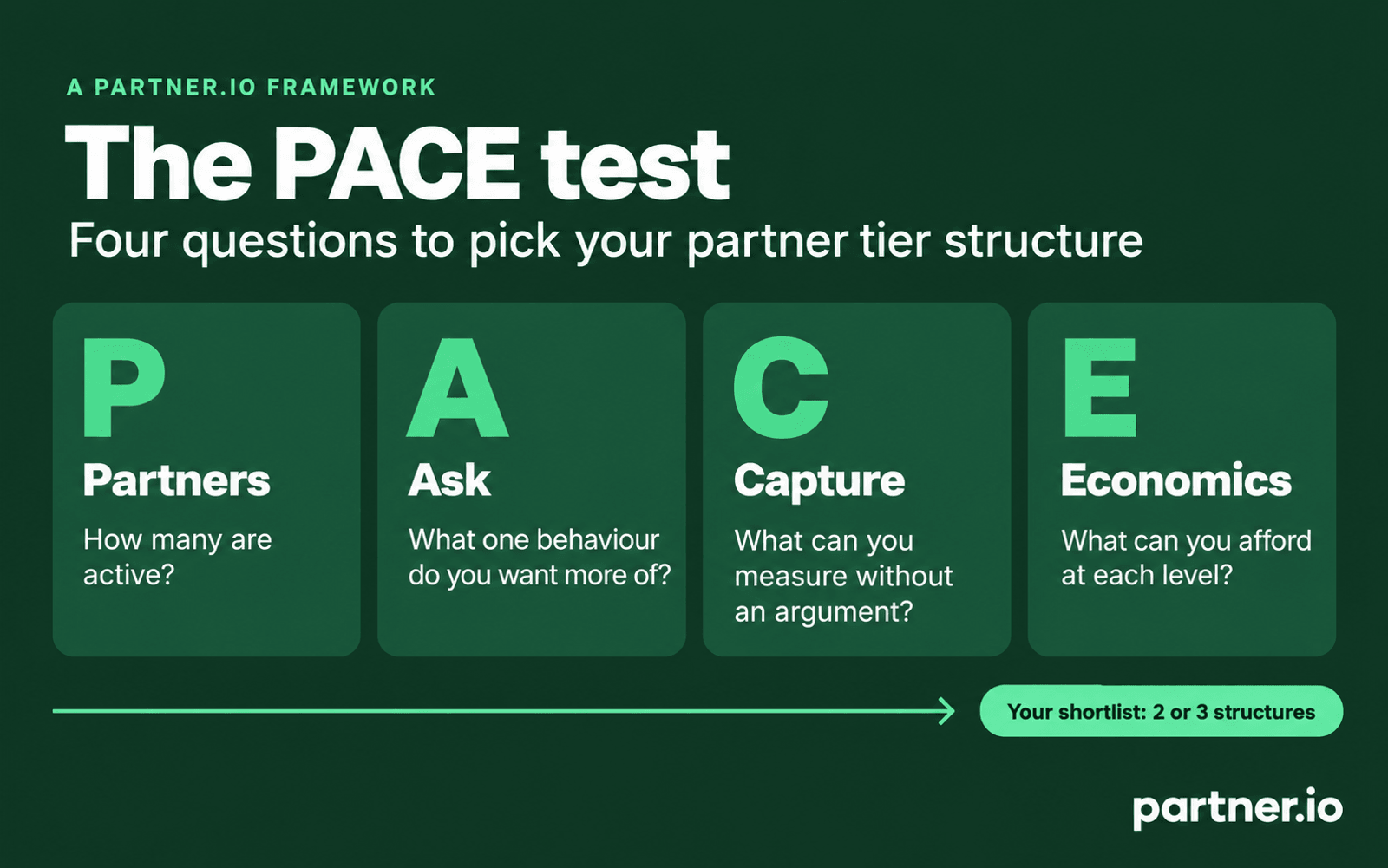
P: Partners. How many are active?
Count partners who registered a deal or completed training in the last six months. Ignore everyone else.
Under about 25 active partners, go flat (1) or flat plus an invite-only tier (10). Above that, keep going.
A: Ask. What one behaviour do you want more of?
Sourced deals point to the revenue ladder (2) or volume ladder (3). Better delivery points to capability gates (6) or outcome tiers (9). A mix of sourcing and influence points to weighted points (4). Depth in a niche points to specialisation badges (7).
If you run more than one partner type, answer this once per type. Different answers mean you need parallel tracks (8). If you can't name one behaviour at all, you're not ready to tier.
C: Capture. What can you measure without an argument?
Only build tiers on data you already capture per partner. If deal registration lives in email, sourced revenue isn't measurable yet. If courses live in a Google Doc, certifications aren't either.
Partners need to see their own numbers too. A tier they can't track is a tier they'll ignore, which is why a composite score (5) rarely passes this step under $25M ARR.
E: Economics. What can you afford to give at each level?
Rate increases scale with revenue, so they're safe at every level. Partner manager time, marketing funds and leads from your team are fixed costs, so keep them for the top. Our guide to setting referral fee percentages covers the rate side.
“A tier you can't measure, explain or pay for is a promise you'll break at the first review.
”
Want to build your tiers in a real portal? Try Partner.io free for 7 days, no credit card needed.
Simple vs precise: the trade-off you're choosing
Every structure trades simplicity against precision. Partners reward simplicity. In the Techaisle survey, 71% of partners named simplicity as the first place programs fall short. Asked to design tiers from scratch, only 19% chose an index.
| Structure | Easy to explain | Rewards non-revenue work |
|---|---|---|
| Flat or volume ladder | Yes | No |
| Revenue ladder | Yes | No |
| Points or outcomes | Mostly | Yes |
| Composite score | No | Yes |
If you have to pick, pick the structure your partners can explain to each other.
How to roll out a new tier structure in 30 days
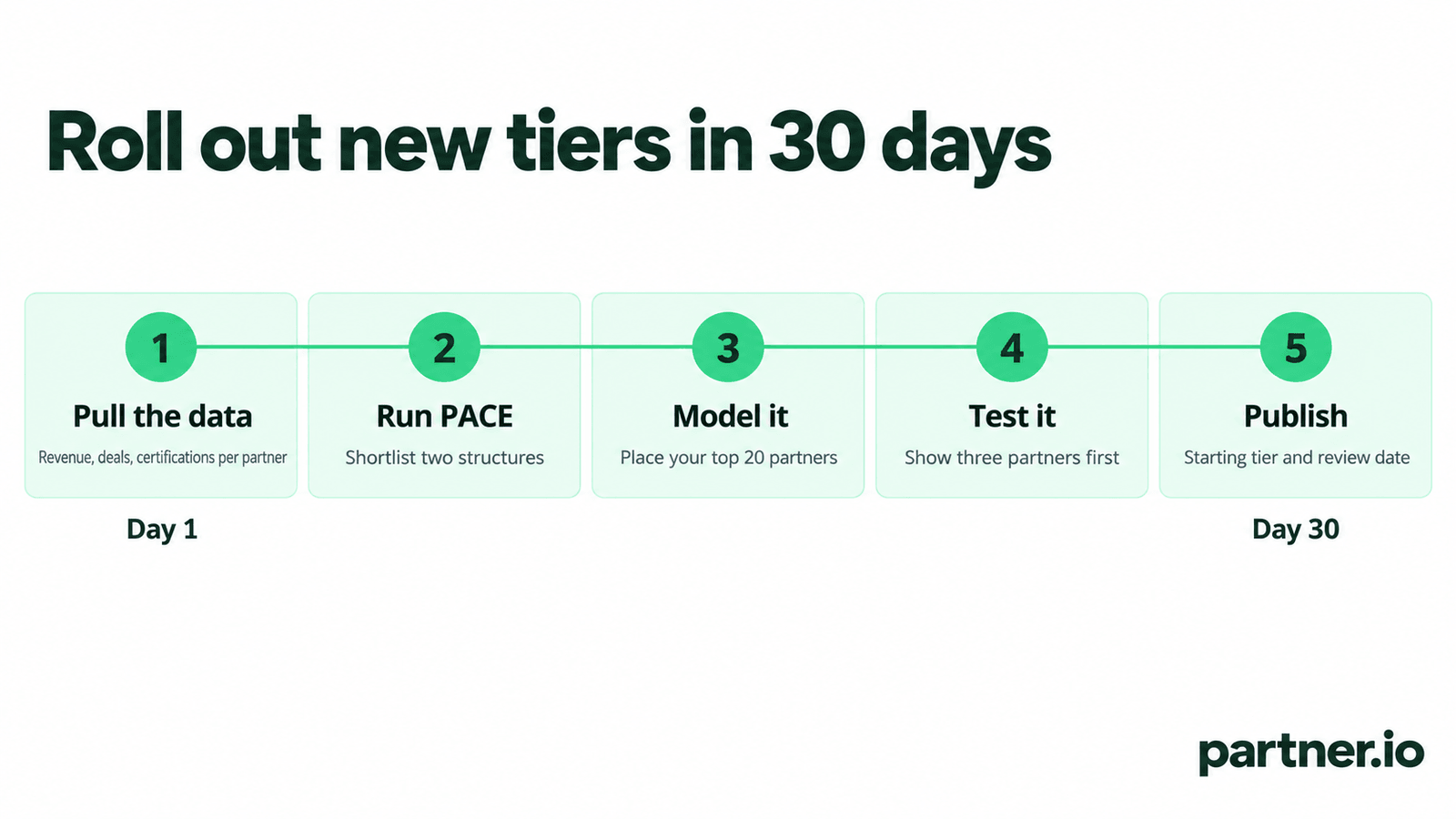
- Pull last year's partner data. Sourced revenue, deals, certifications and retention per partner, from your CRM and PRM.
- Run the PACE test. Shortlist two structures and draft both with real thresholds.
- Model it on real partners. Put your current top 20 partners into each draft. If your best agency lands in the bottom tier, the structure is wrong, not the agency.
- Show three partners first. Pick one top partner, one mid-tier and one new partner, and ask what they'd change.
- Publish with a review date. Tell every partner their starting tier, what it takes to move up and when the next review happens.
Our partner scorecard template gives you a quarterly review sheet for whichever structure you choose.
What this looks like in the real world
Here's an illustrative example, not a customer story.
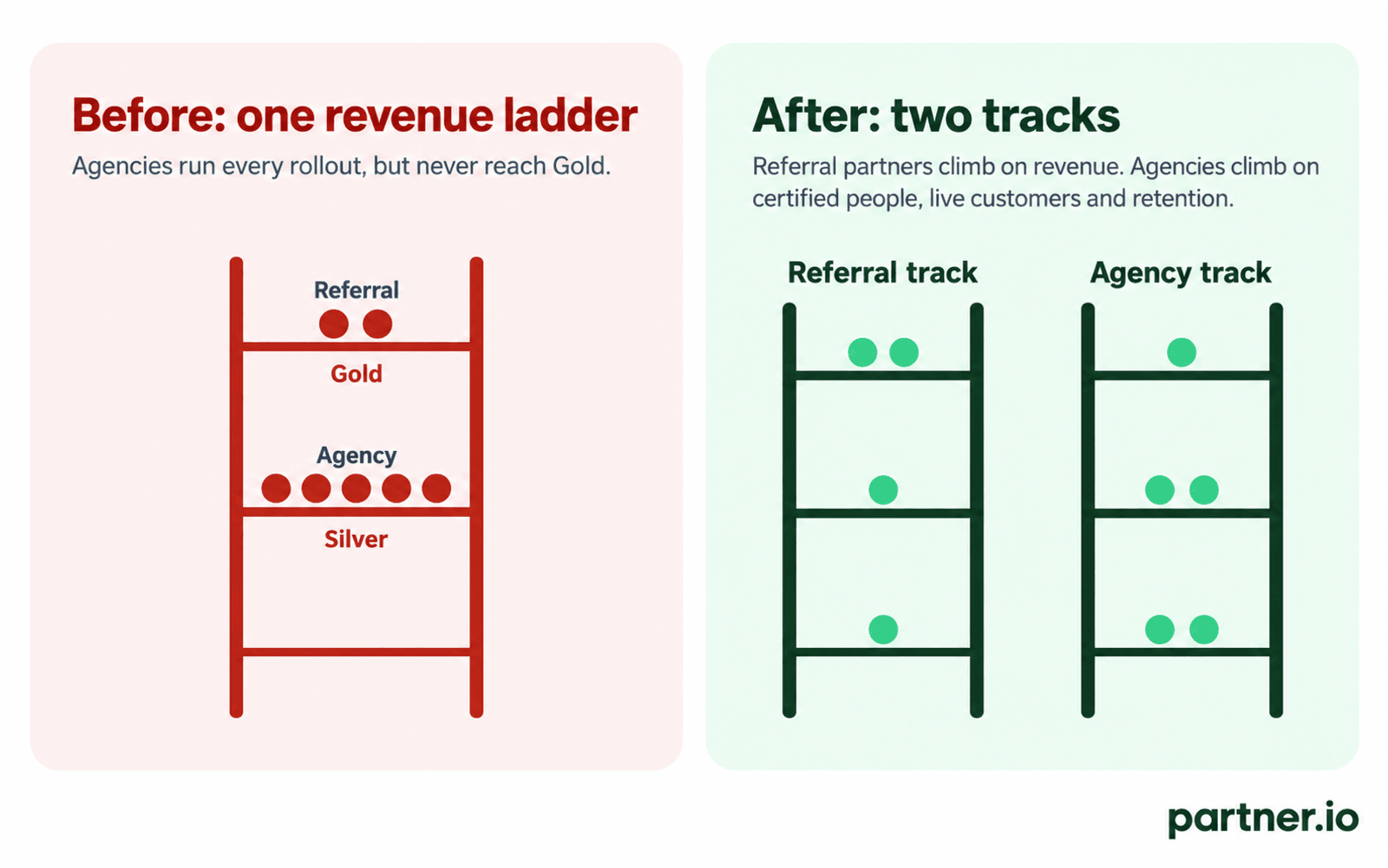
A 45-person SaaS company runs a three-level revenue ladder with 60 partners: 40 referral consultants, 15 implementation agencies and 5 integration partners.
After a year, the Gold tier holds two referral consultants. The agencies, who run every enterprise rollout, are all in Silver, because the deals they deliver were sourced by the sales team. Two of them start recommending a competitor whose program pays for implementation.
The fix takes one quarter. The company splits into two tracks (structure 8). Referral partners keep the revenue ladder. Agencies get a capability-gated track (structure 6), with levels based on certified consultants and live customers, plus a retention requirement at the top (structure 9).
The tiers didn't get more complicated for any one partner. Each partner now sees a ladder that matches their work.
Where Partner.io fits
Most tier structures fail in the running, not the design. Someone has to track each partner's numbers, apply the right rate and tell the partner where they stand.
In Partner.io, tiers, commissions and payouts are built from perks. Each perk is a trigger, such as a payment recorded, a lead approved or a course passed, plus a reward, such as a commission rate, a cash bonus or a badge. Conditions narrow when a perk applies, using deal value, partner type, partner score or courses completed.
That covers most of the ten structures:
- Parallel tracks (8): set a default tier per partner type, so new agencies and referral partners start on the right ladder.
- Capability gates and badges (6, 7): training and certification lets partners pass courses that fire perks and earn badges with verifiable certificates.
- Visibility for partners: the partner portal shows each partner their tier, perks, leads, revenue and commission, so nobody manages to a number they can't see.
- Sourced revenue you can trust: leads and deal registration syncs partner-referred deals with your CRM, which is what any revenue ladder runs on.
- Reviews that happen: automation flows can branch on partner score or total leads and create a review task for your team, and you can move partners between tiers individually or in bulk.
For more on rewards beyond commission, read how Partner.io handles partner rewards. If your partners currently live in a spreadsheet, the hidden cost of managing partners in spreadsheets explains why tiers rarely survive there.
Pick the structure your partners can explain
There's no best partner tier structure. There's the one that fits how many partners you have, what you need from them, what you can measure and what you can pay for.
Start simpler than feels right. A flat rate with one invite-only tier is a real program. So is two tracks with three levels each. You can add precision later, once you know which partner behaviours actually drive revenue and your best partners have told you what they need, as covered in the biggest mistake SaaS companies make with partnerships.
What you can't do is run tiers nobody can see.
Try Partner.io free for 7 days → No credit card, no setup fee, cancel anytime.
Prefer a walkthrough first? Book a demo and we'll map it to your program.
- [partner-led-growth]
- [prm]
Published October 19, 2026