
Most SaaS partnerships are designed around the vendor's pipeline, not the partner's business. Here's why that fails, and how to build a program partners want to sell.
The Biggest Mistake in SaaS Partnerships Is Asking the Wrong Question
Every partner program starts with the same question: what can partners send us?
It sounds reasonable. It's also the reason most programs stall.
Your partners don't wake up thinking about your pipeline. They run agencies, consultancies, software companies and resellers. They have payroll, clients and their own targets. They'll recommend you when it makes their business better, and not one day sooner.
The biggest mistake in SaaS partnerships isn't a missing portal, a low commission or a weak partner page. It's designing the whole program around what you want from partners, instead of what partners get from you.
Flip that one question, and most of the other problems get smaller.
Partners don't work for you. They work for their clients.
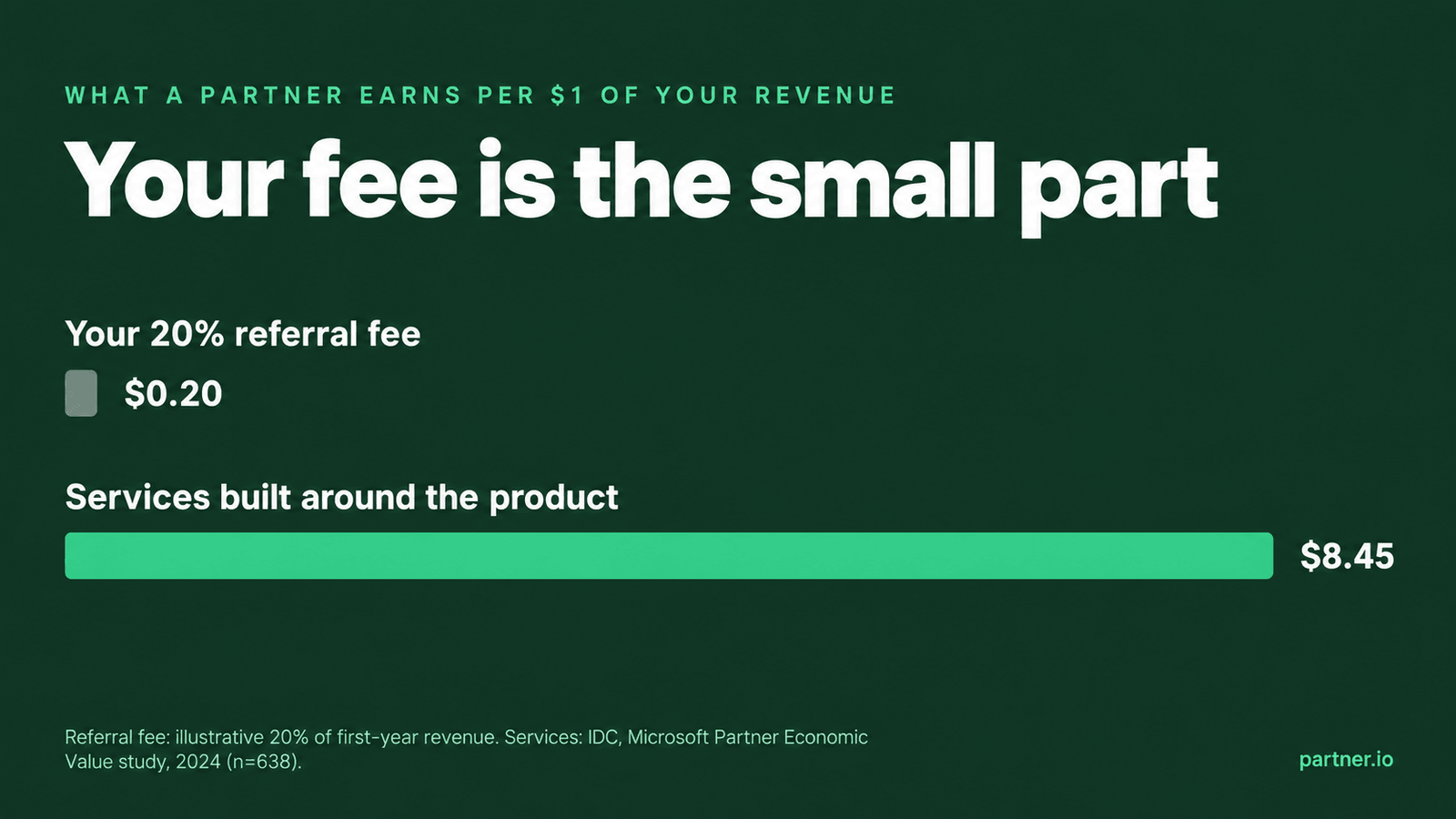
Here's what most partner programs miss: for the partners who matter, your referral fee is a rounding error.
IDC surveyed 638 Microsoft partners for a 2024 study of partner economics. The multiplier it found is the whole story:
“For every $1 of Microsoft revenue, partners who provide services generate $8.45 and partners who develop software generate $10.93.
”
Salesforce tells a similar story. An IDC study it sponsored forecast that its partner ecosystem would earn $6.19 for every $1 Salesforce makes by 2026.
Those partners aren't living on referral fees. They're building implementation projects, managed services, integrations and retainers around the product. The vendor is an ingredient in their business.
Your company is not Microsoft. But the principle scales all the way down: a partner's interest in you is set by what you do for their own revenue, clients and reputation.
"Then we'll just pay a bigger commission"
This is the instinct, and it's the strongest objection. Money motivates people. Raise the fee and referrals will follow.
Sometimes they do, for a while. Usually they don't, and the maths shows why.
Say your average deal is $12,000 a year and you pay a 20% referral fee. That's $2,400 to the partner, once.
Now say that same partner is an agency, and the client rollout around your product is a $25,000 project, followed by a monthly retainer to run it. The referral fee is less than a tenth of what the relationship is worth to them.
Doubling the commission doesn't change their decision. Making the project easier to win and deliver does.
Commission still matters. It's a thank-you, a tie-breaker and a signal that you take partners seriously (here's how Partner.io handles partner rewards beyond cash). It just isn't the reason a good partner puts their name behind you.
You're too small for a partner practice. Good.
A common reply: "That's fine for Microsoft. No agency is going to build a practice around a 40-person SaaS company."
True. They won't. So don't ask them to.
Ask a different question: whose existing business does your product make better?
The HubSpot agency doesn't need a new practice. It needs its retainers to stick, so a tool that makes its clients' reporting look good is worth recommending.
The fractional CFO doesn't need commission. They need to look sharp in front of a client, so a tool that closes the books faster makes them look good.
The integration partner doesn't need your referral fee. It needs its own customers to churn less, and a working integration with you might do that.
Small SaaS companies win partners by being an ingredient, not a practice. You slot into something the partner already sells, and make it better.
What each partner actually earns from you
Different partners get paid in different currencies. Most programs offer one currency (commission) to everyone, then wonder why only a few partners engage.
Referral consultants and advisors
What they earn: credibility with clients, plus occasional referral fees.
What they need from you: a product that won't embarrass them, fast follow-up on every intro, and a clear picture of what happened.
Implementation agencies
What they earn: project fees and retainers around your product.
What they need: training so they can deliver well, early access to deals they can attach services to, and a reason clients keep paying them.
Integration and technology partners
What they earn: retention and expansion in their own customer base.
What they need: a reliable integration, co-marketing to shared customers and a clean way to pass deals in both directions.
Resellers and MSPs
What they earn: margin and recurring management fees.
What they need: predictable pricing, protected deals and billing that doesn't create work for them.
Customers who refer
What they earn: credit, status and the satisfaction of being right.
What they need: a referral link that works and a reward that arrives without chasing.
Omdia's Jay McBain and Lisa Lawson describe what service partners actually do for SaaS vendors in their analysis of the top business SaaS ecosystems: they "fill implementation and resource gaps, bring vertical and domain expertise, drive business KPIs, and improve retention." That's a description of the partner's business, not yours.
Fixing the biggest SaaS partnerships mistake: the Partner P&L
If the mistake is building from your side, the fix is a simple exercise from theirs. Before you design tiers, write the program brief or buy any software, draft a Partner P&L for each partner type.
It has four lines.
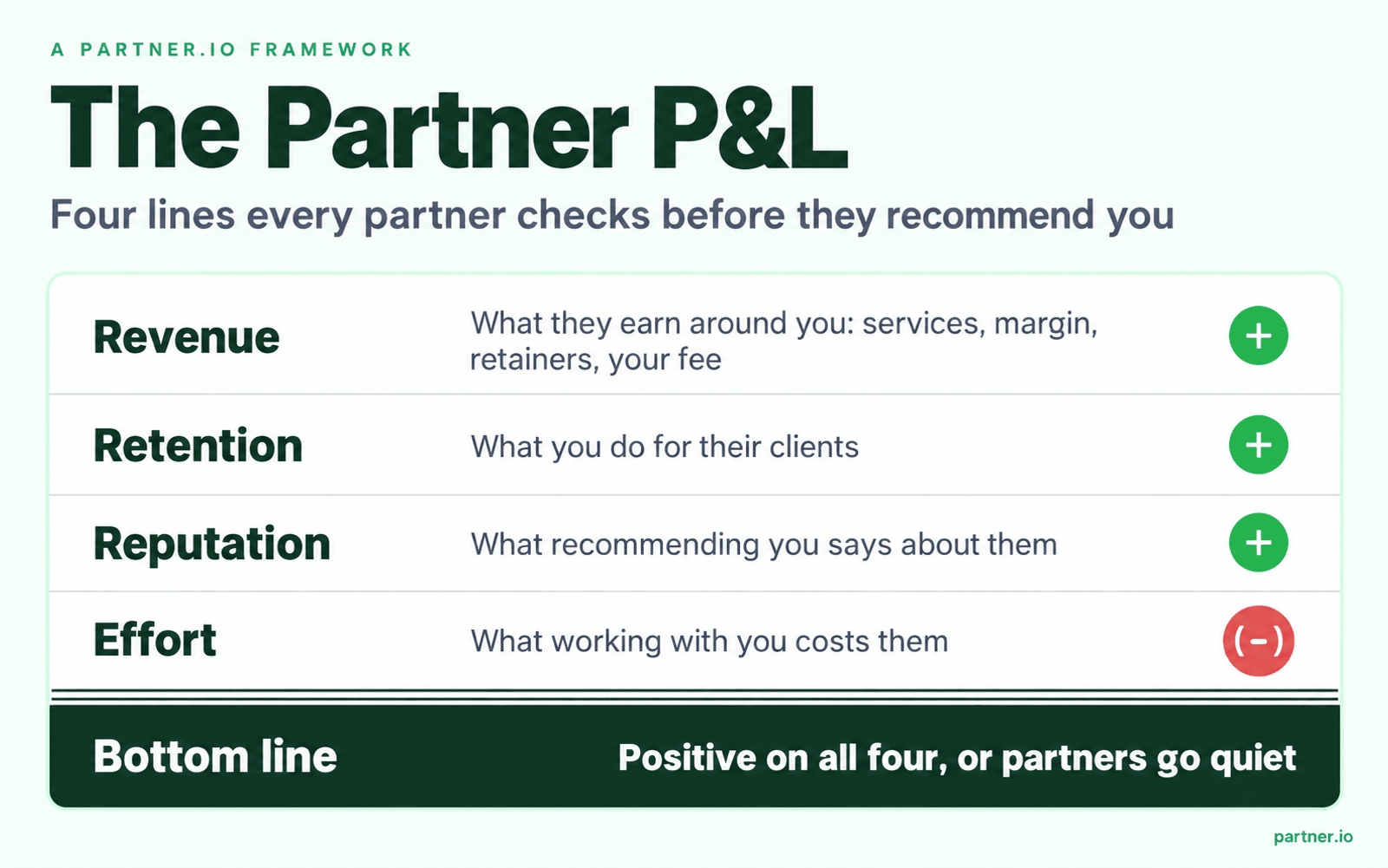
Revenue: what they earn around you
Not just your commission. Include services, margin, retainers and expansion. If you can't name a revenue line beyond your referral fee, expect referrals to stay occasional.
Retention: what you do for their clients
Does your product keep their clients happier, longer? For agencies and integration partners, this line is often worth more than revenue.
Reputation: what recommending you says about them
Every intro is a bet with the partner's name on it. Slow follow-up, a botched onboarding or a surprise price rise costs them more than it costs you.
Effort: what working with you costs them
Time to learn the product, register a deal, chase an update and get paid. Every hour here is a cost on their P&L. Most programs never count it.
A partner program is healthy when all four lines come out positive for the partner. If one is negative, that's the line to fix first, before you recruit anyone else.
“Partners don't join your program. They add you to their business. Make sure you improve it.
”
Want to cut the Effort line for your partners? Try Partner.io free for 7 days, no credit card needed.
How to rebuild a program from the partner's side
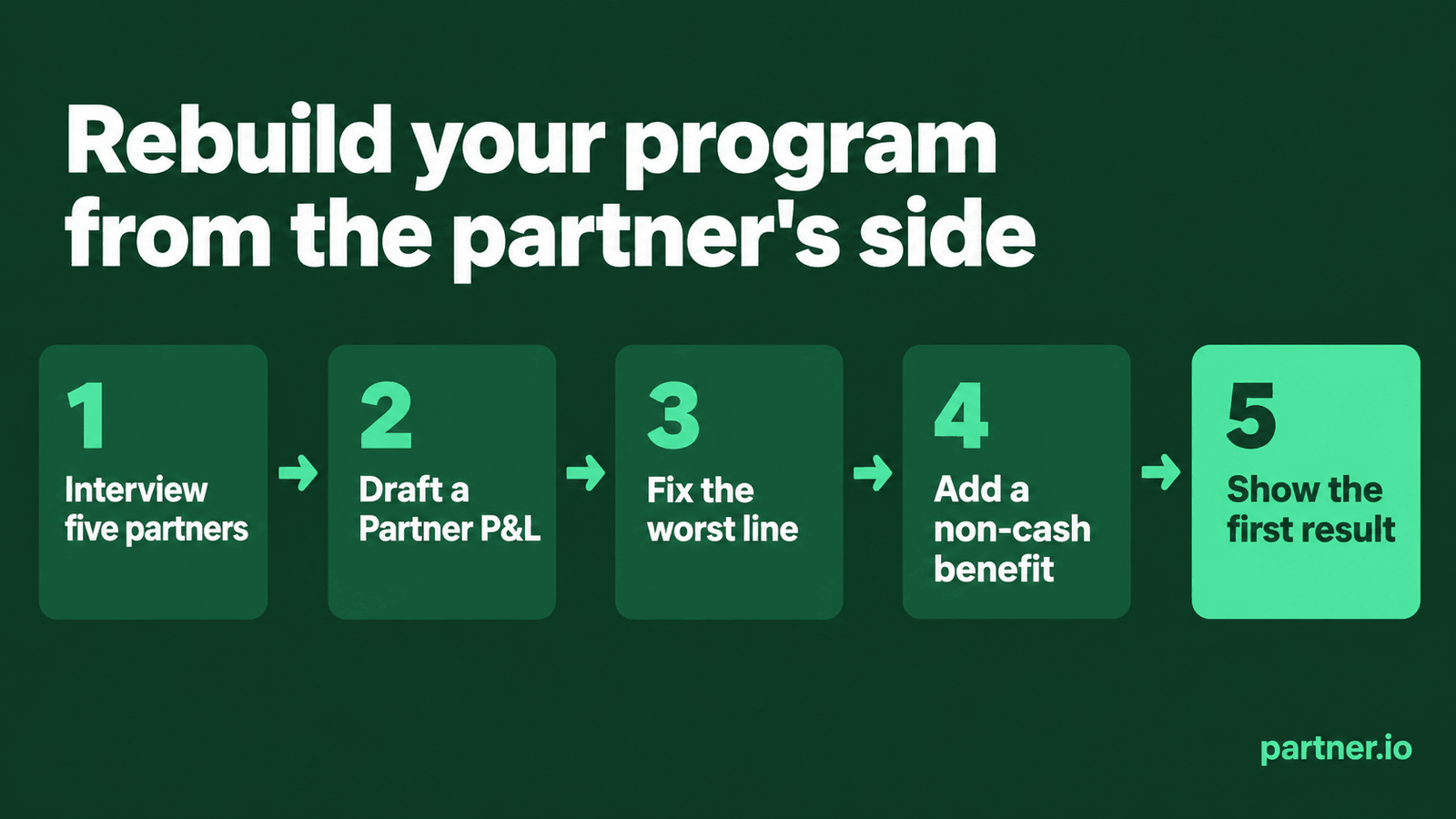
You don't need to start again. You need five conversations and one change.
- Interview five active partners about their business, not yours. Ask how they make money, what their clients complain about and where you fit.
- Draft a Partner P&L for each partner type using what they told you. Mark every line as positive, neutral or negative.
- Fix the worst negative line first. Usually it's Effort (deals vanish into the CRM) or Reputation (slow follow-up on intros).
- Add one benefit that isn't commission. Training they can use with clients, early access to deals, co-marketing to shared customers.
- Tell partners what changed, and show them the first result: a deal they can track, or a payout that arrived on time.
Here's the decision rule. If a partner's P&L has no revenue line beyond your commission, treat them as an occasional referrer: keep it light, pay fast and don't invest in tiers. If they earn services or retention around you, they're a core partner. Train them, share deals with them and build the program around their success.
The trade-off: designing for each partner type takes more work than one generic program. You'll run two or three tracks instead of one. In return, you stop paying for a partner list that never sends anything.
What this looks like in the real world
Here's an illustrative example of a pattern we see often.
A 45-person SaaS company sells customer success software. It launches a partner program with a 25% referral fee, a partner page and a form. Fifty agencies sign up. Four send a deal in the first two quarters.
The team runs five partner interviews. Every agency says the same thing: they don't need the fee, they need to know how to implement the product without calling support, and they want to be first in line when a client asks for help.
So the program changes. Agencies get a certification course, a listing on the company's site and early notice when a new customer in their region signs up without an implementation partner. The referral fee stays, but nobody talks about it much.
Two quarters later, eleven agencies are active. The deals they register are bigger, because they arrive with an implementation plan attached.
Nothing about the commission changed. The program finally showed up on the partner's P&L.
Built around your pipeline vs built around their business
Put the two approaches side by side and the difference shows up in every part of the program.
A pipeline-first program asks partners to fill in a form and hope. A partner-first program shows them the deal, trains them to deliver and pays them on time.
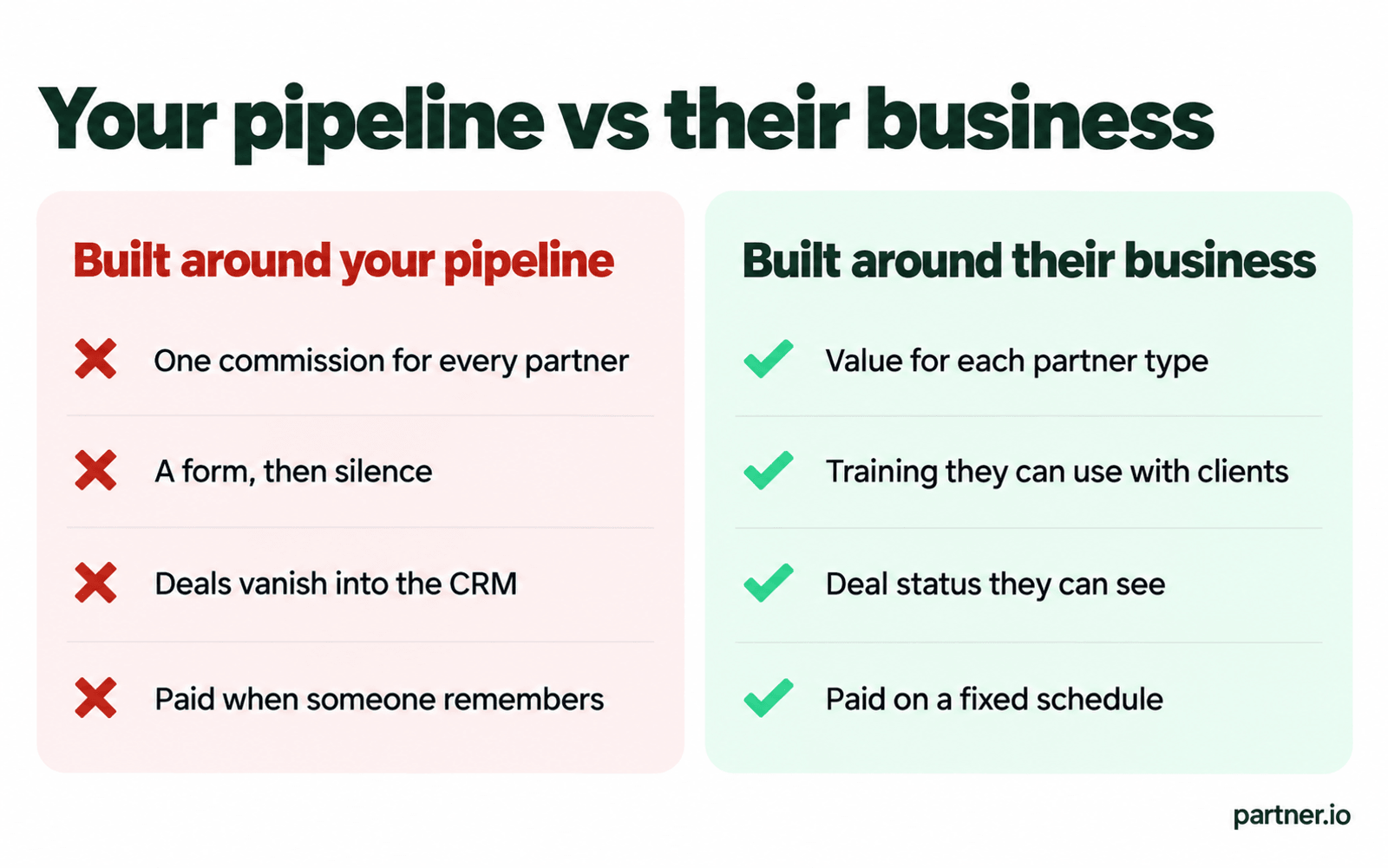
The first one is cheaper to launch. The second is the one partners keep using.
When it breaks
Why this matters more now
Partners aren't a side channel anymore. Forrester's Kathy Contreras, in the State of Partner Ecosystems 2025, put the shift plainly:
“Partners are playing a more strategic role in shaping and assisting B2B customer decisions.
”
When partners shape the decision, the vendors they recommend are the ones that make the partner look good, earn them money and don't waste their time. The rest get a polite "we'll keep you in mind."
Where Partner.io fits
You can't change the partner's business for them. But you can make sure your side of their P&L is positive. Each line maps to something in Partner.io:
- Revenue: commissions and payouts with tiers, perks and Stripe payouts and no platform fee, plus Deal Surround and Partner Discovery to bring the right partner into deals they can attach services to.
- Retention: training and certification, so partners deliver your product well and their clients stay.
- Reputation: deal registration syncs every intro to your CRM with the partner attached, and automation handles approvals and follow-ups so no intro goes cold.
- Effort: a branded partner portal where partners register deals, see status and get paid without chasing anyone.
If you're still sorting out the basics, the difference between having partners and running a partner program is a good place to start. Why most teams fail at partner-led growth covers the activation problem, and why partnerships collapse without internal alignment covers the internal side.
Before you recruit another partner
- Ask five current partners how they make money, and write down the answers.
- Draft a Partner P&L for each partner type you have.
- Find the line that's negative for most partners, and fix it first.
- Add one benefit that isn't commission.
- Check how long it takes to follow up on a partner intro, and cut it.
- Check how long it takes to pay a partner after close, and cut that too.
Start from their side
The question that breaks most partner programs is "what can partners send us?"
The one that fixes them is "what does working with us do for their business?"
Answer it honestly, for each kind of partner you have. Then build a program that makes the answer obvious.
Try Partner.io free for 7 days → No credit card, no setup fee, cancel anytime.
Prefer a walkthrough first? Book a demo and we'll map it to your program.
- [partner-led-growth]
- [prm]
Published October 15, 2026