
Goodwill gets a partner program started. It can't scale one. How to turn one person's partner relationships into promises every partner can rely on.
Goodwill Doesn't Scale a Partner Program. Systems Do.
Your best partner manager just handed in their notice.
Think about what walks out with them.
The agency owner's mobile number.
The 25% you agreed on that one big deal, over coffee.
An unwritten rule: the fintech consultancy sees fintech leads first.
Why three partners still answer your emails.
None of it is in your CRM. All of it was holding your program together.
That's the problem with goodwill. It works, until the person carrying it leaves, gets busy or simply runs out of hours. If you want to scale a partner program, the trust partners place in one person has to move into something that outlasts them.
Every early partner program runs on goodwill
That's not a criticism. It's how programs start.
The first ten partners join because they like someone at your company. Deals get protected because that person remembers who introduced whom. Commissions get paid because someone checks a spreadsheet on the last Friday of the month. When something goes wrong, a phone call fixes it.
At ten partners, that's fine. At sixty, it quietly breaks.
There's a ceiling on how many relationships one person can hold. The anthropologist Robin Dunbar put the number of stable relationships people can maintain at once at around 150, and that covers their whole life, not just your partner list. Your partner manager also has an AE team to support, finance to chase and a boss to report to.
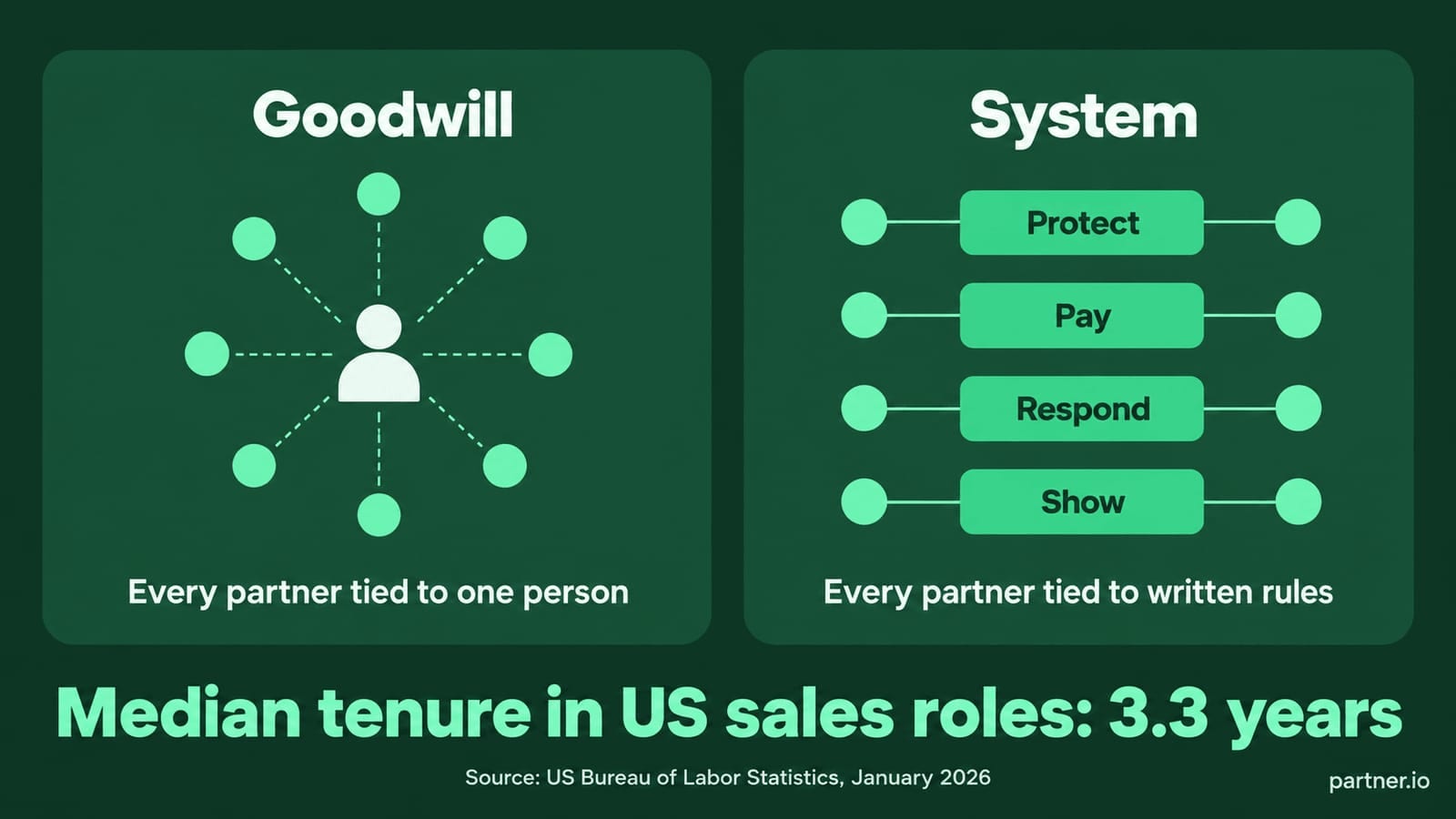
People also move on. The US Bureau of Labor Statistics puts median tenure in sales and related occupations at 3.3 years in January 2026.
Your partner program should outlive at least one partner manager. If it can't, you don't have a program. You have a person.
"But partnerships are a relationship business"
They are. That's the strongest objection to everything in this post, and it's half right.
Partners refer you because they trust you. Clients buy because someone they trust vouched for you. Jay McBain, the channel analyst, describes the modern buying group as the customer surrounded by "the seven people they trust". No workflow replaces that.
Here's the half that's wrong: the belief that systems make partnerships cold.
Partners don't trust you because your partner manager is charming. They trust you because what you said would happen, happened.
Their deal stayed theirs.
The commission arrived on the date you said.
Someone answered within a day.
Techaisle's 2026 survey of 5,450 partner firms found 78% rate predictability as critical or very important. One line from that report should be on every partner team's wall:
“Partners will accept thinner margins in exchange for rules that hold for a year.
”
Goodwill feels like trust. Predictability is trust. Systems are how you make predictability survive a resignation, a busy quarter or a doubling of your partner count.
Where goodwill breaks first
Goodwill doesn't fail in one dramatic moment. It leaks in four places.
Favours become precedents
A top agency asks for 30% instead of 20% on a big deal. Your partner manager says yes, because the relationship matters.
Two months later, another agency hears about it at a conference. Now you have a choice: grant it again and blow up your commission model, or say no and explain why one partner gets a better deal. Either way, a favour just became a policy nobody wrote down.
Goodwill gets spent on admin
Every "any update on that referral?" message costs a little goodwill. So does every late commission and every invoice chased by email.
Partners notice. In the same Techaisle survey, manual and slow administration was the most common partner-experience shortfall, at 67%. Jay McBain saw it years earlier as a Forrester analyst. In a post on channel automation, he wrote that for most vendors:
“many of their basic program and channel management processes are still painfully manual and error-prone.
”
The relationship should be spent on joint planning and winning deals. Admin drains it.
Handshake deal protection fails at the first conflict
A consultant introduces a prospect in a Slack DM. Three weeks later, your AE finds the same company through outbound, and an integration partner claims it too.
Who gets credit? If the answer depends on who remembers what, you'll make one partner unhappy whatever you decide. Our guide to channel conflict covers the rules that stop this argument before it starts.
Partners can't see goodwill
A partner can't log in and check your partner manager's good intentions. They can only see what you show them: the status of their deals, what they've earned and when it pays.
If the only way to find out is to ask, every question is a small withdrawal from the relationship.
The Four Promises: how to scale a partner program without losing trust
Most of what partners value comes down to four promises. Goodwill keeps them some of the time. A system keeps them every time, for every partner, whoever is on holiday.
We call them the Four Promises. Each one replaces a goodwill habit with a written rule.
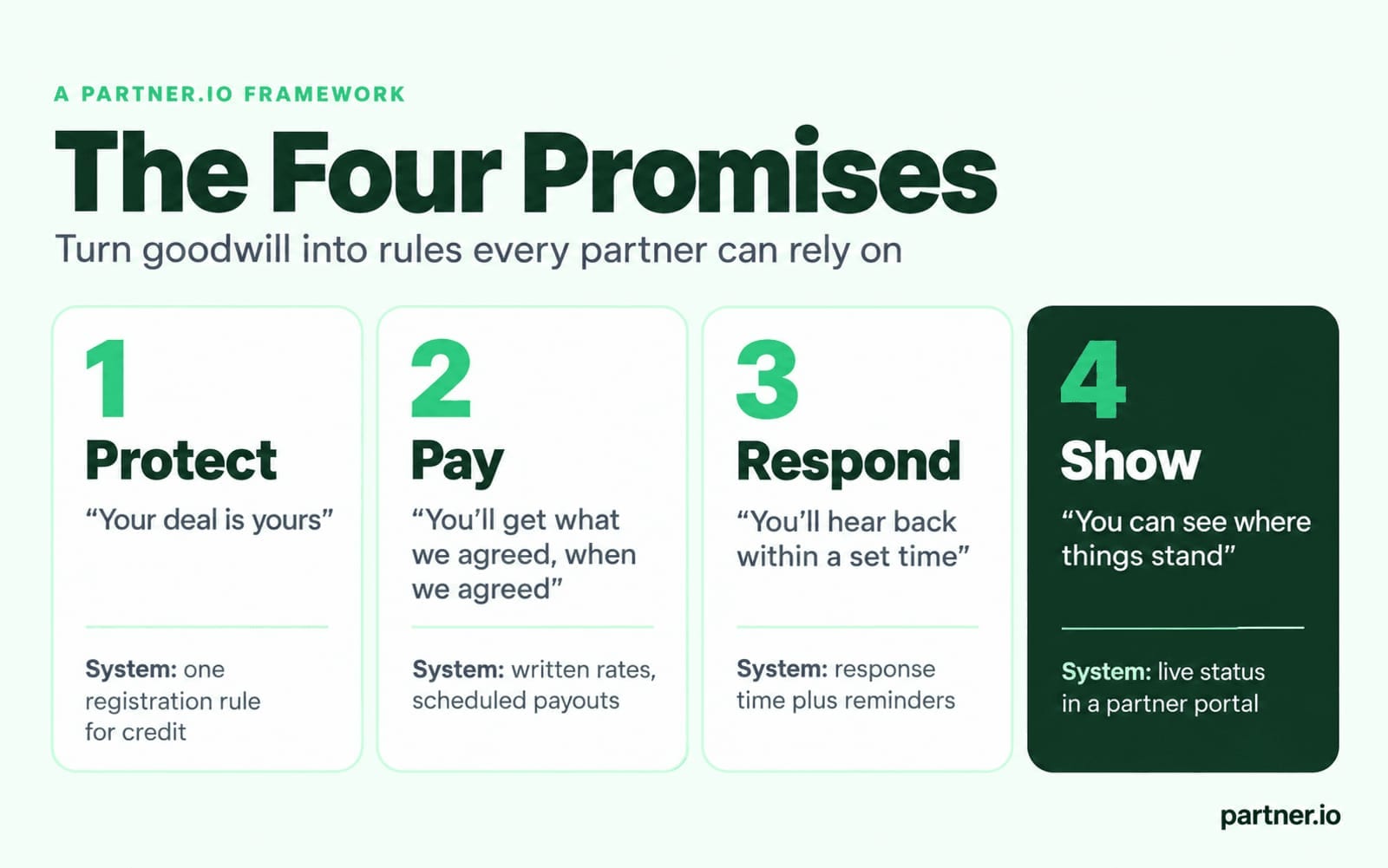
1. Protect: "Your deal is yours"
Goodwill version: your partner manager remembers who introduced which account.
System version: partners register deals in one place, with a written rule for who gets credit and for how long. Duplicates and conflicts are decided by that rule, not by whoever argues hardest. Our deal registration guide has a starting set of rules.
2. Pay: "You'll get what we agreed, when we agreed"
Goodwill version: someone checks a spreadsheet at month end and pays what looks right.
System version: commission rates live in a written agreement and a tier, commissions are calculated from recorded revenue, and payouts run on a published schedule. Exceptions are written down and time-boxed.
3. Respond: "You'll hear back within a set time"
Goodwill version: your partner manager replies fast when they're not in back-to-back calls.
System version: a written response time for new referrals and registrations (we'd suggest two business days), with automatic reminders when something sits too long.
4. Show: "You can see where things stand without asking"
Goodwill version: partners message for updates.
System version: partners see every deal's status, what they've earned and when it pays, in a portal they can check at 11pm on a Sunday.
“A promise only one person can keep isn't a program. It's a favour.
”
Want to keep all four promises in one place? Try Partner.io free for 7 days, no credit card needed.
Run a handshake audit in one afternoon
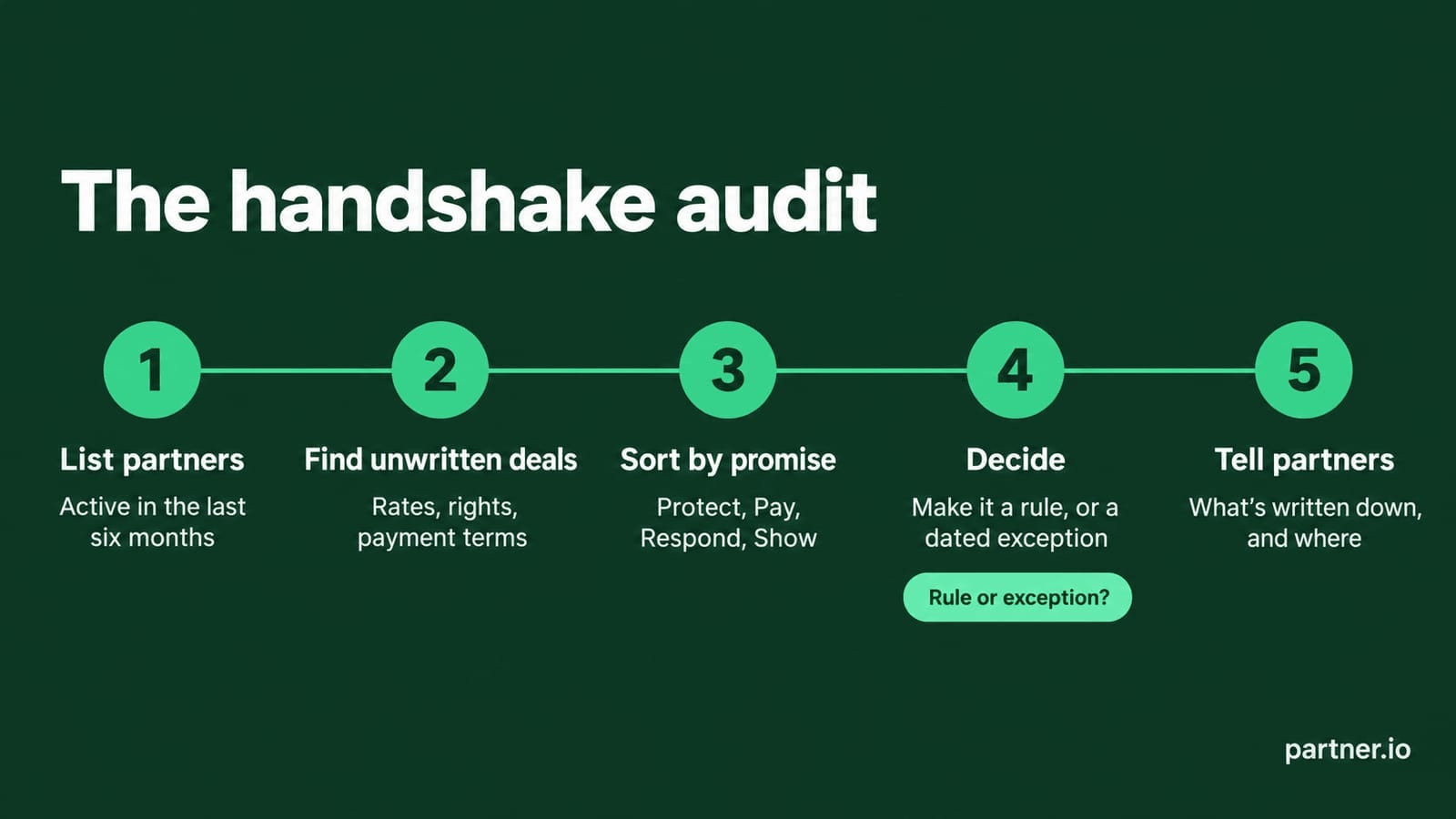
You can't systemise promises you haven't found. Most of them live in DMs, inboxes and one person's memory.
- List every active partner. Anyone who referred, registered or earned in the last six months.
- Write down every unwritten deal. Special rates, territory or vertical rights, "first look" arrangements, verbal payment terms.
- Sort each one against the Four Promises. Is it about protection, payment, response or visibility?
- Decide: rule or exception. If it would be fair for every partner of that type, make it a rule. If not, write it into that partner's agreement with an end date, or retire it with notice.
- Tell partners what changed. One short email per partner: what's now written down, and where they can see it.
Harvard Business Review authors make the same case for complex business relationships: write the trust down. In A New Approach to Contracts, they describe a formal relational contract as one that:
“specifies mutual goals and establishes governance structures to keep the parties' expectations and interests aligned over the long term.
”
A referral partner agreement is the small-company version. It doesn't need lawyers on retainer. It needs the rules you already follow, in writing.
Flexibility vs predictability: the trade-off you're making
Systems cost you something. You lose the freedom to say yes to every request on the spot.
That's the point. Every on-the-spot yes is a rule that only one partner knows about. Partners told Techaisle the same thing in a different way: only 4% accept quarterly changes to program rules.
The trade-off works like this:
- Keep flexibility for genuinely new situations: a first co-sell with a new integration partner, a pilot with a reseller in a new region. Write the exception down and give it an end date.
- Remove flexibility from anything that repeats: commission rates, deal credit, payment timing, response times.
When a partner asks for an exception, ask one question: would we offer this to every partner like them? If yes, it's a rule. If no, it's a time-boxed exception or a polite no.
What this looks like in the real world
Here's an illustrative example, not a customer story.
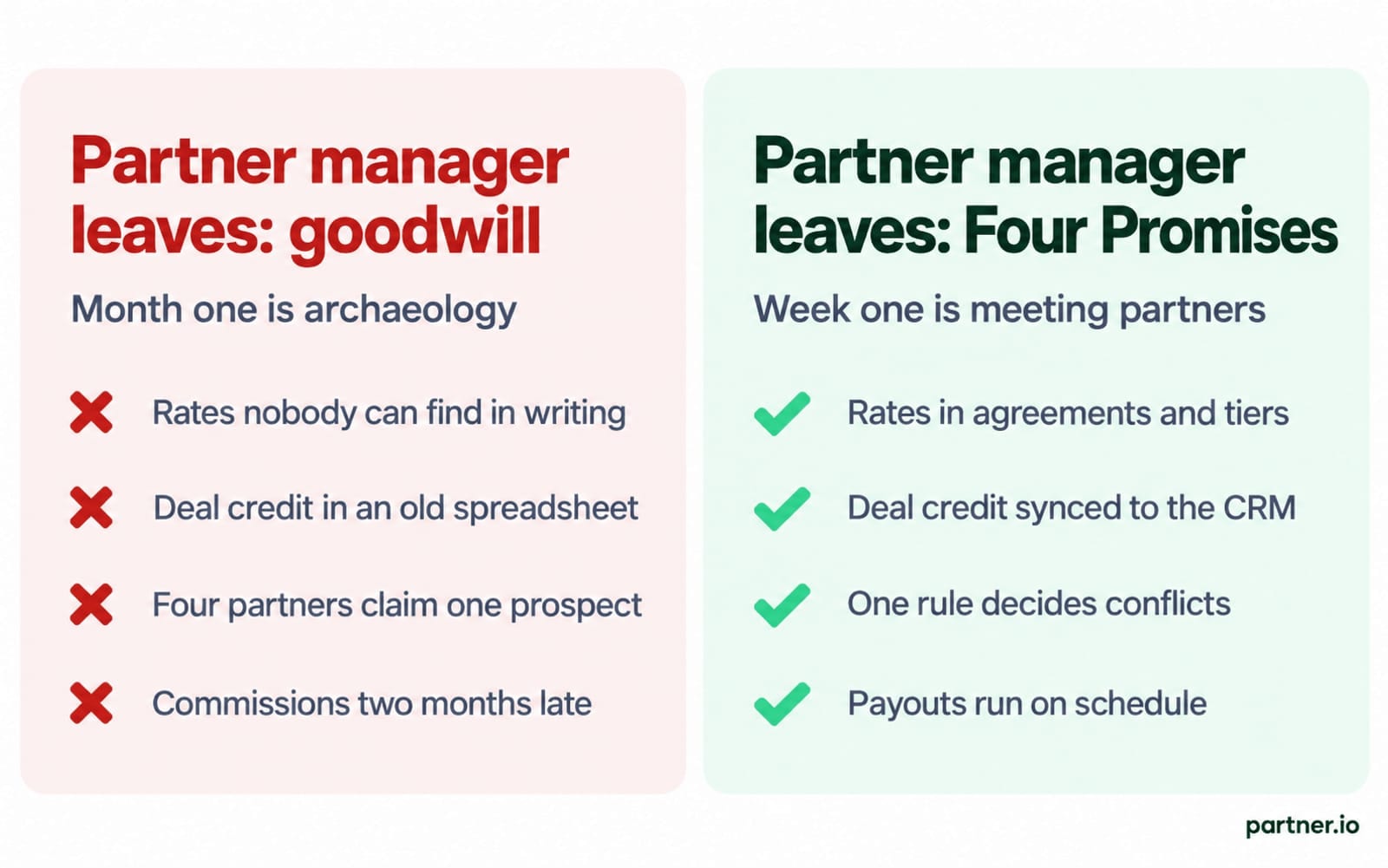
A 35-person SaaS company has 50 partners, mostly agencies and consultants. One partner manager built every relationship. Partners love her. She replies on WhatsApp at weekends.
She leaves for a bigger role. Her replacement starts on a Monday and finds:
- seven agencies on rates nobody can find in writing
- a Google Sheet of "who introduced who" last updated in June
- four partners who each think they own the same healthcare prospect
- two months of unpaid commissions, because she ran payouts from her own spreadsheet
The first month goes on archaeology. Two agencies quietly stop referring.
Now run the same story with the Four Promises in place. Rates sit in agreements and tiers, and deal credit lives in one system, synced to the CRM. Payouts run on schedule whether anyone remembers or not.
The new partner manager spends week one meeting partners, not reconstructing their history.
Relationships still need rebuilding. Promises don't.
Where Partner.io fits
Partner.io is built to keep the Four Promises without a heroic partner manager holding them together.
- Protect: partners register deals and refer leads through leads and deal registration. Approved deals sync to HubSpot, Pipedrive or Salesforce, and your team is notified when a deal is registered, won, lost or updated.
- Pay: tiers, commissions and payouts calculate commission from recorded revenue, approve it by hand or by rule, bundle it into invoices on your schedule and pay through Stripe.
- Respond: automation can auto-approve referrals that match your conditions and run flows that send reminders and create tasks, so nothing sits unanswered because someone was busy.
- Show: the partner portal shows each partner their leads, deal status, commissions, invoices and tier, with a message thread on every lead.
- Write it down: the Partner Room in the Engagement Hub stores signed agreements and assets, so the rules live somewhere a new hire can find them.
If your program is still in a spreadsheet, the hidden cost of managing partners in spreadsheets shows where it leaks. For the bigger picture, read the difference between having partners and running a partner program. And if your tiers are part of the problem, start with 10 partner tier structures and which one fits.
Keep the goodwill. Stop depending on it.
Goodwill is how your first partners found you. It's still the reason a great agency picks up the phone.
But it's a terrible operating system. It forgets, it gets tired and it hands in its notice.
Build the promises into the program, and every relationship your team builds from here starts on solid ground. Your partner managers get to spend their time on the work that actually grows partner revenue, not on remembering who was promised what.
Try Partner.io free for 7 days → No credit card, no setup fee, cancel anytime.
Prefer a walkthrough first? Book a demo and we'll map it to your program.
- [partner-led-growth]
- [prm]
Published October 20, 2026