
Partner.io vs Unifyr for SaaS partner teams: one public plan with unlimited free partners and Stripe payouts, against quote-only tiers priced per partner.
Partner.io vs Unifyr: Don't Pick a PRM That Charges You for Growing
Your 26th partner should be good news.
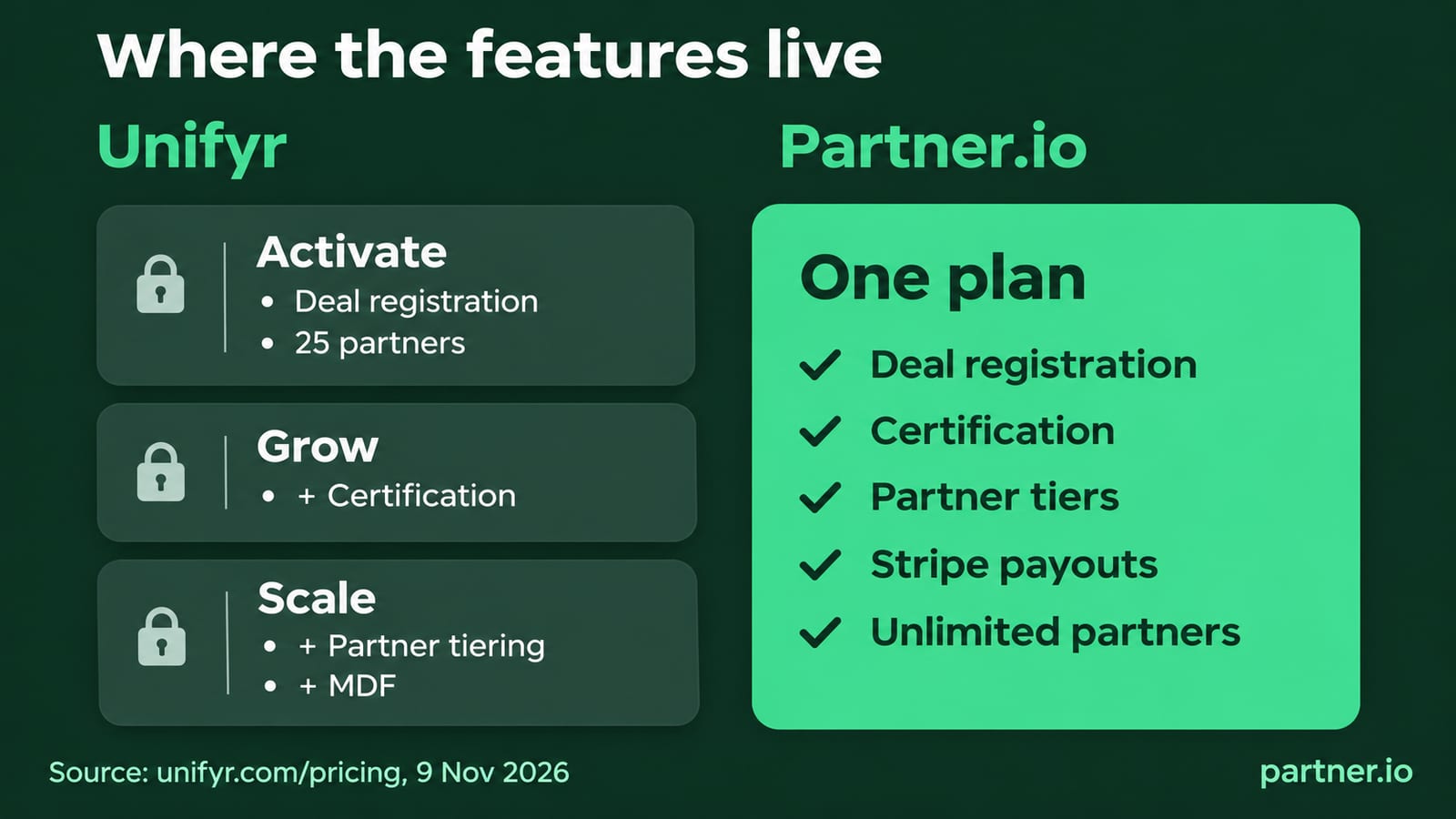
On Unifyr's entry plan, it's a pricing conversation. Activate includes 25 partners, is "priced per partner", and the price isn't on the website. Partner tiers sit on the top plan. Certifications need the middle one.
Now flip it.
On Partner.io, the 26th partner costs nothing.
So does the 260th.
Tiers, certification and Stripe payouts are on the one plan everyone gets.
That's the Partner.io vs Unifyr decision in a sentence. Unifyr (the company formerly known as Zift Solutions) builds an enterprise channel platform for resellers, MSPs and multi-brand programs. Partner.io is a PRM built for SaaS partner teams who want referrals, deals and payouts running this week, at a price that doesn't climb with every partner they recruit.
The short answer
For a SaaS partner program, Partner.io is the better choice by a distance. One plan at $79 per seat per month, published on the website. Partners are free and unlimited. Every feature is included, you can try it for 7 days without a card, and commissions are paid through your own Stripe account with W-9s and 1099-NEC forms handled.
Unifyr earns a look in one case. You run a large, multi-brand or global reseller channel, you need MDF and co-op funds, your CRM is Dynamics or Zoho, and you have the budget and patience for a sales-led buying process.
If that isn't you, keep reading. The gap is wider than a feature grid shows.
Why "built for enterprise" is the wrong yardstick
The fair counterargument goes like this. Unifyr has been in the channel business since 2006, when Zift Solutions was founded. It merged with Relayware in 2017, rebranded in 2024 and raised a $20 million investment led by Investcorp in January 2026, according to Unifyr's own about page. It lists unlimited admin users on every plan, supports four languages and carries a SOC 2 Type II badge.
That's a serious company. If you'll have 2,000 resellers in five countries, it deserves a call.
Most SaaS programs won't. They'll have 15 partners next quarter and 60 by year end.
For that program, enterprise depth isn't insurance. It's cost and clicks. The year-one risk isn't outgrowing your PRM. It's a referral sitting in an inbox for eleven days, a commission landing three weeks late, and your best agency quietly going elsewhere.
New to the category? Start with what a PRM is and when you need one.
Partner.io vs Unifyr at a glance
Everything below comes from each vendor's public pages as of 9 November 2026. Unifyr doesn't publish prices, so confirm the details with them before you buy.
| Partner.io | Unifyr | |
|---|---|---|
| Price | $79 per seat, public | Not published |
| Priced by | Your team's seats | Partner count |
| Partners | Unlimited, free | 25 on Activate |
| Free trial | 7 days, no card | Demo only |
| Partner tiers | Every account | Scale plan |
| Certification | Every account | Grow and Scale |
| CRM connectors | All, on one plan | One on Activate |
| Partner payouts | Built in, via Stripe | Your finance process |
| W-9 and 1099-NEC | Built in | Not listed |
Unifyr pricing: what you can and can't see
Unifyr's pricing page shows three plans: Activate, Grow and Scale. None has a price. The page asks you to "get a plan sized to your partner count", and every route ends at a demo.
Here's what each plan includes, in Unifyr's words:
- Activate: 25 partners included (up to 1,000), one CRM connector, API only, 25,000 AI credits a month that don't roll over. Features: partner registration, deal registration, a content library and partner onboarding.
- Grow: 50 partners (up to 2,500), all integrations, and adds certification management, contests and gamification, campaign management and lead distribution.
- Scale: 100 partners (up to 1 million), and adds custom objects, deal registration workflows, partner tiering, MDF management and an agency marketplace.
Partner tiering is a Scale feature. Tiers are how most SaaS programs tell an agency what it takes to earn 25% instead of 15%. On Unifyr, that motivator sits behind the top plan.
Contract length, overage charges and trial terms aren't on the page. You'll find out on the call.
Third-party sites quote starting figures, but the ones we found are published by other PRM vendors, so we're not repeating them. The honest summary: you won't know what Unifyr costs until a salesperson tells you, and the number moves every time you add partners.
What Partner.io costs
Partner.io costs $79 per seat per month. A seat is someone on your team who signs in. Partners use the portal free, in any number.
Two people running the program cost $1,896 a year. That covers every partner you'll recruit, plus commissions, payouts, tax forms, tiers, training, automation, Deal Surround and every integration.
There's no partner meter, no plan ladder and no call required.
Why SaaS partner teams pick Partner.io
Here's a typical SaaS partner program:
A fractional CFO who refers two deals a quarter.
Five agencies that implement your product and want 20% of year one.
An integration partner whose customers overlap your target list.
A reseller who owns the relationship in one region.
Partner.io is built for that mix. Here's where it pulls ahead.
Recruiting partners never raises your bill
Per-partner pricing sounds fair until you run a recruitment push.
Picture a program that signs 30 new agencies after a webinar. Half will never send a deal. On a per-partner plan, you pay for all 30 anyway, or you start rationing invites.
Partner.io charges for your team, not your partners. Invite every agency that applies, let the partner portal show who's active, and prune later on performance, not on price.
Commissions, payouts and tax live in one system
This is the biggest gap in the comparison.
Unifyr's channel incentives page says a SPIFF payout "follows the finance or fulfilment process selected for the program", and that for international payouts, local tax and payment requirements "remain with the relevant finance team". We couldn't find Stripe payouts, W-9 collection or 1099 forms anywhere on Unifyr's public pages.
Partner.io handles commission approval, self-billed invoices and payouts through your own Stripe account, and takes 0% of what you pay partners. Stripe's payouts documentation covers the timing. For US partners, tax compliance collects a W-9 before money moves and generates 1099-NEC forms at year end.
Barika Pace put the stakes plainly in an ISG analyst perspective on partner experience:
“Incentives that are calculated after the fact do not drive behavior, they create frustration.
”
A commission a partner can watch move from approved to paid is an incentive. One that disappears into a finance queue is a support ticket.
Tiers and certification on day one
Every Partner.io account starts with a default tier, a referral form and a partner application form. Add Silver, Gold and Platinum with their own commission rates the same afternoon, and let automation flag partners for promotion on partner score, revenue or certifications. Our guide to points vs revenue vs certification as tier criteria walks through which to use.
For certification, describe a course or upload your existing deck, and training and certification drafts the lessons and quizzes. Partners get courses and certificates in their portal the same week, on the same plan.
Deal registration that lands in your CRM with the partner attached
Partners submit referrals and register deals in a portal on your own domain. Leads and deal registration syncs each one to HubSpot, Pipedrive or Salesforce with the partner attached, so a partner-sourced deal never gets logged as inbound and argued over at commission time.
All three CRMs are on the one plan. Switch from Pipedrive to HubSpot next year and nothing about your subscription changes.
Co-sell that starts with a named account
Deal Surround and Partner Discovery shows which of your partners can open a specific target account. The ask to a partner becomes "can you introduce us to their head of ops before the renewal", which beats a quarterly sync with no agenda. Try the public Deal Surround demo without signing up.
Test it before anyone sells to you
Unifyr's homepage promises you can "get started in one afternoon". You still can't start without a demo.
Partner.io gives you seven days, no card and sample partners and leads you can clear in one step. Month-to-month after that, so if it doesn't earn its place, you cancel from your billing settings.
When Unifyr makes sense
There are programs Unifyr fits better, and it's worth being straight about them.
MDF and co-op funds. Unifyr manages fund requests and claims on its Scale plan. Partner.io doesn't offer MDF.
Dynamics, Zoho or SugarCRM. Unifyr lists connectors for all three. Partner.io connects to HubSpot, Pipedrive and Salesforce.
Global, multi-brand reseller channels. Unifyr is built for programs with thousands of partners across regions, with a localised interface in Chinese, Korean and Japanese.
Large admin teams. Unifyr lists unlimited admin users on every plan. If 40 people on your side need to sign in, per-seat pricing adds up, and you should do the maths.
Recognise your program in that list? Take the demo. If your partners are agencies, consultants and integration partners, you'd be paying an enterprise premium, by the partner, for a channel you don't run.
The PAID test for choosing a PRM
Every PRM demo looks complete. Four questions cut through them, and together we call them the PAID test, because a partner program lives or dies on whether partners get paid.
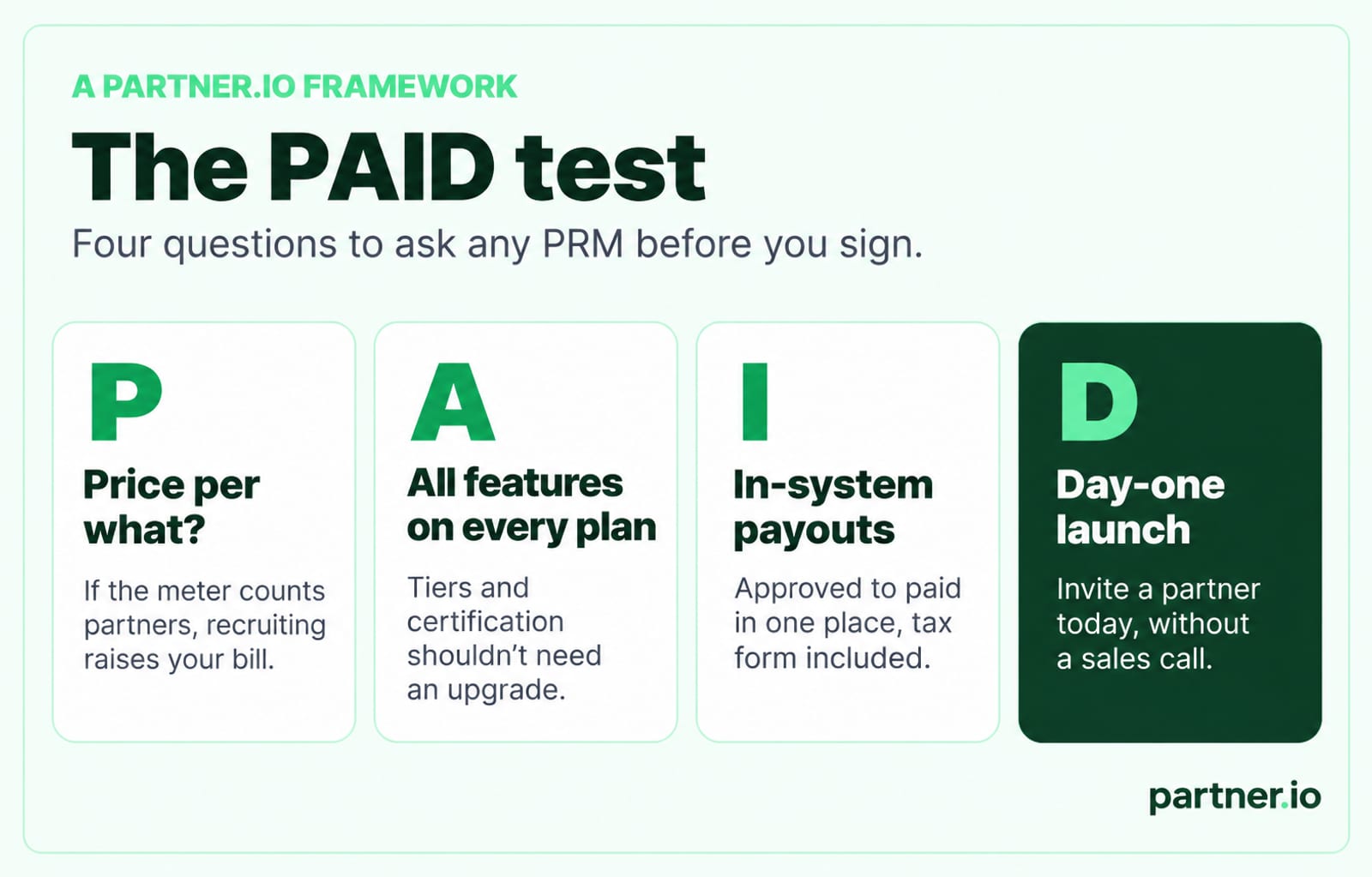
P: Price per what?
Find out what the meter counts. If it counts partners, your bill grows every time recruitment works.
A: All features on every plan.
List the five features you'll use in year one. If tiers or certification sit on a higher plan, that plan is your real price.
I: In-system payouts.
Does a commission go from approved to paid inside the PRM, tax form included? Every handoff to finance is a place money gets late.
D: Day-one launch.
Can you invite a partner today, without a call? Partners judge you on their first week, long before they see your feature list.
Score both vendors in writing. For a SaaS program, Partner.io passes all four. Unifyr's public pages leave three of them as questions for the sales call.
Want to run the PAID test on a real portal? Try Partner.io free for 7 days, no credit card needed.
What this looks like in the real world
Here's a composite of a situation we see often.
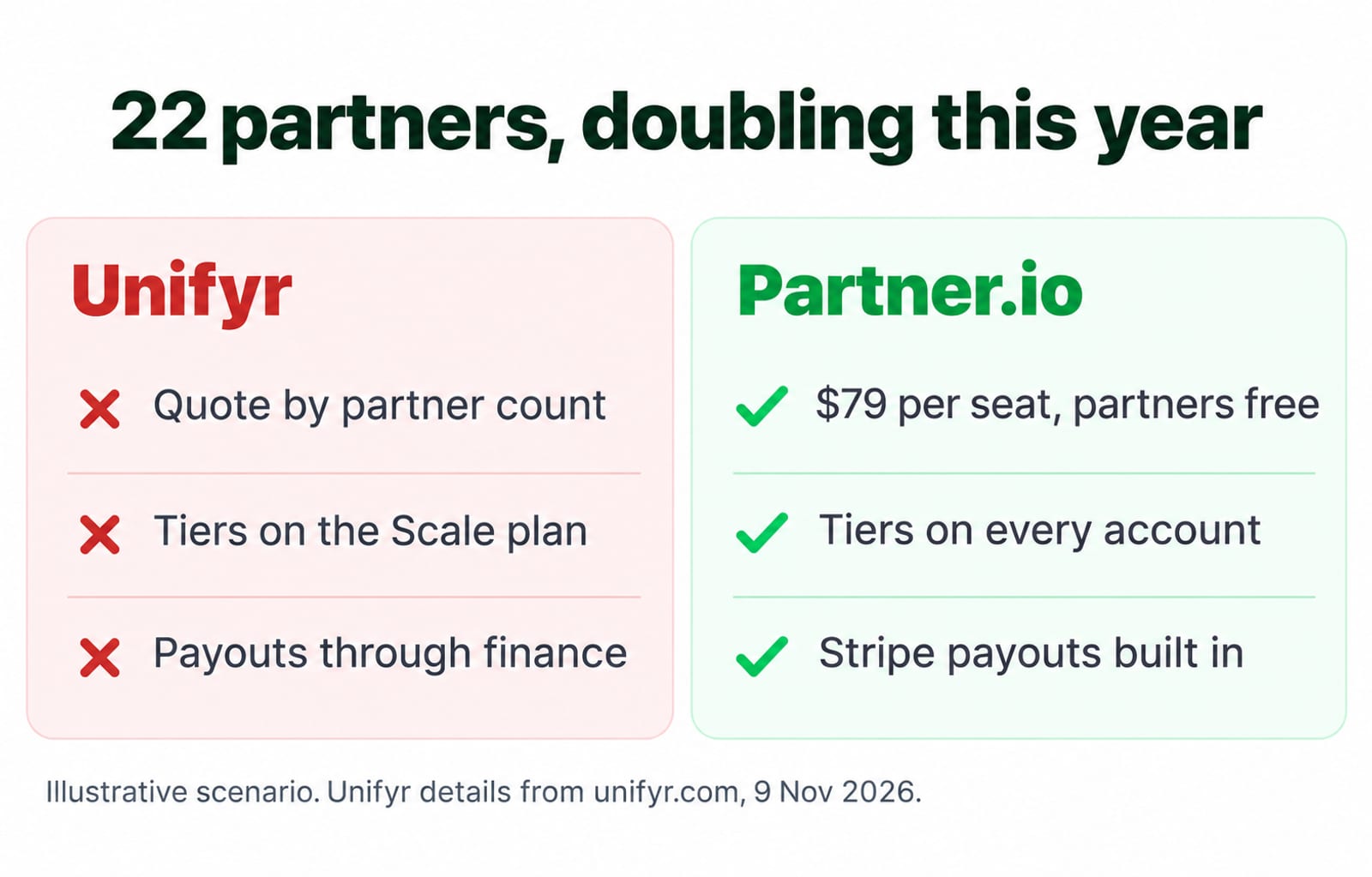
A 60-person SaaS company on HubSpot has 22 partners: twelve agencies, eight referral consultants and two integration partners. Commissions live in a Google Sheet. The partner lead plans to double the agency count this year.
They book a Unifyr demo. The AI agents look sharp.
Then the maths starts. Activate covers 25 partners, and the recruitment plan blows past that by spring. Tiers, the lever they planned to use to move agencies from 15% to 25%, sit on Scale. Payouts would still run through finance.
They start a Partner.io trial on a Monday. By Wednesday, three tiers are live and all 22 partners are invited. The next week an agency registers a deal that lands in HubSpot with the partner attached, the commission rule fires, and the payout goes out through Stripe at month end.
When they recruit 25 more agencies in Q2, the bill doesn't move.
Run your first week before you decide
Don't let either vendor run your evaluation. Run it with real partners and one real deal.
- Day 1: set up two tiers with your real commission rates and your logo.
- Day 2: connect your CRM and push a test deal through. Check the partner field survives an edit.
- Day 3: invite three partners. One keen, one average, one who never reads email.
- Day 4: have a partner register a live deal. Change the amount in the CRM and check what the partner sees.
- Day 5: approve the commission and pay it. Then check where the W-9 lives.
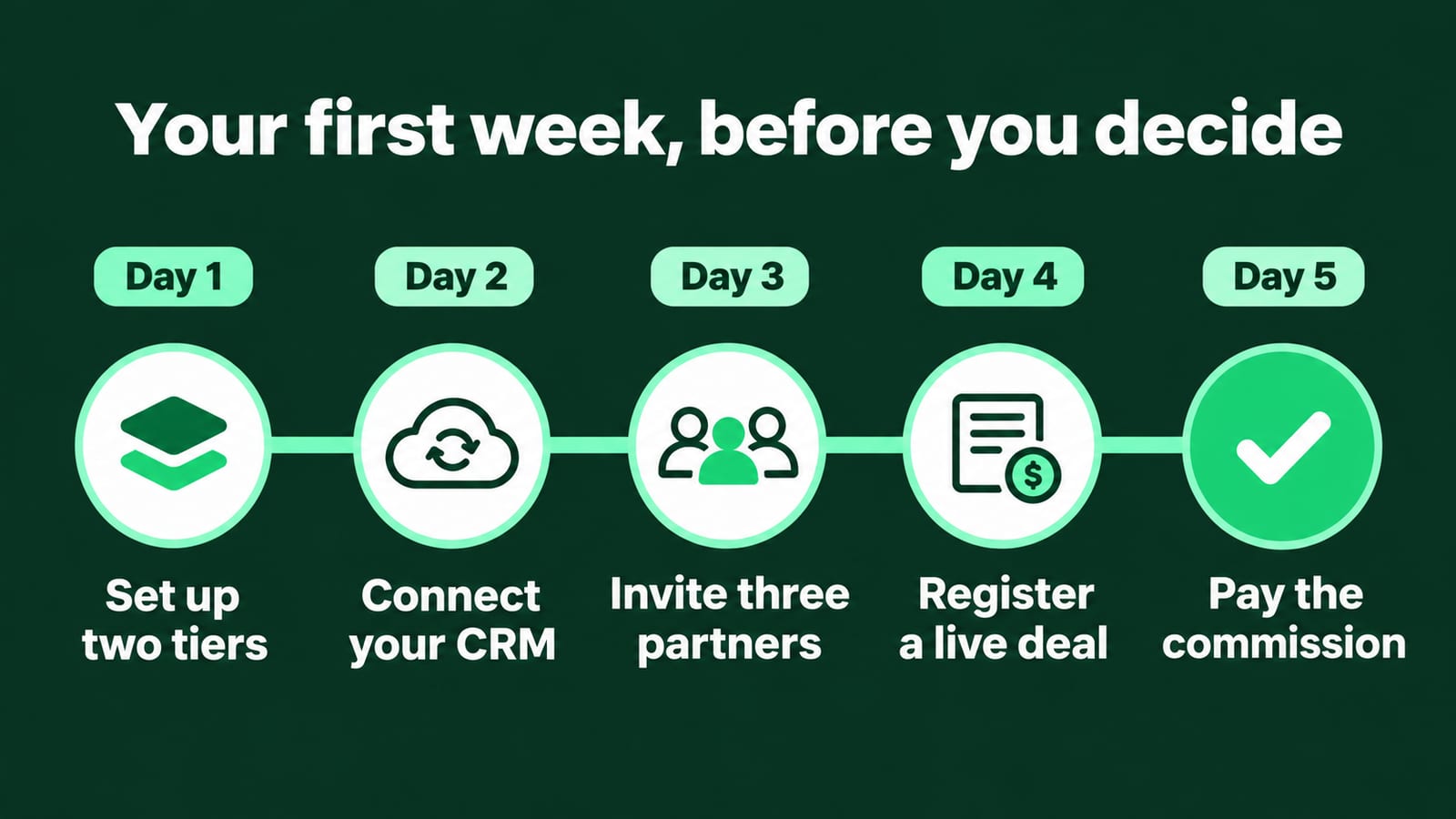
Partner.io's trial covers every step inside the 7 days, on your own. For Unifyr, ask for a sandbox on these exact terms, ask which plan includes tiers at your partner count, and ask who sends the money on day 5.
Decision points and trade-offs
If your program is referrals, agencies, integration partners and co-sell on HubSpot, Pipedrive or Salesforce, start with Partner.io and see whether you ever miss anything.
If you run a multi-brand reseller or MSP channel with MDF, Dynamics and partners in a dozen countries, put Unifyr on the list. Ask for a price in writing.
The trade-off is plain. Unifyr gives you an enterprise channel platform with unlimited admins, priced by partner after a conversation. Partner.io gives you the PRM a SaaS program runs on, with tiers, payouts and tax built in, at a price on the website that doesn't punish recruitment. For a program you want growing this year, that's not a close call.
When a PRM rollout breaks
If commissions still live in a sheet while you decide, read the hidden cost of managing partners in spreadsheets. Running fewer than ten partners today? Here's how to structure a partner program under 10 partners.
Before you sign anything
- Get the year-one total in writing, at today's partner count and at 3x.
- Ask how a "partner" is counted, and what happens when you pass the plan's limit.
- Ask which plan includes partner tiers and certification.
- Follow one commission all the way to paid, including the tax form.
- Find out the contract length and the notice period.
Comparing more vendors? Our Partner.io vs Mindmatrix Bridge comparison runs the same checks on another enterprise channel suite.
Where Partner.io fits
If the problems above are yours, here's what solves each one:
- Partners can't see their deals: the partner portal puts deal status and earnings on the first screen, on your own domain.
- Referrals get lost or logged as inbound: leads and deal registration syncs the partner to HubSpot, Pipedrive or Salesforce.
- Commissions are late: tiers, commissions and payouts pays through your Stripe account.
- Approvals and follow-ups eat your week: automation handles them, and Slack notifications tell the right rep when a deal comes in.
- Tiers aren't motivating anyone: 10 partner tier structures shows how to reward the right behaviour.
Start with one partner, one deal, one clean record
Partner programs are getting more ambitious, not less. In Forrester's 2025 state of partner ecosystems, two-thirds of the leaders surveyed expect partner-influenced revenue to grow above or well above last year. Kathy Contreras, the VP and principal analyst behind it, explains why:
“Partners are playing a more strategic role in shaping and assisting B2B customer decisions.
”
That growth needs a PRM that welcomes every new partner instead of billing for them.
Unifyr is a capable platform for a vendor running a large, multi-brand reseller channel. For a SaaS team building a partner program, Partner.io is the better PRM: a price you can see, unlimited partners from day one, and payouts that never leave the system. Finding out costs nothing.
Try Partner.io free for 7 days → No credit card, no setup fee, cancel anytime.
Prefer a walkthrough first? Book a demo and we'll map it to your program.
- [prm]
- [comparisons]
Published November 9, 2026