
Partner.io vs Magentrix for SaaS partner teams: unlimited free partners, Stripe payouts and a same-week launch, against partner-capped tiers from $1,500 a month.
Partner.io vs Magentrix: Count Your Partners Before You Count Features
Your eleventh partner shouldn't change your software bill.
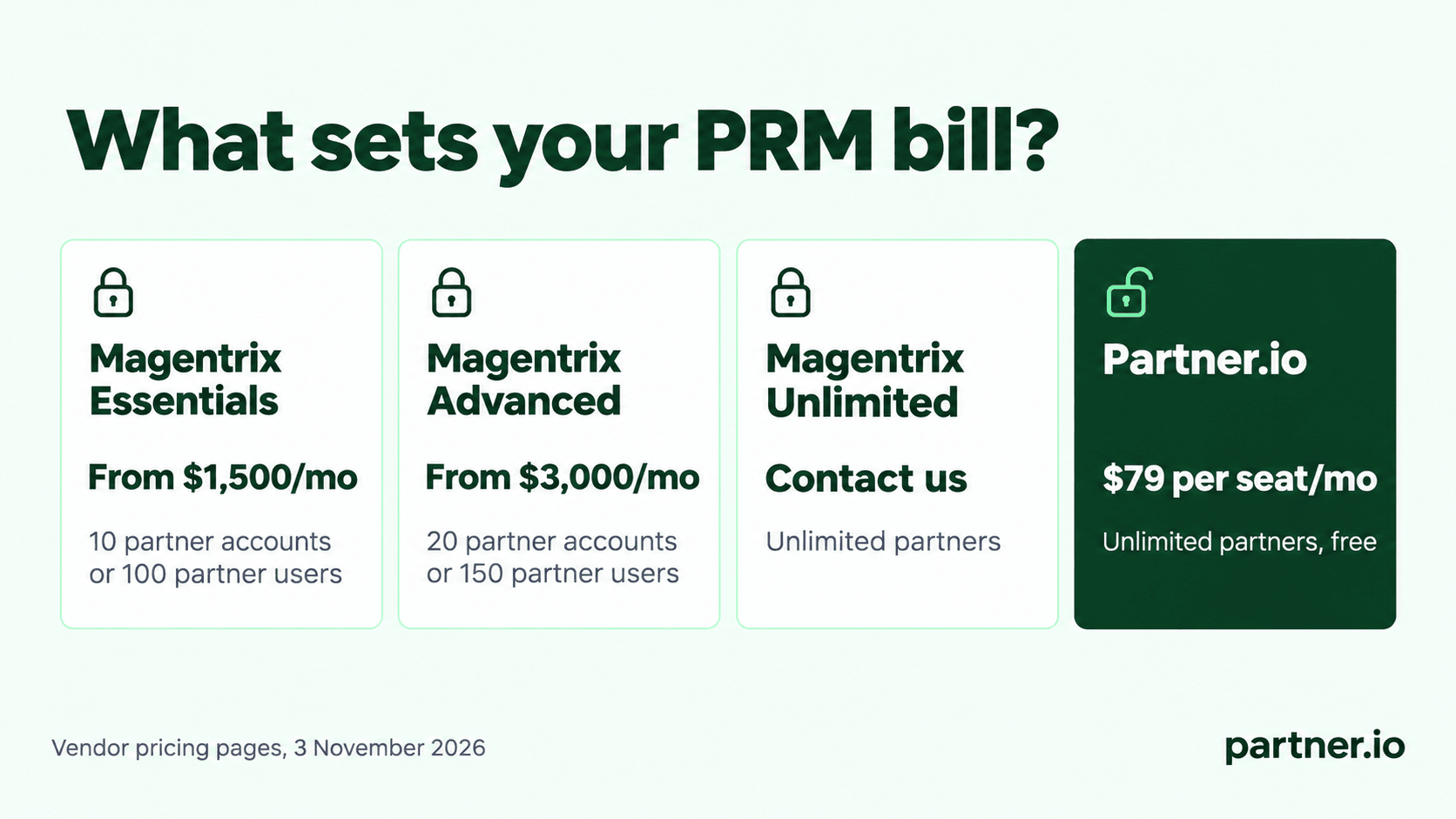
On Magentrix's entry plan, it can. Essentials covers 10 partner accounts or 100 partner users. Sign the agency that pushes you past that line and you're having a pricing conversation, not a launch.
That's the real Partner.io vs Magentrix question. Both give you a branded portal, deal registration, training and payouts. They price your program's growth in opposite ways.
Magentrix prices by partner footprint.
Partner.io prices by the people on your own team, and partners are free.
For a SaaS company that plans to recruit, that difference decides most of this comparison before you open a demo.
The short answer
For most SaaS partner teams, Partner.io is the better fit. It's built for referral, agency, reseller and integration partners on HubSpot, Pipedrive or Salesforce. Partners are unlimited at $79 per seat, commissions go out through Stripe with tax forms handled, and partners can register deals this week. A 7-day trial lets you test all of it before talking to anyone.
Magentrix makes sense in a narrower case. Think of a heavily customised Salesforce or Dynamics org where partners must work with custom objects inside the portal. Or a plan to run your customer support portal on the same platform.
If neither of those is you, the rest of this post explains why the gap is wider than the feature grids suggest.
Why your partner count is the number that matters
Partner programs that work don't stay small. In Forrester's 2025 state of partner ecosystems, two-thirds of the leaders surveyed expect partner-influenced revenue to grow by more than 30% on the previous year. Kathy Contreras, the VP and principal analyst who wrote it, explains where that demand comes from:
“B2B buyers and customers continue to highlight preferences for working with partner ecosystems.
”
Growth like that means more partners in the portal: more agencies, and more consultants who refer two deals a year and need a login to do it.
So ask what each PRM charges you when the program succeeds. Priced by partner count, every recruiting win becomes a budget line. Priced by internal seats, the PRM doesn't care how many partners you add.
The fair counterargument: Magentrix counts partner accounts or partner users, and 100 users goes a long way when most partners are one-person referrers. If you'll never pass 10 partner companies, the cap won't bite.
But nobody builds a partner program to stay at ten. You build it to recruit.
New to the category? Start with what a PRM is and when you need one.
Partner.io vs Magentrix at a glance
Everything below comes from each vendor's public pages as of 3 November 2026. Pricing pages change, so check again before you buy.
| Partner.io | Magentrix | |
|---|---|---|
| Entry price | $79 per seat per month | From $1,500 a month |
| Partners included | Unlimited, free | 10 accounts or 100 users |
| Contract | Monthly, cancel anytime | Annual; monthly adds 10% |
| Free trial | 7 days, no credit card | No; on request, may carry a fee |
| Stated launch time | Invite partners on day one | 3 to 6 weeks |
| Payouts | Stripe, included | Tier varies on pricing page |
| W-9 and 1099-NEC | Built in | Not listed publicly |
| CRM | HubSpot, Pipedrive, Salesforce (on request) | Salesforce, Dynamics, HubSpot |
What Magentrix's published pricing buys you
Magentrix publishes prices, which plenty of PRM vendors don't. There are three partner management tiers.
Essentials starts at $1,500 a month. It covers 100 partner users or 10 partner accounts with unlimited users, and includes self-registration, deal management, training, partner attribution, co-branding and AI deal registration.
Advanced starts at $3,000 a month for 150 partner users or 20 partner accounts. The tier card adds gamification and incentives, MDF, partner payout, business planning, microsites, deeper CRM integration and the developer console with REST API.
Unlimited removes the partner caps. The price is "Contact Us".
Read the terms twice. The page says prices are "based on annual contract", while the table header says listed prices are monthly and to ask for annual pricing. Monthly billing carries a 10% surcharge on a credit card.
Users beyond your tier's allowance cost extra. So does storage past the included 100 GB of files and 2 GB of records.
The page also contradicts itself on which tier includes partner payouts, MDF and the REST API: the Advanced card lists them, but the feature table marks some of them against Essentials. Paying partners is the one job a PRM can't get wrong, so get that answer in writing.
At list price, Essentials comes to $18,000 a year and Advanced to $36,000.
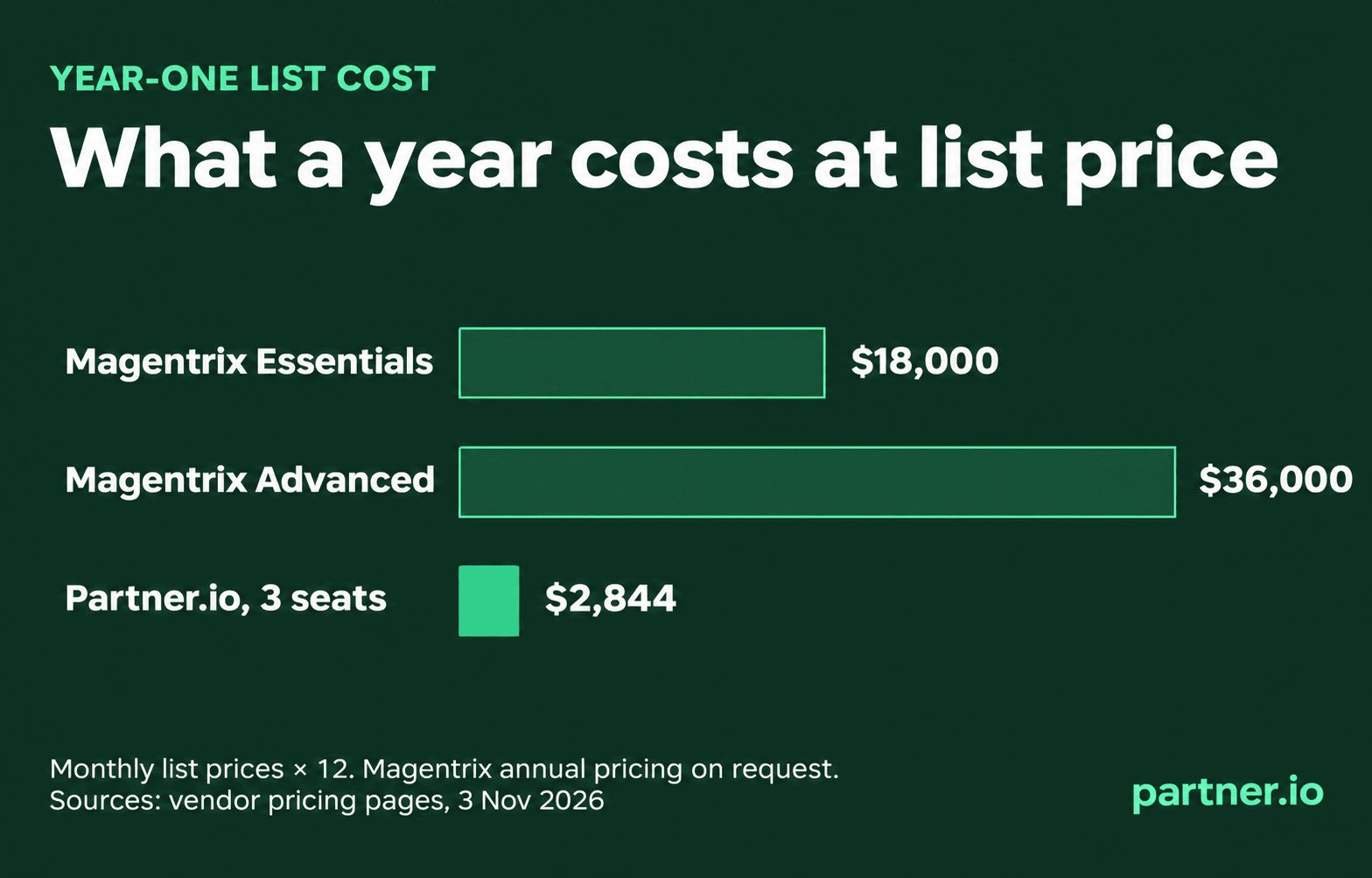
Partner.io is $79 per seat per month. A seat is someone on your team who signs in. Partners use the portal free, in any number. Three people running the program cost $2,844 a year, with commissions, payouts, tax forms, training, automation and every integration included.
No tiers to climb. No feature held back for a bigger plan.
Magentrix Essentials at list price would cover six Partner.io seats for three years, with change left over.
Why SaaS partner teams pick Partner.io
Most SaaS partner programs look like this:
A fractional CRO who refers two deals a quarter.
Three agencies that implement your product and want 20% of year one.
A reseller who owns the customer relationship in one region.
An integration partner whose customer list overlaps your target accounts.
Partner.io is built for exactly that mix. Here's what it changes.
Your partner count is never a pricing tier
Recruit 15 partners or 500. If your team doesn't change, neither does the bill. You stop asking whether a small referrer is worth a portal login and start asking whether they'll send one deal. That one shift opens up the long tail of consultants and advisors who make referral programs work.
Commissions, payouts and tax in one place
Partner.io handles commission approval, self-billed invoices and payouts through your own Stripe account, and takes 0% of what you pay partners. Stripe's payouts documentation covers the timing.
For US partners, the tax compliance tools collect W-9s before money moves, track commissions against the 1099 threshold and generate 1099-NEC forms at year end. The IRS guidance on Form 1099-NEC explains when you need one. We couldn't find W-9 or 1099 handling on Magentrix's public pages, so if you're evaluating both, ask.
“Partners don't remember your feature list. They remember whether they got paid.
”
Incentives partners notice
Tiers in Partner.io carry commissions, gift cards, swag and badges, so a partner who registers their third deal sees the reward the same day. On Magentrix's pricing page, gamification and incentives sit on the Advanced card, at twice the Essentials price.
Live in days, with nobody to wait for
Magentrix's implementation page puts a standard partner portal at 3 to 6 weeks from kick-off to live, and a customised one at 4 to 15 weeks. You supply a decision-maker, a CRM admin, testers and test data. It's a well-run process. It's still a project, and it eats half a quarter.
Partner.io starts every account with a default tier, a referral form and a partner application form. You invite your first partners the day you sign up. Automation handles approvals and follow-ups, and Slack notifications tell the right rep when a partner registers a deal.
Training that writes itself
Describe a course or upload your existing material, and training and certification drafts the lessons and quizzes. Partners get courses and certificates in their portal. Ramp time drops from "whenever they find the PDF" to a course they can finish this week.
Co-sell that starts with a named account
Deal Surround and Partner Discovery shows which of your partners can open a specific target account. The co-sell ask becomes "can you introduce us to their head of ops before the renewal", which beats another vague quarterly sync. Try the public Deal Surround demo without signing up.
Try it before anyone sells to you
Magentrix doesn't offer free trials; you can request one, and it may carry a fee. Partner.io gives you 7 days without a card, sample partners and leads you can clear in one step, and month-to-month billing after that. If it doesn't earn its place, you cancel. No 30-day renewal notice to diarise.
When Magentrix makes sense
To be fair to Magentrix, there are programs it suits better.
Deep CRM mirroring. Magentrix's headline claim is that it mirrors your CRM data model and schema. On Advanced, that includes custom objects, custom fields and managed packages. If partners must edit custom Salesforce objects in the portal, test this hard in a demo, with your own org.
Microsoft Dynamics. Magentrix lists a Dynamics connector. Partner.io doesn't connect to Dynamics.
Partner and customer portals from one vendor. Magentrix also sells a customer management product with case management, forums and storefronts. Partner.io is a PRM and doesn't try to be a support desk.
Classic channel extras. MDF, business planning and co-branded microsites appear on the Magentrix tiers. Partner.io doesn't offer MDF.
If your program is a channel of resellers on a customised Salesforce or Dynamics org, take the Magentrix demo. If it's the SaaS partner mix above, those extras are budget you'd spend on features you won't switch on this year.
The FITS test for choosing a PRM
Feature grids make every PRM look complete. The old complaint about the category still stands. Jay McBain, then a principal analyst at Forrester, put it this way in a 2020 Forrester post on PRM:
“PRM has been recognized as a platform that is a mile wide and an inch deep
”
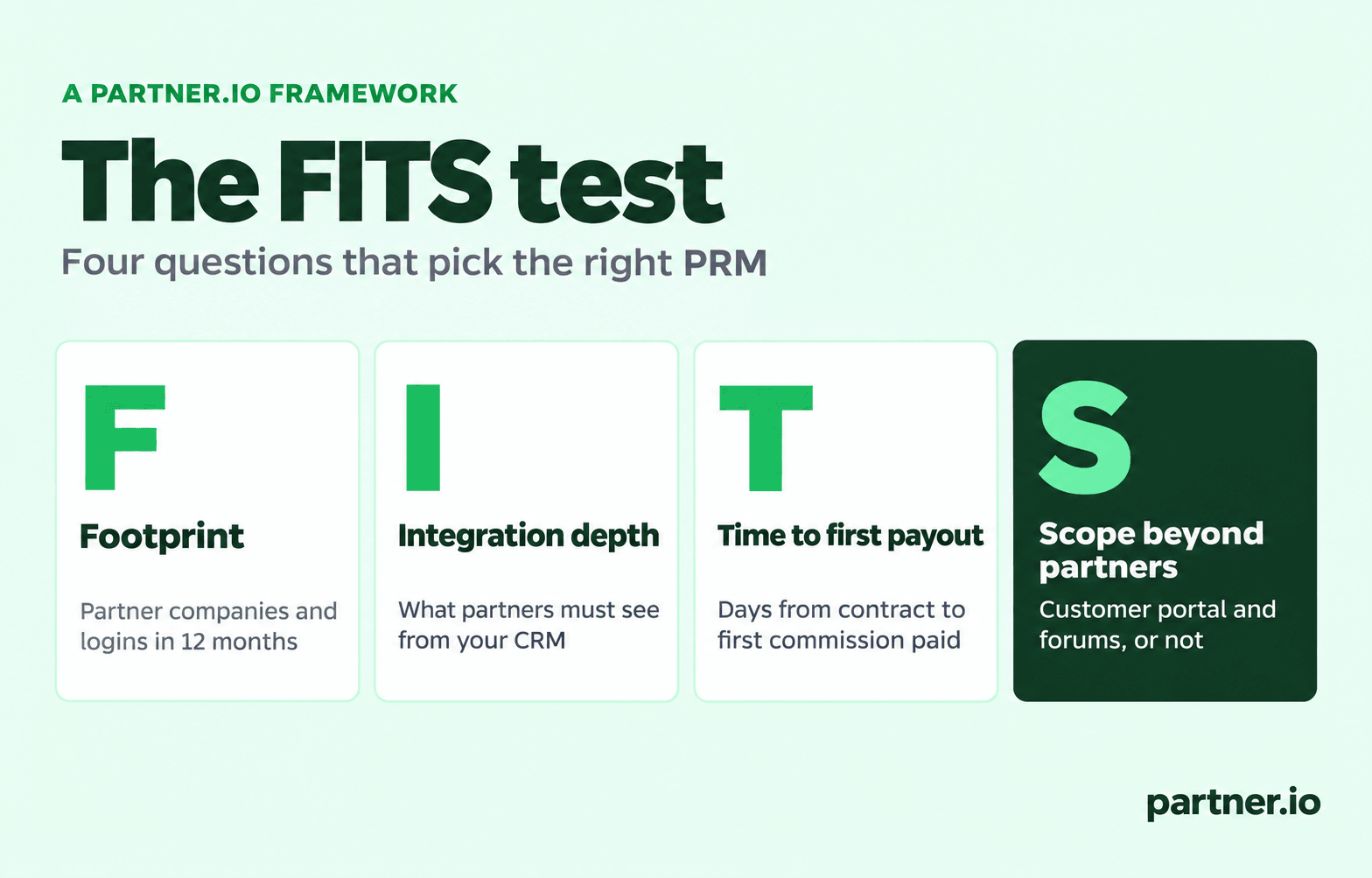
Breadth isn't the test, then. Fit is. Four questions decide this comparison, and we call them the FITS test.
F: Footprint.
Write down how many partner companies and partner logins you'll have in 12 months, not today. On Magentrix that number picks your tier. On Partner.io it doesn't move the price.
I: Integration depth.
List what partners must see from your CRM. For most SaaS programs it's deals, contacts and status with the partner attached, and a clean two-way sync covers it. Only custom objects and managed packages call for mirroring.
T: Time to first payout.
Count the days from signed contract to the first commission landing in a partner's account. This is the number your partners will judge you on.
S: Scope beyond partners.
Do you also want a customer support portal, forums and a storefront from the same vendor? If not, don't pay for them.
Score both vendors in writing. For most SaaS teams, F and T settle it, and both point the same way.
Want to run the FITS test on a real portal? Try Partner.io free for 7 days, no credit card needed.
What this looks like in the real world
Here's a composite of a situation we see often.
A 60-person SaaS company on HubSpot has 14 partner companies: eight agencies, four consultants who refer and two resellers. Commissions live in a Google Sheet with a tab per quarter. Last month an agency invoiced for a deal that had already been paid.
Their partner lead sits through a Magentrix demo and likes it. The portal is polished and the CRM sync is impressive.
Then the pricing conversation starts. Fourteen partner companies already rules out the 10-account option on Essentials, so the plan hangs on partner logins staying under 100. Partner payouts sit on the Advanced card. The recruiting plan says 40 partners by next year.
They start a Partner.io trial on a Tuesday instead. By Thursday the agencies are in the portal. By the following Monday a consultant has submitted a referral that lands in HubSpot with the partner attached, the commission rule is set, and the sheet is read-only.
Nobody on that team needed custom object mirroring. They needed partners to stop asking where their money was.
How to pressure-test both in ten working days
Don't let either vendor run your evaluation. Run it with real partners and one real deal.
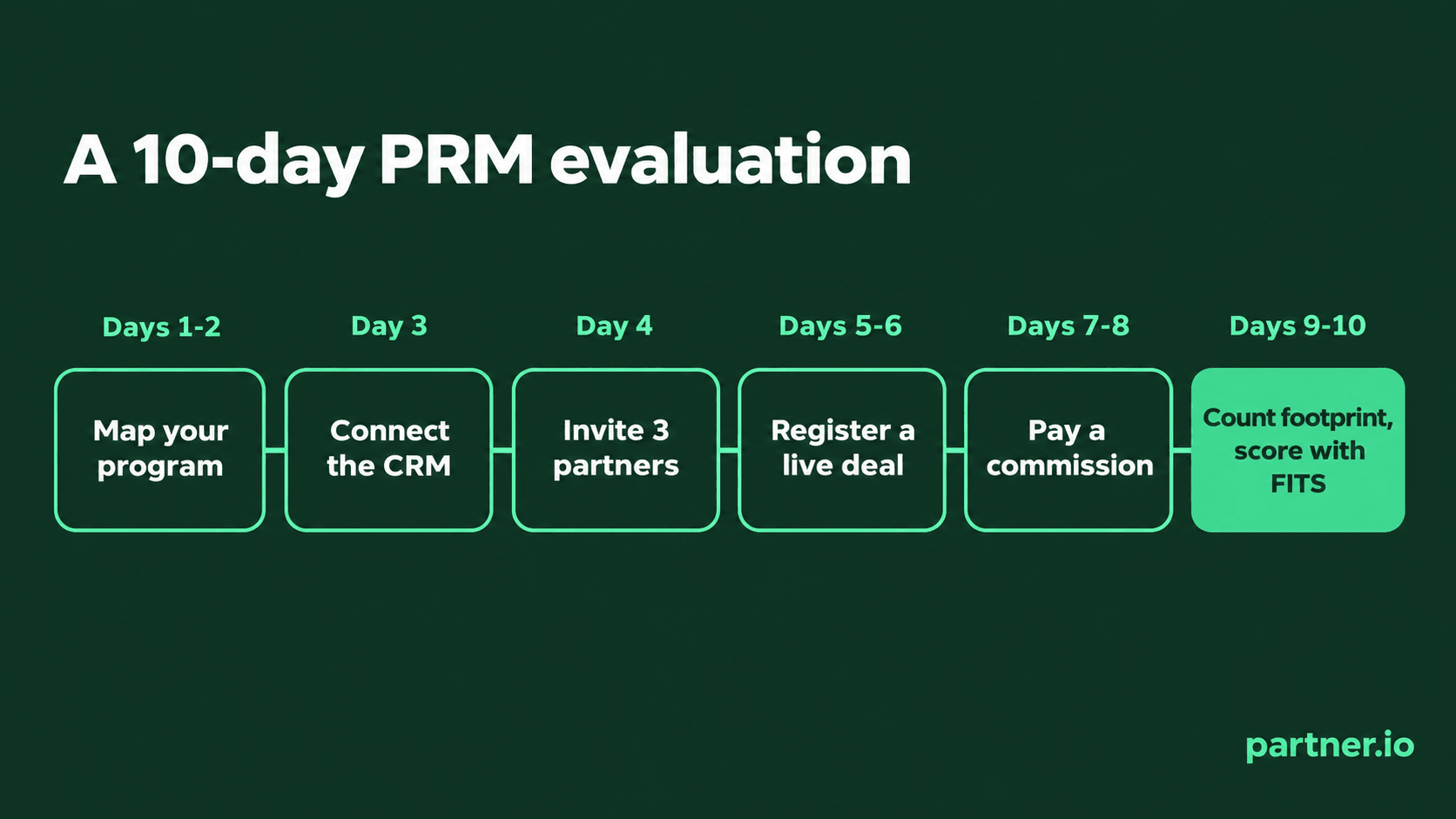
- Days 1 and 2: map your real program. One tier, your actual commission rule, your logo.
- Day 3: connect your CRM. Push a test deal through and check the partner field survives an edit.
- Day 4: invite three partners. One keen, one average, one who never reads email.
- Days 5 and 6: register a live deal. Have a partner submit it, change the amount in the CRM, and check what the partner sees.
- Days 7 and 8: pay a commission. Approve it, pay it, then test what happens on a refund.
- Day 9: count your footprint. Partner companies and logins today, and in 12 months.
- Day 10: score both on FITS. Decide.
Partner.io's trial covers all of this on your own, inside the 7 days. For Magentrix, ask for a sandbox on these exact terms, ask whether it carries a fee, and ask which tier each step needs.
Decision points and trade-offs
If your program is referrals, agencies, resellers and co-sell on HubSpot, Pipedrive or Salesforce, start with Partner.io and see whether you ever miss anything.
If partners must edit custom Salesforce objects in the portal, or your CRM is Dynamics, put Magentrix on the list and test it with your own org.
Planning to pass 20 partner companies next year? Price Magentrix's Unlimited tier before you sign anything, because that's where you'll end up.
The trade-off is plain. Magentrix gives you deep CRM mirroring and a customer portal option, priced by how many partners you have. Partner.io gives you a PRM with commissions, payouts, tax, training and automation included, priced by the size of your own team. For a program built to grow, that pricing model matters more than any single feature.
When a PRM rollout breaks
Both tools fail the same way if the rollout is sloppy.
If commissions still live in a sheet while you decide, read the hidden cost of managing partners in spreadsheets. Once you're live, 10 partner tier structures will help you set up tiers that reward the right behaviour.
Before you sign anything
- Get the year-one total in writing at today's partner count and at 3x.
- Confirm which tier includes payouts, incentives and the API.
- Watch a partner, not an admin, register a deal.
- Follow one commission all the way to paid, including the tax form.
- Find out what leaving looks like: notice period and contract length.
Comparing more vendors? Our Partner.io vs ZINFI comparison runs the same checks on a 30-application suite.
Where Partner.io fits
If the problems above are yours, here's what solves each one:
- Partners can't see their deals: the partner portal puts deal status and earnings on the first screen, on your own domain.
- Referrals get lost or logged as inbound: leads and deal registration syncs the partner to HubSpot, Pipedrive or Salesforce.
- Commissions are late: tiers, commissions and payouts pays through your Stripe account.
- Partners go quiet between deals: the Engagement Hub runs newsletters, events and your asset library.
- Your team wants answers without opening another tab: the MCP server connects your program to Claude and ChatGPT.
Start with one partner, one deal, one clean record
Magentrix is a capable platform for a customised Salesforce or Dynamics channel.
But if your partners are agencies, consultants, resellers and integration partners, and the problem is that deals go missing and commissions arrive late, you don't need a pricing tier that grows with your partner list. You need one partner to register one deal this week and get paid for it next month.
That takes a few days in Partner.io, at a fraction of the cost, with no contract to escape if it doesn't work. Finding out costs nothing.
Try Partner.io free for 7 days → No credit card, no setup fee, cancel anytime.
Prefer a walkthrough first? Book a demo and we'll map it to your program.
- [prm]
- [comparisons]
Published November 3, 2026