
Partner.io vs Kiflo compared on partner caps, contracts, payouts and CRM sync, and why growing SaaS partner programs get more from Partner.io for less.
Partner.io vs Kiflo: The PRM That Doesn't Cap Your Growth
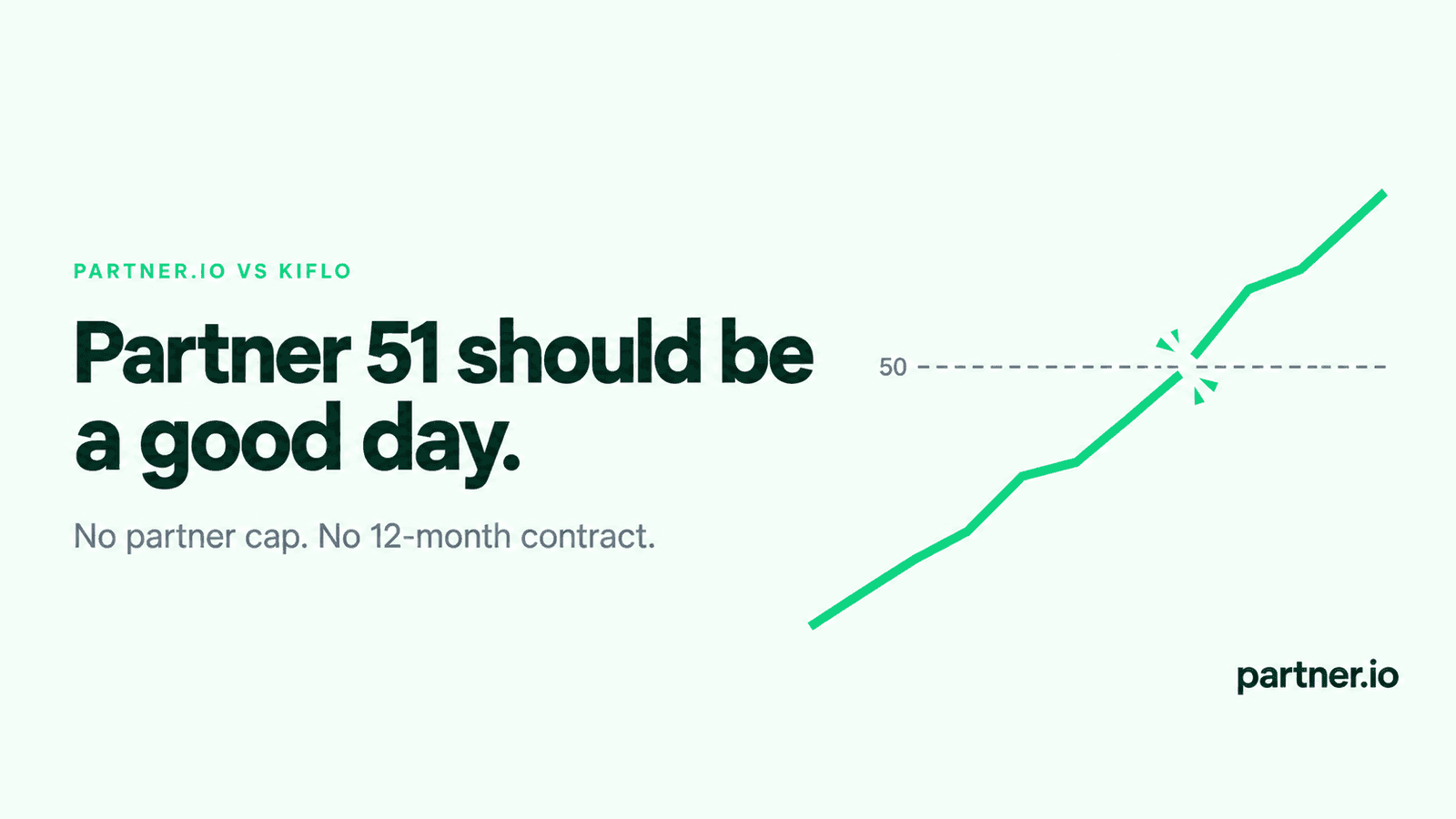
Partner number 51 should be a good day.
On Kiflo's Core plan, it's a sales call.
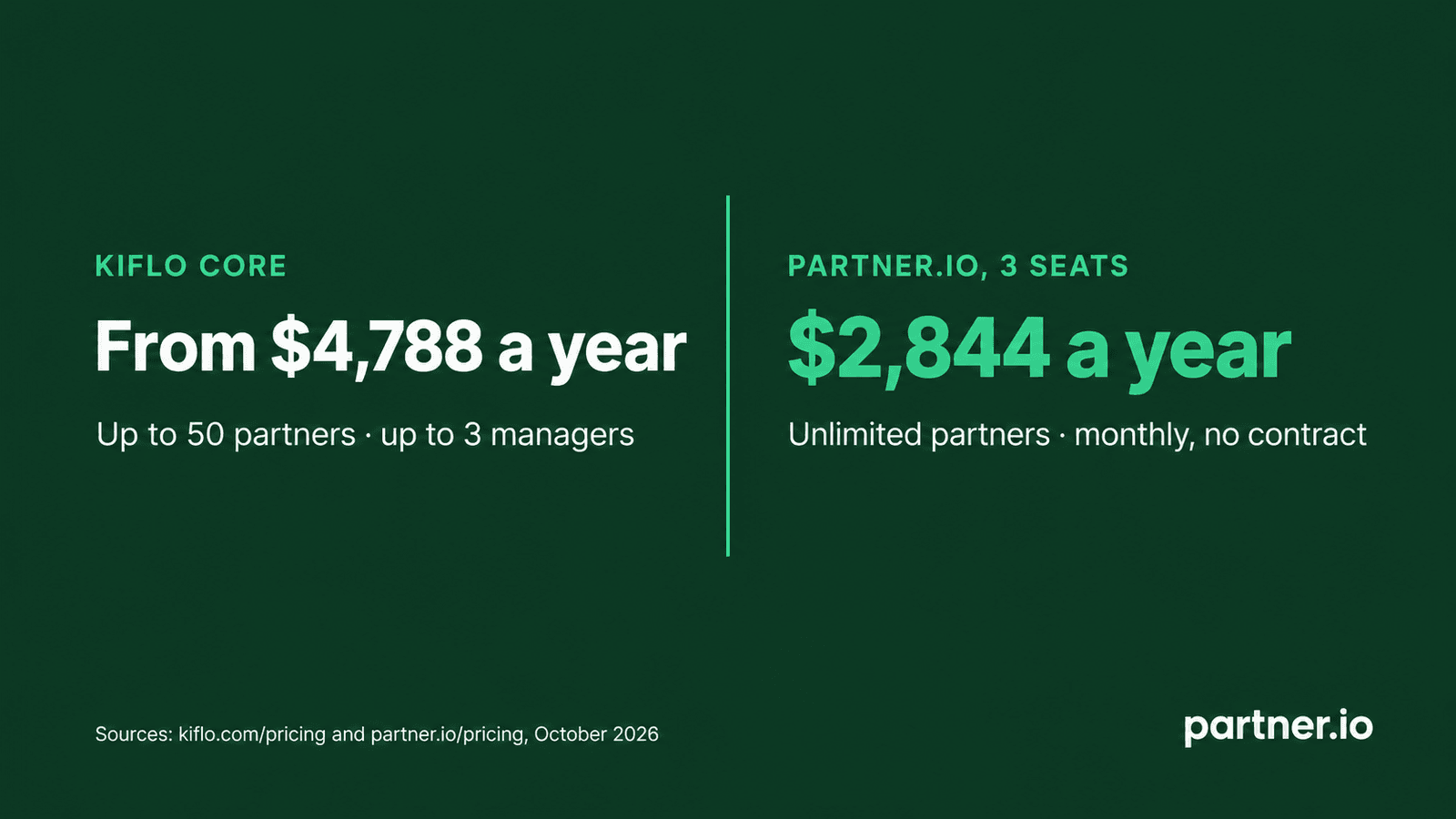
That's the sharpest difference in Partner.io vs Kiflo. Kiflo's entry plan lists a price that scales with active partners up to 50, with three partner managers, sold on 12-month contracts. Past either limit, you move to a plan with no published price. Partner.io charges $79 per seat per month for your own team, with unlimited partners, no contract and payouts built in.
Both tools run a partner portal, register deals, map accounts and calculate commissions. The question is which one still fits when the program works.
The short answer
Pick Kiflo if you run Salesforce and expect to stay under 50 partners. It also suits programs full of EU resellers who need VAT reverse-charge invoices, where finance insists on releasing every payment itself.
Pick Partner.io for almost everything else. You get a published price, unlimited partners, monthly billing and a self-serve trial. Pipedrive syncs natively, and partners get paid through Stripe from the same place you approve their commissions.
Most SaaS programs under $25M ARR plan to grow past 50 partners. That's the point of building one.
The strongest case for Kiflo
Start with the argument against us, because parts of it hold.
Kiflo lists HubSpot and Salesforce as full native two-way integrations on every plan. Partner.io syncs natively with HubSpot and Pipedrive, and turns Salesforce on per account on request. If your sales team lives in Salesforce, ask us about it before you trust a blog post.
Kiflo also validates EU VAT IDs and applies reverse charge on the partner invoices it generates. For a program built on European resellers, that's real work taken off your plate.
And some finance teams want the money to leave from their own bank, on their own schedule. Kiflo is built that way. Its commissions page says finance releases the money.
Here's the test. Count the partners you expect to have in eighteen months, and count the people on your team who'll work with them. If the answers are "under 50" and "three or fewer", Kiflo's Core plan holds. If either number is bigger, you'll be renegotiating mid-contract, and the price is no longer on the page.
That growth isn't a stretch. Partners already carry most B2B buying, according to Forrester's buyer research:
“nearly 70% of over 10,000 global B2B purchase influencers in the past 12 months purchased their offering from an indirect route to market or partner rather than directly from the supplier.
”
The summary sits in Forrester's data snapshot on partner ecosystems. If partners are where your buyers go, your partner count should climb. Your PRM shouldn't punish that.
Partner.io vs Kiflo at a glance
Kiflo facts come from its own pricing, product and integration pages, checked on October 30, 2026. Pricing pages change, so confirm before you sign.
| Partner.io | Kiflo | |
|---|---|---|
| Price | $79 per seat per month | Core $399 a month, scaling with partners; Plus and Premier through sales |
| Partners | Unlimited, free | Core up to 50 |
| Your team | Any number of seats | Core up to 3 managers |
| Contract | Monthly, cancel anytime | 12-month contracts, billed once a year |
| Try it | 7-day trial, no card | Trial or proof of concept on request |
| Paying partners | Stripe payouts in the tool, 0% fee | Your finance team pays from an export |
| Pipedrive | Native two-way sync | Zapier or REST API |
| Salesforce | On request | Native on every plan |
| Account mapping | Built in, plus Deal Surround | Built in |
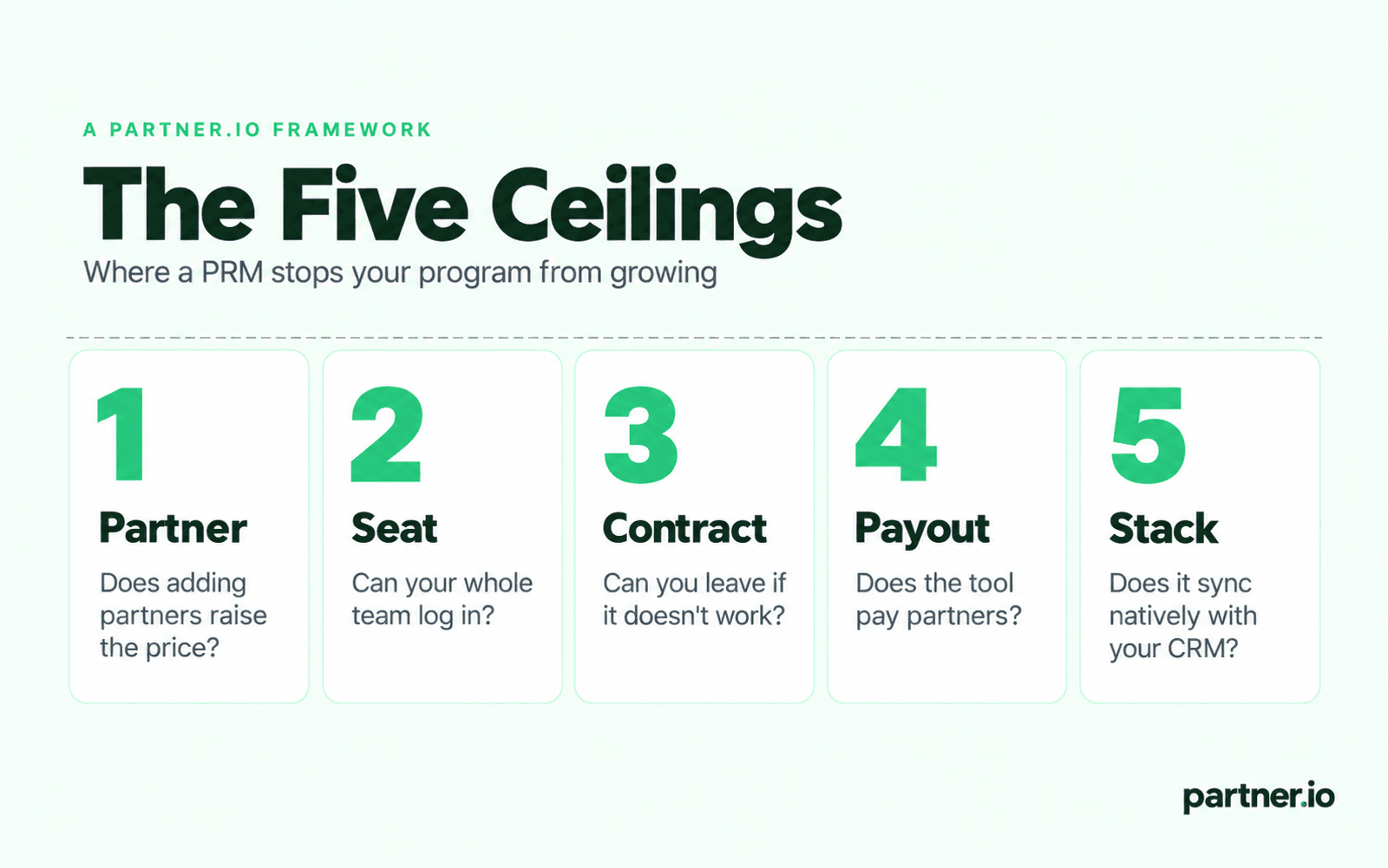
The Five Ceilings
Feature lists don't tell you much, because every PRM has a portal and a deal form. What separates them is where they stop you as the program grows. We call these the Five Ceilings. Run any PRM through them, including us.
1. The Partner ceiling
Kiflo's pricing page says Core's price scales with active partners, up to 50, and tells you to move to Plus if you need more. An active partner is any partner with at least one user who can log in to the portal.
Read that last part again. Inviting a partner to the portal is what makes them count. So every new reseller you onboard nudges the bill, and the 51st one changes your plan.
That creates a quiet incentive to keep partners out: ration logins, leave the agency's second rep off, send deal updates by email instead. Every one of those choices undoes the reason you bought a portal.
On Partner.io, partners and partner reps are free and unlimited. Invite the agency's whole delivery team into the partner portal and nothing changes on your invoice.
2. The Seat ceiling
Core allows three partner managers. A fourth person, say a RevOps lead who wants to clean up deal records, means Plus, and Plus is priced through sales.
Partner.io bills per seat on your team at $79 a month, pro-rated when you add someone. Four seats cost $3,792 a year. Five cost $4,740. Kiflo's own FAQ says Kiflo starts at $4,788 a year, so five Partner.io seats with unlimited partners still come in under Kiflo's entry price.
3. The Contract ceiling
Kiflo's FAQ says its plans are 12-month contracts, billed once a year. The page also shows a monthly and yearly toggle on Core, so ask which terms apply to you.
A year is a long time for a partner program under $25M ARR. You might change partner model, change CRM, or find that resellers outperform referrals and rebuild your tiers. Locking a year of spend before you've seen partners log in is a bet on a plan that hasn't met reality.
Buyers have said for years that they want to see pricing and try before they talk to anyone. In TrustRadius's buying research, 81% of buyers wanted to find pricing information on their own. Megan Headley of TrustRadius summed up the industry:
“We live in the age of obscurity when it comes to software pricing.
”
Gartner's 2025 sales survey found 61% of B2B buyers prefer an overall rep-free buying experience. Partnership leaders are buyers too.
Partner.io's pricing is monthly, with no contract and no setup fee. Start a 7-day trial without a card and cancel from billing settings whenever you like.
4. The Payout ceiling
This is where the two tools part ways most.
Kiflo calculates commissions and prepares payouts with a ready-to-pay export. Then, in its own words, finance releases the money. On Core, payout statements are triggered by hand; automatic statements and self-invoicing come with Plus.
So the partner manager approves a commission in Kiflo, exports a file, sends it to finance, and waits. Finance pays from the bank, then someone marks the payout as paid back in Kiflo. Every handoff is a place for a payment to sit. And a late payment is the fastest way to lose a partner's attention.
Partner.io closes the loop. Commissions are approved by hand or by rule, bundled into self-billed invoices and paid through Stripe or bank transfer, to the partner organization or to individual reps, in twelve currencies.
Stripe's Connect payout documentation says standard payouts typically land one to two business days after submission. Partner.io takes 0% of what you pay partners. See tiers, commissions and payouts.
US companies also get W-9 collection and Form 1099-NEC generation through tax compliance. The IRS says to use Form 1099-NEC to report nonemployee compensation, which is exactly what a referral commission is.
“A partner program runs on trust, and trust runs on getting paid on time. Every handoff between approval and payment is a place for that trust to leak.
”
5. The Stack ceiling
Kiflo's integrations page lists HubSpot and Salesforce as native two-way. Its Pipedrive page describes two routes: Zapier, or building against Kiflo's REST API.
If you sell on Pipedrive, that's a Zap to maintain, or a developer project, before partner deals show up where your reps work. Partner.io syncs two-way with Pipedrive and HubSpot natively, so a registered deal lands in your CRM with the partner attached.
On automation, Partner.io runs Flows on 17 triggers, plus auto-approval rules for partners, leads and commissions. And for co-sell, both tools include account mapping. Partner.io adds Deal Surround, which ranks the partners who already know a target account. Try the no-signup Deal Surround demo to see it on real accounts.
Want to test the Five Ceilings on a real portal? Try Partner.io free for 7 days, no credit card needed.
Where Kiflo still holds up, and why it rarely decides it
Fairness matters in a comparison, so here's the full list of Kiflo advantages we found, and what each one is worth.
Native Salesforce on every plan. A real point. On Partner.io, Salesforce is switched on per account on request, so ask during your trial.
EU VAT reverse charge on partner invoices. Useful for European reseller programs. For most US-based SaaS teams paying US referral partners, 1099-NEC matters more, and that's where Partner.io does the work.
Finance-controlled payments. If finance must pay from its own bank, Kiflo fits that process. Most partner teams would rather have partners paid in two days than defend an export every month.
Influence attribution. Kiflo tracks partner influence as well as sourced deals. Partner.io credits each lead and deal to its partner from referral to commission, synced with your CRM.
Everything else, from portal to deal registration to account mapping to AI assistants in Claude and ChatGPT, both tools cover. That leaves the Five Ceilings to decide it. Partner.io removes four of them outright.
How to run a 7-day side-by-side
Don't take our word for it. Run both for a week.
- Day 1: write down three numbers. Partners you expect in 18 months, people on your team who'll use the tool, and commissions paid last year.
- Day 1: start a Partner.io trial and ask Kiflo for its trial or proof of concept on the same day.
- Day 2: invite three real partners into the Partner.io portal: a referral partner, an agency and a reseller.
- Day 3: register a live deal and check it lands in your CRM with the partner attached.
- Day 4: approve a test commission and follow it to an invoice and a payout.
- Day 5: get Kiflo's quote in writing for your 18-month partner count, not today's.
- Day 7: put both annual costs side by side, including the cost of a year's contract you can't exit.
The decision rule: if you'll stay under 50 partners and three managers for the full contract, run Salesforce and want finance to pay, Kiflo works. If not, you'll outgrow Core inside a year, and Partner.io gives you the room at a price you can see today.
When switching breaks
Switching PRMs mid-year makes people nervous, and fairly. Here's where it goes wrong.
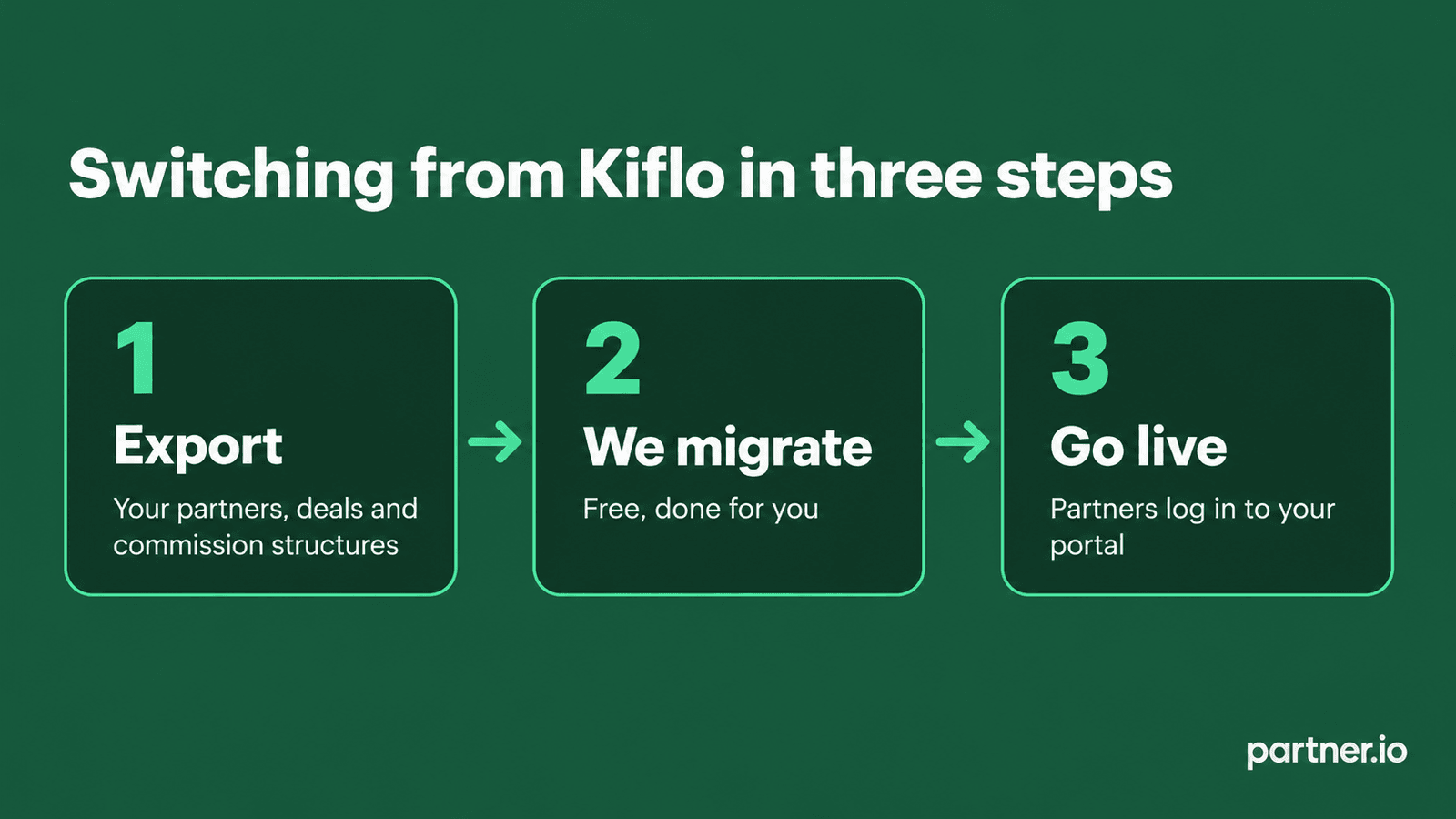
If you're moving from Kiflo, send us your export. We migrate partners, deals and commission structures at no charge, and most teams are live within days.
What this looks like in the real world
Here's an illustrative example, not a customer story.
A 35-person SaaS company sells through Pipedrive. Partnerships is three people. One owns the program, one works with partners day to day, and a sales engineer helps with co-sell.
In January they have 38 partners. Agencies are converting, so by June they've signed 16 more.
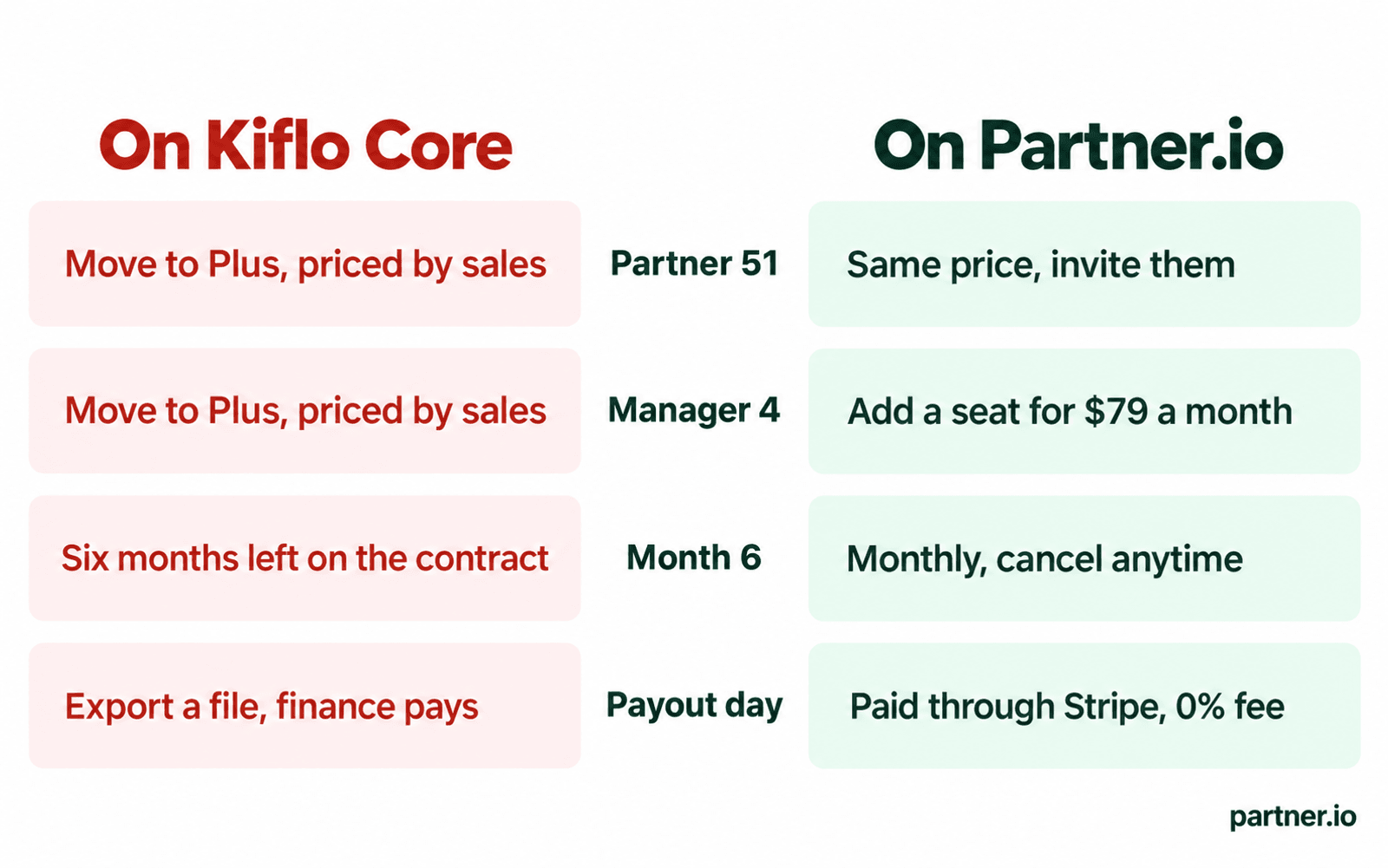
On Kiflo Core, partner 51 arrives in May. So does the request to add a RevOps lead as a fourth user. Both mean Plus, priced through sales, partway through a 12-month contract. Meanwhile partner deals reach Pipedrive through a Zap someone built in February, and agencies get paid when finance runs the export.
On Partner.io, May looks like any other month. The fourth seat adds $79. The new agencies get portal logins the day they sign. Their deals land in Pipedrive natively, and their first commissions go out through Stripe from the same screen where they were approved.
Same team. Same partners. One tool turned success into a renegotiation.
If you're still deciding which partner motion to build, read 7 partner program models for B2B SaaS. If you're still on spreadsheets, start with the hidden cost of managing partners in spreadsheets and what a PRM is and whether you need one.
Where Partner.io fits
Partner.io is built for SaaS teams running referral, agency, reseller and technology partners. On one plan, you get:
- A white-label partner portal on your own domain, free for unlimited partners
- Leads and deal registration with tracked links, a no-login quick-refer page and two-way CRM sync
- Tiers, commissions and payouts through Stripe, with 0% taken from payouts
- Training and certification with an AI course builder
- Account mapping and Deal Surround for co-sell
- Flows and auto-approval to cut the admin
Rebuilding incentives as you switch? Our guide to partner tier structures helps. Comparing more than two tools? See the full Partner.io vs Kiflo comparison, the list of Kiflo alternatives, and how we stack up in Partner.io vs PartnerStack.
Build the program you'll have next year
You don't buy a PRM for the program you run today. You buy it for the one you're about to have: more partners, more people working them, more commissions going out every month.
Kiflo prices that future in a sales call. Partner.io prices it on the page, and pays your partners when they earn it.
Try Partner.io free for 7 days → No credit card, no setup fee, cancel anytime.
Prefer a walkthrough first? Book a demo and we'll map it to your program.
- [prm]
- [comparisons]
Published October 30, 2026