
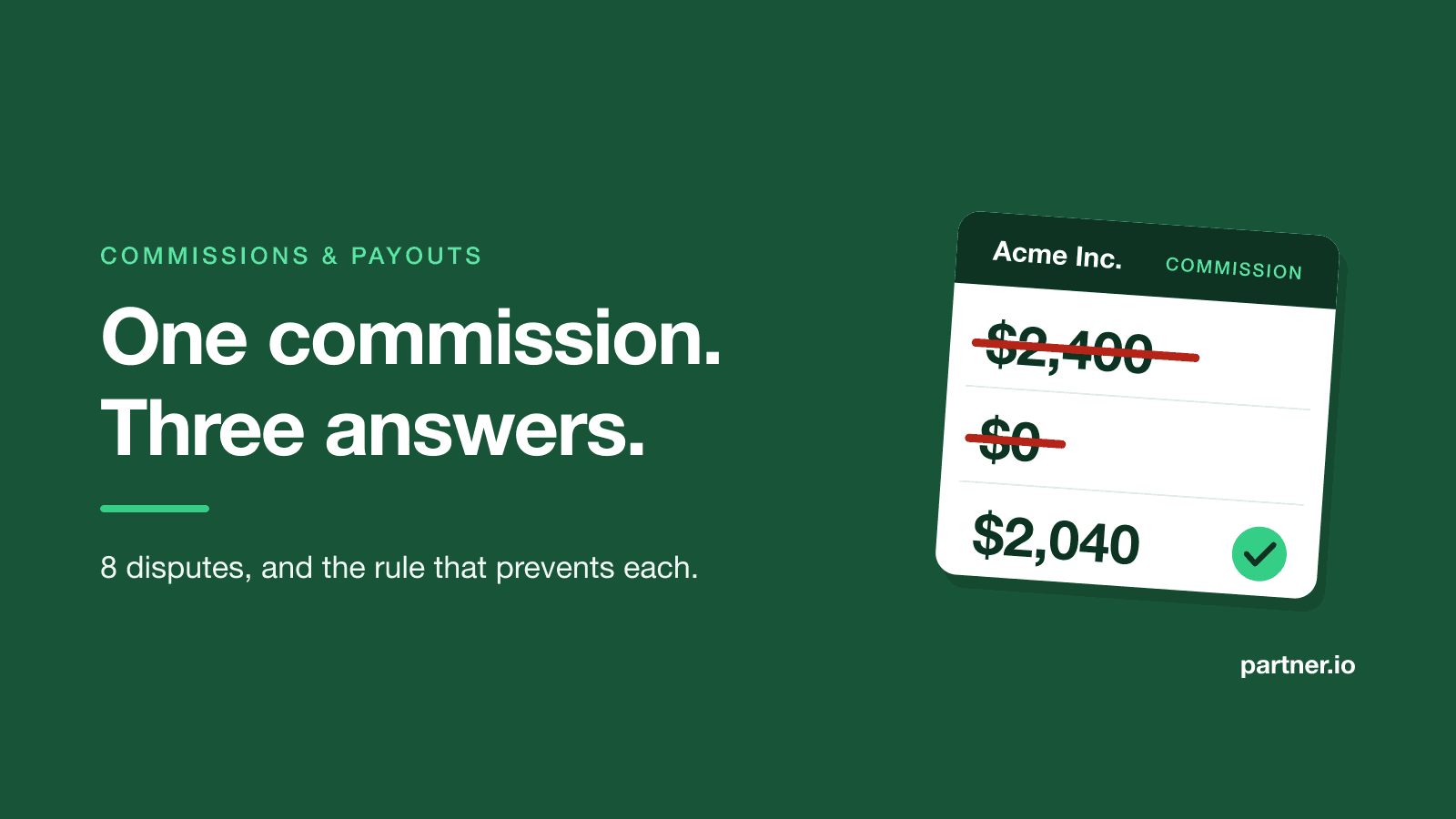
Most partner commission disputes start months before the payout. Here are the eight places they begin, and the one-sentence rule that closes each.
Most Partner Commission Disputes Start Months Before the Payout
The email lands on the third of the month.
"Hi, just checking on the Acme commission?"
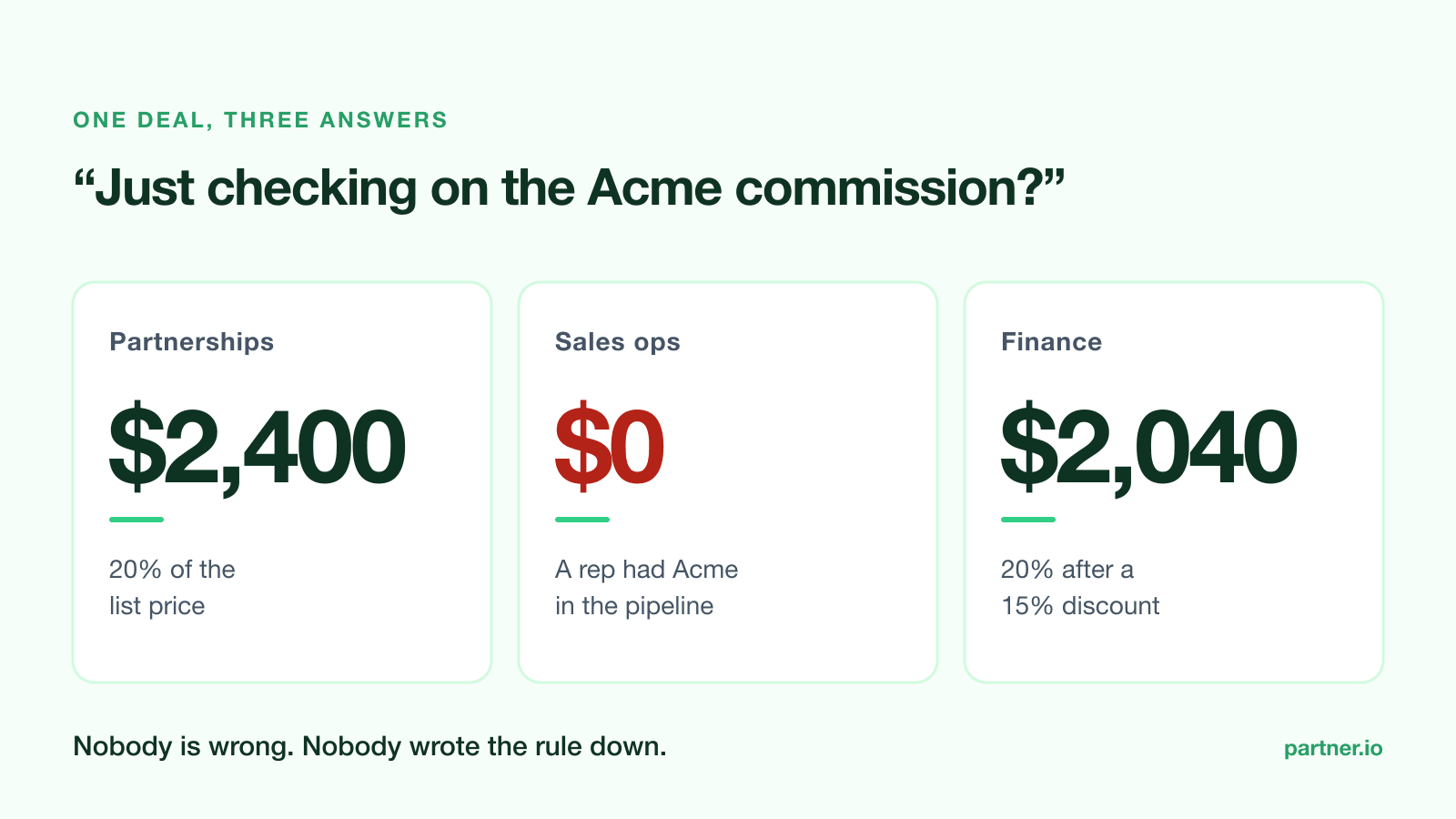
Three people look it up and come back with three numbers.
The partner manager says $2,400.
Sales ops says $0, because a rep had Acme in the pipeline.
Finance says $2,040, because Acme got a 15% discount at signing.
Nobody is lying. Each of them is applying a rule. They're just different rules, and none of them is written down.
That's how most partner commission disputes begin. Not with a greedy partner or a stingy finance team, but with a question the program never answered before the deal closed. By the time the partner asks, any answer you give is a ruling against someone.
Below are the eight places it happens, and the one-sentence rule that closes each.
"We'll sort it out on a call"
That's the strongest objection, and early on it's right.
With five partners you know personally, a rulebook feels like lawyering a friendship. A 30-page agreement nobody reads doesn't stop disputes anyway. It just gives both sides more to quote at each other.
Case by case works until the case is between two partners, or between a partner and your best rep. Then whoever decides is picking a winner after the result is known, and the loser remembers. A rule agreed before the deal costs nothing. A rule invented after the deal is a negotiation one side has to lose.
You don't have to choose between trust and terms. Research by Todd Zenger at Washington University found that writing down what can be written down lowers the trust a relationship needs to get going:
“We found that contracts and relational governance act as complements.
”
So keep the call. Just stop using it to make the rules up. What follows is eight sentences, not 30 pages, and the goodwill you've built with early partners is exactly what they protect.
Who gets credit: disputes 1 and 2
Attribution fights are the loudest kind, because there's a loser with a name.
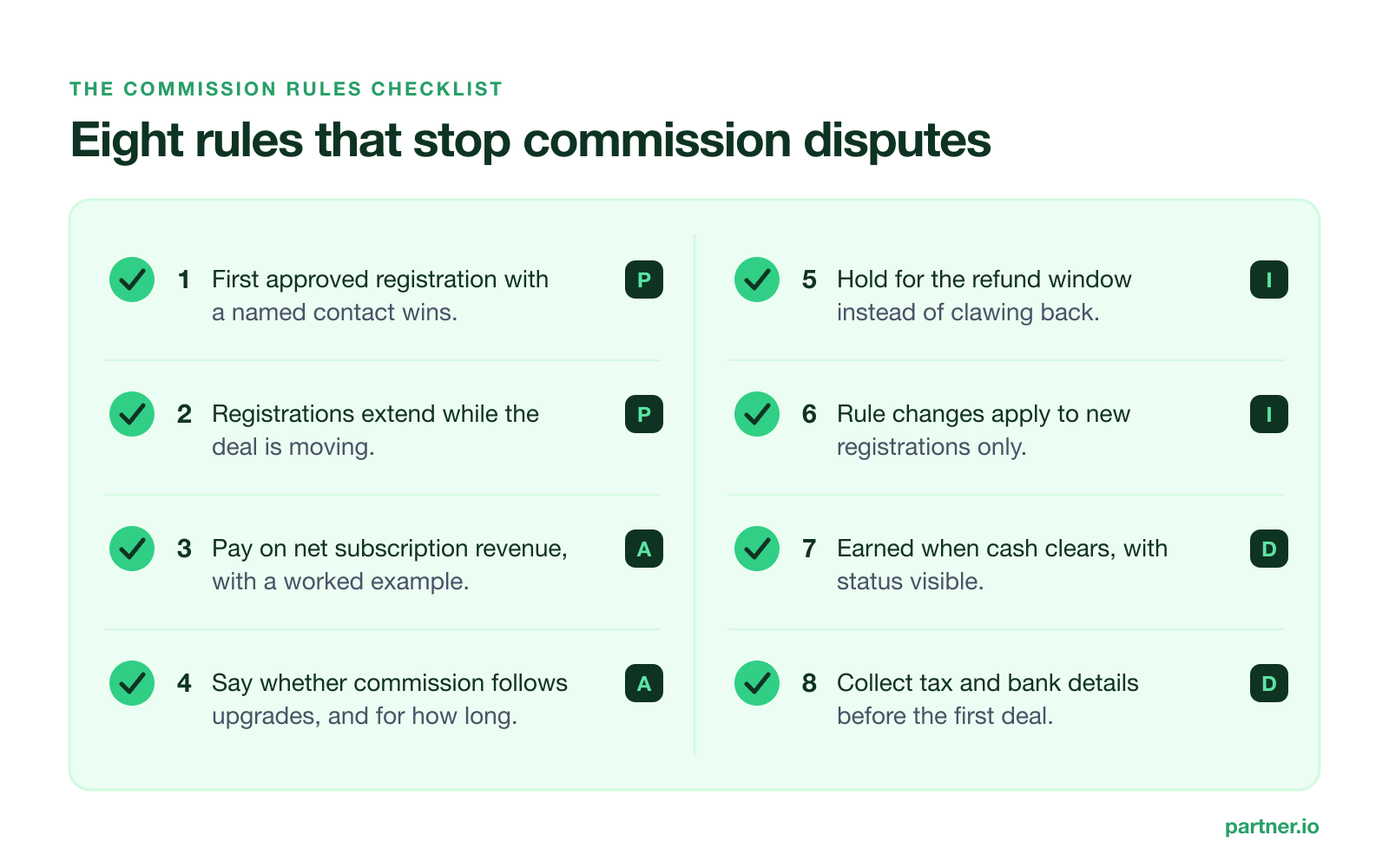
1. Two partners claim the same deal
An agency mentions a prospect on a pipeline call in March. A referral consultant submits the same company through your form in April. The customer signs in June and, asked how they heard about you, names both.
Or the other version: a partner registers the deal, and your AE says they had a discovery call with that account last year.
Both sides have a story. Neither has a record you agreed in advance would settle it.
For some partners, the fight with direct sales is getting worse. Eclipse's CEO told Channel Dive in May 2026:
“In my experience, we've had more conflict with direct teams in the last six months than probably the prior six years.
”
The rule: the first approved registration with a named contact wins, and "already in our pipeline" means an open opportunity with logged activity in the last 30 days.
That second half matters most. Without it, every rep can find a stale contact record from 2024 and call it prior engagement. With it, the decision is a CRM lookup.
If the rep's opportunity is open and active, the rep keeps the deal and the partner hears so within 48 hours.
If not, the partner's registration stands, and the rep gets told the same way.
HubSpot's published partner sales rules are blunter still. Only one partner can receive credit and revenue share in a single sales process, and if the rules don't settle priority, HubSpot decides and its decision is final. You may not want to be that firm. But every HubSpot partner knows the rule before they start.
2. The registration expired before the deal closed
Your deal registration lasts 90 days. The partner's prospect is a 600-person company with a security review, and the deal closes on day 131.
Finance checks the date and declines the commission. The partner did the work for four months and nobody told them a clock was running.
The rule: a registration lasts a fixed term, extends automatically while the deal is moving, and nobody loses one without a warning 14 days before it lapses.
"Moving" needs a definition too. A stage change or a logged meeting in the last 30 days is enough for most B2B sales cycles. Expiry exists to free up deals partners have abandoned, not to catch out the ones who are slow because your buyer is slow.
What the rate applies to: disputes 3 and 4
Most money disputes aren't about the rate. They're about what the rate is multiplied by.
3. "20% of what?"
The partner sees a $30,000 list price and expects $6,000.
Then the deal closes at $24,000 a year after a discount, with a $3,000 onboarding fee, quarterly billing and sales tax on every invoice.
Depending on who does the sum, the partner is owed $6,000 (list price), $5,400 (everything but tax) or $4,800 (subscription only). Three answers again, and each one has a spreadsheet behind it.
A rate is one dial and the anchor it applies to is another, as we showed in nine SaaS partner commission structures.
The rule: commission is calculated on net subscription revenue actually invoiced, excluding tax, one-off services and pass-through fees, and the agreement includes one worked example.
A worked example does more than the definition. A partner who has seen "$24,000 a year plus $3,000 onboarding: 20% of $24,000 = $4,800, paid in four parts as the customer pays each quarter" won't ask the question again.
4. The upgrade nobody priced
One referred customer starts on a $6,000 plan. In year two your customer success team moves them to $40,000.
The partner sees the logo on your case study page and expects 20% of $40,000. Your CS lead thinks the partner did nothing after the first call. Both are being reasonable.
The rule: say in one sentence whether commission follows the customer, the original contract or the partner's continued involvement, and for how many months.
Any of the three can work. HubSpot, for example, pays partners on net upsell MRR and cuts their commission by the same percentage when a customer downgrades. What fails is silence, because silence lets each side assume the answer that pays them. If you're still deciding the term, recurring vs one-time referral fees works through it partner type by partner type.
What happens when the deal changes: disputes 5 and 6
These are the disputes that feel personal, because something already promised gets taken back.
5. The refund, the churn and the clawback nobody mentioned
You pay a consultant $2,400 the week a deal closes. In month two the customer invokes the 60-day cancellation clause and gets a refund.
Now you're asking a one-person consultancy to send money back. They spent it in October.
The rule: hold commission for the length of your refund window instead of clawing it back, and if you ever must claw back, take it from future payouts, never by invoice.
Clawbacks aren't always wrong. The trade-off section below covers the one case where they're fair.
6. The rules changed while the deal was in flight
On 1 July you cut the referral rate from 25% to 15%. A partner registered a deal in May that closes in August.
Which rate applies? The partner says the one they signed up for. Finance says the one in force on the close date. Your agreement doesn't say either.
The rule: changes apply to registrations made after the effective date, every partner gets 30 days' notice in writing, and nothing already earned is ever recalculated.
Affiliates know how the alternative lands. On 14 April 2020, CNBC reported that Amazon would cut its Associates rates a week later: furniture and home improvement from 8% to 3%, grocery from 5% to 1%.
Amazon can absorb that backlash. A program with 30 partners can't.
When and how the money moves: disputes 7 and 8
The last two aren't about the amount at all. The partner agrees with your number. They just don't have it.
7. Booked vs paid
The deal closes on 28 March. The partner expects to see the commission in April's payout run.
But Acme is on net-60 terms, pays late, and the cash clears in June. Your finance team pays commission on cash collected, which is sensible. Nobody told the partner, so from their side you've gone quiet for ten weeks.
Late payment isn't an edge case. Atradius found 55% of US suppliers report B2B customers delaying invoice payments. Some partner deals will pay late, so decide now what the partner sees while they wait.
The rule: commission is earned when the customer's payment clears, paid in the next scheduled run, and the partner can see which stage it's at without asking.
Four stages cover it: pending, approved, scheduled, paid. A partner who can see "pending, waiting on customer payment" doesn't send the email at the top of this post.
8. The payout that stalled in silence
The commission is approved. Then it sits.
The partner never sent a W-9, so finance can't pay. Their bank details bounced. The amount is under your $100 minimum and rolls forward. It's due in euros and nobody agreed which day's exchange rate applies.
Each is a reasonable hold. Silence turns it into a dispute.
The W-9 hold has legal weight. The IRS instructions for Form W-9 set backup withholding at 24%. For nonemployee compensation it applies immediately, even while the payee waits for a taxpayer ID.
So a missing form doesn't just delay a US partner's payout. It shrinks it by almost a quarter, and the partner finds out when the money lands.
The rule: collect tax forms and bank details before the first deal, not the first payout, and send a notice with the reason whenever a payout is held.
The PAID test: four questions that prevent partner commission disputes
The eight rules sort into four questions. We call it the PAID test.
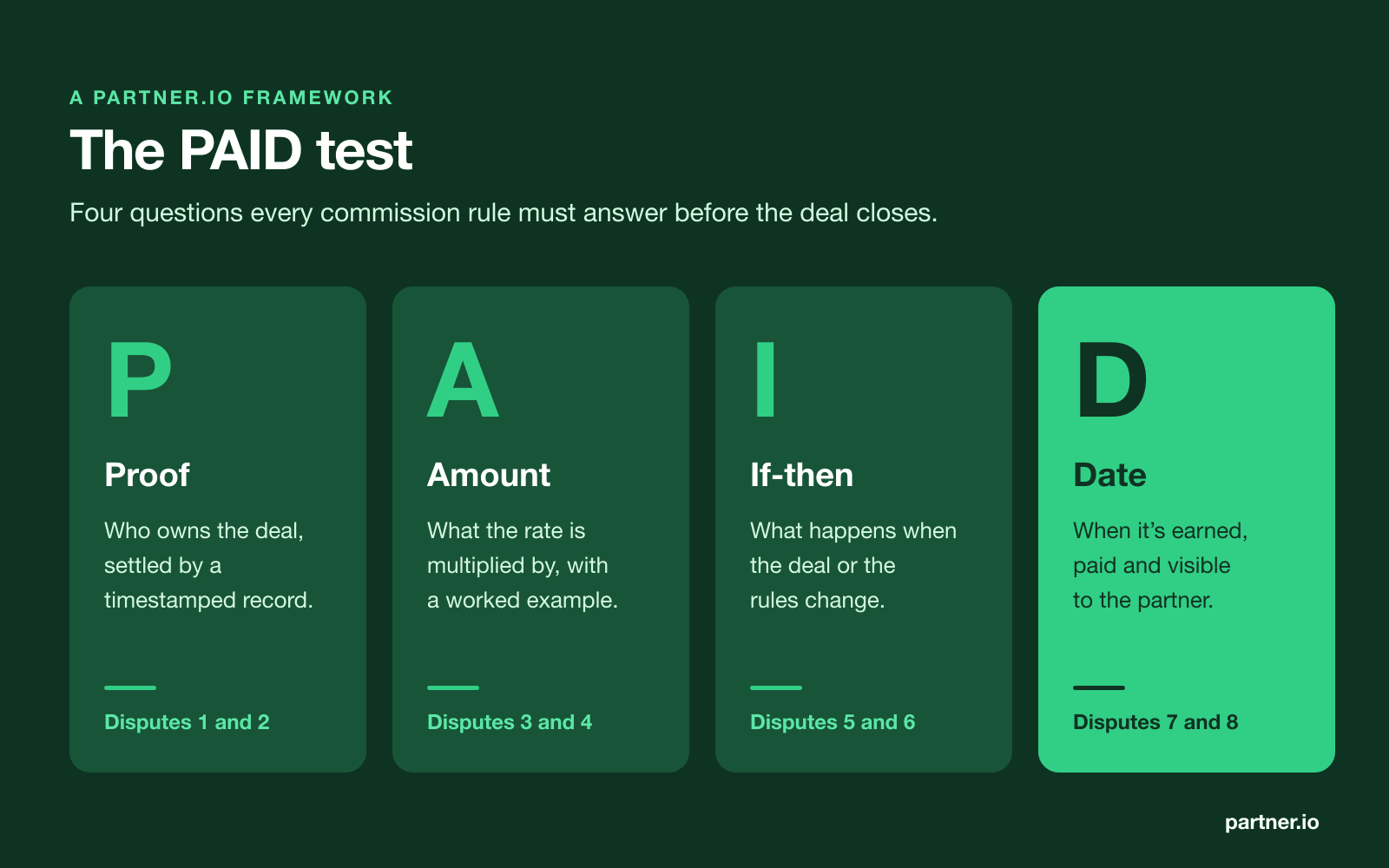
- Proof (disputes 1 and 2): who owns the deal, decided by a timestamped record instead of memory.
- Amount (disputes 3 and 4): what the rate is multiplied by, written as a formula with a worked example.
- If-then (disputes 5 and 6): what happens when the deal changes after the close, or the rules do.
- Date (disputes 7 and 8): when commission is earned, when it's paid and what the partner can see in between.
Run every new partner type, deal type and rate change through the four questions before it goes live. If any answer starts with "it depends", you've found your next dispute. Write the sentence now, while nobody is owed anything.
Want to run the PAID test in a real portal? Try Partner.io free for 7 days, no credit card needed.
How to write your commission rules in an afternoon
You don't need a lawyer for the first draft. You need your inbox.
- Pull the last ten commission questions from email, Slack and partner calls. Tag each one P, A, I or D.
- Write one sentence per dispute using the eight rules above as a starting point. Change the numbers to fit your sales cycle and refund window.
- Add one worked example: a single deal with a discount, an upgrade in year two and a refund. Show the commission at each step.
- Match the sales comp plan. Reps and partners need the same "already in pipeline" definition, or dispute 1 comes back through the side door. See sales and partnerships alignment for rules of engagement.
- Set the dispute process: partners raise a query within 30 days of a statement, you reply within five working days, one named person decides, and the decision is logged.
- Publish it where partners already are: in the signed agreement and the portal, not a Google Doc linked from a welcome email.
- Review it every quarter against the questions you received. A rule that still generates questions needs rewriting.
Hold or claw back: the trade-off you're choosing
Rule 5 forces a choice most programs make by accident.
| Hold for refund window | Pay now, claw back | |
|---|---|---|
| Partner gets paid | Later | Sooner |
| Disputes | Rare | Frequent |
| Your admin | Low | Chasing money |
| Best for | Referral, affiliate | Resellers you pay often |
If your partners are paid every month and have commission flowing in, a clawback offset against the next statement is fair and simple. If not, hold. A consultant paid twice a year can't absorb a reversal, and won't refer again after one.
What this looks like in the real world
An illustrative example, not a customer story.
A 35-person SaaS company has 20 active partners: consultants, implementation agencies and a few resellers. The partner manager spends the first three days of every month answering payout questions.
She pulls six months of messages and tags them with the PAID letters. Almost none are about the rate. Most are Date questions: is it approved, when does it pay, why is it less than last time. The rest are one attribution fight with sales and two partners nobody told about a rate change.
She writes eight sentences and gets finance and the head of sales to sign them. Commission status goes into the portal. The two partners on the old rate keep it for every deal registered before the change.
The emails don't stop. They change. "Where's my money?" becomes "the portal says pending, is the customer paying late?", which takes thirty seconds to answer.
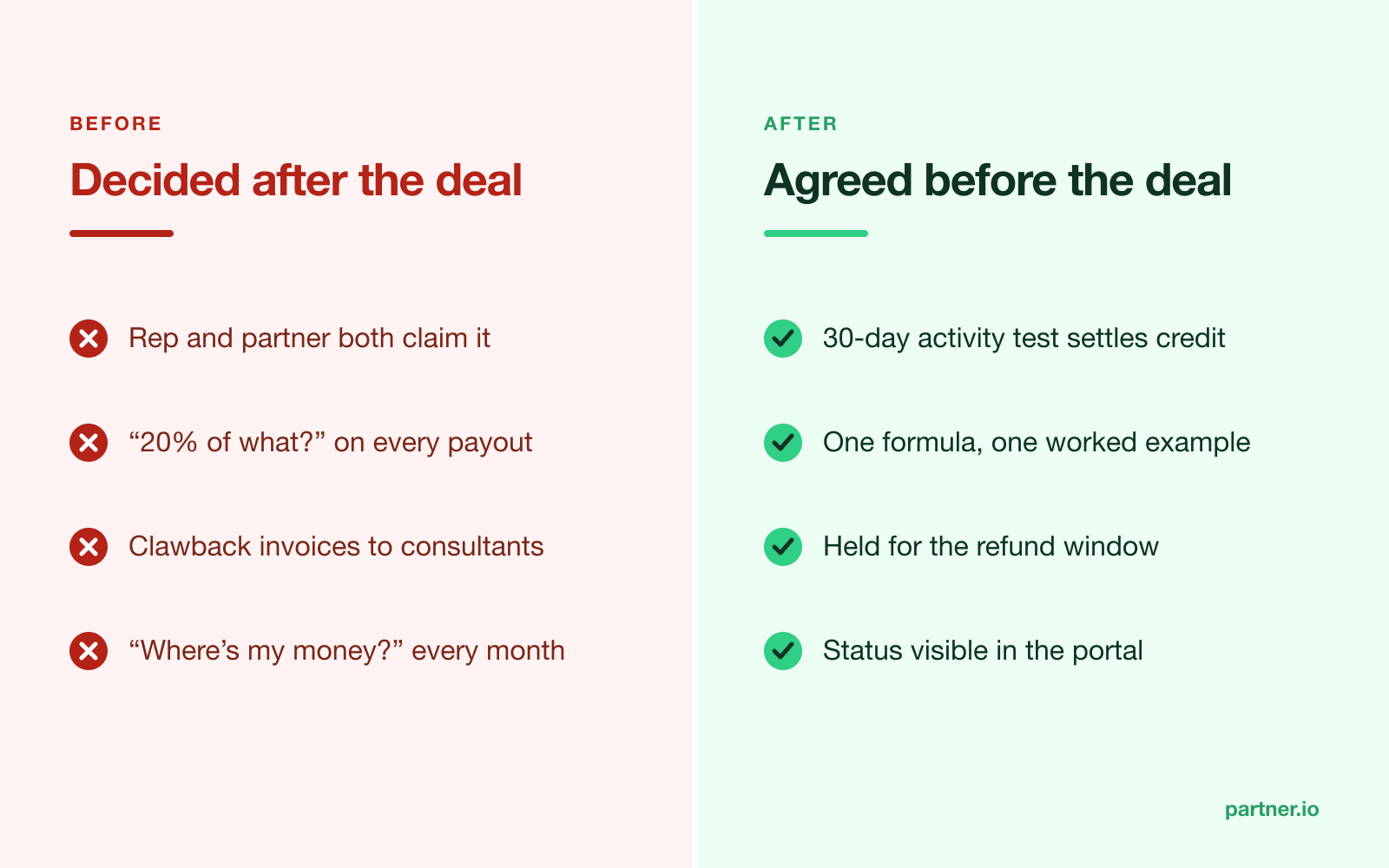
Where Partner.io fits
Writing the rules is the thinking. Applying them to every deal, every month, is where spreadsheets fail, and we've written about what that costs.
“A commission rule that lives in someone's head gets applied differently every time they're tired.
”
Here's how Partner.io maps to the PAID test.
Proof. Partner.io records who referred what and when, attributes every lead to a partner and rep, and keeps a timeline of each change. Referrals and registered deals are approved by hand or by rule, then sync to HubSpot, Pipedrive or Salesforce with the partner attached. See leads and deal registration.
Amount. Commissions are set as a percentage of deal value or of each recorded payment, with conditions on deal value, partner type or any custom field. Each self-billed invoice shows the commission, the trigger and the lead, so the partner can check the sum. See tiers, commissions and payouts.
If-then. A payout delay in days, weeks or months covers your refund window, so you hold instead of claw back. Agreements are signed in the partner portal, and changing the terms forces a re-sign, so nobody can say they weren't told.
Date. Every commission moves from pending to approved to scheduled to paid, and partners see each lead with its status, deal value and commission in their portal. Approval rules in automation keep an audit trail of every decision, including why one was left for review. US partners complete a W-9 during onboarding and get a 1099-NEC at year end through tax compliance, so the W-9 version of dispute 8 never starts.
Write the eight sentences before the next payout run
Every commission dispute you've had was a rule you hadn't written yet.
Pull your last ten partner questions this week. Sort them with the PAID test. Write the sentences, show your partners where to check their money, and the email on the third of the month stops being a fight.
Try Partner.io free for 7 days → No credit card, no setup fee, cancel anytime.
Prefer a walkthrough first? Book a demo and we'll map it to your program.
- [prm]
- [referrals]
- [revops]
Published November 25, 2026