
Buyers pick a favourite before they ever fill in your form. Partner-influenced revenue is how you get on that shortlist. Here's the data and the ROOM framework.
Partner-Influenced Revenue Starts Before Your Funnel Does
Your funnel starts when a buyer fills in a form.
Their decision started months earlier.
Somebody else was in the room for it.
That's the uncomfortable maths behind partner-influenced revenue. By the time a prospect books a demo, they usually know who they want to buy from. The person who put that name in their head was rarely your ad, your SDR or your nurture sequence. It was an agency, an integration vendor, a consultant or a peer they trust.
Your next deal will come from that conversation. Your funnel will just be where it gets logged.
The shortlist is written before your funnel opens
6sense surveyed nearly 4,000 B2B buyers for its 2025 Buyer Experience Report. Two numbers from it should change how you plan pipeline.
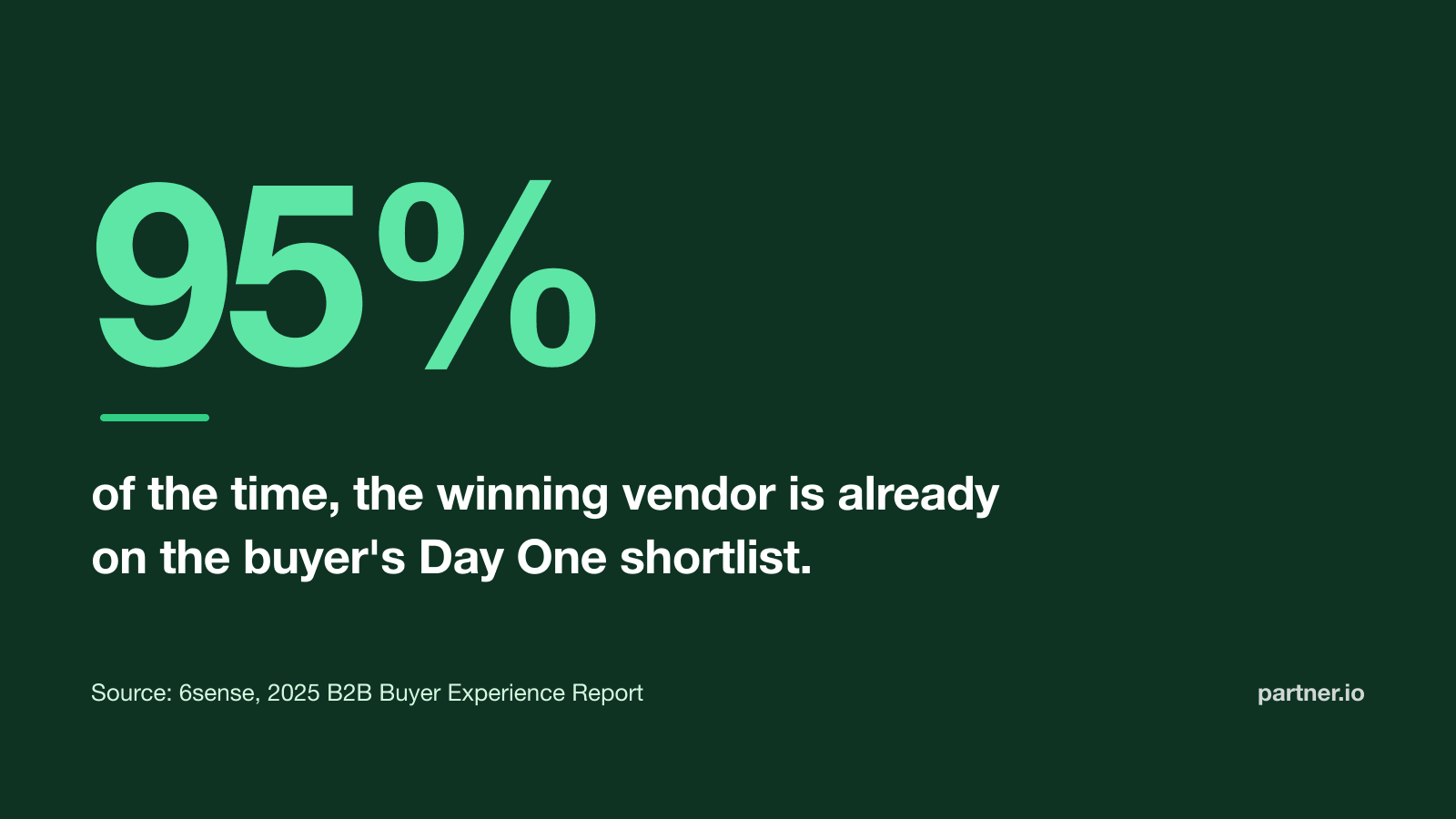
Ninety-five percent of the time, the winning vendor was already on the buyer's Day One shortlist.
Four out of five deals went to the vendor the buyer favoured before speaking to any seller.
Forrester found the same pattern from a different angle. In its 2024 Buyers' Journey Survey, 92% of buyers started with at least one vendor in mind, and 41% already had a single preferred vendor before formal evaluation began.
“B2B buying today is a process of confirmation, not selection.
”
Read that as an operator and the implication is blunt. The B2B sales funnel you've spent years tuning mostly processes decisions that were made somewhere else. It measures demand well. It creates very little of it.
"But buyers are reaching out to sellers earlier now"
They are, and it's the strongest objection to everything above.
The same 6sense study found buyers now first contact a seller 61% of the way through a purchase, down from 69%. That's roughly six to seven weeks earlier. Buyers are pulled into conversations sooner, partly to check AI claims, pricing and security. If buyers arrive earlier, the argument goes, the funnel gets more chances to win them.
Except the shortlist didn't move. 6sense's own summary says decisions "remain locked in before first contact", with the 95% and four-in-five figures holding. Buyers arriving earlier are verifying a favourite, not looking for one. They also average eight to nine previous purchases in the category, so they're hard to talk round.
Earlier contact gives your sales team more time with a buyer who already leans one way. Whether that lean points at you was settled before the form fill.
Nine people outside the company shape the average deal
Here's who settles it.
Forrester's Buyers' Journey Survey 2025 found that an average purchase decision involves 13 people inside the buyer's organisation and nine from outside. Nine outsiders. Most funnels have no field for any of them.
“…you’re not selling to an individual but to their entire network
”
For a B2B SaaS buyer, those outsiders look familiar:
- The implementation agency scoping a rebuild, which recommends the stack it already knows how to deploy.
- The integration partner whose app is installed, and whose team gets asked "what do your other customers use for this?"
- The fractional consultant or advisor who sits in on vendor selection for three clients a quarter.
- The reseller or MSP that owns the relationship and the renewal conversation.
- The peer customer in a Slack community, answering a thread at 10pm.
Every one of them is a partner, or could be. Most are working for you already, unpaid and unrecorded, or working for a competitor who bothered to ask.
Your attribution report calls partner influence "organic"
Follow one deal through a typical CRM.
An agency mentions you on a scoping call. The buyer searches your brand name that evening, reads two pages and books a demo. Your CRM stamps the contact Organic search. Marketing claims it, sales closes it, and the agency hears nothing.
Next quarter, that agency recommends a competitor who sent it a thank-you and a commission.
This is why partner-influenced revenue stays invisible. Funnel attribution records the last door a buyer walked through, and partners almost never own the door. They own the reason the buyer was walking down that corridor at all.
When partner referrals do get recorded properly, they outperform. Ebsta and Pavilion's 2025 GTM Benchmarks report ranked partner referrals the most efficient source, 30% above average, scoring 1.3x against 1.05x for outbound and 0.68x for paid. We broke down the earlier version of that data in partner referrals: 10% of pipeline, 31% of revenue.
The channel that performs best is the one your reports can see least.
Funnel spend fights over the last 5%
If the winner is on the Day One list 95% of the time, every dollar spent pushing a buyer who didn't shortlist you is a long shot. Retargeting, gated content and SDR follow-up all work on buyers already in motion. Very little of that spend reaches the conversation that decided the list.
That doesn't make the funnel useless. It makes it a different tool from the one most plans assume.
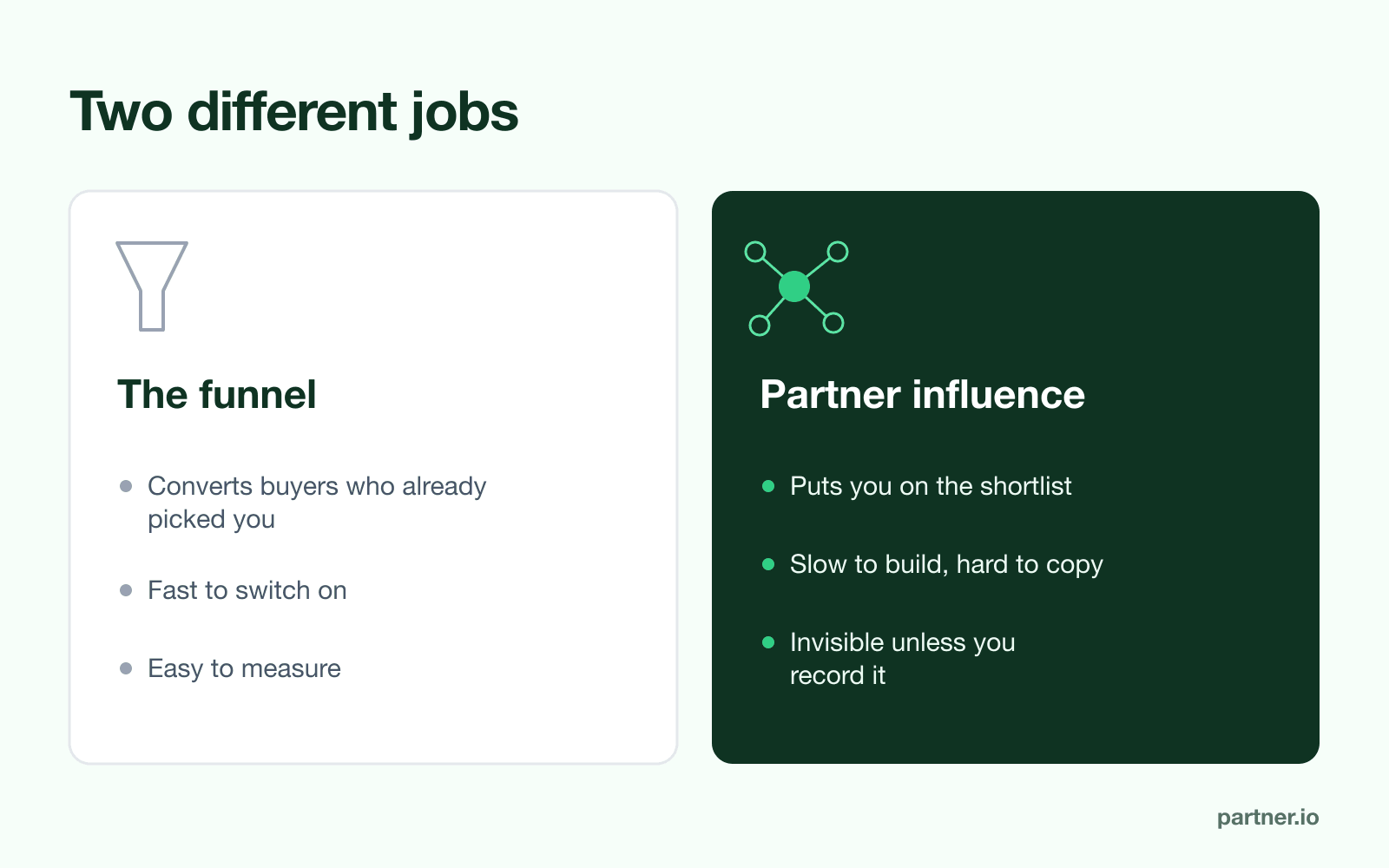
| Funnel | Partner influence | |
|---|---|---|
| Best at | Converting known demand | Creating the shortlist |
| Control | High | Shared |
| Time to start | Days | Months |
| Trust at first contact | Low | Borrowed from the partner |
| Shows in attribution | Always | Only if you record it |
The trade-off is control for position. You can switch a paid campaign on by Friday. You can't switch on an agency's recommendation, and you can't fully steer what a partner says about you. What you get in return is a seat on the list before anyone else is in the running.
The ROOM framework: get named before the funnel opens
If the deal is decided in a room you're not in, the job is to get represented there. We call it the ROOM framework: four moves that turn the outsiders around your buyers into partner-influenced revenue you can plan, see and pay for.
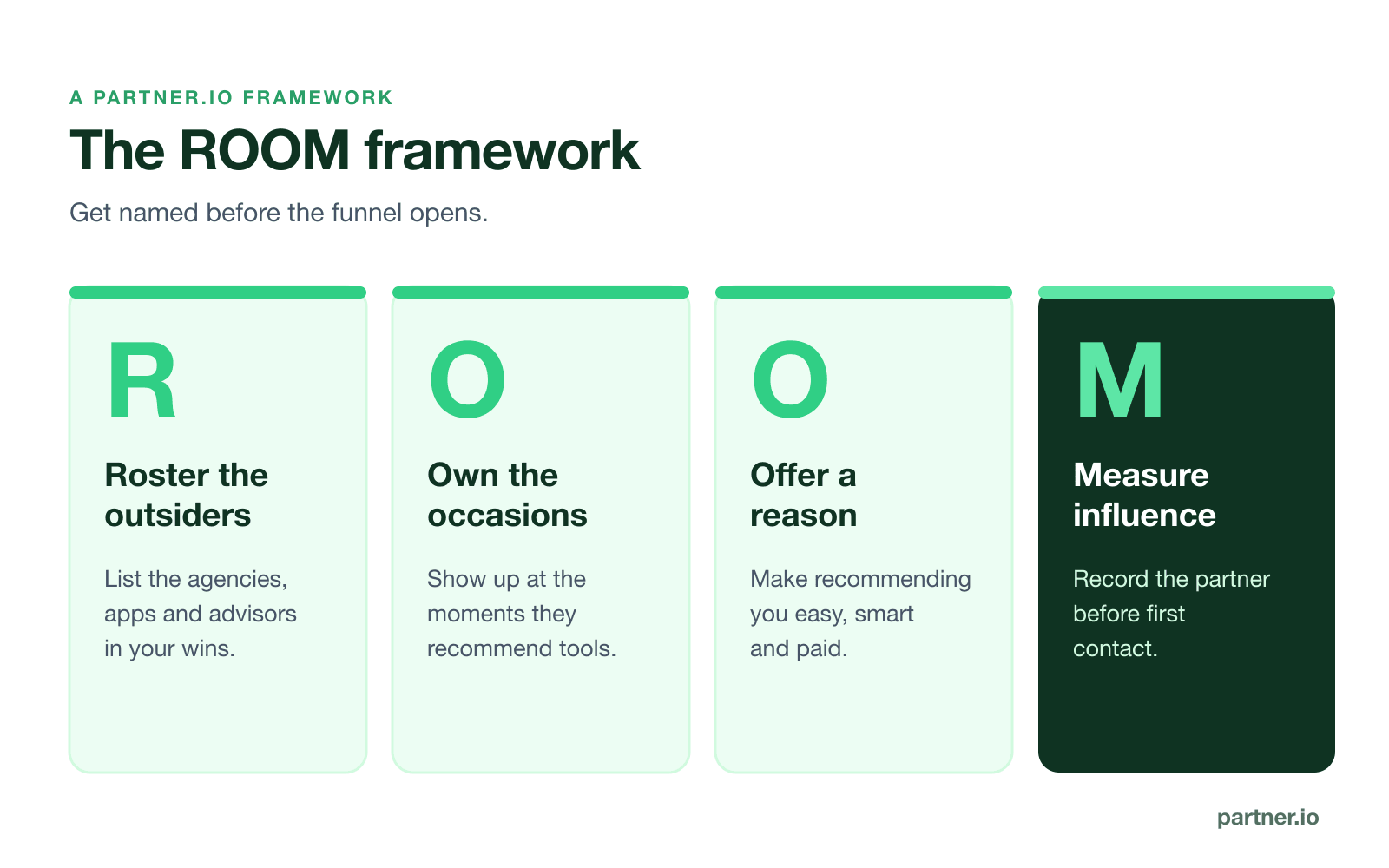
R: Roster the outsiders
List the companies and people in the room when your buyers choose. Not "partners" in general. For your last 20 wins, which agencies, integration vendors, consultants and resellers were involved?
Most teams find two or three names repeat. Those are your first partners, whether or not they've signed anything.
O: Own the occasions
Outsiders don't recommend vendors at random. They do it at predictable moments: the scoping call, the platform migration, the quarterly business review, the "what else should we connect?" question after an integration goes live.
“Companies are now looking at these 28 moments, which is the average of a considered purchase.
”
McBain said that on Demandbase's podcast. You don't need all 28. Pick the three where your partners are already present and make sure your name comes up there.
O: Offer a reason to say your name
A partner recommends you when doing so makes them look good, saves them work or pays them. Ideally all three.
Give the agency a one-paragraph answer to "why this over the obvious option" for their kind of client. Give the integration partner a joint use case their CSMs can repeat. Then pay for the introduction in a way that's visible and quick, because a commission nobody sees for four months doesn't change behaviour. Our guide to partner commission structures has the maths.
M: Measure influence, not only source
Add one field: which partner was involved before first contact. Record it at registration, not at close, when memories have been rewritten by whoever wants the credit.
Then report partner-influenced revenue next to partner-sourced revenue. Forrester's State of Partner Ecosystems 2025 found two-thirds of respondents expect partner-influenced revenue to grow more than 30% on the previous year. You can't manage that growth if your CRM calls it organic.
Want to run ROOM in a real portal? Try Partner.io free for 7 days, no credit card needed.
How to run a shortlist audit in two weeks
You can test the thesis on your own deals before you change a single budget line.
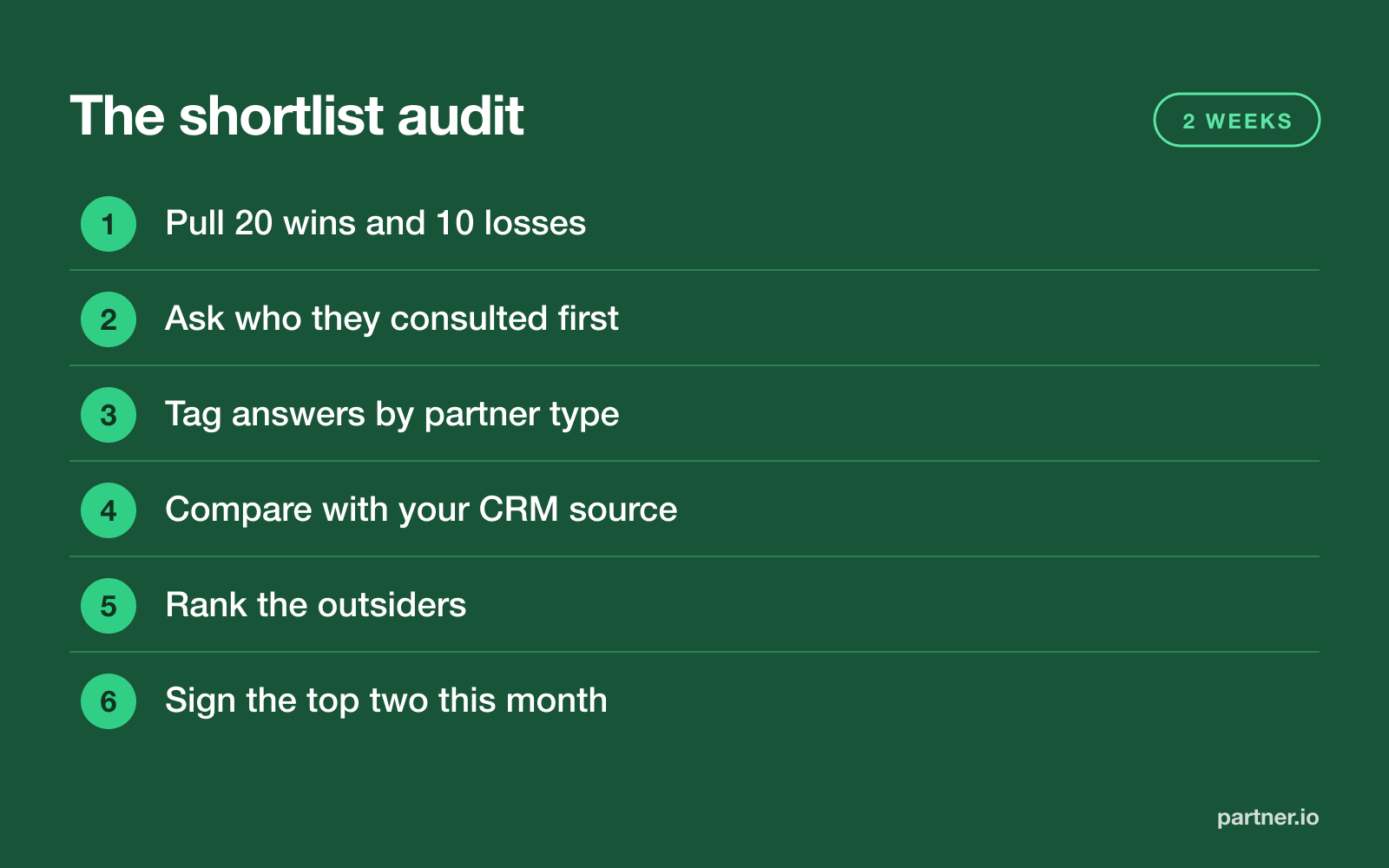
- Pull your last 20 closed-won deals, plus 10 losses where the buyer chose a competitor.
- Ask each customer one question: "Before you spoke to us, who did you ask about tools like ours?" A short email from the account manager gets more honest answers than a survey.
- Tag every answer by type: agency, integration partner, consultant, reseller, peer, none.
- Compare the answers with your CRM source field. Count the deals marked organic, direct or inbound where the customer named an outsider.
- Rank the outsiders by how often they appear in wins and losses.
- Pick the top two and have a real conversation about a referral and co-sell arrangement this month.
The decision point. If outsiders show up in more than a third of your wins, partners are already deciding your shortlist and you're not paying for it. Move one funnel line item, such as a retargeting budget or an events sponsorship, into a partner program for two quarters. If outsiders show up in fewer than one in ten, your buyers decide alone; keep investing in the funnel and revisit the audit in six months.
The losses matter as much as the wins. If the same agency appears in three deals you lost, you've found a partner who's working for someone else.
When it breaks
Partner influence fails in quiet ways. Three patterns come up again and again.
What this looks like in the real world
Here's an illustrative example, not a customer story.
A 45-person SaaS company sells reporting software to e-commerce brands. Its dashboard says 70% of new revenue is "organic inbound". The head of growth runs the shortlist audit on 20 recent wins.
Eleven customers name someone they asked first. Six mention the same two Shopify agencies. Three name an inventory app whose support team suggests the product when merchants ask about reporting. Two name a former colleague.
None of the 11 deals has a partner attached in the CRM.
The team signs both agencies to a referral agreement, sets up a registration link, and builds a co-marketing page with the inventory app. Six months later, partner-registered deals make up a visible share of new pipeline, and the "organic" number has dropped by roughly the same amount.
Total demand didn't change much. The company finally saw where it came from, and the partners creating it got paid.
Where Partner.io fits
Partner.io is a PRM built for teams who want partner-influenced revenue on the dashboard instead of hidden inside "organic".
Roster the outsiders. Deal Surround and Partner Discovery take a target account's domain and rank the partners most likely to be connected, with signals such as "sells to the target" or "referred the target". Account mapping shows your prospects against each partner's customers. You can try it in the public demo without signing up.
Own the occasions. The Engagement Hub keeps partners primed between deals with announcements, newsletters and events, plus a shared library for the one-pagers and use cases they'll repeat to clients.
Offer a reason. Partners refer and register deals from a branded partner portal on your own domain, follow each deal's progress, and see what they've earned. Commissions and payouts follow the revenue recorded on the lead, so the reward lands while the introduction is still fresh.
Measure influence. Leads and deal registration give every partner-involved deal one record, with the partner fixed when it's created, and sync it to HubSpot, Salesforce or Pipedrive. Automation can auto-approve registrations that match your rules, so partners hear back in hours, not weeks.
For the broader shift, read from funnels to networks in B2B SaaS growth. For turning influence into introductions, see from cold outreach to warm introductions. And for why those deals move faster once they arrive, why partner-sourced deals close faster.
Get named before the form fill
Your funnel will keep doing its job. It'll catch the buyers who already picked you and log them neatly.
The next deal, though, is being decided this week in a scoping call you're not on. The only question is whether someone in that room says your name, and whether you'll know when they do.
Try Partner.io free for 7 days → No credit card, no setup fee, cancel anytime.
Prefer a walkthrough first? Book a demo and we'll map it to your program.
- [partner-led-growth]
- [referrals]
- [revops]
Published November 24, 2026