
Sales and partnerships alignment fails over credit and comp, not customers. The maths on why partners multiply sales, and the SHARE model to end the turf war.
Sales and Partnerships Alignment Isn't a Truce. It's a Multiplier.
A reseller registers a deal on an account a rep has been working for six weeks.
The rep finds out from a CRM notification.
The forecast call gets loud.
Someone splits the commission, and nobody likes the split.
Nobody cancels the partner program after that. Sales just stops returning partner emails, and within two quarters the "channel" is three agencies and a spreadsheet.
That's how most companies end up believing partnerships compete with sales. They built the competition themselves, through comp plans and missing rules, and then blamed the partners.
The numbers say the opposite. When partners are in a deal, the deal is usually easier to win, bigger and faster. Sales and partnerships alignment isn't about keeping the peace between two teams. It's about letting one multiply the other.
"Partners cost margin and steal credit"
That's the strongest objection, and it deserves a straight answer, because parts of it are true.
Partners do cost money. A reseller takes a margin. A referral partner takes a fee, sometimes for years. If you pay a rep full commission on a partner deal as well, you've paid twice for one customer.
Credit fights are real too. Two people claim the same logo, one of them has a quota, and the other has a contract.
But look at where those fights start. Ted Grossman at the Alexander Group, a sales compensation consultancy, traces channel conflict back to incentive plans designed and approved by separate teams. When a direct team underbids its own partners, his diagnosis is blunt:
“The sales force is not given an incentive for supporting the partner strategy.
”
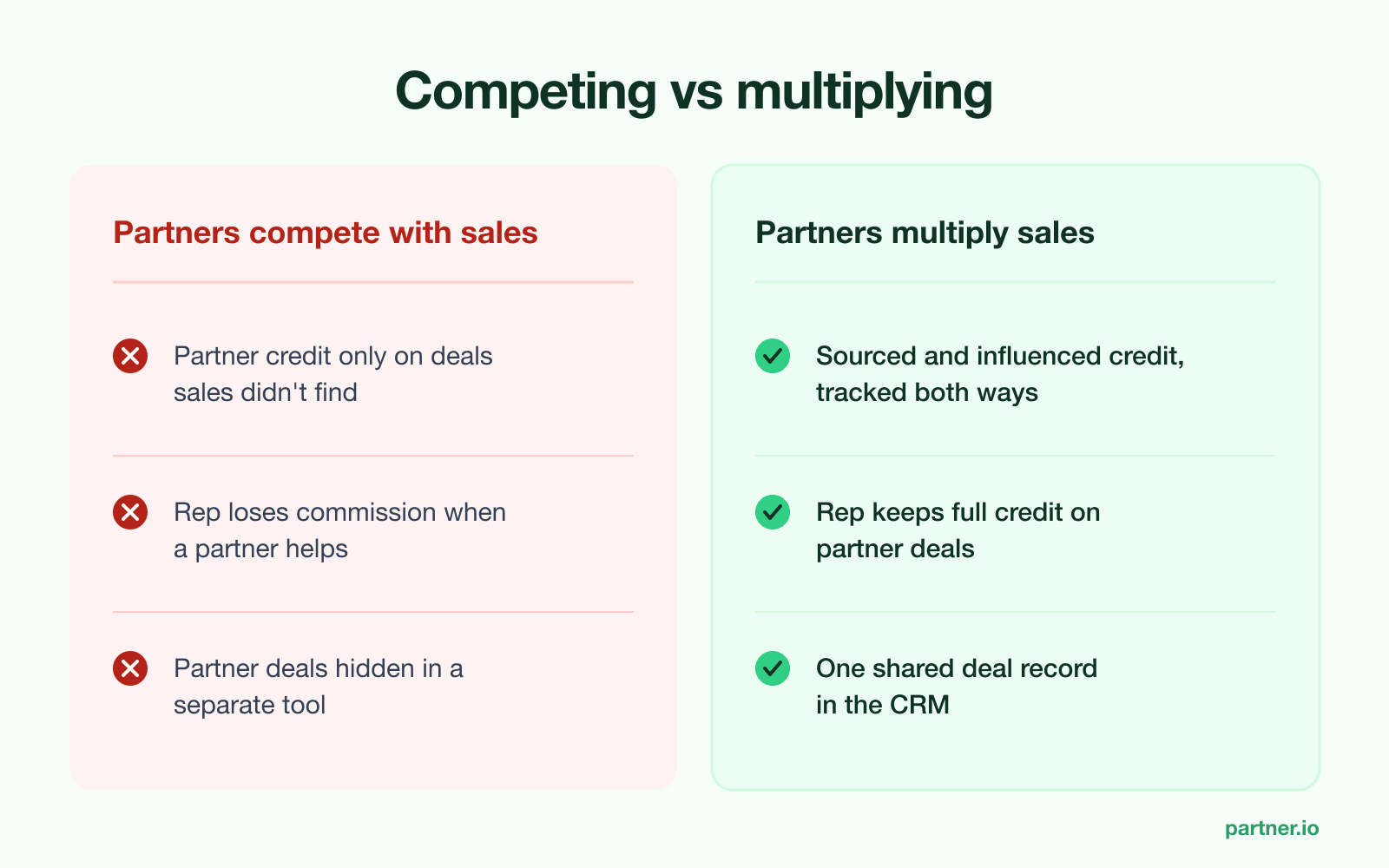
That isn't a partner problem. It's a plan design problem. Reps are rational. If a partner on the deal lowers their payout, they'll keep partners off the deal, however much it would help the customer.
“Sales doesn't fight partners. It fights comp plans that make partners expensive.
”
Fix the plan and most of the objection goes away. The margin is still there, so the real question is whether partners return more than they cost. That's a maths question, and the maths is kind to partners.
The multiplier maths: win rate, deal size and speed
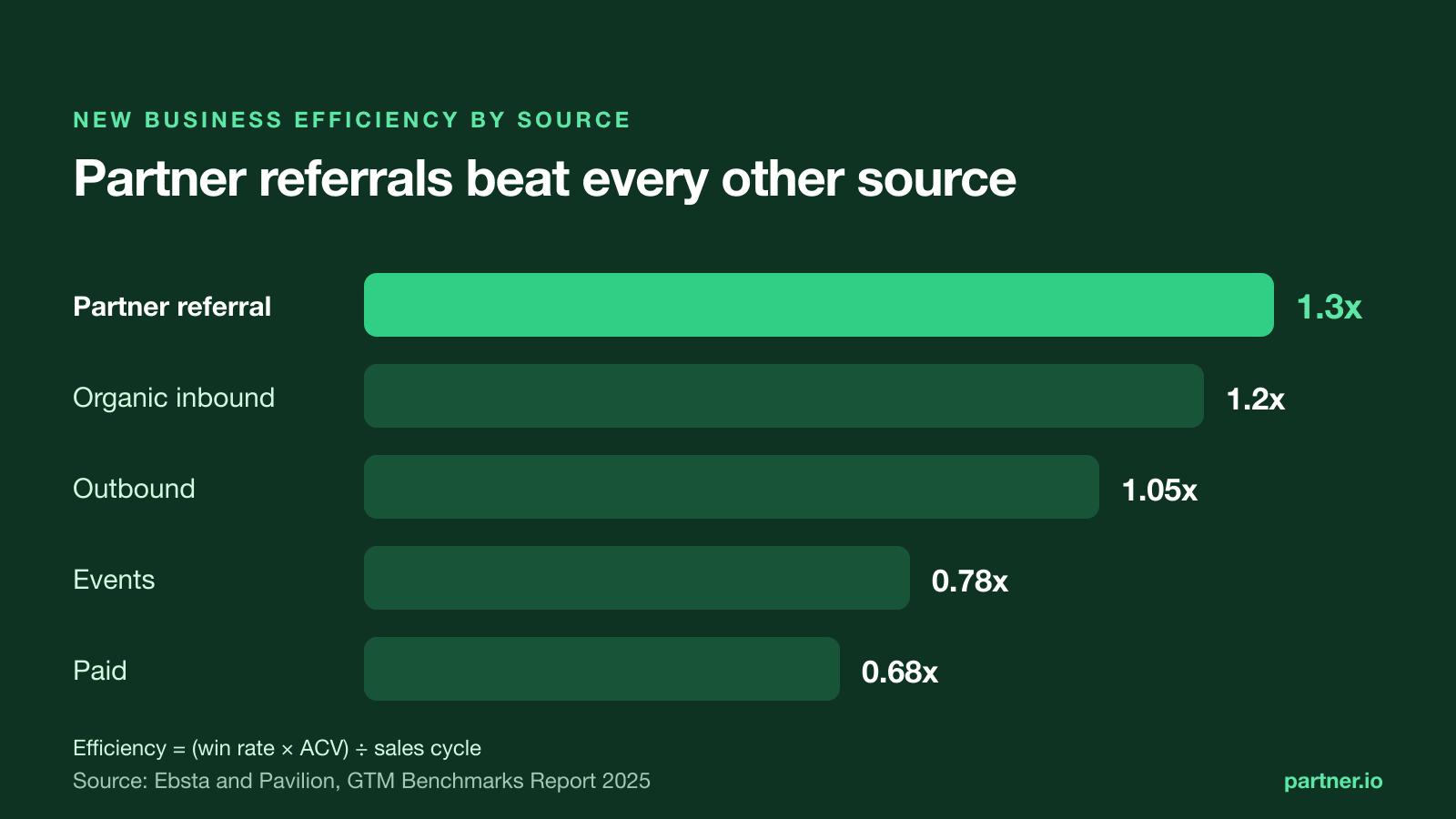
Ebsta and Pavilion's GTM Benchmarks Report 2025 analysed $48 billion of revenue and scored each lead source with one formula:
Efficiency = (win rate × ACV) ÷ sales cycle
Partner referrals came top at 1.3x. Organic inbound scored 1.2x, outbound 1.05x, events 0.78x and paid 0.68x.
Look at what that formula contains. Every term in it is a number sales already lives by. Partners don't add a new metric for reps to care about. They push on the three that already decide commission.
The report's own advice is something most sales leaders would happily sign:
“Double down on what works. Scale high-performing channels like partnerships and customer expansion to maximize growth.
”
Here's how each term moves when a partner is in the room.
Win rate goes up because someone already did discovery
A fractional RevOps consultant who audited the prospect's CRM last month knows the budget, the deadline and who signs. A rep starting cold spends three calls finding that out, and some of it never comes out at all.
The year before, the same benchmark series found partner referrals made 10% of pipeline but 31% of revenue. That gap is mostly win rate.
Deals get bigger because partners see the whole problem
An implementation agency doesn't just know the prospect wants your product. It knows the prospect also needs the data migration, the second team rolled out in Q2, and the integration nobody mentioned on the demo.
Microsoft's marketplace team reports that co-sell deals are about 30% larger and close up to twice as fast as deals without a co-sell partner.
“Data consistently shows that co-sell deals outperform non-co-sell deals
”
That's one company's program, and your numbers will be different. The direction is the point.
Cycles get shorter because trust arrives early
Security reviews, integration questions and "who else uses this?" stall more deals than price does. A technology partner who already passed the prospect's security review last year can answer two of those in one email.
We've covered the mechanics in why partner-sourced deals close faster. The short version: a partner shortens the stage where buyers decide whether to believe you.
Reps get selling time back
Salesforce's State of Sales survey of 7,775 sales professionals found that reps spend just 28% of their week selling. The rest goes on admin, research and internal work.
A partner who handles scoping, implementation questions or procurement paperwork gives a rep hours back on every deal. No sales tool on the market can hand a rep a second pair of hands inside the customer.
Sourced vs influenced: the attribution that ends the turf war
Most programs only count partner-sourced revenue: deals a partner brought in that sales didn't have.
That one choice turns partners into competitors. If partner credit only exists when sales didn't find the deal, every partner win looks like a rep loss. The partner team is incentivised to claim deals, and reps are incentivised to log opportunities early so partners can't.
Count partner-influenced revenue as well. Influenced means the rep owns and sources the deal, and a partner helped close it: an intro to the champion, a reference call, an implementation plan, an answer to the security questionnaire.
Influence credit doesn't take anything from the rep. The rep keeps the deal, the quota credit and the commission. The partner gets recognised, and sometimes paid, for the help. And your partner team gets measured on making sales better, not on beating sales to the logo.
The SHARE model for sales and partnerships alignment
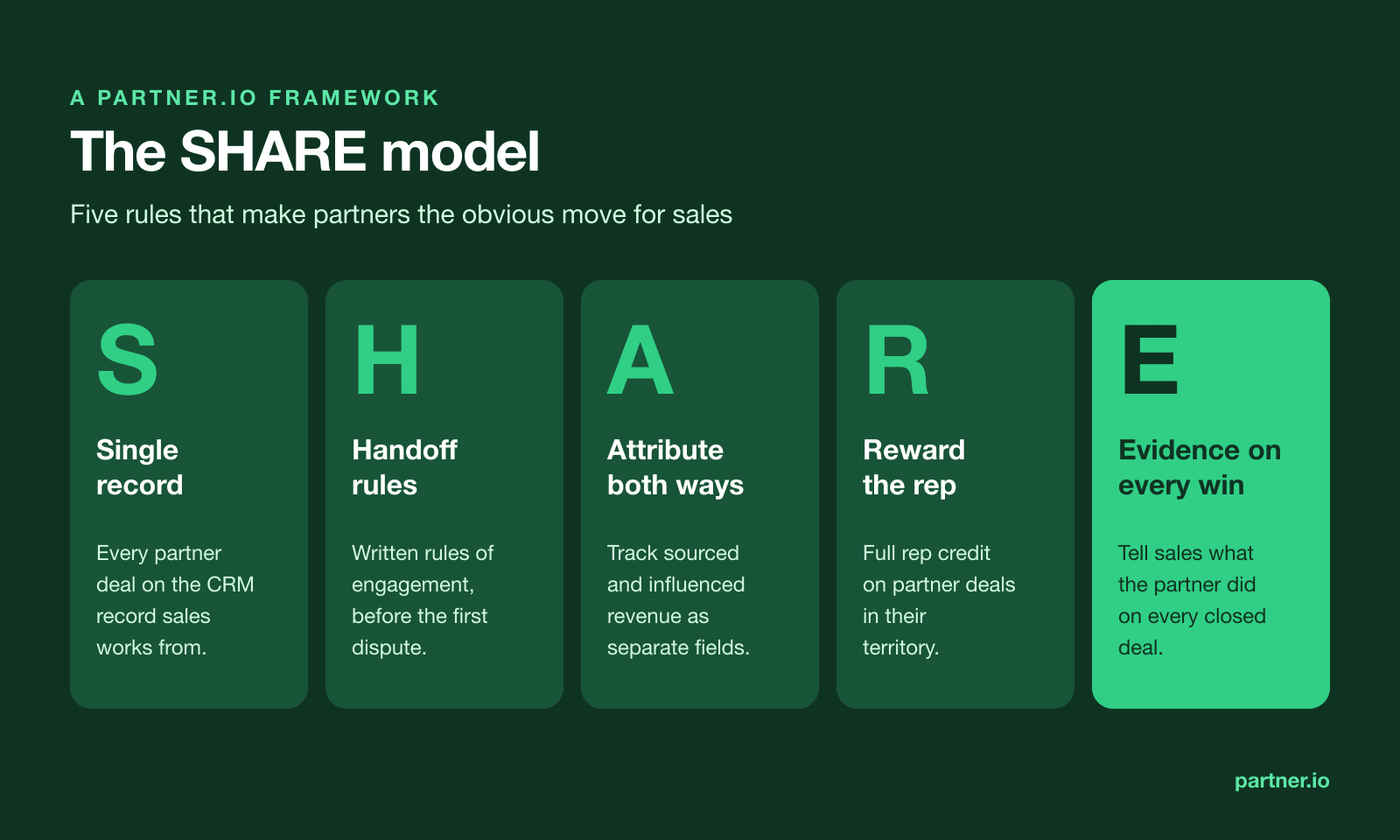
You can't fix this with a kickoff talk about collaboration. You fix it with five rules, written down, that make working with partners the obvious move for a rep.
The SHARE model has one rule for each place the turf war usually starts.
S: Single record
Every partner deal lives in the same CRM record the rep works from, with the partner and the partner's rep attached. No side spreadsheet, no partner portal that sales never opens.
If a rep has to log in somewhere else to see which partner is involved, the partner is invisible. Invisible partners don't get invited to calls.
H: Handoff rules
Write the rules of engagement before the first dispute, not during it. One page covers it:
- who owns an account a partner registers when there's no open opportunity
- who owns it when there is one
- how long a registration protects the partner (pick a number, such as 90 days)
- who decides a tie, and within how many days
Deal registration that checks against your CRM turns those rules into a process instead of an argument on Slack.
A: Attribute both ways
Track sourced and influenced as separate fields. Report both every quarter, side by side with win rate, deal size and cycle length for deals with and without a partner.
Lock the source field once a registration is approved. Otherwise the field gets edited after the first call, and the partner's work disappears from the report.
R: Reward the rep
Pay reps full credit on partner deals in their territory. Some call it channel-neutral comp. It feels expensive, and it's the cheapest conflict insurance you'll ever buy.
For referral and agency partners, consider a small SPIFF for the rep on any deal that closes with a partner involved. You're paying for a behaviour you want repeated.
E: Evidence on every win
When a partner-influenced deal closes, tell the sales team what the partner did. Name the deal, the partner and the step that moved: "the agency got us past security review in four days".
Reps copy what wins. One story in the Monday pipeline call does more than any enablement deck. Our post on turning reluctant reps into partner advocates goes deeper on building this into the sales process itself.
Want to run this in a real portal? Try Partner.io free for 7 days, no credit card needed.
Rules of engagement: the decision and the trade-off
Most conflicts come down to one moment: a partner registers an account, and sales has an opinion about it.
The decision
If there's no open opportunity on the account, approve the registration. The partner gets sourced credit, the rep in that territory gets the deal and full comp, and nobody argues.
If an opportunity already exists and is active (a meeting in the last 30 days), the rep keeps the deal as sourced. Invite the partner in with influence credit if they can help.
If an opportunity exists but has gone quiet for 60 days or more, treat the partner's registration as new life on a dead deal. Give the partner sourced credit and keep the rep paid.
Put those three lines in writing. You'll still get edge cases, but you'll get them once a month instead of every week.
The trade-off
Every way of paying for partner deals costs something. Pick the cost you can live with.
| Comp approach | Conflict | Cost |
|---|---|---|
| Rep gets no credit | High | Low on paper |
| Split credit | Medium | Medium |
| Full rep credit | Low | Pay twice |
"Rep gets no credit" looks cheap until you count the deals reps quietly keep partners out of. Our view: for most teams under $25M ARR, full rep credit on partner deals is the right default, because a handful of faster, bigger deals covers the extra commission. If your margins can't carry it, split credit with a written formula beats a negotiated split every time.
How you structure the partner side matters too. Our breakdown of SaaS partner commission structures runs the maths on nine models.
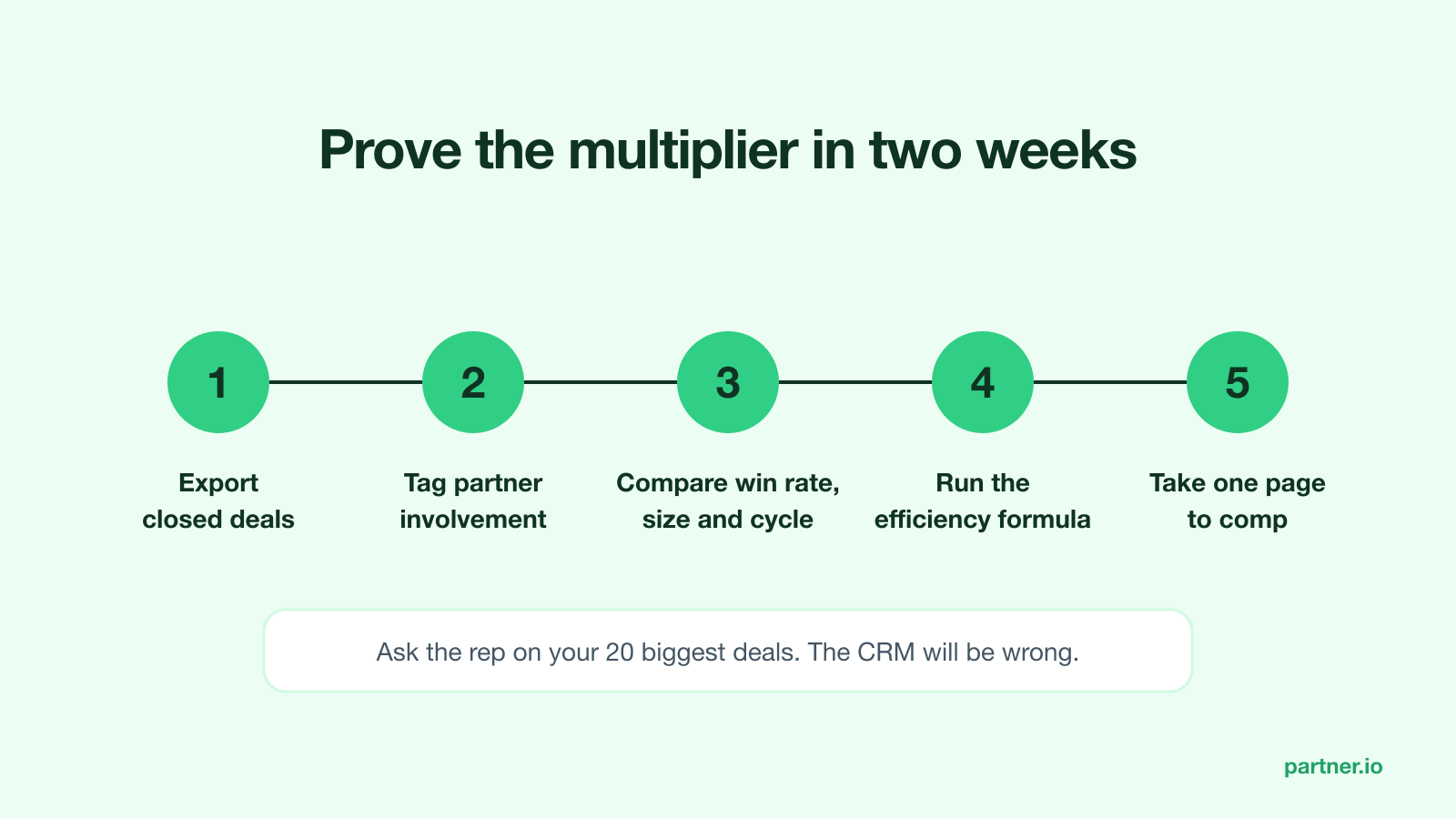
How to prove the multiplier on your own CRM in two weeks
The benchmarks are a reason to look. Your own data is what changes a comp plan.
- Export every closed deal from the last four quarters, won and lost, with amount, created date and close date.
- Tag each deal: partner-sourced, partner-influenced or no partner. Ask the rep on the 20 biggest deals, because the CRM will be wrong.
- Calculate win rate, average deal size and days to close for each group.
- Run the efficiency formula (win rate × deal size ÷ days to close) for each group.
- Take one page to whoever owns the sales comp plan: the three groups side by side, and the cost of full rep credit on last year's partner deals.
If partner deals score at least 20% higher on efficiency, the case for full rep credit makes itself. If they don't, your partners aren't the problem yet. Check whether sales is following up on partner deals at all before you change anything else.
What this looks like in the real world
Here's an illustrative example of how this plays out.
A 40-person SaaS company sells a scheduling platform to field service businesses. One of its reps has a $38,000 deal stuck at security review for five weeks. The prospect's IT lead keeps asking how the integration with their job management system handles customer data.
The partner manager runs the account against shared partner lists. A two-person implementation agency already supports that prospect's job management system and set up its last integration.
The agency joins one call. It answers the data question in ten minutes, because it's the team that wired up the integration the prospect is worried about. The prospect adds a second region to the order. The deal closes three weeks later at $52,000.
Under the old plan, the rep would have lost part of the commission for bringing the agency in. Under the new one, the rep keeps full credit, and the agency gets an influence fee and a case study.
The next week the rep sends the partner manager a list of four more stuck deals.
That's the multiplier. Nobody ran a workshop on collaboration. One rep got paid more for using a partner, and told the others.
Where Partner.io fits
Partner.io is a PRM built for partner-led growth teams. It handles the parts of the SHARE model that break when they live in spreadsheets and Slack threads.
One record, in the CRM sales already uses. Approved referrals and registered deals sync to HubSpot, Pipedrive or Salesforce with the partner and partner rep attached. Pipeline stage, deal value and products come back on each sync, so partner reports and sales reports use the same numbers.
Deal registration with rules. Leads and deal registration give partners one form to submit through. Auto-approval in automation can approve registrations that match your conditions, and anything that doesn't match waits for a person.
Finding the partner who can unstick a deal. Deal Surround ranks the partners most likely to have a relationship with a target account, and account mapping shows the accounts you share with each partner. With HubSpot connected, reps see Deal Surround recommendations on the record itself. You can try it without signing up in the public Deal Surround demo.
Paying partners without a fight. Commissions and payouts calculate commission from recorded revenue, approve it by hand or by rule, and pay partners through Stripe on a schedule you set.
Partners who can see their deals. The partner portal shows partners the status of every lead they've sent, which is what makes them send the next one.
If the problem is that your sales tooling was never built for partners, our post on sales ops built for reps explains why the CRM alone won't fix it.
Start with one partner, one deal, one clean record
Partnerships only compete with sales when you pay them to. Change that, and the partner team becomes the reason sales hits its number.
Pick one stuck deal this week. Find the partner who already knows that customer, put them on the record, and pay the rep in full when it closes.
Try Partner.io free for 7 days → No credit card, no setup fee, cancel anytime.
Prefer a walkthrough first? Book a demo and we'll map it to your program.
- [partner-led-growth]
- [revops]
- [prm]
Published November 19, 2026