
Partner referrals made 10% of pipeline and 31% of revenue in a $54B B2B sales study. Why teams still underfund them, and the FLIP framework to fix it.
Partner Referrals Are 10% of Your Pipeline and 31% of Your Revenue
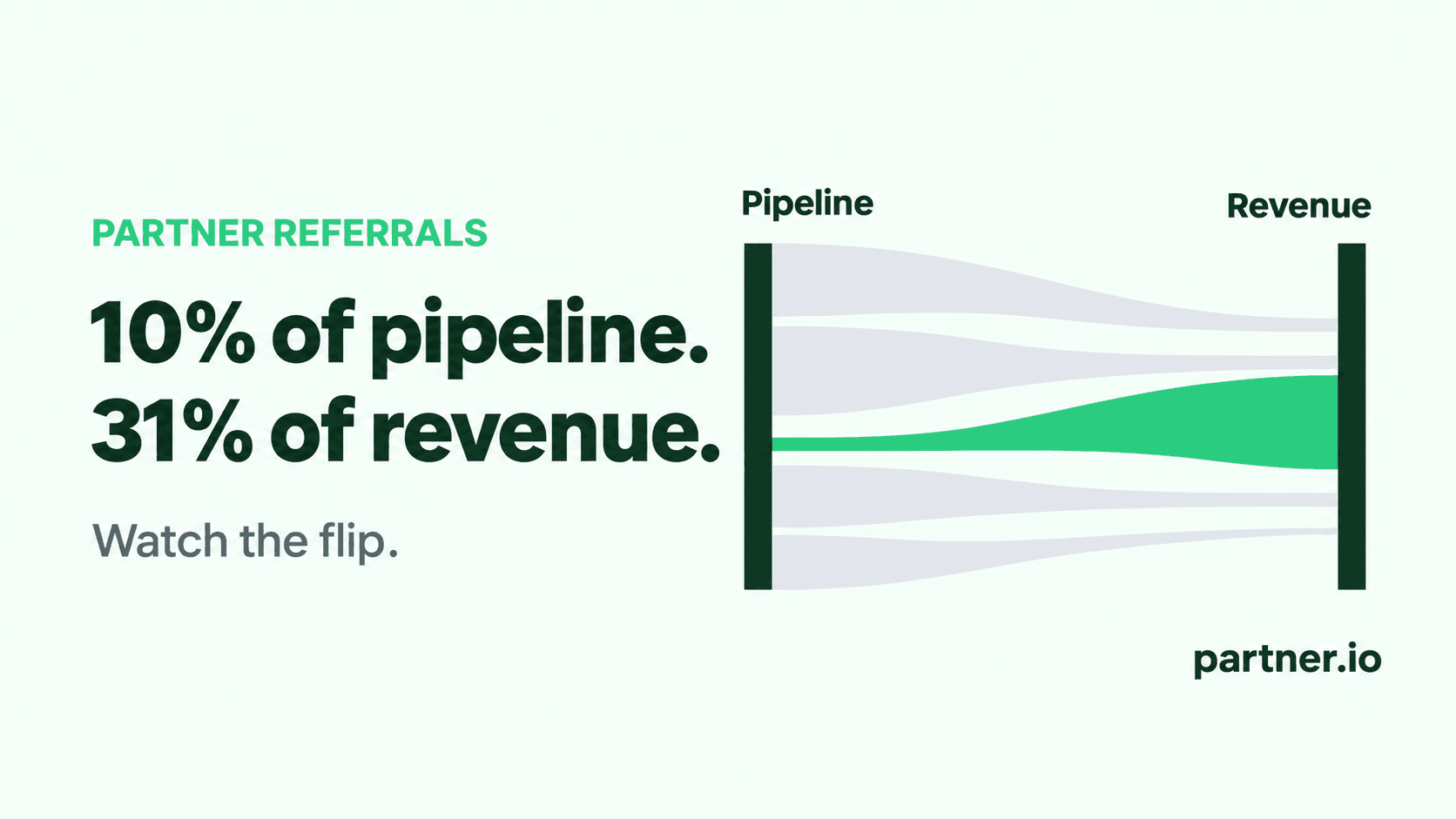
There's a sales meme doing the rounds. Pipeline sources on the left, revenue on the right, and one bar that flips.
Outbound makes 42% of the pipeline and closes 28% of the revenue.
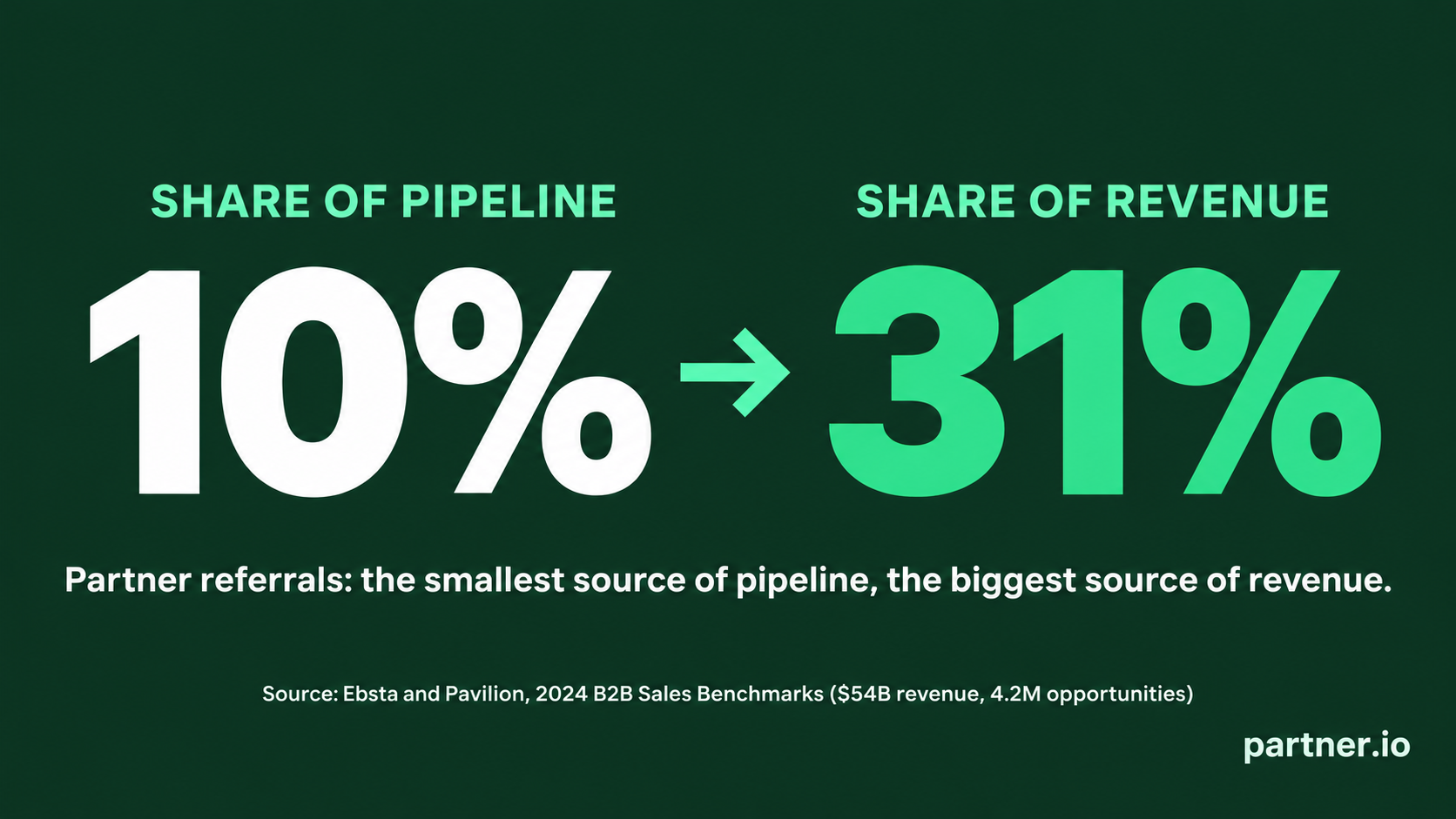
Partner referrals make 10% of the pipeline and close 31% of the revenue.
The numbers are real. They come from page 11 of Ebsta and Pavilion's 2024 B2B Sales Benchmarks, which analysed 4.2 million opportunities and $54 billion of revenue across 530 companies.
The advice printed under it is wrong, though: "Ask every customer for referrals. Consistently."
Read the label on the bar again. It doesn't say customer referral. It says Partner Referral.
That one word decides whether you get the 31% or a slightly warmer email signature. Here's what the flip means, why most teams fund the wrong side of it, and how to turn partner referrals into a channel instead of a habit.
"Referred deals only look good because they're cherry-picked"
That's the strongest objection, and it's half right.
Referred deals do arrive qualified. A consultant who sat in the client's planning meeting knows the budget, the deadline and who signs. Of course those deals close more often.
But that qualification is the product. You aren't buying a name from a partner. You're buying discovery work that someone with context already did, and no outbound sequence can buy that at any price.
The other half of the objection deserves a straight answer too. Ebsta describes the 530 companies as top performers, so your own numbers will look different. That's why the first job is to run the sum on your CRM, not to paste their chart into a board deck.
Why your pipeline report starves partner referrals
Budget follows pipeline. It's the number the board sees every month and the number sales leaders are judged on.
So the source making 42% of pipeline gets the SDR headcount, the sequencing tool and the data subscription. The source making 10% gets a partner manager and a spreadsheet, if it's lucky.
The 2024 report puts it in one line:
“The source of leads is often overlooked by reps.
”
Leaders overlook it too. When a quarter looks thin, the reflex is to add pipeline, and the quickest pipeline to add is outbound. Each quarter that reflex wins, partner referrals stay at 10%.
“Pipeline tells you where your reps spent the quarter. Revenue tells you where your customers came from.
”
Measure revenue yield, not pipeline share
Divide each source's share of revenue by its share of pipeline. Call the result revenue yield. A yield of 1.0 means a source closes in line with the pipeline it creates.
Here's the 2024 benchmark run through that sum:
| Source | Pipeline | Revenue | Yield |
|---|---|---|---|
| Partner referral | 10% | 31% | 3.1 |
| Organic inbound | 31% | 29% | 0.94 |
| Paid | 13% | 10% | 0.77 |
| Outbound | 42% | 28% | 0.67 |
| Events | 4% | 2% | 0.5 |
Every point of pipeline from partner referrals turned into 3.1 points of revenue. A point of outbound pipeline turned into two-thirds of a point. On yield, partner referrals beat outbound by more than four to one, which is a bigger gap than the "3x" the meme claims.
Yield isn't a conversion rate. It blends win rate and deal size, and that's fine, because both pay salaries.
Ebsta and Pavilion's 2025 GTM Benchmarks report used a different measure on a new dataset: win rate times ACV, divided by sales cycle. Partner referrals came top again, at 1.3x against 1.05x for outbound and 0.68x for paid.
“Partner Referrals and trusted recommendations (e.g. from communities) stand out as the most efficient channels, delivering nearly 30% higher efficiency than the average
”
Two years, two datasets, two different formulas. The same source wins both times. If you've read our breakdown of cold outreach vs partnerships, none of this will surprise you; the benchmark just puts a number on it.
A customer referral and a partner referral aren't the same channel
The meme's advice treats them as one thing. They behave very differently.
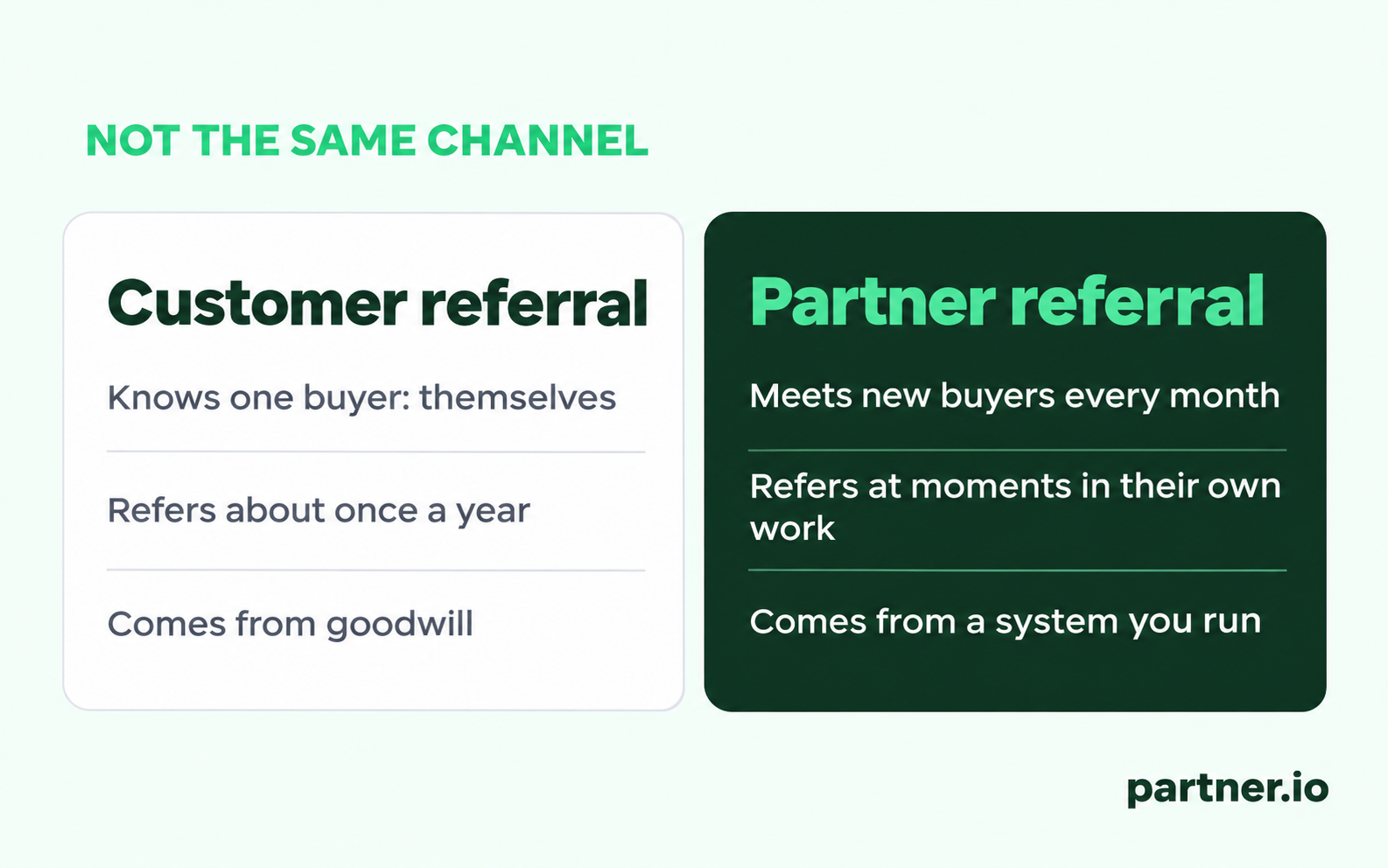
A happy customer knows one buyer well: themselves. They might refer a peer once a year, when someone asks at a conference. Ask them "consistently" and you mostly collect goodwill and a couple of polite intros.
A partner meets buyers for a living. An implementation agency onboards a dozen new clients a quarter. A fractional RevOps consultant audits three CRMs a month. An integration partner watches its own customers hit the exact limit your product removes.
Customer referrals are still worth running, and a user referral program makes them cheap to run. The research supports them. Researchers studied almost 10,000 accounts at a German bank, and customers who came through its referral program had contribution margins about 25% higher and churned about 18% less. The same authors summarised the work in Harvard Business Review as Why Customer Referrals Can Drive Stunning Profits.
But the 31% in the benchmark came from partners. To get that number you need people whose work puts them in front of your buyers before you are. Our guide to the seven partner program models covers which kind of partner fits which product.
Partner referral volume is a supply problem
Why do partner referrals sit at 10% of pipeline if they're the best-yielding source? Mostly because most companies don't run a partner channel at all.
The 2024 report gives that figure as 8% of businesses in its text and 12% on its chart. Take either one. Somewhere around nine in ten companies leave their highest-yield source to chance.
That changes the question. You don't need partners to refer more consistently. You need more partners who see your buyers, and more moments where referring you is the obvious move for them.
If you don't know which partners already sell to the accounts you want, start there. Deal Surround ranks the partners most likely to open a target account, and Partner Discovery finds companies already selling to your customers.
Referral moments beat referral asks
A referral ask is a message: "Know anyone who'd benefit?" It gets a thumbs-up emoji and nothing else.
A referral moment is a point in the partner's own work where your product fixes the problem in front of them:
- an agency scoping a CRM migration for a client whose partner data lives in spreadsheets
- an accountant setting up 1099s for a client who pays 40 affiliates
- an integration partner whose support queue keeps filling with the same feature request
Write down three moments per partner type. Give partners a one-line way to spot each one and a 30-second way to register the deal. For most referral partners that's the entire enablement program, and it fits in a short training course rather than a 40-page deck.
The FLIP framework for partner referrals
The meme says "watch this flip". Here's how to make it happen in your own numbers.
The FLIP framework has four parts. Each one fixes a separate reason partner referrals stay small.
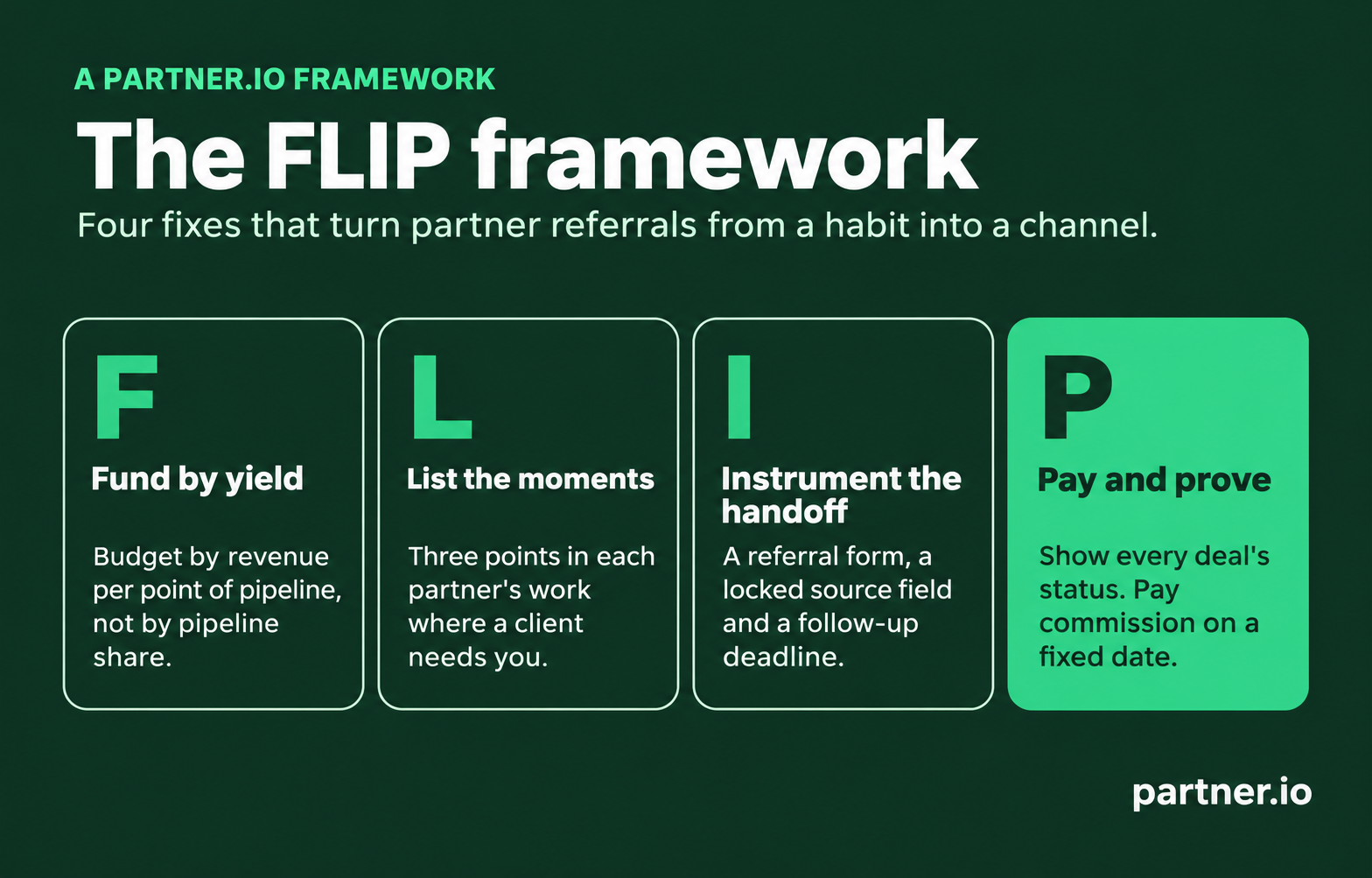
F: Fund by yield
Run the revenue yield table on your last four quarters of closed-won deals, then take it to whoever owns the go-to-market budget. A source returning three times what outbound returns should be funded on what it returns, not on how much pipeline it fills.
L: List the moments
For each partner type, write down the three moments when one of their clients needs you. Recruit partners who hit those moments every month. Let go of the ones who never will, however friendly the intro call was.
I: Instrument the handoff
A partner referral needs a submission form, a source field sales can't overwrite and a follow-up deadline. Without the source field, referred deals get logged as inbound or outbound and your yield table lies to you.
Deal registration that syncs to your CRM keeps partner-sourced revenue visible from introduction to invoice. It's also the fix for the problems in sales ops built for reps, not partner teams.
P: Pay and prove
Partners refer again when two things happen. They can see what became of the last deal, and they get paid without chasing anyone.
Show them deal status in a partner portal, and pay commission on a fixed schedule after the customer pays. The partner who got paid in three weeks is the one who sends the second deal.
Want to run this in a real portal? Try Partner.io free for 7 days, no credit card needed.
How to run a partner referral yield audit in one week
- Export every closed-won deal from the last four quarters with its lead source, amount and created date.
- Export every opportunity created in the same period with its lead source.
- Check the source on your 20 largest deals by hand. Ask the AE where each one came from.
- Calculate each source's share of pipeline, share of revenue and yield.
- Write one page: the yield table, the number of partners who referred a deal last year, and what it would cost to double that number.
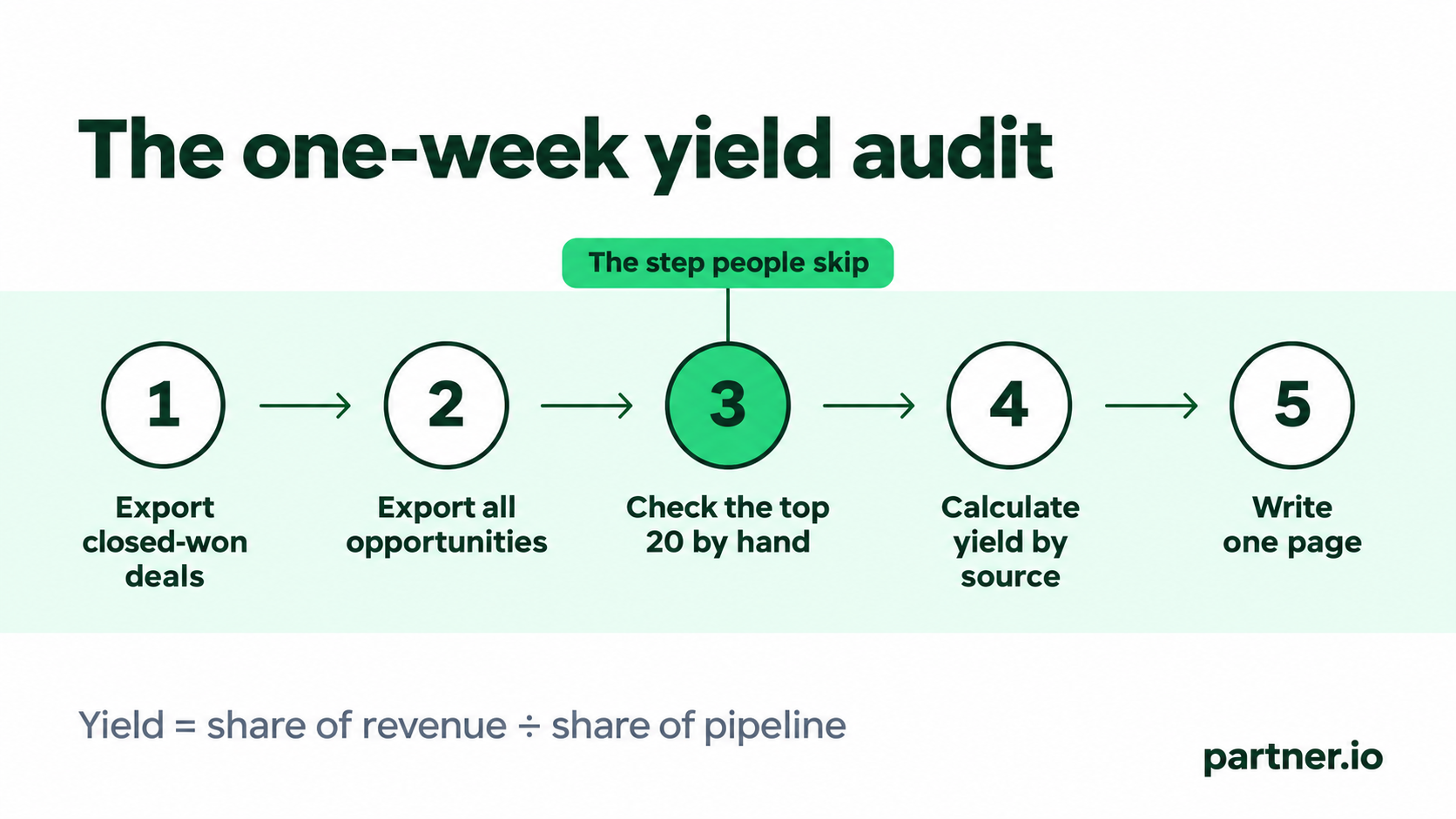
Step 3 is the one people skip. It also moves the answer most, because referred deals are the ones most often mislabelled as inbound.
The decision
If partner referral yield comes out above 2.0 and fewer than 20 partners referred a deal last year, your bottleneck is supply. Spend the next quarter recruiting partners who hit your referral moments.
If yield is above 2.0 and you already have plenty of partners, the bottleneck is activation. Fix the handoff and the payouts before you recruit anyone new.
If yield is under 1.0, the channel isn't small. It's broken. Check whether sales follows up on referred deals at all.
The trade-off
Moving budget from outbound to partners costs you speed. An SDR books meetings next week. A new partner might send a first deal in month three.
| Outbound | Partner referrals | |
|---|---|---|
| First pipeline | Weeks | Months |
| Control of volume | High | Low |
| Yield (2024 data) | 0.67 | 3.1 |
| Cost when it stalls | SDR salaries | Commission stops |
Don't switch off outbound to pay for partners. Cap it, and give the next hire's budget to the partner channel instead. Our playbook for moving budget out of paid media uses the same approach.
The first two fixes are rules, not reminders. Automation can approve referrals that match your conditions and trigger emails and tasks when a lead enters a stage, so nobody has to remember.
What this looks like in the real world
This is an illustrative example, not a customer story.
Picture a 50-person SaaS company selling compliance software to dental groups. Outbound makes 45% of its pipeline. Three dental accounting firms send a deal every few weeks, and nobody tracks them as a separate source.
The partner manager runs the yield audit. Checking the 20 biggest deals by hand turns up eight referrals logged as inbound. Partner referral yield lands at 2.8. Outbound lands at 0.6.
One page goes to the CRO, and the next SDR hire becomes a second partner manager instead. A year later the company works with eleven accounting firms, each with a referral form, a view of every deal they've sent and commission paid on the same date each month.
Nobody asked a single customer for a referral. The flip came from building the channel, which is the argument why partner-sourced deals close faster makes from the sales side.
Where Partner.io fits
Partner.io is a PRM for teams that want partner referrals to show up in the revenue report, not only in the thank-you emails.
- Leads and deal registration: partners refer with a form, a tracked link or a quick-refer page. Approved referrals sync to HubSpot, Pipedrive or Salesforce with the partner attached, so yield is a report, not a quarterly excavation.
- Partner portal: every partner sees each lead they referred with its status, deal value and commission.
- Tiers, commissions and payouts: commission is calculated from recorded revenue, bundled into invoices on your schedule and paid through Stripe.
- Automation: auto-approval rules and flows that send emails and create tasks when a referred lead changes stage.
- Deal Surround and Partner Discovery: find which partners can open a target account, and which companies already sell to your customers.
Start with one partner, one deal, one clean record
The chart was never telling you to be nicer to customers. It shows that the source making the least pipeline makes the most money, and that most companies don't run that source on purpose.
Run the yield table on your own CRM this week. If the flip shows up, stop funding by pipeline share and start building the channel.
Try Partner.io free for 7 days → No credit card, no setup fee, cancel anytime.
Prefer a walkthrough first? Book a demo and we'll map it to your program.
- [partner-led-growth]
- [referrals]
Published November 2, 2026