
Partner.io vs Euler compared on price, free trial, AI agents, payouts, US tax forms and account mapping, including where Euler is the better pick.
Partner.io vs Euler: Only One of These PRMs Shows You the Price
Euler's homepage has an AI agent that registers deals from forwarded emails, an AI account manager that answers partners around the clock, and a third agent that runs program operations.
It doesn't have a price.
Partner.io costs $79 per seat per month, and you can start using it today without talking to anyone.
That sounds like a small difference. For a two-person partner team trying to launch before the quarter ends, it decides almost everything. This Partner.io vs Euler comparison covers price, AI, payouts, tax, account mapping and launch time, including the places where Euler is the better pick.
The short answer
Pick Euler if a larger team runs a multi-motion program (resellers, distributors, cloud marketplaces, MDF), you want AI agents handling intake and partner questions, and you're comfortable buying through a sales process.
Pick Partner.io if two to five people run the program, you want to know the cost before the first call, and you need US tax forms, account mapping and partner training without extra contracts.
Most SaaS partner teams under $25M ARR fit the second description. Here's the detail.
Euler PRM pricing vs Partner.io pricing
Partner.io publishes its pricing: $79 per seat per month. A seat is anyone on your team who signs in. Partners use the portal free, in unlimited numbers. No setup fee, no contract, and a 7-day trial that needs no credit card.
Euler doesn't publish a number. The FAQ on its demo page says it runs on a flat platform fee, with no per-user and no per-partner pricing, and that you get a quote scoped to your program after a demo. The same FAQ lists the Partner Directory and the AI Communications Hub as optional add-ons.
A flat fee has real appeal. If twelve people need logins, per-seat pricing adds up and a flat fee doesn't.
But you can't put a number next to a sales call. Here's what each vendor tells you before you speak to anyone:
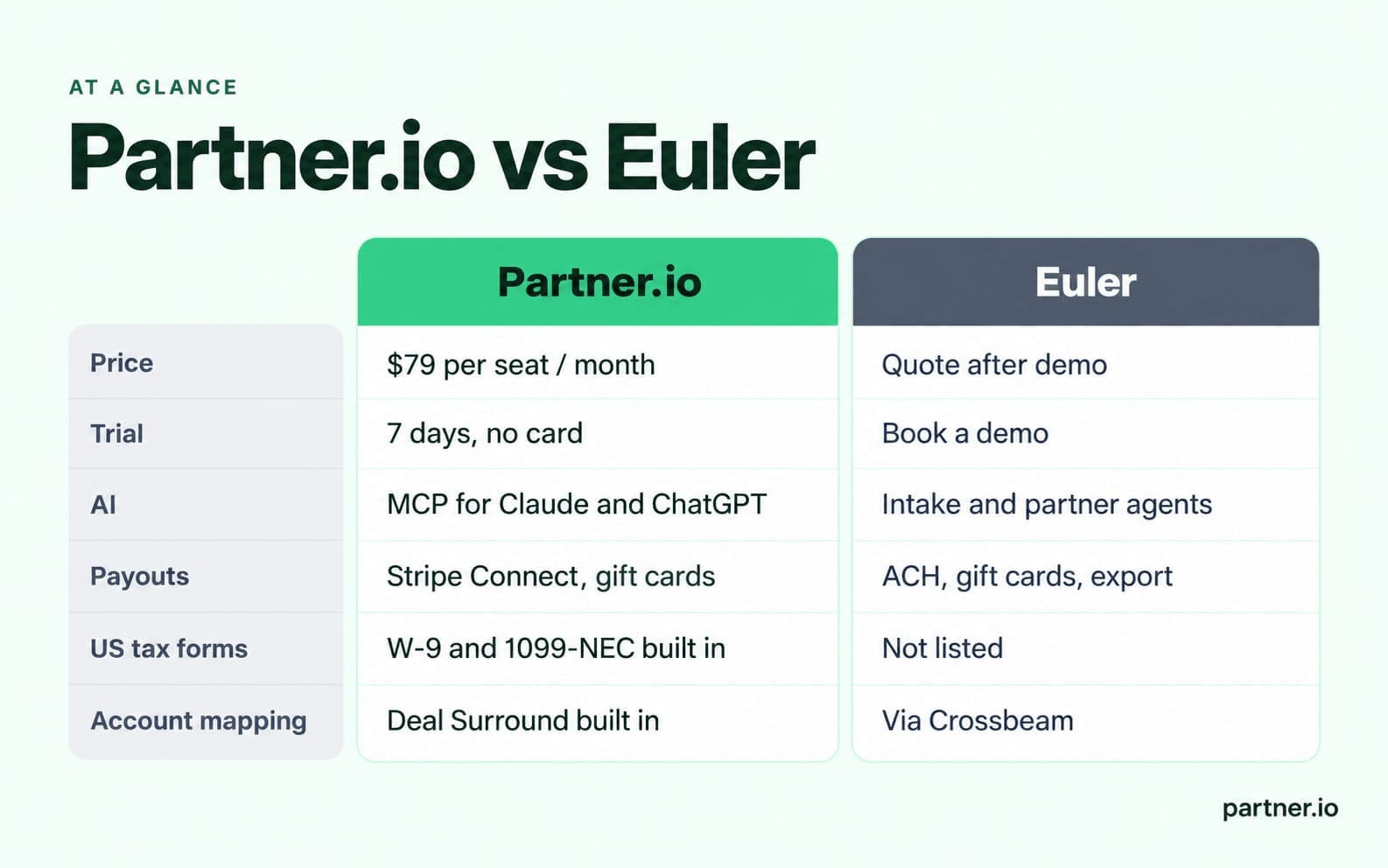
| Partner.io | Euler | |
|---|---|---|
| Price | $79 / seat / month | Quote after demo |
| Model | Per team seat | Flat platform fee |
| Partners | Free, unlimited | No per-partner fee |
| Trial | 7 days, no card | Book a demo |
| Add-ons | None | Directory, Comms Hub |
Three Partner.io seats come to $237 a month, or $2,844 a year. Whatever Euler quotes, that's the figure to hold it against.
Where Euler is the stronger choice
Euler has built a lot, and some of it Partner.io doesn't match.
AI that handles intake. Euler's DealFlow AI reads a forwarded intro email or a partner's Slack message, pulls out the company and contact, and creates a pending registration with the partner attached. There's a browser extension too. Euler is clear that the agent can't approve a deal; your team still does that.
An AI account manager for partners. PAM answers partner questions from their own records (deals, commissions, tiers, training) in the portal, in Slack and on mobile. It can also submit a referral or file an MDF request from a plain-language message.
More ways to pay partners. Both platforms send gift cards; Partner.io sends one from the Tango catalogue automatically when a reward fires. Beyond that, Euler can pay by ACH through Euler Pay, push approved payouts to your accounting system or export a file for finance. Partner.io pays cash commissions through Stripe Connect.
A wider stack. Euler lists billing integrations with Chargebee, Maxio, Recurly, QuickBooks and Stripe, plus AWS for hyperscaler programs, Docusign for agreements and Crossbeam for account mapping. Its learning paths accept SCORM files, so courses you already own come across without a rebuild.
Enterprise proof. The homepage carries logos including Gong and BambooHR, and ISO, SOC and GDPR badges.
So if you run resellers, distributors and an AWS Marketplace listing with a partner ops team of five, Euler deserves a demo.
Where Partner.io pulls ahead
Most SaaS partner programs look different:
Two people running it.
A dozen agencies and consultants who refer.
A reseller or two.
One integration partner with overlapping customers.
That program needs to be live in a week, and it needs a cost the founder can approve from a pricing page. Partner.io was built for it.
You can run it before you buy it
The trial is the full product. Put the partner portal on your own domain, connect HubSpot or Pipedrive (Salesforce is in beta), invite three real partners and have one register a real deal.
You'll hit the awkward bits early: the partner who ignores invites, the duplicate lead, the field your CRM insists on. Better in week one than after the contract.
“A demo shows you the vendor's data. A trial shows you yours.
”
US tax compliance is built in
If you pay US partners, the 1099-NEC is due by January 31, and the IRS guidance on Form 1099-NEC gives no automatic extension.
Partner.io's tax compliance tools collect a W-9 before the first payout, track each partner against the 1099 threshold and generate 1099-NEC forms at year end. We couldn't find W-9 or 1099 handling on Euler's reward or integrations pages. If you pay US partners, ask before you sign.
Account mapping without a second platform
Deal Surround ranks the partners most likely to open a target account, and Partner Discovery finds companies already selling to your customers. Both sit inside Partner.io's price; your account team switches them on. You can try Deal Surround without signing up in the public demo.
Euler's account mapping runs through its Crossbeam integration. That works, but it's a second platform to set up, and partners have to be on it too.
Training you can build in an afternoon
Training and certification are included, with an AI course builder that turns your existing docs into a course. If you already own SCORM courses, Euler's support for them is a genuine plus. If you're starting from a Google Doc and a Loom, the course builder gets you further, faster.
AI where it earns its place
Partner.io's MCP server connects Claude and ChatGPT to your program. Ask who referred what this month, register a lead from an email thread, or run Deal Surround on an account you're trying to win. Your team can also log a referral from Slack with a slash command.
The routine work runs on rules, not agents. Automation handles approvals, follow-ups and reminders: auto-approve a registration with no open opportunity, nudge a partner whose deal has gone quiet for 14 days.
Do AI agents replace a partner manager?
This is the strongest argument for Euler, so take it seriously.
Euler says its customers save $40k per partnerships headcount every year. That figure is vendor-reported, and we couldn't verify how it's calculated. The logic behind it is sound, though: if agents handle intake, answer partner questions and reconcile commissions, a small team stretches further.
Here's the catch. In a two-person program, the slow part is rarely typing deal fields into a form. It's launching at all, getting partners to send the first deal, and paying them correctly and on time.
Gartner's guidance on where AI agents fit is useful here. In a June 2025 press release, it predicted that over 40% of agentic AI projects will be cancelled by the end of 2027, citing cost, unclear value and weak risk controls. Its analyst also set out a simple rule:
“They can start by using AI agents when decisions are needed, automation for routine workflows and assistants for simple retrieval.
”
Deal registration is a routine workflow. A partner checking their commission is simple retrieval. Neither needs an agent to work well; both need clean rules and a portal partners will open.
That doesn't make Euler's agents a gimmick. It means you should test them against your volume. If you get five registrations a week, a form and an auto-approval rule will do. If you get fifty from email threads, DealFlow AI starts to pay for itself.
The PROOF test: how to compare any two PRMs
Feature grids flatter whoever wrote them, including ours. Before you sign with anyone, run five checks we call the PROOF test.
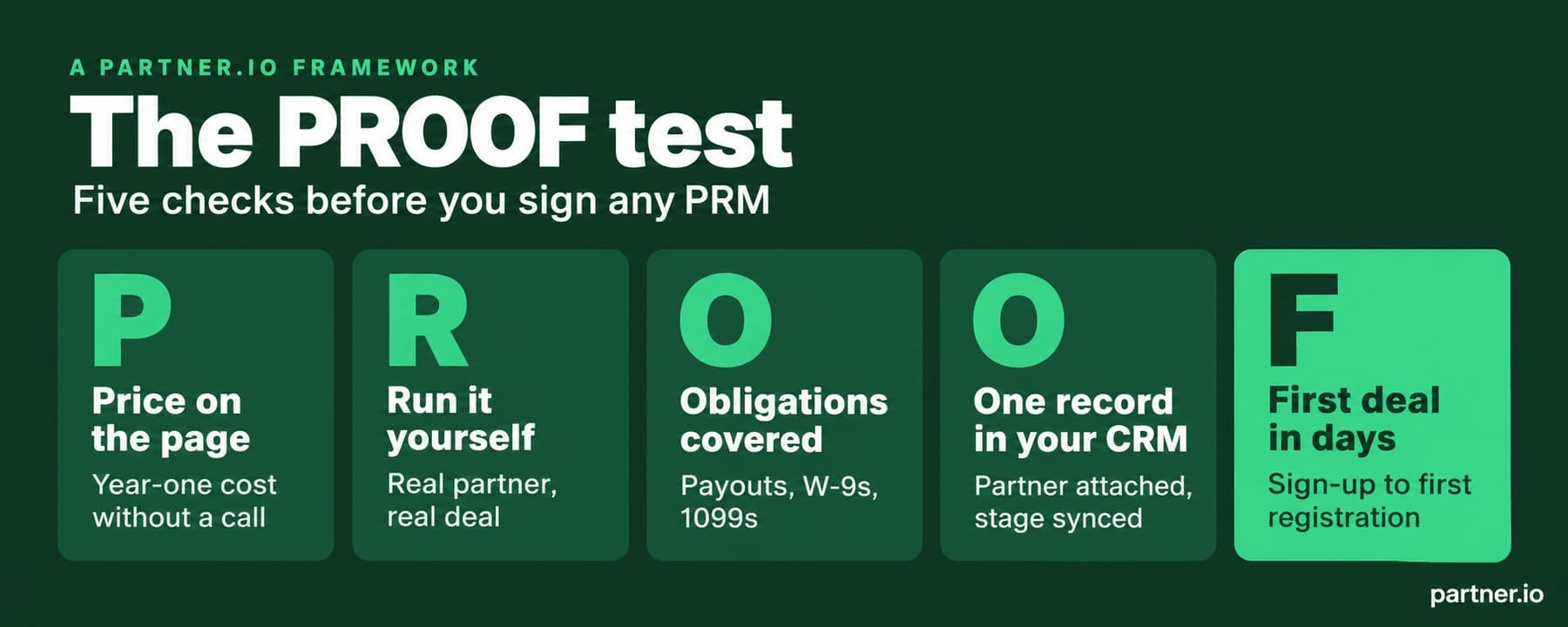
P: Price on the page.
Can you work out the year-one cost, add-ons included, without a call? If not, get it in writing before the second meeting.
R: Run it yourself.
Can you test with a real partner and a real deal before you sign? A trial beats a sandbox, and a sandbox beats a demo.
O: Obligations covered.
Who handles payouts, W-9s, 1099s and currency? List every obligation that follows a commission and check each one is owned.
O: One record in your CRM.
Does a registered deal land in HubSpot, Salesforce or Pipedrive with the partner attached, and does the stage sync back? Watch it happen.
F: First deal in days.
How long from sign-up to one real partner registering one real deal? Every week of setup is a week of salary with no partner pipeline.
Partner.io passes P and R before you speak to us. Euler does well on the CRM record. Run the rest yourself.
Forrester's research is a good reminder of why the choice matters. In its 2023 report on buyer preferences, it found:
“Data from Forrester's Buyers' Journey Survey, 2022 reveals nearly 70% of over 10,000 global B2B purchase influencers in the past 12 months purchased their offering from an indirect route to market or partner rather than directly from the supplier.
”
If partners influence that much buying, the PRM is part of your revenue stack. Choose it on evidence.
Want to run the PROOF test on Partner.io? Try Partner.io free for 7 days, no credit card needed.
What this looks like in the real world
Here's a composite of a situation we see often.
A 60-person SaaS company has 30 agency partners and eight consultants who refer, most of them in the US. Two people run the program. The CFO wants the PRM cost in next quarter's budget by Friday.
They book an Euler demo, and it's good. The agents are impressive, and the flat fee would cover the sales reps who want logins. The quote needs a scoping call first, and their own procurement wants three weeks for any new annual contract.
In parallel they start a Partner.io trial on a Monday.
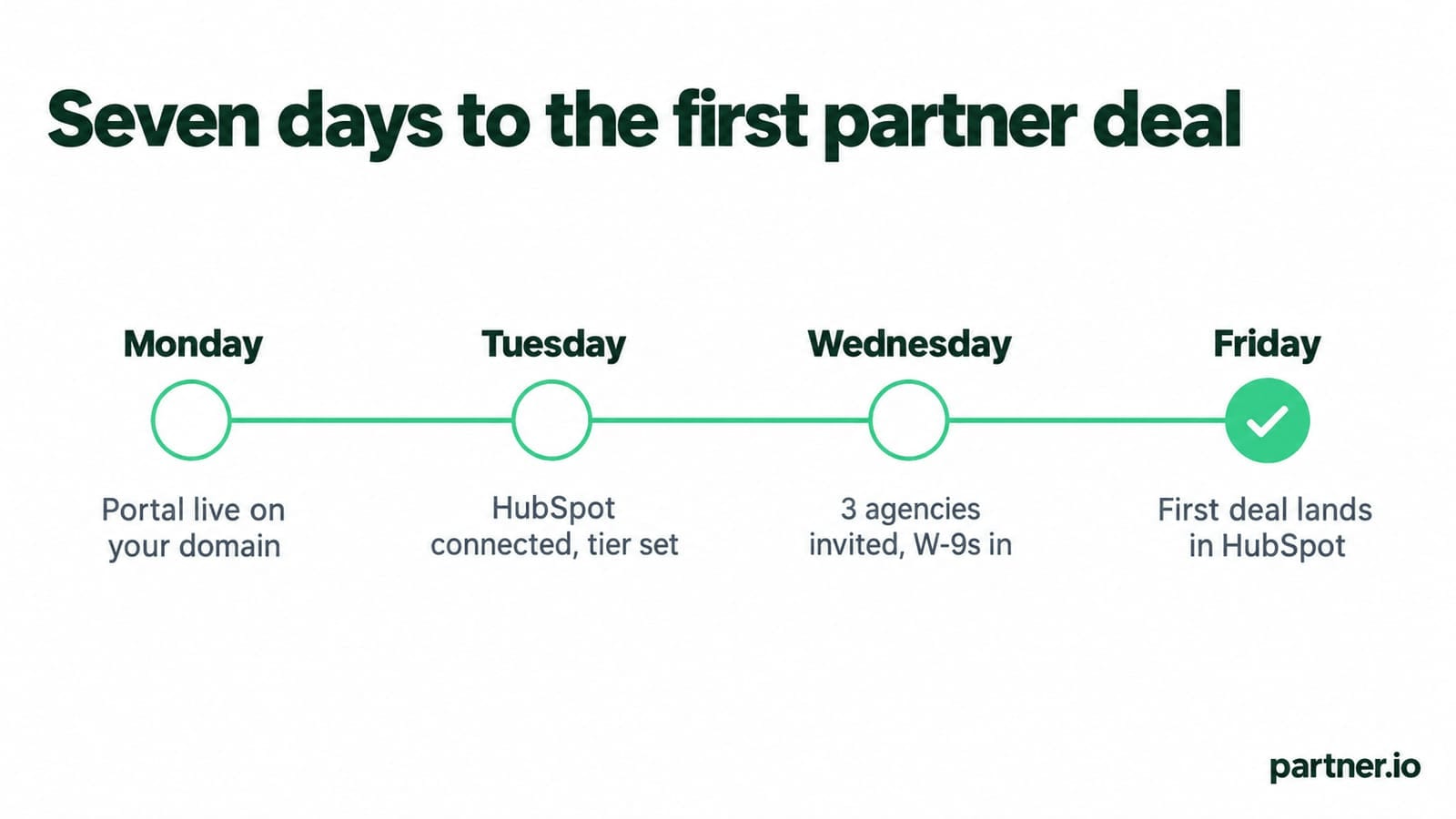
Monday: portal live on partners.theirdomain.com.
Tuesday: HubSpot connected, default tier and commission set.
Wednesday: three agencies invited, two W-9s collected.
Friday: the first registered deal lands in HubSpot with the agency attached.
The CFO gets a number: three seats, $237 a month. They choose the program that's already running over the agents they haven't tested. They'll revisit AI intake if registrations ever outgrow the form.
Decision points
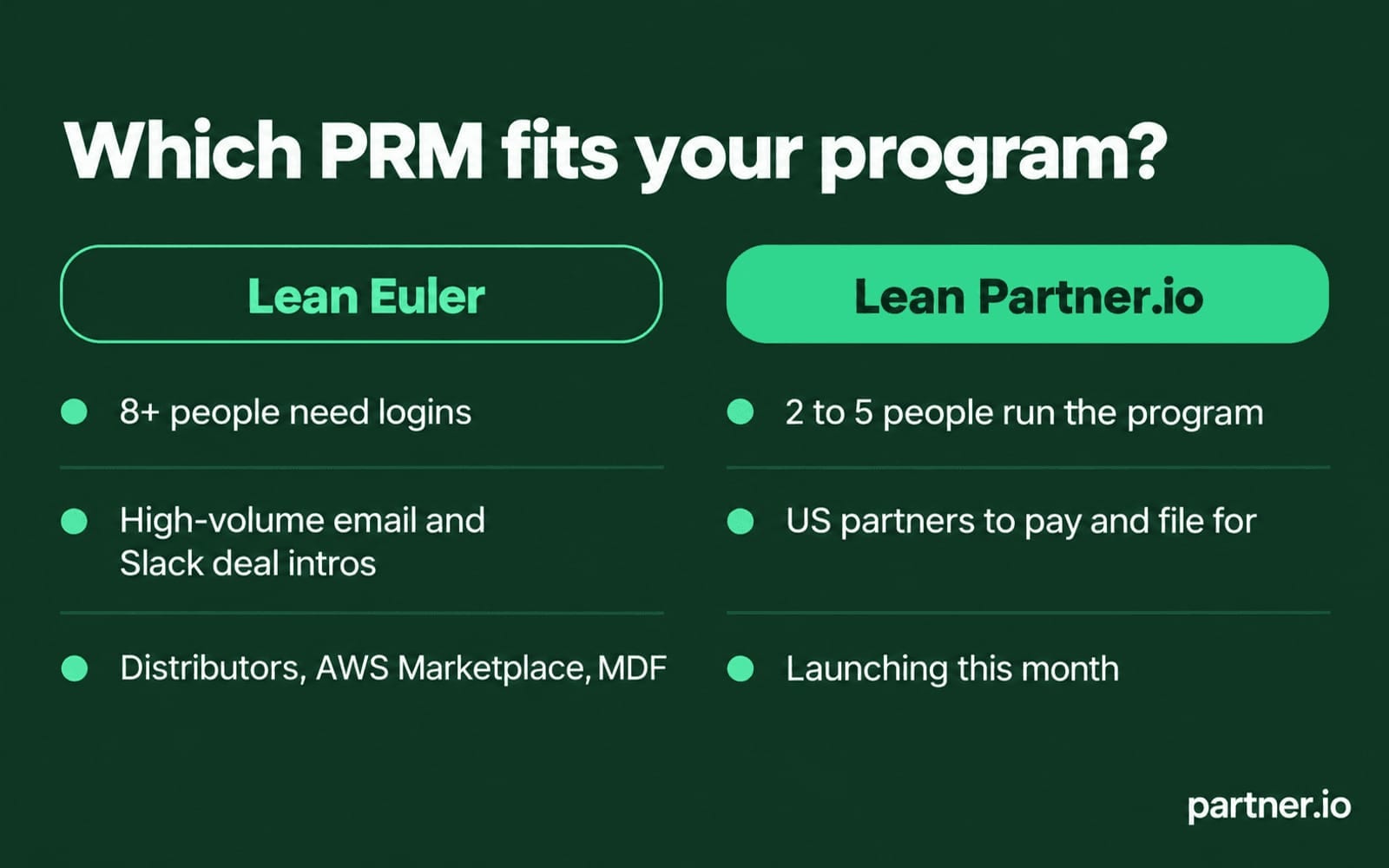
If eight or more of your people need logins, a flat platform fee will likely beat per-seat pricing. Get Euler's quote and compare the year-one totals.
If partners send most deals as email intros or Slack messages at volume, test DealFlow AI with a week of your real threads.
If you run distributors, AWS Marketplace listings, MDF or SCORM courses, Euler covers those today.
Two to five people, US partners to pay, a launch this month? Start with Partner.io.
When the comparison goes wrong
If part of your program still lives in a spreadsheet, the hidden cost of managing partners in spreadsheets is worth five minutes. Still deciding whether you need a PRM at all? Start with what a PRM is and when you need one.
Before you sign with either
- Count the people who need to sign in, then count again without the sales reps who could work from the CRM.
- Get the year-one cost in writing, add-ons included.
- Have one real partner register one real deal and check it lands in your CRM with the partner attached.
- Follow one commission from closed-won to paid.
- Ask who collects W-9s and files 1099-NECs.
- Ask what leaving looks like: data export, notice period, contract length.
Comparing more vendors? Our Partner.io vs Journeybee and Partner.io vs Introw comparisons use the same approach.
Start with one partner, one deal, one price
Euler is a serious platform, and for a large, multi-motion channel team its agents and flat fee make sense.
Most partner teams aren't that. They're two people with a launch date, a budget line and partners who need paying correctly. They don't need a quote. They need a program running by Friday.
Try Partner.io free for 7 days → No credit card, no setup fee, cancel anytime.
Prefer a walkthrough first? Book a demo and we'll map it to your program.
- [prm]
- [comparisons]
Published October 21, 2026