
Partner.io vs PartnerStack compared on price, payout fees and features, and why most SaaS partner programs get the same job done for a fraction of the cost.
Partner.io vs PartnerStack: The Same Job for a Lot Less
PartnerStack's pricing page lists three plans and no prices.
Ours lists one number. $79.
That gap is the whole story of Partner.io vs PartnerStack for most SaaS teams under $25M ARR. Both run a partner portal, track referrals, register deals, pay commissions and train partners. One tells you what it costs before you talk to anyone, takes nothing from your payouts and puts every feature on one plan. The other prices you in a demo and charges a percentage of every commission invoice you pay.
If you run a few dozen referral partners, a handful of agencies and a reseller or two, you're paying for the difference. This post shows you how much, and when PartnerStack is still worth it.
The short answer
Pick PartnerStack if you want to recruit partners from a large existing marketplace, and you'd rather the vendor pays every partner for you, including the international tax paperwork.
Pick Partner.io if your partners are agencies, consultants and resellers you already know. You get a published price, unlimited partners and no fee on what you pay them.
Most programs we talk to are the second kind. They don't need a marketplace. They need the partners they already have to send more deals, get paid on time and see what happened to the last referral.
The strongest case for PartnerStack
Start with the argument against us, because it's real.
PartnerStack has a marketplace it calls the world's largest B2B partnerships network. If your growth plan depends on hundreds of affiliates and creators finding you, that network is something Partner.io doesn't have. We don't run a marketplace. You recruit partners into your own program.
PartnerStack also pays partners on your behalf from one monthly invoice and collects W-9 and W-8 forms. For a program with affiliates in thirty countries, handing that off has value.
So here's the honest test. Count the partners who drove revenue last year and ask where they came from. If the answer is "the marketplace", stay. If the answer is "an agency our CEO knows, two consultancies and a customer who kept referring friends", you're paying for a network you don't use.
That second answer is common, and it fits the wider data. Forrester's buyer research shows how much buying already flows through partners:
“Data from Forrester's Buyers' Journey Survey, 2022 reveals nearly 70% of over 10,000 global B2B purchase influencers in the past 12 months purchased their offering from an indirect route to market or partner rather than directly from the supplier.
”
You can read the summary in Forrester's data snapshot on partner ecosystems. The partners those buyers trust are usually the ones already around your customers. You don't find them in a directory. You find them in your CRM.
Partner.io vs PartnerStack at a glance
PartnerStack facts come from its own pricing page and help center, checked in October 2026. Check again before you buy, because pricing pages change.
| Partner.io | PartnerStack | |
|---|---|---|
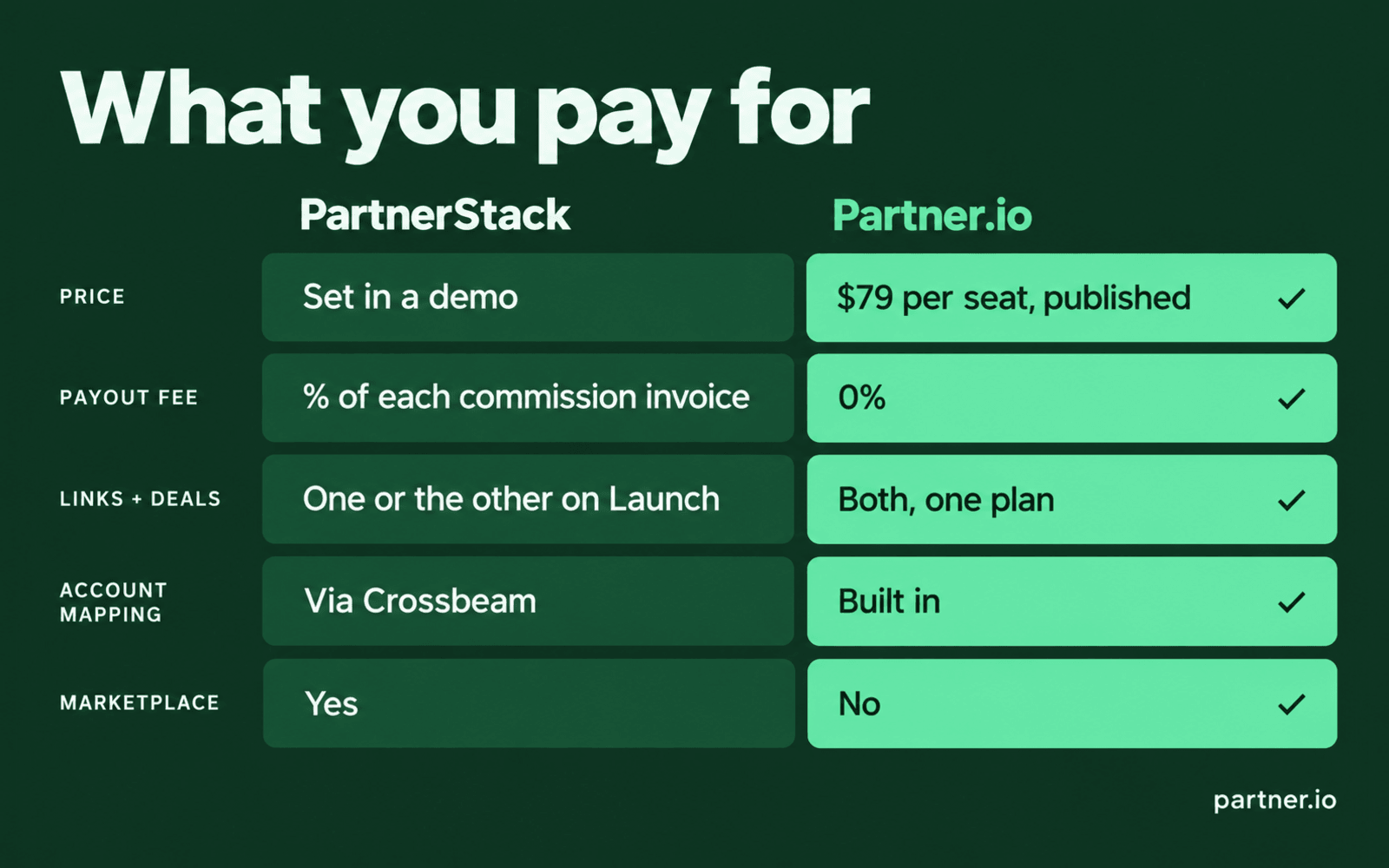
| Price | $79 per seat per month, published | Not published; set in a demo |
| Partners | Free and unlimited | No partner limit |
| Fee on payouts | 0% | A percentage of each commission invoice |
| Links and deal registration | Both, on one plan | Launch: one or the other |
| Training (LMS) | Included | From Growth |
| Account mapping | Built in, plus Deal Surround | Through a Crossbeam integration |
| Portal | Your own domain | Branded portal |
| CRM sync | HubSpot, Pipedrive; Salesforce on request | Salesforce, HubSpot |
| Marketplace | No | Yes |
| Try it | 7-day trial, no card | Demo first |
What PartnerStack costs
PartnerStack doesn't publish prices. Its pricing page says pricing is based on your program size, feature needs and level of support, and the final plan is confirmed in a demo.
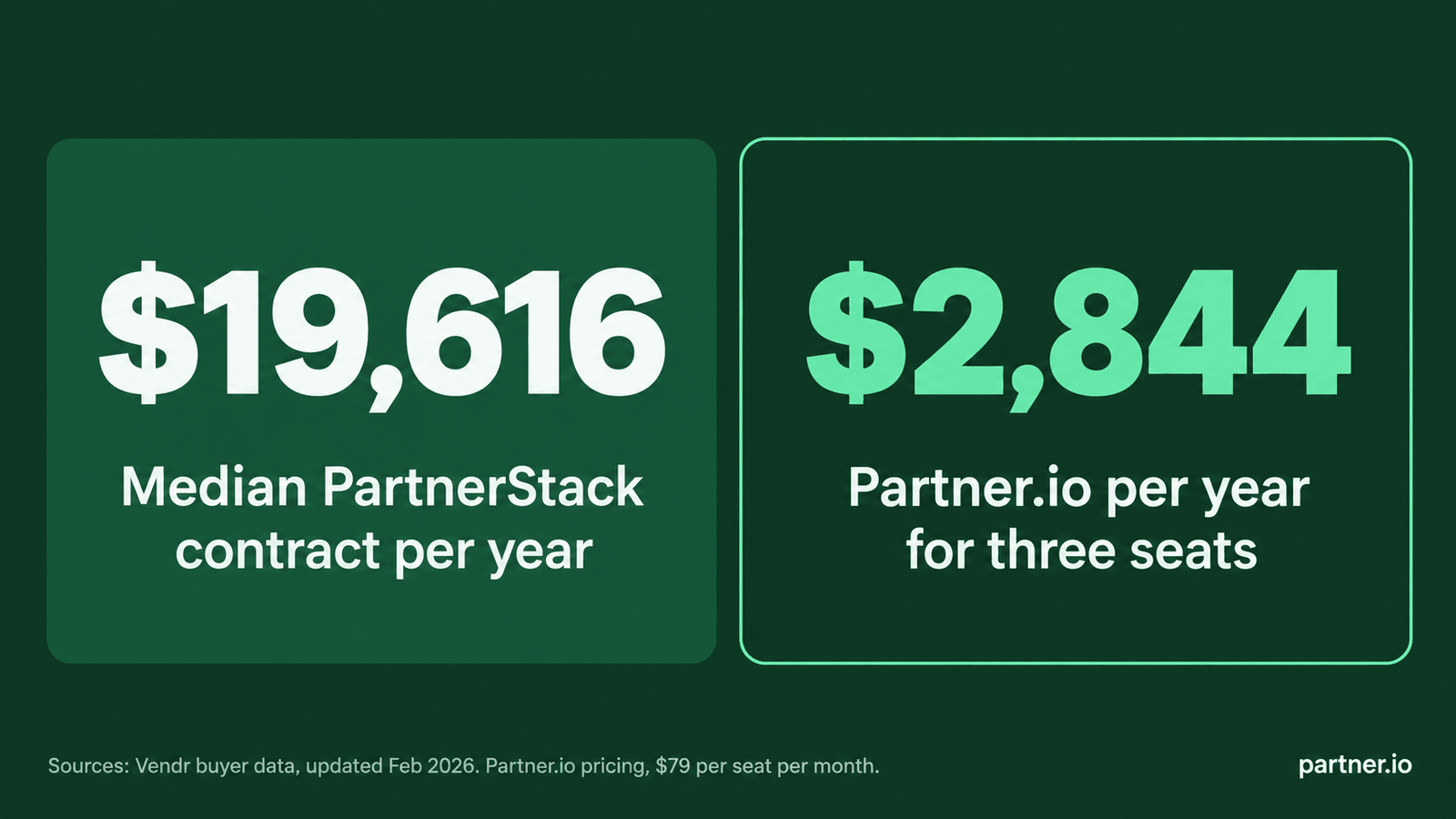
Third-party buyer data fills the gap. Vendr, the software procurement platform, tracks real PartnerStack purchases. Its pricing data, last updated February 2026, puts the median contract at $19,616 a year, with deals ranging from $9,186 to $37,770.
Now the other side:
Three people on your team using Partner.io: $2,844 a year.
Five people: $4,740 a year.
Nine people: $8,532 a year.
Nine seats on Partner.io still cost less than the cheapest PartnerStack contract in Vendr's data. At three seats, the median PartnerStack buyer pays about seven times more.
And that's before the payout fee.
The Five PRM Taxes
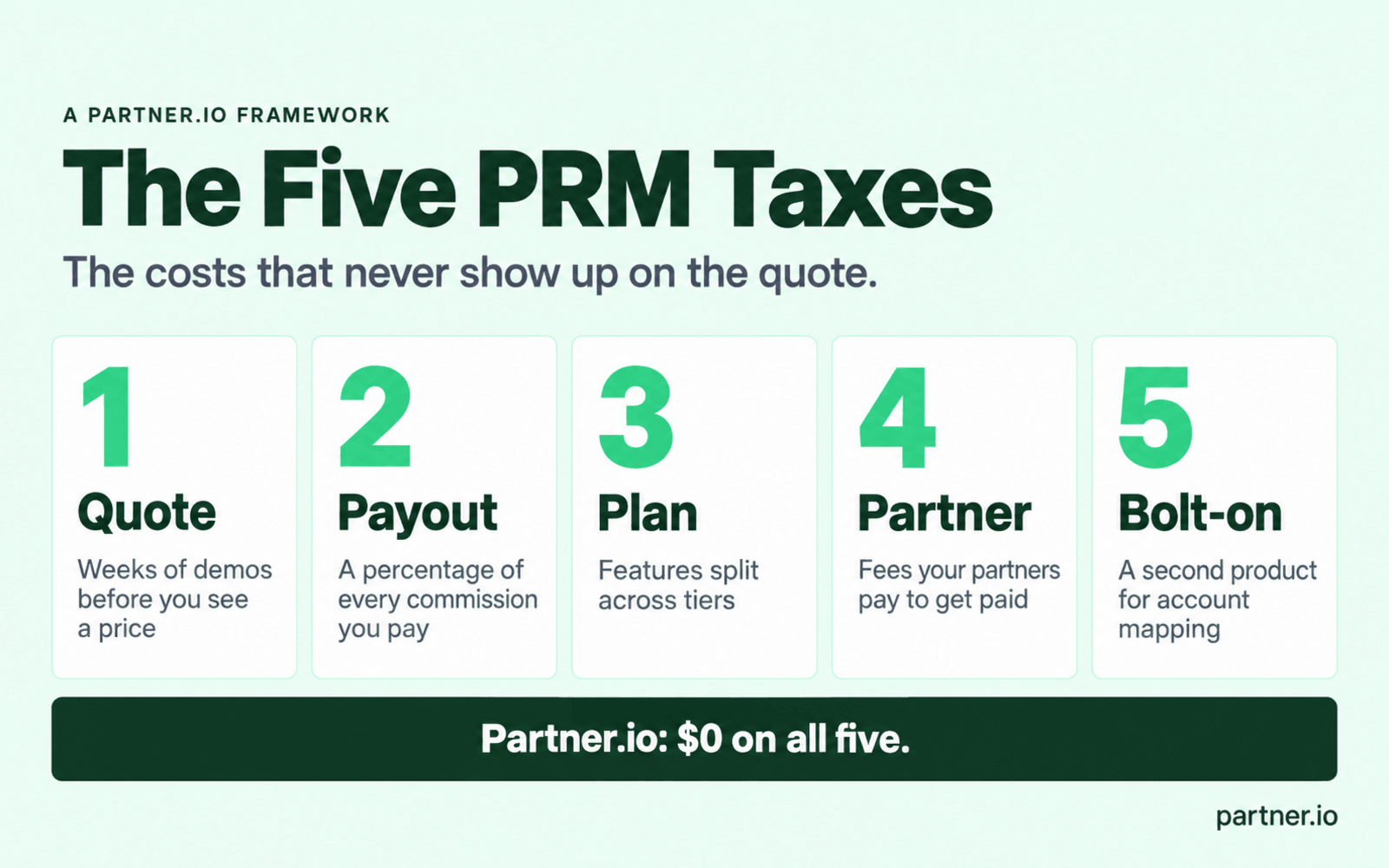
Comparing list prices isn't enough, because the expensive part of a PRM rarely sits on the quote. It hides in how the vendor makes money as your program grows. We call these the Five PRM Taxes. Run any vendor through them, including us.
1. The Quote tax
You pay it in weeks. No price means a discovery call, a demo, a proposal, a negotiation and a procurement loop before you can put a number in a budget.
Buyers have said for years that they hate this. In TrustRadius's buying research, 81% of buyers said they want to find pricing on their own, and 71% said readily available pricing would make them more likely to buy. Megan Headley, who leads research at TrustRadius, put it bluntly:
“We live in the age of obscurity when it comes to software pricing.
”
Gartner found the same instinct across B2B buying: 61% of B2B buyers prefer an overall rep-free buying experience. Partnership leaders are buyers too.
On Partner.io, it's $79 per seat per month on the pricing page. You can model next year's cost in a spreadsheet today.
2. The Payout tax
This one compounds. PartnerStack's own company FAQs say it charges a percentage, which it calls a PartnerStack fee, on your partner commission invoice total. The rate isn't published; you get it from your Customer Success Manager.
Do the arithmetic for your own program. Every percentage point on $100,000 of commissions is $1,000 a year. The more your partners earn, the more you pay the platform for the privilege of paying them.
Partner.io takes 0% of partner payouts. Commissions are approved by hand or by rule, bundled into self-billed invoices and paid through Stripe or bank transfer. See commissions and payouts.
3. The Plan tax
PartnerStack's Launch plan includes affiliate link tracking or lead and deal registration, chosen to fit your program. Full access to both is listed on Enterprise. The learning management system, MDF and partner challenges start on Growth.
That matters the day an agency that registers deals sits next to a consultant who just wants a referral link. Most programs have both by year two.
Partner.io puts tracked links, a portal referral form, a no-login quick-refer page and deal registration with stages and a message thread on one plan.
4. The Partner tax
PartnerStack pays partners itself, and partners withdraw through PayPal, Stripe or direct deposit with a withdrawal fee that depends on the method. Your partner earns $2,000 and receives a bit less.
Partners notice. It's a small number that makes your program feel like someone else's.
On Partner.io, partners use the portal free and get paid through Stripe Connect, to the partner organization or to individual reps, in twelve currencies. Partner.io takes no cut on either side.
5. The Bolt-on tax
PartnerStack offers account mapping through an integration with Crossbeam, which is a separate product with its own pricing. Co-sell with an integration partner means a second tool and a second contract.
In Partner.io, account mapping from a partner's CSV or CRM is built in, and Deal Surround shows which partners already know a target account. Try the no-signup Deal Surround demo to see it with real accounts.
“A partner platform should get cheaper per deal as your program grows. If it gets more expensive, check who it's built for.
”
Want to run the Five PRM Taxes against a real portal? Try Partner.io free for 7 days, no credit card needed.
Same job: what you give up and what you don't
"The same for less" only holds if the core work is covered. Here's the feature walk, with PartnerStack's strengths left in.
Partner portal. PartnerStack offers a branded portal. Partner.io gives you a white-label partner portal on your own domain, with your logo and colors.
Training. PartnerStack lists interactive courses, completion tracking and certifications, with its LMS on Growth. Partner.io's training and certification drafts courses with AI from your existing docs, adds quizzes and issues certificates partners can share.
Automation. PartnerStack has multi-step email workflows and onboarding tasks. Partner.io has Flows on 17 triggers, plus auto-approval rules for partners, leads and commissions.
CRM. PartnerStack syncs both ways with Salesforce and HubSpot. Partner.io syncs both ways with HubSpot and Pipedrive, and turns on Salesforce sync per account on request. If you run Pipedrive, that's a point for us.
Tax. PartnerStack collects W-9 and W-8 forms. Partner.io collects W-9s and generates Form 1099-NEC for US companies through tax compliance. The IRS explains the form in its guidance on Form 1099-NEC. If most of your partners sit outside the US and you want the vendor handling every form, PartnerStack's managed model is the stronger fit.
MDF. PartnerStack has MDF management from Growth. Partner.io doesn't have an MDF module. If market development funds run your channel, weigh that.
That's the trade-off in one line: PartnerStack sells you a network and a managed payments service. Partner.io sells you your own program, at a price you can see.
How to run a 7-day side-by-side
Don't decide from a blog post, including this one. Run both for a week.
- Day 1: write down your real numbers. Seats on your team, partners who sent a deal last year, total commissions paid. You need these for both quotes.
- Day 1: book the PartnerStack demo and start a Partner.io trial on the same day.
- Day 2: invite three real partners into the Partner.io portal: one referral partner, one agency, one reseller or integration partner.
- Day 3: register one live deal and check it lands in your CRM with the partner attached.
- Day 4: approve a test commission and follow it all the way to an invoice.
- Day 5: get the PartnerStack quote in writing, with the payout fee rate and plan tier.
- Day 7: put both annual costs side by side, including the payout fee on last year's commissions.
The decision rule: if the marketplace will source more than a fifth of next year's partner revenue, PartnerStack's fee can pay for itself. If not, you're renting a network you won't use, and Partner.io does the same job for less.
When switching breaks
Switching PRMs mid-year scares people, and fairly. Here's where it goes wrong and how to avoid it.
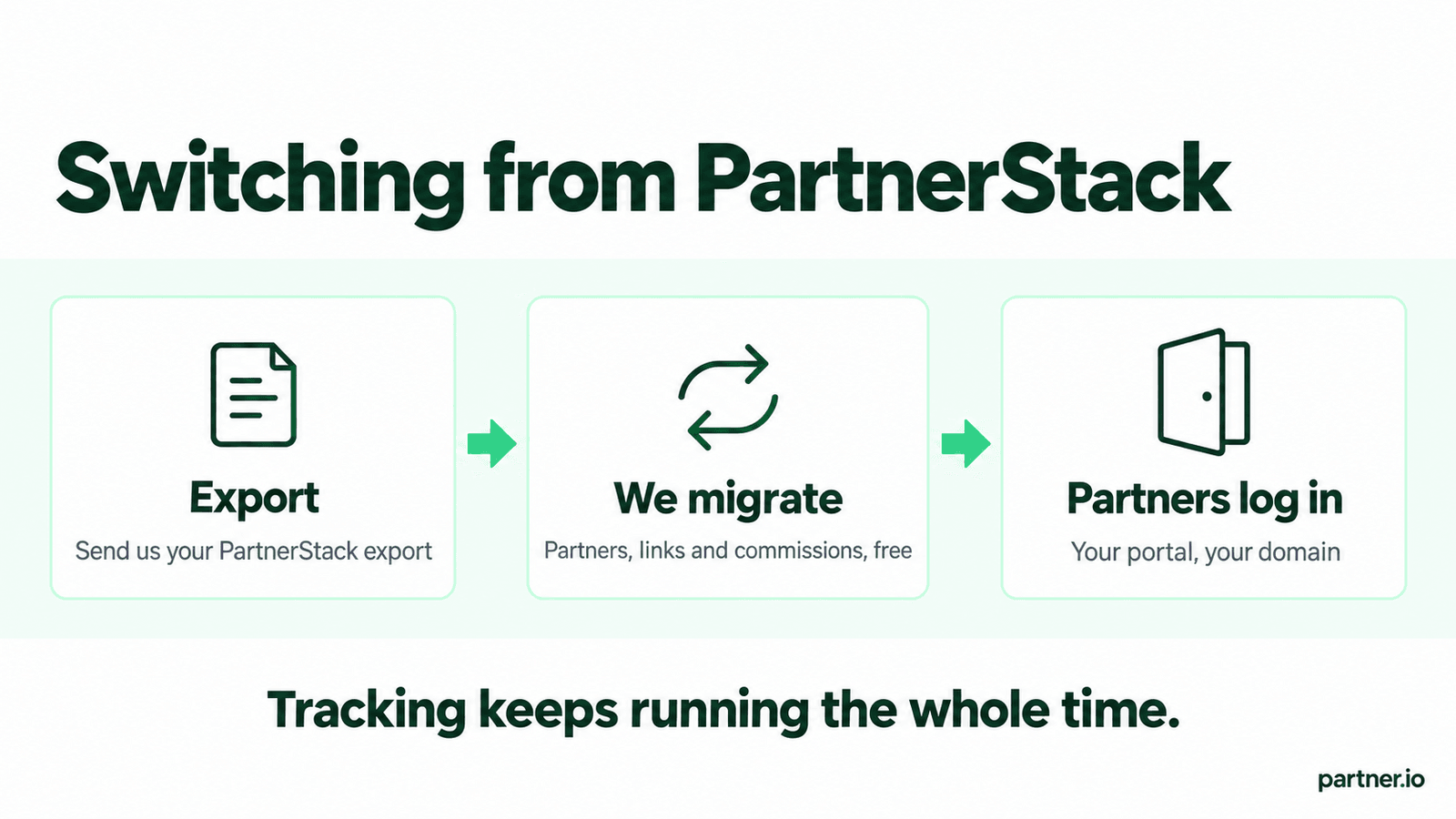
If you're moving from PartnerStack, send us your export. We import your partners, referral links and commission structures at no charge, tracking continues during the switch, and most teams are live within days.
What this looks like in the real world
Here's an illustrative example, not a customer story.
A 40-person SaaS company runs its partner program with three people. One owns the program, one works with partners day to day, and one keeps the CRM honest.
They have 55 partners. Six are agencies that implement the product and register deals; the rest are consultants and customers who send referrals. Last year they paid $120,000 in commissions.
None of their top ten partners came from a marketplace. All ten came from relationships the team already had.
On Partner.io, that program costs $2,844 a year, and all $120,000 in commissions goes to partners. On PartnerStack, it costs whatever the demo says, plus a percentage of $120,000 at a rate set by a Customer Success Manager. Each point of that fee is another $1,200.
The partner manager's week looks the same in both tools. Approve deals, chase the agency that went quiet, ship the new training module. What changes is the invoice, and who keeps the money.
If you're still running all of this in a spreadsheet, start with the hidden cost of managing partners in spreadsheets, then what a PRM is and when you need one.
Where Partner.io fits
Partner.io is built for SaaS teams running referral, agency, reseller and technology partners. On one plan, you get:
- A white-label partner portal on your own domain
- Leads and deal registration with tracked links and two-way CRM sync
- Tiers, commissions and payouts through Stripe, with no fee on payouts
- Training and certification with an AI course builder
- Account mapping and Deal Surround for co-sell
- Flows and auto-approval to cut the admin
If you're designing incentives as you switch, our guide to partner tier structures helps you rebuild them cleanly. And if you're comparing more than two tools, the full Partner.io vs PartnerStack comparison and the list of PartnerStack alternatives have the details.
Stop paying a toll on your own partners
A partner program is a relationship between you and the people who send you customers. The software should sit in the middle without taking a cut.
PartnerStack makes sense if you need its marketplace. For everyone else, the same job costs a fraction of the price, and every dollar of commission reaches the partner who earned it.
Try Partner.io free for 7 days → No credit card, no setup fee, cancel anytime.
Prefer a walkthrough first? Book a demo and we'll map it to your program.
- [prm]
- [comparisons]
Published October 28, 2026