
Partner.io vs Introw compared on partner experience, CRM fit, training, payouts, AI and pricing, so you can decide where your partner program should live.
Partner.io vs Introw: Should Partners Come to You, or Should You Go to Them?
Introw makes a sharp argument against tools like ours.
Standalone partner portals ask every partner to log in somewhere new. Most don't. Adoption stays low, and the program quietly runs on email again.
So Introw went headless. Partners register deals from Slack, Teams, their own CRM or an AI assistant, and your team works inside HubSpot or Salesforce. There's a branded portal too, but nobody has to visit it.
It's a good argument. It's also only half of the job.
The Partner.io vs Introw decision isn't really about portals. It's about where your partner program lives, and what has to happen after a partner registers a deal: training them, paying them, and finding them the next one.
This post compares both platforms on all of it, including the parts where Introw is stronger.
The short answer
Pick Introw if your team lives in HubSpot or Salesforce and your partners already work in Slack, Teams or their own CRM. It's also the better fit if you want AI agents answering partner support questions around the clock.
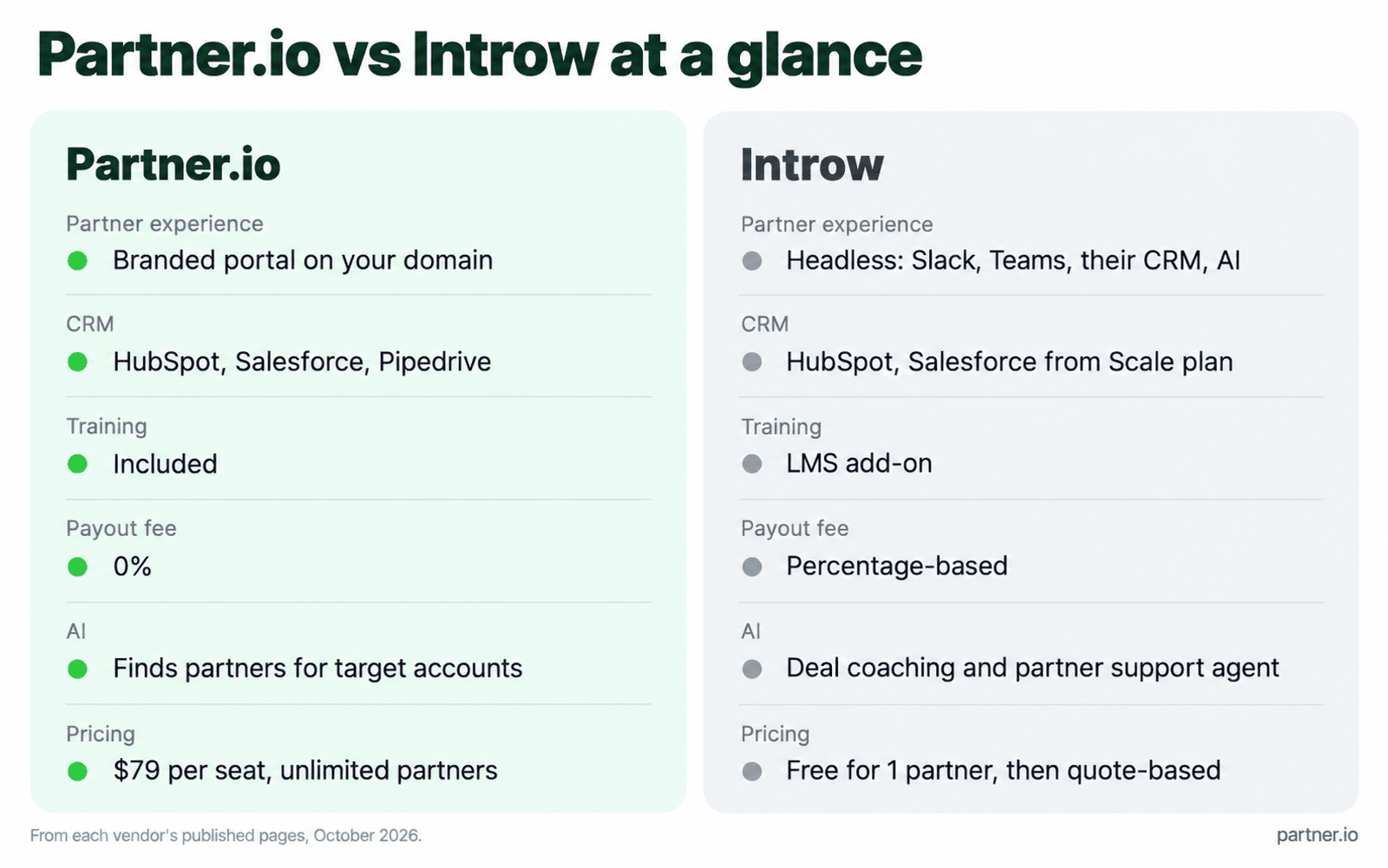
Pick Partner.io if you want partners to have a branded home on your domain, with training, payouts and tax handling built in. It also wins if you run Pipedrive or Shopify, or want to find deals partners haven't registered yet.
Both sync two-way with HubSpot and Salesforce. The difference is what each one assumes your partners need from you.
For a feature-by-feature table, see our Introw comparison page. This post goes deeper on the trade-offs behind it.
Two different ideas of where a partner program lives
Every PRM makes a bet about where partners will actually do the work.
Introw's bet is "where they already are." Its homepage describes partners registering deals by tagging Introw in Slack or Teams, or connecting their own CRM so deals sync between both companies. They can also work from ChatGPT, Claude or Gemini through MCP. Introw offers a branded portal as well; the pitch is that partners shouldn't need it.
Partner.io's bet is "a home worth visiting." Partners get a white-label partner portal on your domain, where they register deals, see status and earnings, pick up assets and finish training. Your team works in the CRM, with deals and status flowing both ways.
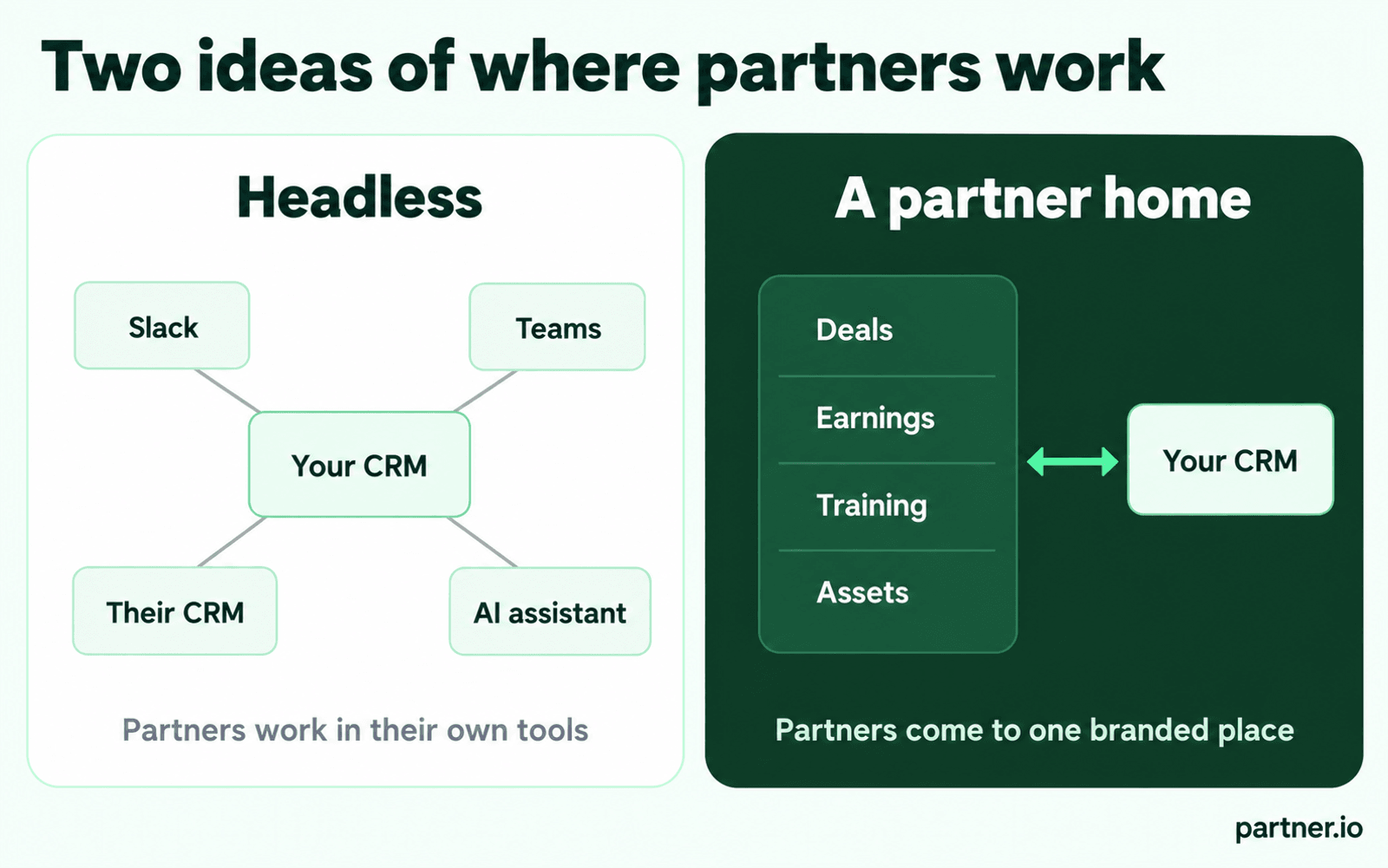
Neither bet is wrong. They suit different partners.
A reseller with its own Salesforce org and a 20-person sales team will not log in to your portal every day. Syncing deals CRM to CRM is the right answer for them.
A boutique agency that refers you two deals a quarter has no CRM worth syncing. It wants one place to check what it's owed, grab the pitch deck and see whether that intro went anywhere.
Most programs we talk to have far more of the second kind than the first.
Where Introw is the stronger choice
Introw gets several things right, and some of them Partner.io doesn't match.
Partners can work without logging in. According to its homepage, partners can tag Introw in Slack or Teams to register deals and ask support questions, and the newer Partner Connect feature lets them sync deals from their own CRM. Partner.io's Slack integration is built for your team (alerts and a slash command for referrals), not for partners working outside the portal.
AI agents for partner support. Introw lists a 24/7 partner support agent, deal coaching, QBR prep and AI channel conflict detection. If your partner team spends its days answering the same twenty questions, that matters.
Classic channel modules. MDF, CPQ and multi-lingual portals in 30+ languages are available as Introw add-ons. Partner.io doesn't have an MDF module or CPQ.
Security paperwork. Introw states it holds ISO 27001 and SOC 2 Type 2, which shortens security reviews with larger buyers.
A free plan. Introw's Starter plan is free for one partner, so you can connect your CRM and try the flow before talking to anyone.
If your partners are resellers and system integrators with their own CRMs, and your buyers send you security questionnaires, Introw deserves a serious look.
Where Partner.io pulls ahead
The headless argument covers deal flow. A partner program has more jobs than that.
Partners get a reason to show up
Introw is right that portals fail when they only collect data. Partners don't log in to fill in forms.
They do log in to see money.
A Partner.io portal shows each partner its deals, its tier, what it's earned and what's been paid. Commissions are approved and paid through Stripe from the same place, so the portal becomes the answer to "where's my commission?" That one question brings partners back more reliably than any newsletter.
“Partners don't log in to fill in forms. They log in to see what they've earned.
”
Training is part of the product
Introw's pricing page lists its Learning Management System as an add-on on paid plans. In Partner.io, training and certification are included, with an AI course builder that drafts the modules, lessons and quiz questions from a brief and the documents you already have.
That matters more than it sounds. Agencies that don't understand your new packaging sell the old one, and every wrong-package deal costs a sales cycle to fix.
Finding deals, not only coaching them
Introw's AI coaches partners on deals they've already registered. Useful, but it starts after the partner has found the deal.
Deal Surround works the other way round. You enter a target account, and it ranks the partners, existing and new, most likely to have a relationship there, using your CRM and the Partner.io network. It finds the warm intro before anyone has registered anything.
Getting partners paid, cleanly
Introw's pricing table lists a percentage-based commission payout fee, without publishing the percentage. Partner.io charges no platform fee on commissions and payouts: what you approve is what the partner receives, through Stripe's payout rails.
If you pay US partners, Partner.io's tax compliance collects W-9s before money moves and generates 1099-NEC forms at year end. The IRS page on Form 1099-NEC covers who has to file. We couldn't find tax form handling on Introw's pricing page or homepage, so ask them directly.
More than two CRMs
Introw is built on HubSpot and Salesforce, and its Pro plan connects to HubSpot only. Salesforce starts on Scale.
Partner.io syncs two-way with HubSpot, Salesforce and Pipedrive, and supports Shopify app partners with install and revenue attribution. If your CRM is Pipedrive, the decision is already made.
The HOME test: where should your partner program live?
Feature tables don't settle this. A better question is where your partner program should live, and four things decide it. We call it the HOME test.
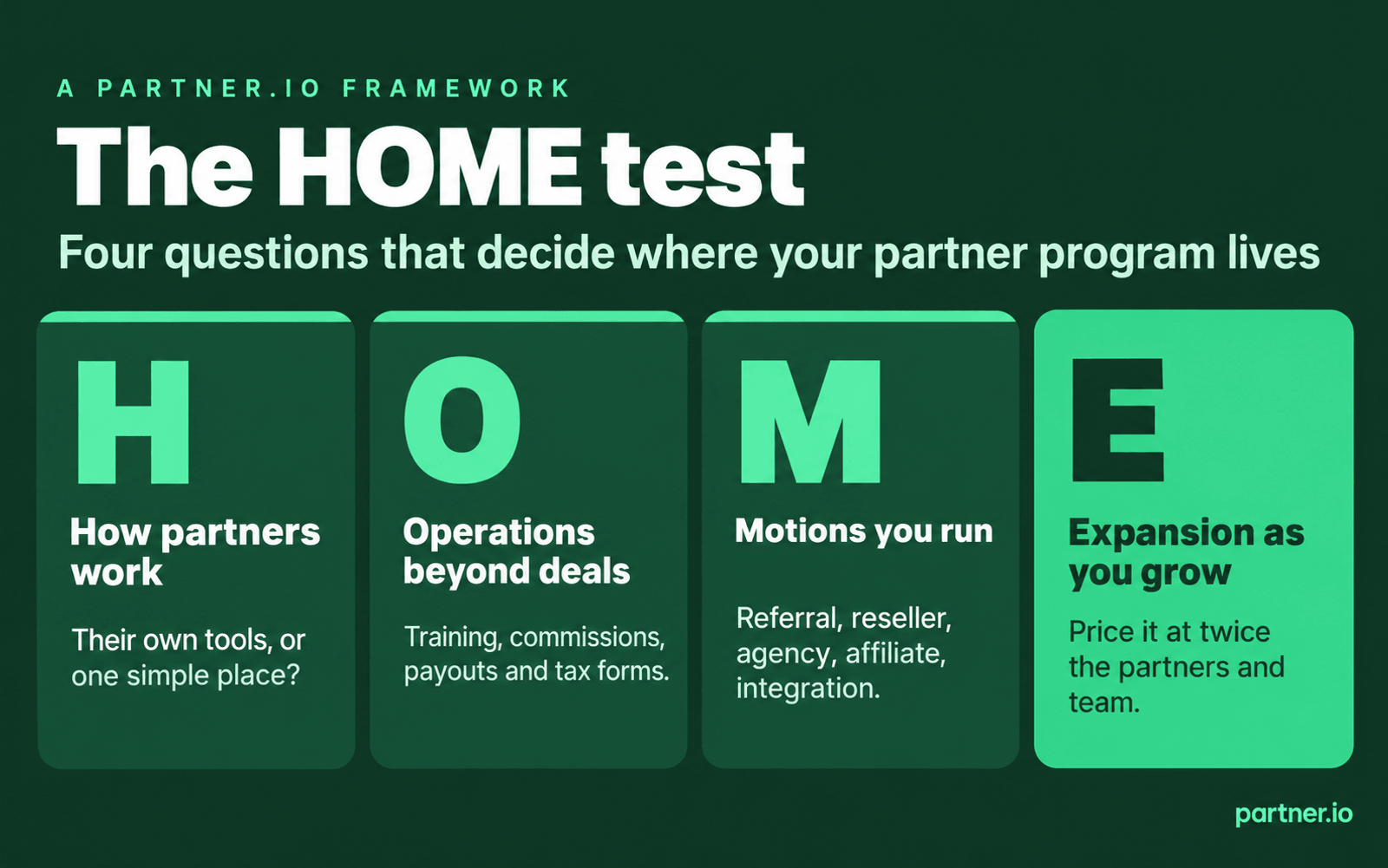
H: How partners work.
Do most of them run their own CRM and live in Slack or Teams? Or are they agencies, consultants and advisors who need one simple place to go?
O: Operations beyond deals.
Registering a deal is the start. Who trains partners, calculates what they're owed, pays them and handles tax forms? List every job, then check which tool does it without an add-on.
M: Motions you run.
Referral partners, resellers, agencies, affiliates and integration partners need different things. Count your motions today and the ones you'll add next year.
E: Expansion as you grow.
What happens when partners double, when you add two people to the team, or when you switch CRM? Price both tools at that size, not today's.
Score both platforms against all four. If H points one way and O, M and E point the other, follow the three.
Want to see a partner home that does all four jobs? Try Partner.io free for 7 days, no credit card needed.
How Partner.io vs Introw pricing differs
Price isn't the main story here, but the two models push you in different directions as you grow.
Partner.io publishes one price: $79 per seat per month for each person on your team who signs in. Partners are free and unlimited, and training, payouts, account mapping, the API and the MCP server are included.
Introw has a free Starter plan for one partner. Its Pro, Scale and Enterprise plans are quote-based. Its FAQ says paid plans "scale with the numbers of partners you manage". MDF, CPQ, affiliate programs, the LMS, embedding, multi-lingual portals, Power BI and API access are listed as add-ons.
So the questions to ask are different. With Partner.io, count the people on your team who need a seat. With Introw, ask for a quote at today's partner count and at three times that, and list the add-ons you'll need in year one.
Why getting this right matters now
Partner programs are being asked to carry more of the number. Forrester's State of Partner Ecosystems 2025 found two-thirds of respondents expect partner-influenced revenue to grow more than 30% on the previous year. Kathy Contreras, who wrote it, puts the shift plainly:
“Partners are playing a more strategic role in shaping and assisting B2B customer decisions.
”
More partner revenue means more partners, more motions and more payouts. Jay McBain, writing for Forrester on what partner relationship management has to become, named what separates the winners:
“Those brands that can balance their direct and indirect execution while ensuring consistent customer expectations and experience are having outsized success in the market.
”
Both platforms aim at that balance. They just put the partner experience in different places.
What this looks like in the real world
Here's an illustrative composite of a decision we see often.
A 50-person HR tech company runs HubSpot. It has 35 partners: 28 implementation agencies, five payroll consultants who refer, and two resellers with their own sales teams.
The two resellers love the idea of syncing deals straight from their own CRMs. That's Introw's strongest pitch, and it lands.
Then the team runs the HOME test.
H: 33 of the 35 partners don't have a CRM worth connecting.
O: agencies keep selling last year's packaging, so training is a must.
M: they want to add an affiliate program for HR bloggers next year.
E: they plan to double the agency count by summer.
They pick Partner.io. The agencies get a portal on the company's domain with a short course on the new packaging. The resellers register deals in the portal too, which they accept because their commissions show up there.
The trade-off they chose: two resellers lost CRM-to-CRM sync, and 33 partners got a home.
Decision points
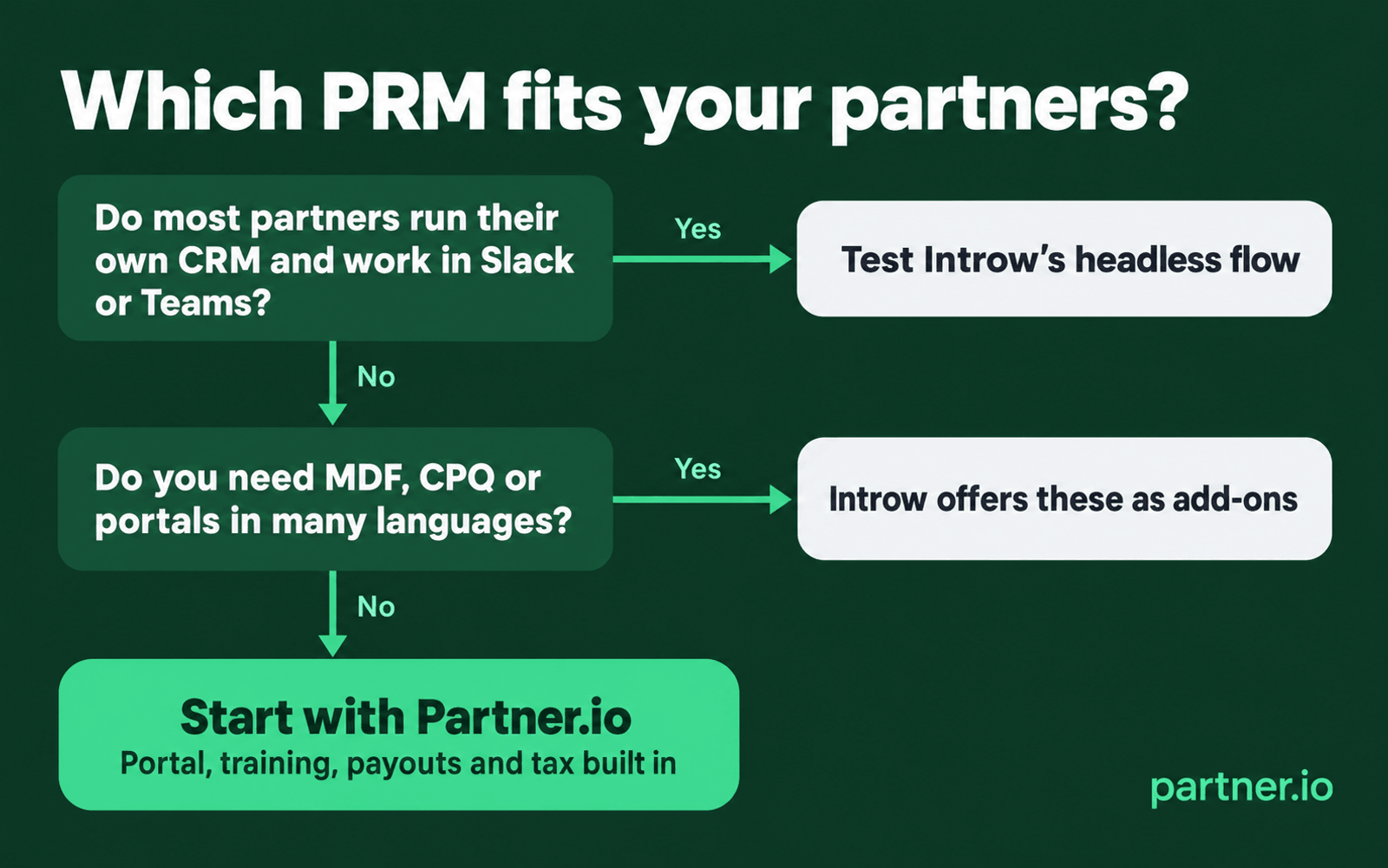
If most of your partners run their own CRM and live in Slack or Teams, test Introw's headless flow with three of them before you decide.
If you need MDF, CPQ or portals in many languages, Introw offers them as add-ons and Partner.io doesn't.
If you run Pipedrive or sell a Shopify app, Partner.io has native Pipedrive sync and Shopify app attribution. Introw's CRM integrations are HubSpot and Salesforce.
If training, payouts and tax forms are on your list, start with Partner.io. They're included, not priced separately.
When the choice goes wrong
Before you sign anything
- Ask five real partners whether they'd rather use a portal or their own tools.
- List every job beyond deal registration: training, commissions, payouts, tax forms.
- Get every add-on you'll need in year one priced in writing.
- Price the platform at today's size and at twice the partners.
- Have one partner register one real deal and check it lands in your CRM with the partner attached.
- Follow one commission from closed-won to paid.
Comparing more vendors? Our Partner.io vs Journeybee and Partner.io vs ZINFI posts use the same approach. If you're still deciding whether you need a PRM at all, read what a PRM is and when you need one, and for where it sits next to your CRM, see the modern revenue stack.
Give your partners somewhere to go
Introw is a capable platform, and its headless idea is the right one for partners who already run their own sales machine.
Most SaaS partner programs aren't built from those partners. They're built from agencies, consultants and advisors who need to know what to sell, whether their intro went anywhere and when they'll be paid. They need a home, and your team needs it connected to the CRM.
Run the HOME test with your own partner list. Then try the home.
Try Partner.io free for 7 days → No credit card, no setup fee, cancel anytime.
Prefer a walkthrough first? Book a demo and we'll map it to your program.
- [prm]
- [comparisons]
Published 8 October 2026