
AI made digital channels cheap, so buyers tune them out. The best sales channel in B2B SaaS is the people your buyers already trust. Here's how to run it.
Your Best Sales Channel Isn't a Dashboard. It's a Person.
Every SaaS company can now write a personalised email to every prospect on earth.
That's the problem.
When AI made outbound, ads and content cheap, it made them abundant. And buyers responded the way people always respond to abundance: they stopped paying attention.
Your best sales channel in 2026 isn't the one with the slickest dashboard. It's the consultant your buyer calls before a big purchase, the agency that's rebuilding their stack, the integration partner already inside the account. People your buyer trusts, who don't work for you.
Most companies have that channel already. Very few run it like one.
Buyers have stopped answering
The data on how B2B software gets bought has been saying the same thing for a while.
6sense's 2025 B2B Buyer Experience Report, built on nearly 4,000 buyer responses, found buyers initiated 79% of first contacts with vendors. They reach out when they're ready, not when your sequence says so.
By then, the decision is mostly made.
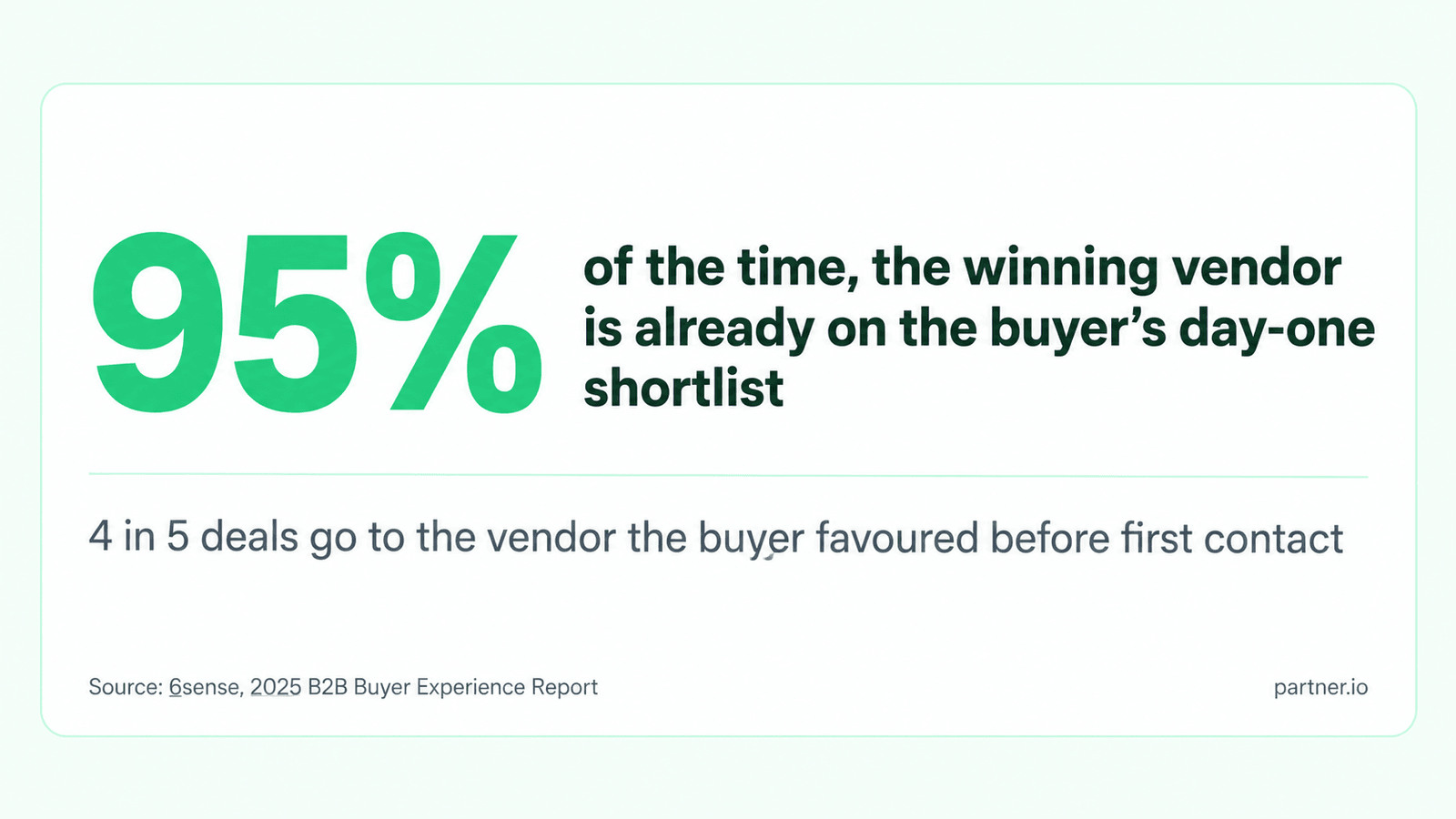
Ninety-five percent of the time, the winning vendor is already on the day-one shortlist, and four out of five deals go to the vendor the buyer already favoured before speaking to anyone. TrustRadius's 2026 B2B Buying Disconnect Report adds that 83% of buyers shortlist three products or fewer.
So the real question isn't how to reach buyers. It's who shapes the shortlist before you're invited in.
"But buyers don't want to talk to anyone"
This is the strongest objection, and it comes with data.
In a Gartner survey of 646 B2B buyers, 67% said they prefer a rep-free buying experience, and 45% had used AI during a recent purchase. If buyers want to do it themselves, why would people matter more?
Because "rep-free" isn't "human-free."
Buyers don't want your rep. They want someone who isn't selling to them. And they don't take AI's word for it either. In the same TrustRadius study, 63% of buyers used AI during their purchase, and 94% of those said they fact-check what it tells them.
“Buyers are using AI to move faster, not to think less.
”
Gartner sees where this goes. It predicts that by 2030, 75% of B2B buyers will prefer sales experiences that prioritise human interaction over AI. Its researcher Colleen Giblin puts it simply: "the enduring value of human interaction is becoming more pronounced."
Read together, the data is clear. Buyers want fewer sales calls and more trusted advice. The human channel is the advice they're looking for.
Who the human channel actually is
"Human" doesn't mean your sales team. It means the people around your buyer who already have their attention.
Referral consultants and advisors
The fractional CFO who tells a client which finance tool to buy. The security consultant who scopes a SOC 2 project and names the vendor. They don't sell anything. Buyers trust them because they don't.
Implementation agencies
The HubSpot agency rebuilding a client's marketing stack picks four or five tools for the job. If yours isn't one of them, a cold email won't fix that.
Integration partners
When your product plugs into a platform the buyer already uses, that platform's team can say "most of our customers pair us with them." That's co-sell, and it lands harder than any ad.
Customers
A happy customer telling a peer in a Slack community what they use is the oldest channel in software. A user referral program turns it from luck into something you can count.
Resellers and MSPs
For buyers who don't want to manage vendors at all, the reseller is the relationship. They decide what goes on the quote.
None of this is new. Forrester's buyer research put a number on how much buying already runs through other people:
“nearly 70% of over 10,000 global B2B purchase influencers in the past 12 months purchased their offering from an indirect route to market or partner rather than directly from the supplier
”
AI search runs on human signals
Here's the twist most teams miss: even when a buyer starts with ChatGPT or Claude, the answer is built from what people have said.
TrustRadius found that "AI-generated recommendations are heavily influenced by trusted third-party content," and 74% of buyers still use reviews to make decisions. Analyst reports, by contrast, were used by only 13% of buyers.
That third-party content is written by humans: an agency's case study about a client rollout, a consultant's comparison post, a partner's integration listing, a customer's review.
Your partners don't just introduce you to buyers. They create the material AI uses to decide whether you're on the shortlist at all.
Why the human channel stays small
If people are the best channel, why do most SaaS companies spend so much more on digital?
Because digital is easy to run. You can turn the dial, see the dashboard and report the number on Monday.
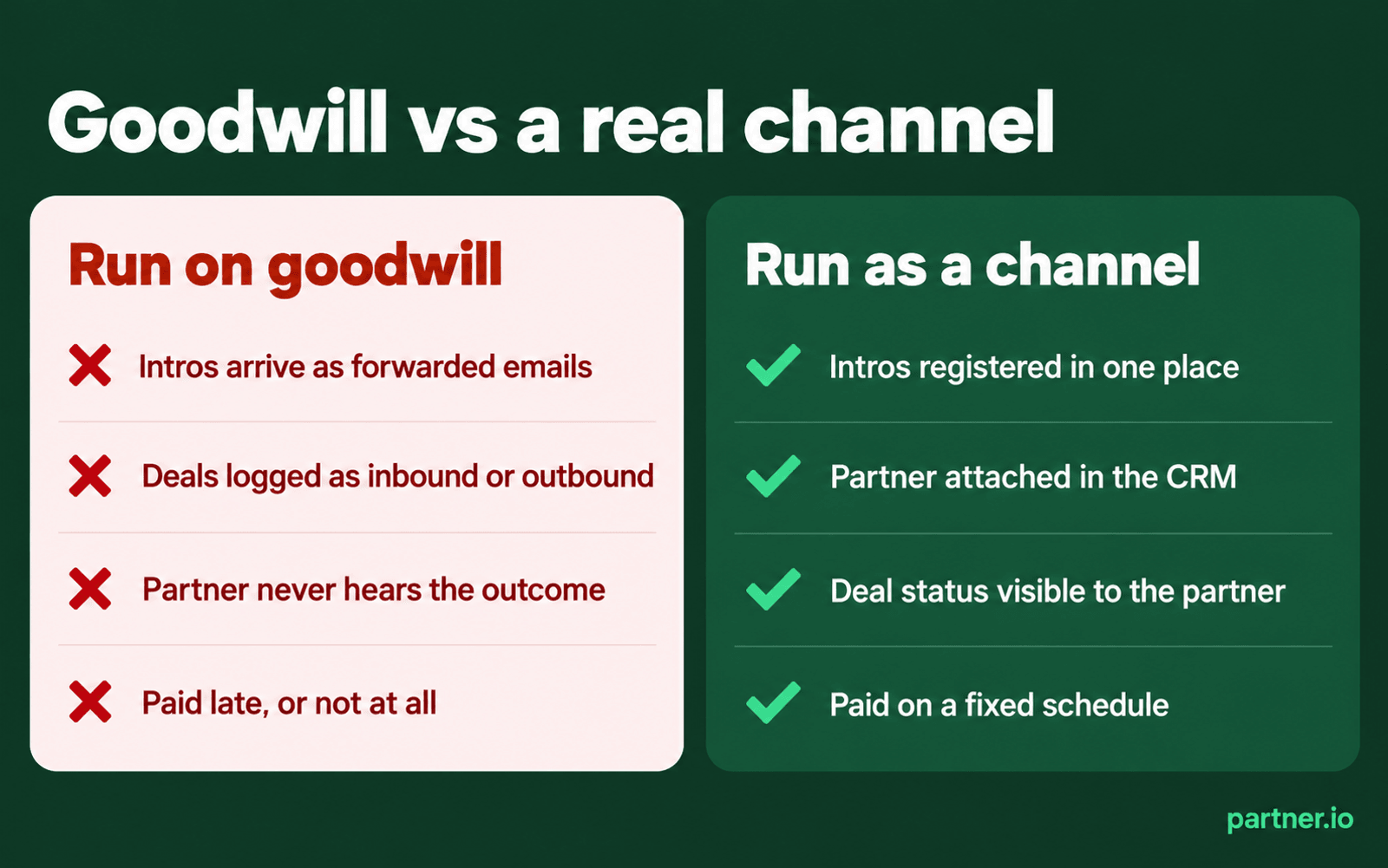
The human channel, as most teams run it, looks like this:
A consultant mentions you to a client over coffee.
The intro arrives as a forwarded email.
A rep logs it as inbound.
The consultant never hears what happened, and never gets paid.
Nobody decided to ignore it. It just has no system, so it never shows up in the numbers, so it never gets budget. (If that sounds familiar, the hidden cost of managing partners in spreadsheets adds it up.)
“Digital channels get budget because they show up on a dashboard. People don't, until you give them one.
”
The WARM model: running people as a sales channel
To run humans as a real sales channel, you need the same four things any channel needs: a target, a route in, an incentive and a number. We call it the WARM model.
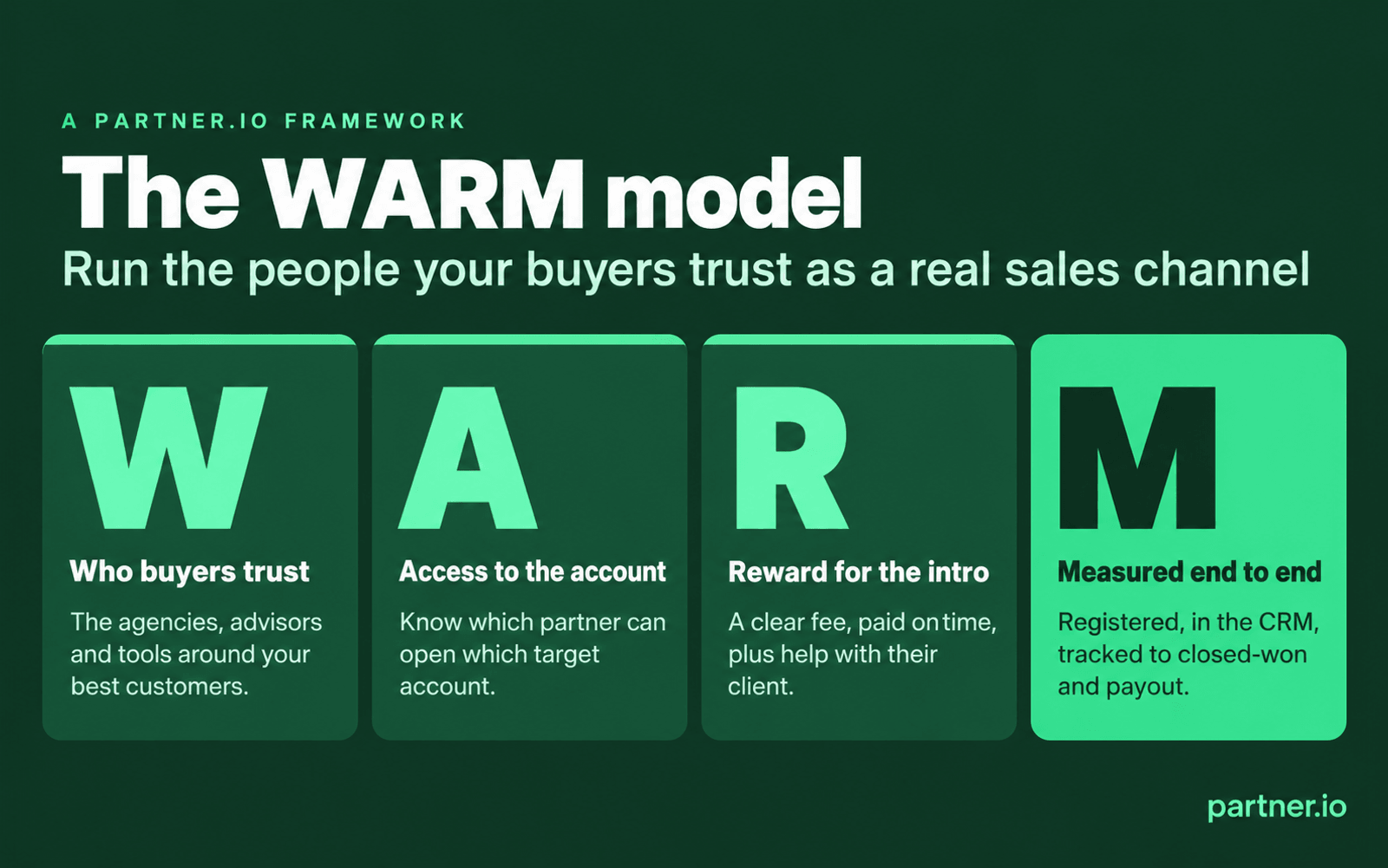
W: Who your buyers already trust
List the people who sit next to your best customers: the agencies they hired, the advisors they quote, the tools they connect you to. Ask your last ten customers who they talked to before buying. The names repeat faster than you'd expect.
A: Access to the account
Trust only matters if it reaches the account you're chasing. Map which partners already work with which of your target accounts, so you ask the right person for the right intro instead of blasting the whole partner list.
R: Reward for the intro
People introduce you when it's worth their while and safe for their reputation. That means a clear commission or referral fee, paid on time, plus whatever helps their client relationship: training, co-marketing, priority support.
M: Measured end to end
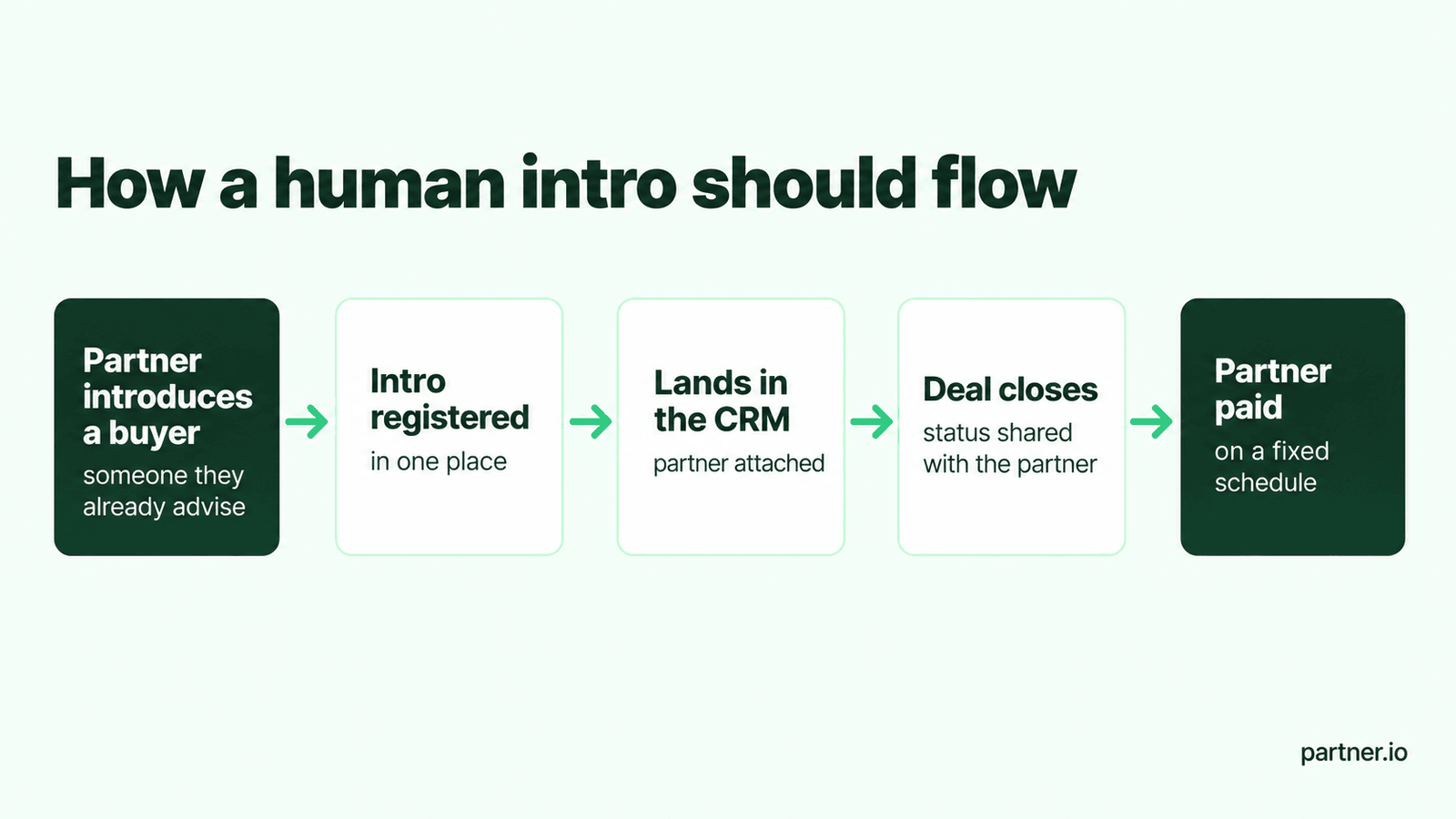
Every intro gets registered, lands in the CRM with the partner attached, and is tracked to closed-won and payout. Without this, the channel stays invisible and loses every budget argument.
Miss any one and the channel stalls. Trust without access is a nice lunch. Access without reward is a favour you can ask once. Rewards without measurement turn into arguments.
Want to run the WARM model in a real system? Try Partner.io free for 7 days, no credit card needed.
Start the human channel in 30 days
You don't need fifty partners. You need five who already know your buyers.
- Ask your last ten customers who influenced the purchase: an agency, a consultant, a tool they integrated. Write down every name.
- Pick the five names that appear most, and call them. Not a partner program pitch: a conversation about their clients.
- Agree one simple deal: a referral fee or commission, one trigger (closed-won) and a payment window you'll keep.
- Give them one place to register intros, so nothing arrives as a forwarded email and gets logged as inbound.
- Pay the first one fast. The first on-time payout does more for the channel than any partner newsletter.
Where digital still wins
This isn't an argument for switching off ads or outbound. It's about which channel you build around.
If your product is self-serve and sells for under a few hundred dollars a year, digital should stay primary. Nobody calls their consultant about a browser extension.
If your deals involve a buying committee, an implementation or a security review, someone is already advising your buyer. Build your go-to-market around reaching that person.
The trade-off is real. A human channel is slower to start than a paid campaign. You can't double it by doubling the budget, and it takes a quarter or two before the intros compound. In return, you get deals that arrive pre-trusted, from people your competitors can't buy their way past.
What this looks like in the real world
Here's an illustrative example of a pattern we see often.
A 30-person SaaS company sells compliance software to mid-size accounting firms. Its marketing runs on LinkedIn ads, SEO and an AI-assisted outbound sequence. The pipeline is busy, but deals stall in evaluation.
When the team looks at its last twelve wins, eight involved one of three outside consultants who advise accounting firms on tech. None of the three had ever been thanked, let alone paid.
They run the WARM model. The three consultants get a referral fee, a short course on the product and a portal to register intros. Two of them introduce a firm within a month. The registered deals land in HubSpot with the consultant attached, and the first fee is paid within two weeks of close.
Six months on, the ads still run. But the channel the team reports on first is the one with three people in it.
When it breaks
Where Partner.io fits
Partner.io exists to turn the human channel into one you can run and measure. Each part of the WARM model maps to something specific:
- Who and Access: Deal Surround and Partner Discovery show which partners are most likely to have a relationship with a target account, and account mapping shows the accounts you share.
- Reward: commissions and payouts with tiers, approvals and Stripe payouts, with no platform fee on what partners earn.
- Measured: referrals and deal registration sync to HubSpot, Salesforce or Pipedrive with the partner attached, so the channel shows up next to paid and outbound.
- A home for partners: a branded partner portal where they register intros, see deal status and get paid, plus training so they describe you accurately.
Customers count too. User referrals let your happiest users introduce peers from inside your product.
If you're still weighing partners against paid, why trust beats traffic and how B2B SaaS replaces cold prospecting with referrals go deeper. For the bigger shift behind all this, read from digital sales to ecosystem sales.
Before you spend another dollar on digital
- List everyone who influenced your last ten wins, inside and outside the company.
- Count how many of those people have ever been thanked, paid or told the outcome.
- Check whether partner-sourced deals in your CRM are labelled as partner, or as inbound and outbound.
- Agree one referral reward you can pay within 30 days of close.
- Give partners one place to register an intro.
- Report the human channel next to paid and outbound every month.
The channel your competitors can't buy
Anyone can outspend you on ads. Anyone can send more AI-written email than you.
Nobody can buy the trust a consultant has with their client, or the seat an agency has in a rebuild. That channel goes to whoever earns it, rewards it and runs it properly.
Start with five people. Give them a reason and a place to send you deals.
Try Partner.io free for 7 days → No credit card, no setup fee, cancel anytime.
Prefer a walkthrough first? Book a demo and we'll map it to your program.
- [partner-led-growth]
- [referrals]
Published 14 October 2026