
Partner.io vs Salesforce PRM for SaaS partner teams: per-partner licences on top of Sales Cloud, against one public seat price with unlimited free partners.
Partner.io vs Salesforce PRM: One Bills You Per Partner. One Doesn't.
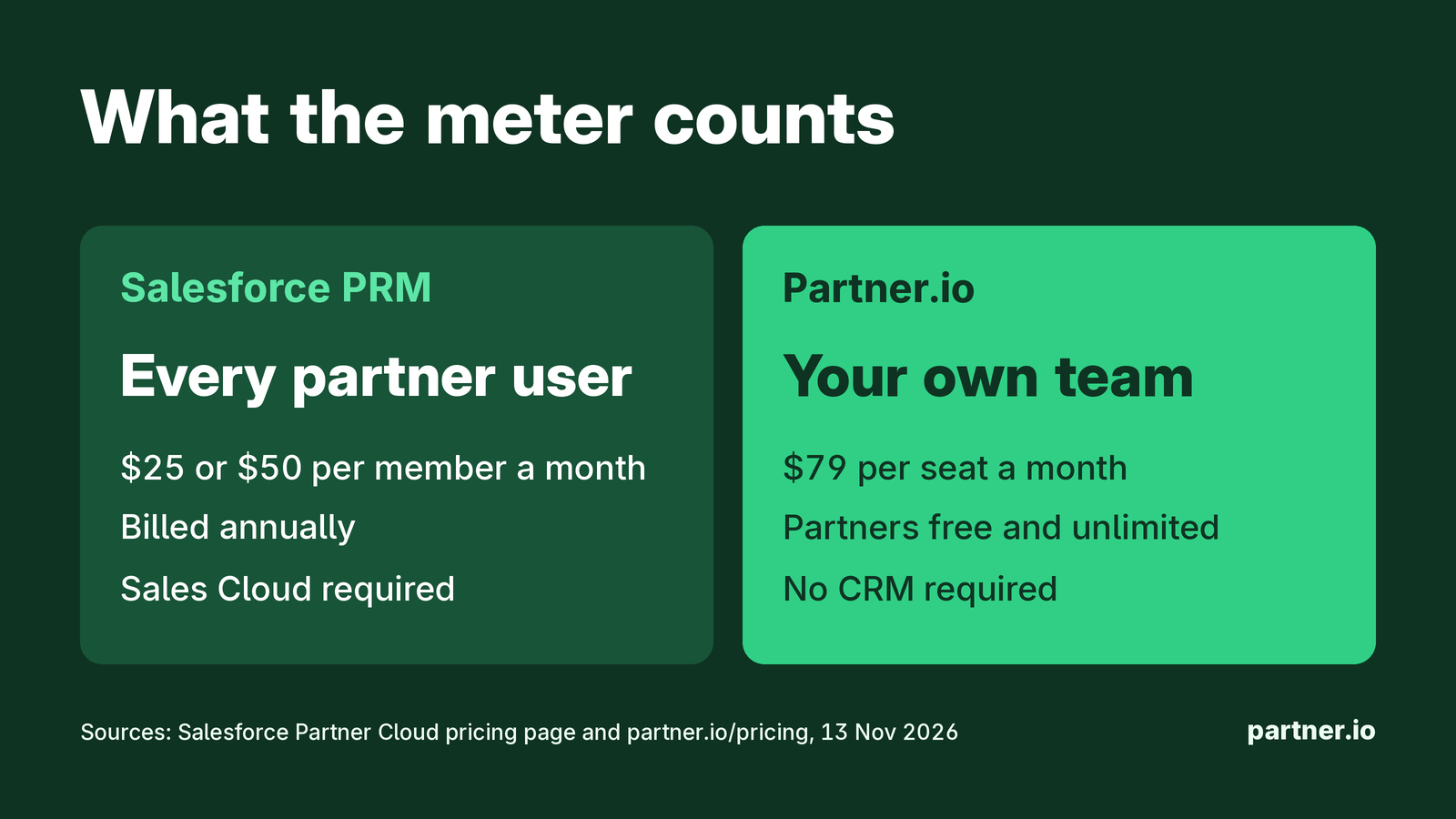
Salesforce PRM starts at $25 a month.
Per partner user.
Billed annually.
On top of a Sales Cloud licence you have to own first.
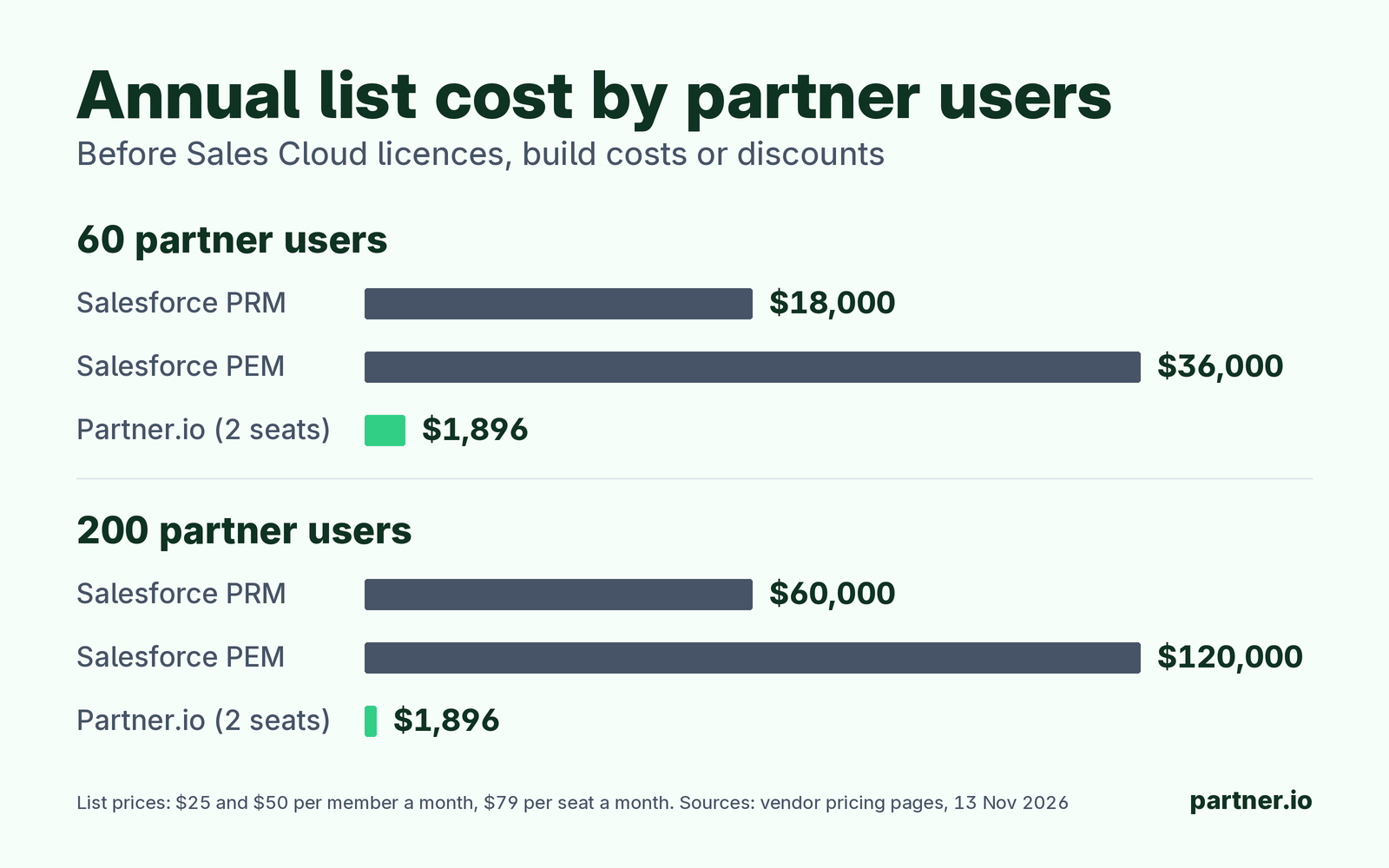
So a program with 30 agencies and two people at each one isn't a $25 line item. It's 60 members and $18,000 a year at list price, before anyone has built the portal those members will sign in to.
On Partner.io, those 60 people cost nothing. So do the next 600.
That's the Partner.io vs Salesforce PRM decision in short. Salesforce sells partner management as an add-on to its CRM, metered by every partner who gets a login. Partner.io is a standalone PRM priced on your own team's seats, with the portal, payouts and tax forms on one plan.
A naming note: Salesforce now sells this as Partner Cloud. "Partner Relationship Management" is the entry edition and "Partner Ecosystem Management" sits above it. Most people still say Salesforce PRM, so we will too.
The short answer
For a SaaS partner program, Partner.io is the better choice. One plan at $79 per seat per month, published on the website. Partners are free and unlimited. It works with HubSpot, Pipedrive or Salesforce, you can try it for 7 days without a card, and commissions are paid through your own Stripe account with W-9s and 1099-NEC forms handled.
Salesforce PRM earns a look in one case. You already run Sales Cloud on a qualifying edition, you have Salesforce admins with spare capacity, and your channel needs things like market development funds, rebates and distributor inventory.
If that isn't you, the gap is wider than a feature grid shows.
The best argument for Salesforce PRM, and why it rarely applies
Here's the strongest case against us.
If your pipeline lives in Salesforce, a PRM built on the same platform has no sync to break. A registered deal is an opportunity. A partner user is a contact with a licence.
Reports, sharing rules and approval flows are the ones your admin already knows. Analysts rate it too: Salesforce's Partner Cloud page cites an IDC MarketScape placing it as a leader.
That's a real advantage, and for a manufacturer with 3,000 dealers it can decide the deal.
Now look at who it helps. It helps companies that already pay for Sales Cloud at the right edition, already employ people who build in Experience Cloud, and have enough partners that a build project pays back.
Most SaaS programs under about $25M ARR have none of the three. Plenty run on HubSpot or Pipedrive. The "admin" is a RevOps person with a backlog. And the program has 15 partners today and wants 60 by year end.
For that program, the year-one risk isn't a sync error. It's a referral that sits in an inbox for eleven days while the portal is still a project plan.
New to the category? Start with what a PRM is and when you need one.
Partner.io vs Salesforce PRM at a glance
Everything below comes from each vendor's public pages as of 13 November 2026. Salesforce prices are list prices, so confirm your own quote before you buy.
| Partner.io | Salesforce PRM | |
|---|---|---|
| Price | $79 per seat | $25 or $50 per member |
| Priced by | Your team's seats | Partner users |
| Partners | Unlimited, free | Each one is a licence |
| CRM needed | None to start | Sales Cloud |
| Works with | HubSpot, Pipedrive, Salesforce | Salesforce |
| Free trial | 7 days, no card | None |
| Contract | Monthly | Annual |
| Commissions | Every account | $50 edition |
| W-9 and 1099-NEC | Built in | Not listed |
| MDF and rebates | No | Yes |
Salesforce PRM pricing: what the page says
Salesforce publishes its prices, which is more than most enterprise PRMs do. Read the page closely, though, because four details change the maths.
1. The unit is a partner member. Partner Relationship Management lists at $25 per member per month, billed annually. Partner Ecosystem Management lists at $50. A member is a partner user, so every person at every partner who needs a login is a licence. The FAQ adds that login-based pricing exists for both, but no login price is published.
2. It's an add-on. The FAQ says the Partner Cloud products are "separate add-ons for Sales Cloud", and the footnote reads "Requires a Sales Cloud or CRM license". The Partner Cloud product page goes further: it "requires Enterprise edition or greater".
Salesforce's Sales Cloud page now lists Starter at $25, Pro at $100 and Core at $195 per user per month, after a September 2026 edition overhaul covered by Salesforce Ben. Ask which of those qualifies before you model anything.
3. Commissions sit on the $50 edition. By the FAQ, incentive compensation (Salesforce Spiff), loyalty management and B2B referral programs come with Partner Ecosystem Management. Channel Revenue Management, which covers rebates, is quote-only. The Agentforce rows carry a "Flex Credits Required" note.
4. You can't try it. This one is best in Salesforce's own words, from the pricing FAQ:
“No, due to the member nature of Partner Cloud, it's not possible to get a free trial.
”
The page suggests a workshop or your own sandbox instead.
Now the maths, at list price and before any discount you negotiate.
Thirty partners with two users each is 60 members. That's $18,000 a year on the $25 edition, or $36,000 on the $50 edition that includes incentive compensation.
Grow to 100 partners and it's 200 members: $60,000 or $120,000 a year. Sales Cloud licences and the build are extra.
What Partner.io costs
Partner.io costs $79 per seat per month. A seat is someone on your team who signs in. Partners use the portal free, in any number.
Two people running the program cost $1,896 a year. At 60 partner users or 200, the number is the same, and it covers commissions, payouts, tax forms, tiers, training, automation, Deal Surround and every integration. The detail is on the pricing page.
There's no member count, no edition ladder and no annual contract.
Why SaaS partner teams pick Partner.io
A typical SaaS partner program looks like this:
A fractional CFO who refers two deals a quarter.
Five agencies that implement your product and want 20% of year one.
An integration partner whose customers overlap your target list.
A reseller who owns the relationship in one region.
Here's where Partner.io pulls ahead for that mix.
Recruiting partners never raises your bill
Per-member pricing forces a bad question: is this partner worth a licence?
The honest answer for most new partners is "we don't know yet". A consultant might send one deal in year one and six in year two. If each login costs $300 to $600 a year, you ration access. You give one login to an agency of twelve, and the account manager who hears about deals never sees the portal.
With unlimited free partners, you invite everyone and prune on performance. That's how a program finds its top ten.
You don't have to be a Salesforce shop
Salesforce PRM assumes Salesforce. Partner.io doesn't assume anything.
Deals and referrals sync to HubSpot, Pipedrive or Salesforce with the partner attached. One caveat, since we're being straight: the Salesforce integration is switched on per account on request, so ask for it on day one of your trial.
Commissions, payouts and tax on the one plan
This is where partner trust is won or lost, and where managing partners in spreadsheets does the most damage.
Partner.io handles approval, self-billed invoices and payouts through your own Stripe account. Stripe's payouts documentation explains the settlement timing.
For US partners, the tax tools collect a W-9 before money moves, track who's nearing the 1099 threshold and generate 1099-NEC forms at year end. The IRS covers what counts in its Form 1099-NEC guidance.
Salesforce's incentive compensation comes with the $50 edition. In the demo, ask one question: when a commission is approved, what sends the money, and where does the W-9 live?
“A partner who can't see what happened to their last deal won't send you the next one.
”
Live this week, with no build project
A Salesforce partner site is assembled in Experience Builder from site templates, then wired to sharing, roles and automation. It's flexible. It's also a project, with an owner, a backlog and a go-live date.
Every Partner.io account starts with a branded partner portal, a default tier, a referral form and a partner application form. Partners register deals and submit referrals the day you invite them.
Training and co-sell without extra licences
Training and certification drafts courses with AI from your existing material and issues certificates inside the portal.
Deal Surround and Partner Discovery shows which partner can open a named target account. Jay McBain, Chief Analyst at Omdia, counts 28 touchpoints before a B2B buyer signs. He puts the stakes like this in his foreword to Partnernomics:
“If you (or your partners) aren't present in those 28 moments, you are invisible.
”
When Salesforce PRM makes sense
There are programs it fits better, and it's worth being plain about them.
You're all-in on Salesforce. Sales Cloud on a qualifying edition, admins on staff and a rule that partner data never leaves the org.
MDF, rebates and distributors. Salesforce lists market development funds, and Channel Revenue Management adds rebates, ship and debit and inventory tracking. Partner.io has none of those.
Pushing leads out to partners. Lead distribution is on Salesforce's feature list. Partner.io is built around deals and referrals coming in.
Heavy customisation. Custom objects, bespoke approval chains and several portal experiences for different partner types.
Recognise your program? Take the workshop. If your partners are agencies, consultants and integration partners, you'd be buying licences by the head for a channel you don't run.
The SEAT test for choosing a PRM
Every PRM demo looks complete. Four questions get past the demo, and we call them the SEAT test, because the fastest way to understand a PRM is to ask whose seat you're paying for.
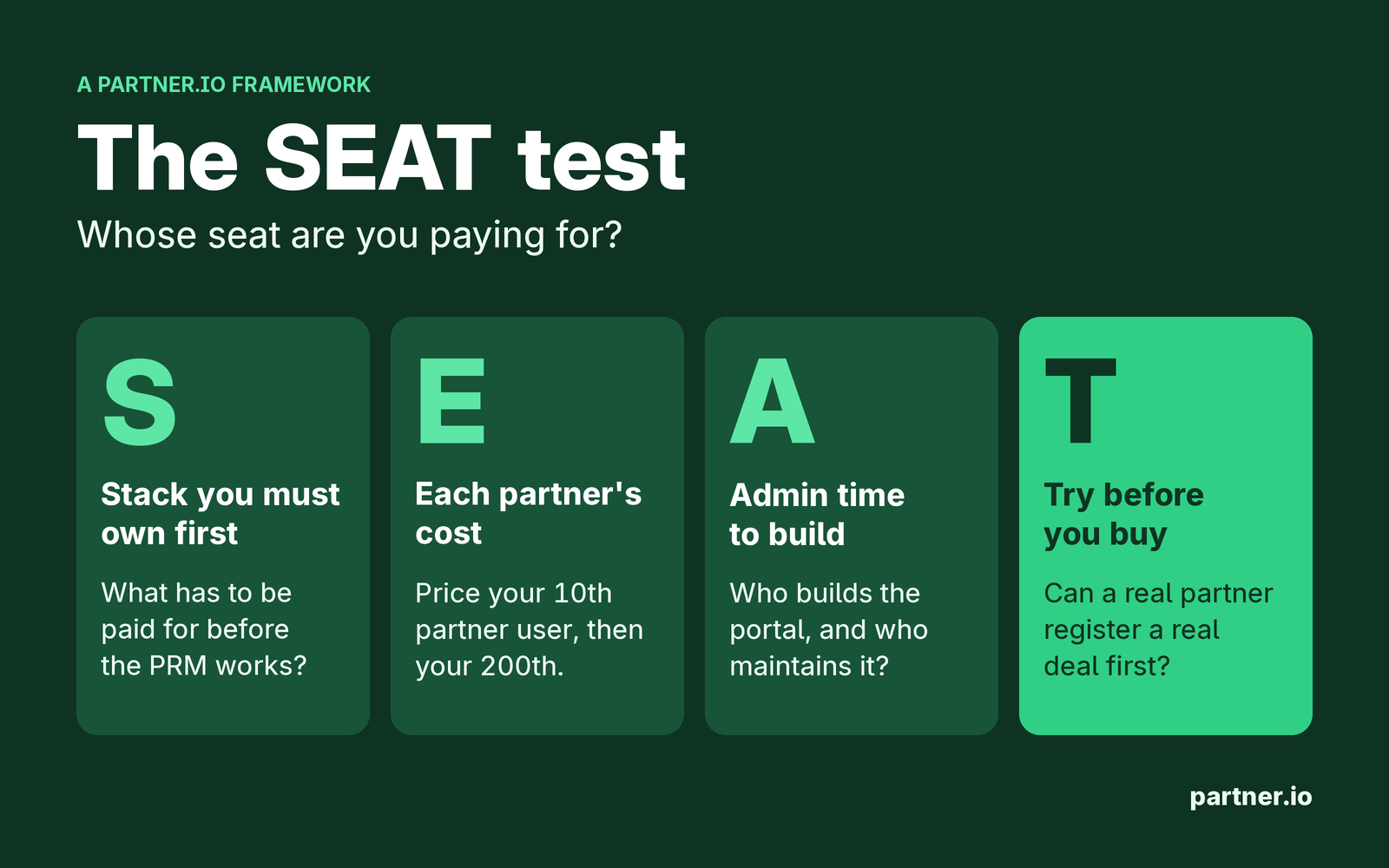
S: Stack you must own first.
What do you need to be paying for before the PRM works? If the answer is a CRM edition, that's part of the price.
E: Each partner's cost.
Price your 10th partner user, then your 200th. If the second number hurts, you'll stop inviting people.
A: Admin time to build.
Name the person who builds the portal and the person who maintains it. If neither has a free month, the launch date is fiction.
T: Try before you buy.
Can a real partner register a real deal before you sign? If not, you're buying a slide deck.
Score both vendors in writing. For a SaaS program, Partner.io answers all four on its website. Salesforce's own pages answer them too, and the answers are Sales Cloud, $25 to $50 a head, your admins and no.
Want to run the SEAT test on a real portal? Try Partner.io free for 7 days, no credit card needed.
What this looks like in the real world
Here's a composite of a situation we see often.
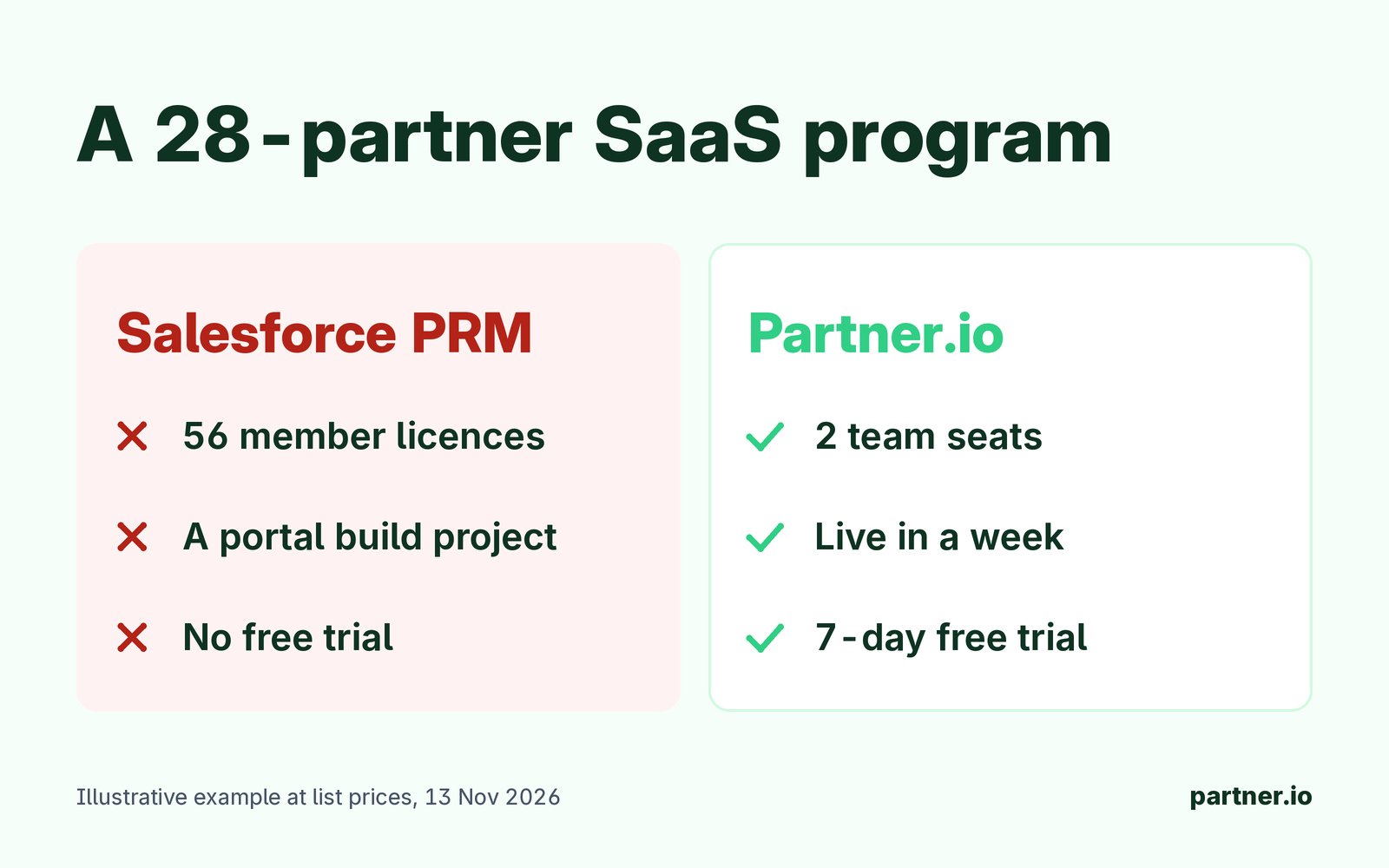
A 70-person SaaS company moved from HubSpot to Salesforce last year. It has 28 partners: eighteen agencies, eight referral consultants and two integration partners. Commissions live in a Google Sheet that one person understands.
The CRO's instinct is tidy: "We're on Salesforce now. Use Salesforce for partners."
Then the partner lead does the sums. Two users at each partner is 56 members. Incentive compensation needs the $50 edition, so that's $33,600 a year at list.
The Salesforce admin, still cleaning up the migration, pencils the portal in for "some time next quarter". And there's no trial to check any of it.
They start a Partner.io trial on a Monday and ask for the Salesforce integration. By Thursday, two tiers are live and all 28 partners are invited, including the account managers who'd never have got a licence. The next week an agency registers a deal that lands in Salesforce as an opportunity with the partner attached.
Two seats: $1,896 a year. When they add 30 agencies in spring, the bill doesn't move.
Run your first week before you decide
Don't let a vendor run your evaluation. Run it with real partners and one real deal.
- Day 1: set up two tiers with your real commission rates and your logo.
- Day 2: connect your CRM and push a test deal through. Check the partner field survives an edit.
- Day 3: invite three partners. One keen, one average, one who never reads email.
- Day 4: have a partner register a live deal. Change the amount in the CRM and check what the partner sees.
- Day 5: approve the commission and pay it. Then find the W-9.
Partner.io's trial covers every step inside the 7 days. For Salesforce, ask for a sandbox on these exact terms, and ask who builds it.
Decision points and trade-offs
If you're on HubSpot or Pipedrive, this isn't a contest. Salesforce PRM needs Salesforce.
If you're on Salesforce with fewer than a few hundred partner users and no MDF, start with Partner.io and see whether you ever miss anything.
If you run distributors, rebates and thousands of dealer logins with an admin team to match, shortlist Salesforce and get the member count in writing.
The trade-off is plain. Salesforce gives you one platform and deep channel finance, paid for per partner and built by your own admins. Partner.io gives you a narrower tool that's live this week, with payouts and tax included, at a price that ignores how many partners you recruit.
When a PRM rollout breaks
For the wider pattern, see why your tech stack was built for direct sales.
Before you sign anything
- Count partner users, not partner companies, at today's size and at 3x.
- Get the year-one total in writing, including the CRM edition it depends on.
- Ask which edition includes commissions, and what sends the money.
- Ask who builds the portal, and how many weeks until one partner registers one deal.
- Find out the contract length and what happens to unused licences.
Comparing more vendors? Our Partner.io vs Unifyr comparison runs the same checks on another per-partner pricing model, and the best PRM software guide covers the wider field.
Where Partner.io fits
If the problems above are yours, here's what solves each one:
- Partners can't see their deals: the partner portal puts deal status and earnings on the first screen, on your own domain.
- Referrals get logged as inbound: leads and deal registration syncs the partner to HubSpot, Pipedrive or Salesforce.
- Commissions are late: tiers, commissions and payouts pays through your Stripe account.
- Approvals and follow-ups eat your week: automation handles them.
- You're starting small: here's how to structure a partner program under 10 partners.
Start with one partner, one deal, one clean record
Buyers have already made partners a main route to market. Forrester's buyer research put a number on it:
“Data from Forrester's Buyers' Journey Survey, 2022 reveals nearly 70% of over 10,000 global B2B purchase influencers in the past 12 months purchased their offering from an indirect route to market or partner rather than directly from the supplier.
”
A channel that large needs more partners in it, and a PRM that bills by the partner pulls the other way.
Salesforce PRM is a capable platform for an enterprise that lives in Salesforce and runs a channel with funds, rebates and distributors.
For a SaaS team building a partner program, Partner.io is the better PRM: a price you can read, every partner invited from day one, and payouts that never leave the system. You can check all of that this week, which is one thing Salesforce won't let you do.
Try Partner.io free for 7 days → No credit card, no setup fee, cancel anytime.
Prefer a walkthrough first? Book a demo and we'll map it to your program.
- [prm]
- [comparisons]
Published November 13, 2026