
Partner.io vs Journeybee compared on real monthly cost, add-on modules, partner experience, training and setup, so you can price the full bill before you choose.
Partner.io vs Journeybee: The Cheaper PRM Depends on One Number
Journeybee's pricing page has a line most PRM buyers love: unlimited users and unlimited partners.
Partner.io charges per seat.
So Journeybee is cheaper. Except, for most small partner teams, it isn't.
The Partner.io vs Journeybee decision comes down to a number you already know: how many people on your team need to log in to run the program. Get that number, add the modules you actually need, and the answer falls out of a spreadsheet in about ten minutes.
This post walks through that math, then everything else that matters once the price is settled.
The short answer
Pick Journeybee if you have seven or more people who need to sign in, your partners refuse to use one more login, or you need MDF, CPQ or distributor management. Journeybee also connects to Dynamics 365, Attio and Zoho CRM, which Partner.io doesn't.
Pick Partner.io if a small team runs the program, you want training and partner discovery without buying add-ons, and you'd rather start a free trial today than book a demo.
Most partner teams at SaaS companies under roughly $25M ARR are two to five people. For them, Partner.io usually costs less and includes more. Here's the proof.
What each PRM costs, in actual dollars
Both vendors publish their entry prices, which makes this comparison easier than most.
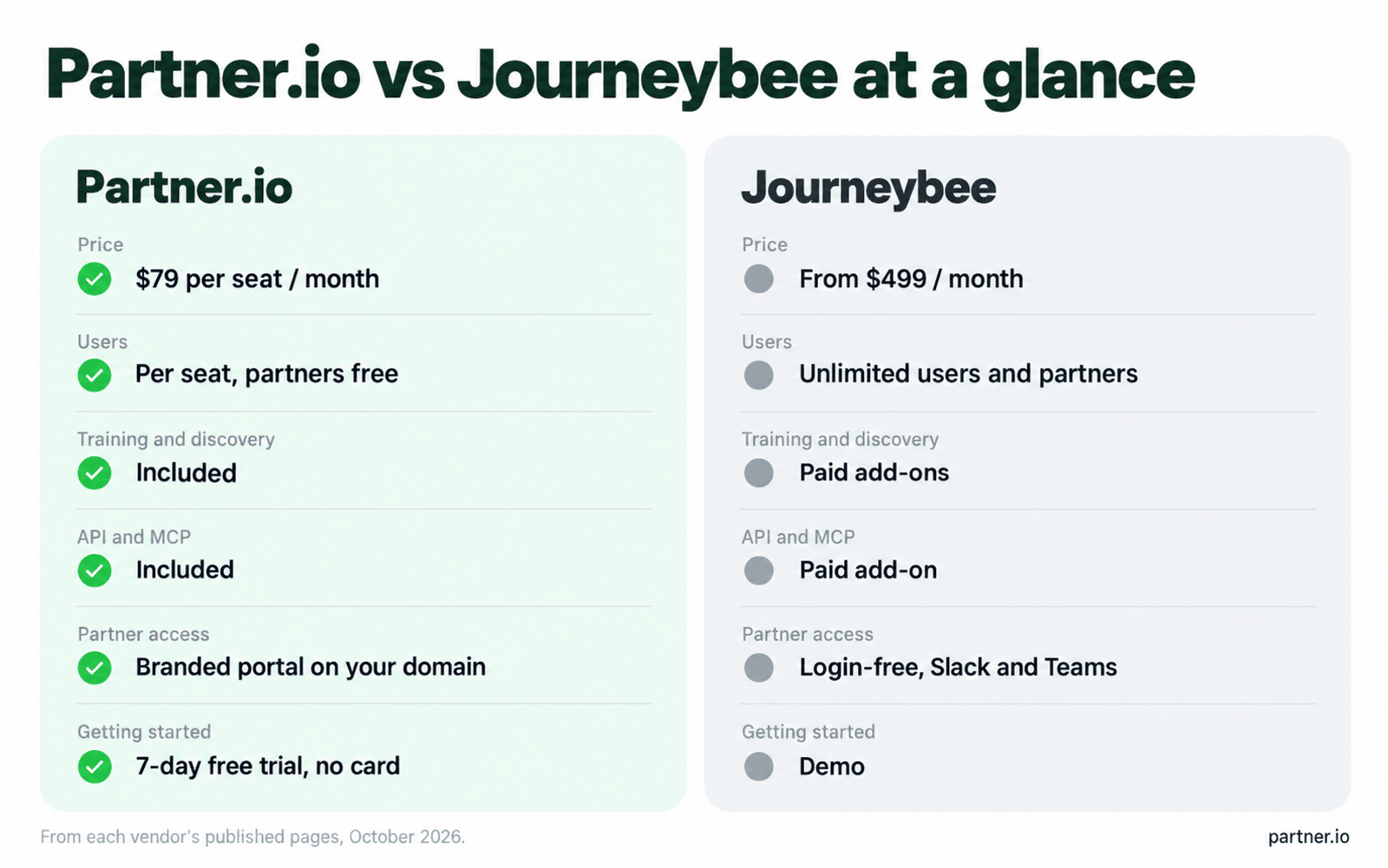
Partner.io costs $79 per seat per month. A seat is anyone on your team who signs in. Partners are free and unlimited, and every feature is included.
Journeybee's pricing page says its Startup plan starts from $499 per month with unlimited users and partners. On top of that sit optional modules: LMS (training), Partner Discovery, Partner Marketing, MDF, CPQ and Distributor Management. Project Management, API and MCP access, Embedded Portals and SAML SSO are add-ons too, and the AI Copilot is billed on usage.
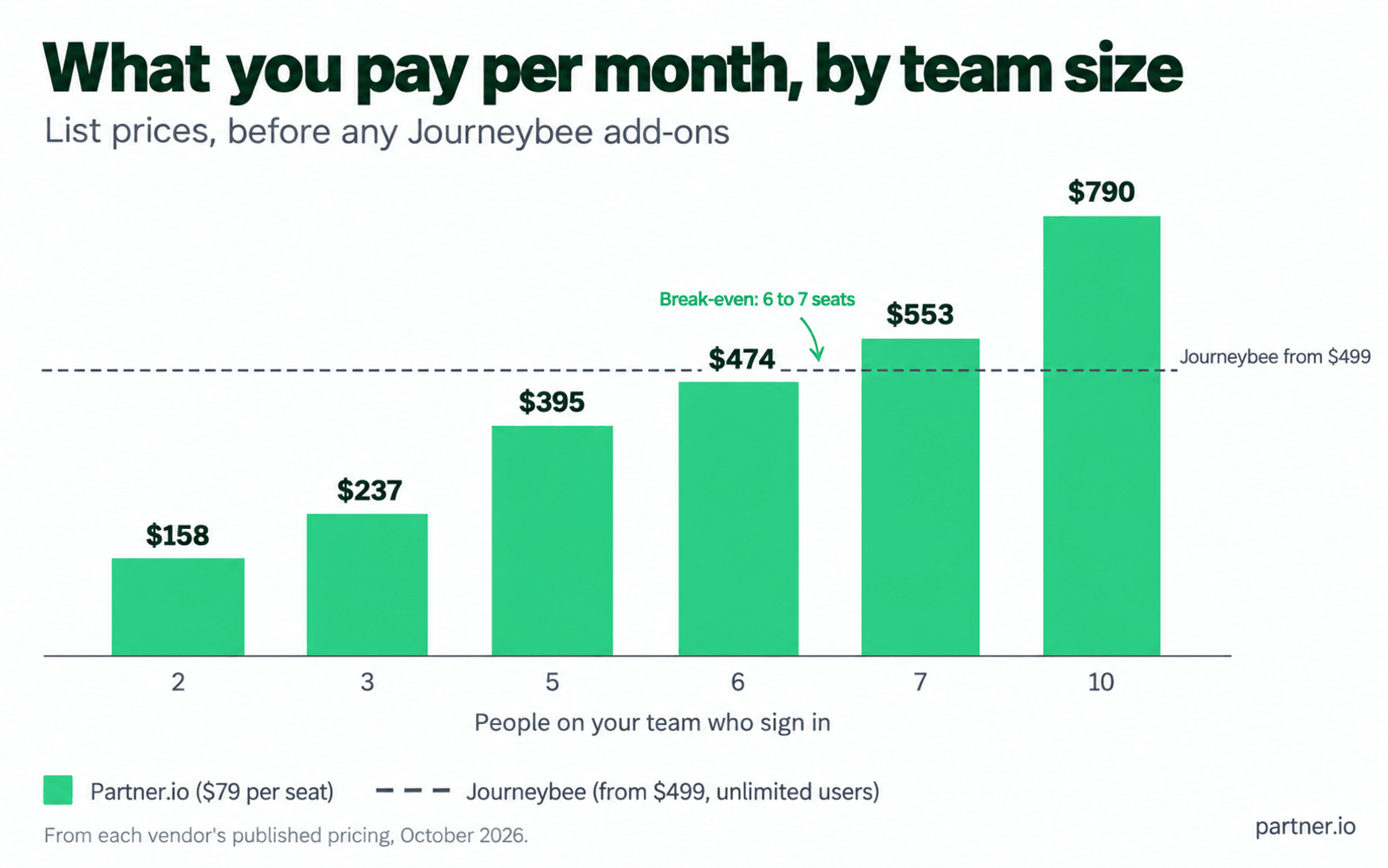
Here's what that looks like by team size, at list price, before any Journeybee add-ons:
| People who sign in | Partner.io | Journeybee |
|---|---|---|
| 2 | $158 / month | From $499 / month |
| 3 | $237 / month | From $499 / month |
| 5 | $395 / month | From $499 / month |
| 6 | $474 / month | From $499 / month |
| 7 | $553 / month | From $499 / month |
| 10 | $790 / month | From $499 / month |
The break-even sits between six and seven seats. Below it, Partner.io is cheaper. Above it, Journeybee's base price wins.
Now add the modules. If you want to train partners in Journeybee, the LMS is an add-on. If you want help finding which partner can open a target account, Partner Discovery is an add-on. In Partner.io, training and certification and Deal Surround and Partner Discovery are part of the $79.
Journeybee doesn't publish add-on prices, so ask for them in writing. Price the bill you'll actually pay, not the number on the pricing page.
Who actually needs a seat?
This is where teams overcount.
Whoever runs the program day to day needs a seat. So does whoever approves commissions, and the person who sends partner newsletters, if that's someone else.
Your account executives might not. Partner.io syncs deals with HubSpot, Salesforce and Pipedrive, so a rep can see the registered deal, the partner attached to it and its stage without ever opening the PRM. If your reps live in the CRM, they don't count.
Do the count properly before you compare prices. It's the number that decides this whole comparison.
Where Journeybee is the stronger choice
Journeybee gets several things right, and some of them Partner.io doesn't match.
Partners don't have to log in. Journeybee describes a login-free portal and lets partners submit leads through Slack, Microsoft Teams, Google Chat, email or a web form. If your partners are agencies who live in Slack and ignore every portal invite, that's a real advantage.
More CRMs. Journeybee lists integrations with Salesforce, HubSpot, Pipedrive, Dynamics 365, Attio and Zoho CRM. Partner.io covers the first three.
Classic channel modules. MDF, CPQ and distributor management are available as Journeybee add-ons. Partner.io doesn't have an MDF module or CPQ.
Big internal teams. Unlimited users means a 15-person partnerships and channel sales team pays the same base price as a team of two.
Journeybee also states it holds ISO 27001 and SOC 2 Type 2 certification, which shortens security reviews if your buyers ask for both.
So if you're a hardware, data or security vendor running resellers and distributors with a large channel team, Journeybee deserves a demo.
Where Partner.io pulls ahead
Most SaaS partner programs look different:
Two or three people running it.
Consultants and agencies who refer.
A reseller or two.
An integration partner with overlapping customers.
That's the program Partner.io was built for.
Everything is in the price
There's no module menu. Partner.io's $79 seat includes:
- the white-label partner portal on your own domain
- referrals, referral links and deal registration with CRM sync
- tiers, commissions and Stripe payouts with no platform fee on partner payments
- training, AI course building and certification
- account mapping and Deal Surround
- the REST API, webhooks and the Partner.io MCP server
That last one matters more than it looks. API and MCP access is an add-on at Journeybee. If you plan to connect your PRM to internal tools or AI assistants, price that in.
“The cheapest PRM is the one where the modules you need are already in the price.
”
You can try it before you talk to anyone
Partner.io has a 7-day free trial with no credit card and no setup fee. Journeybee's pricing page doesn't mention a trial; its path is a demo.
A trial lets you test with real partners and a real deal, on your own schedule. That's worth more than any demo, because demos never use your data.
US tax handling is built in
If you pay US partners, the tax compliance tools collect W-9s before money moves, track the 1099 threshold and generate 1099-NEC forms at year end. The IRS explains the rules in its guidance on Form 1099-NEC. We couldn't find tax form handling on Journeybee's product or pricing pages, so ask them directly.
Both platforms pay partners through Stripe. If you want to know what you're signing up for at the payment layer, Stripe's payouts documentation covers timing and fees.
Why the bill matters more than the feature list
Partner programs rarely die from a missing feature. They die from cost pressure and admin load, usually in the same quarter.
Jay McBain, Chief Analyst at Omdia, is blunt about the stakes in his foreword to Partnernomics:
“Leveraging strategic partners for growth is no longer an option; it's an existential imperative for survival.
”
Buyers agree. Forrester's research found that most B2B buyers purchase through partners or indirect routes:
“Data from Forrester's Buyers' Journey Survey, 2022 reveals nearly 70% of over 10,000 global B2B purchase influencers in the past 12 months purchased their offering from an indirect route to market or partner rather than directly from the supplier.
”
You can read the summary in Forrester's report.
If partners matter that much, the PRM that survives your next budget review is the one whose cost you can defend line by line. That's the point of the framework below.
Price the FULL bill before you choose any PRM
Pricing pages show the entry price. Your finance team pays the full bill. We use a four-part check we call FULL, and it works on any vendor, including us.
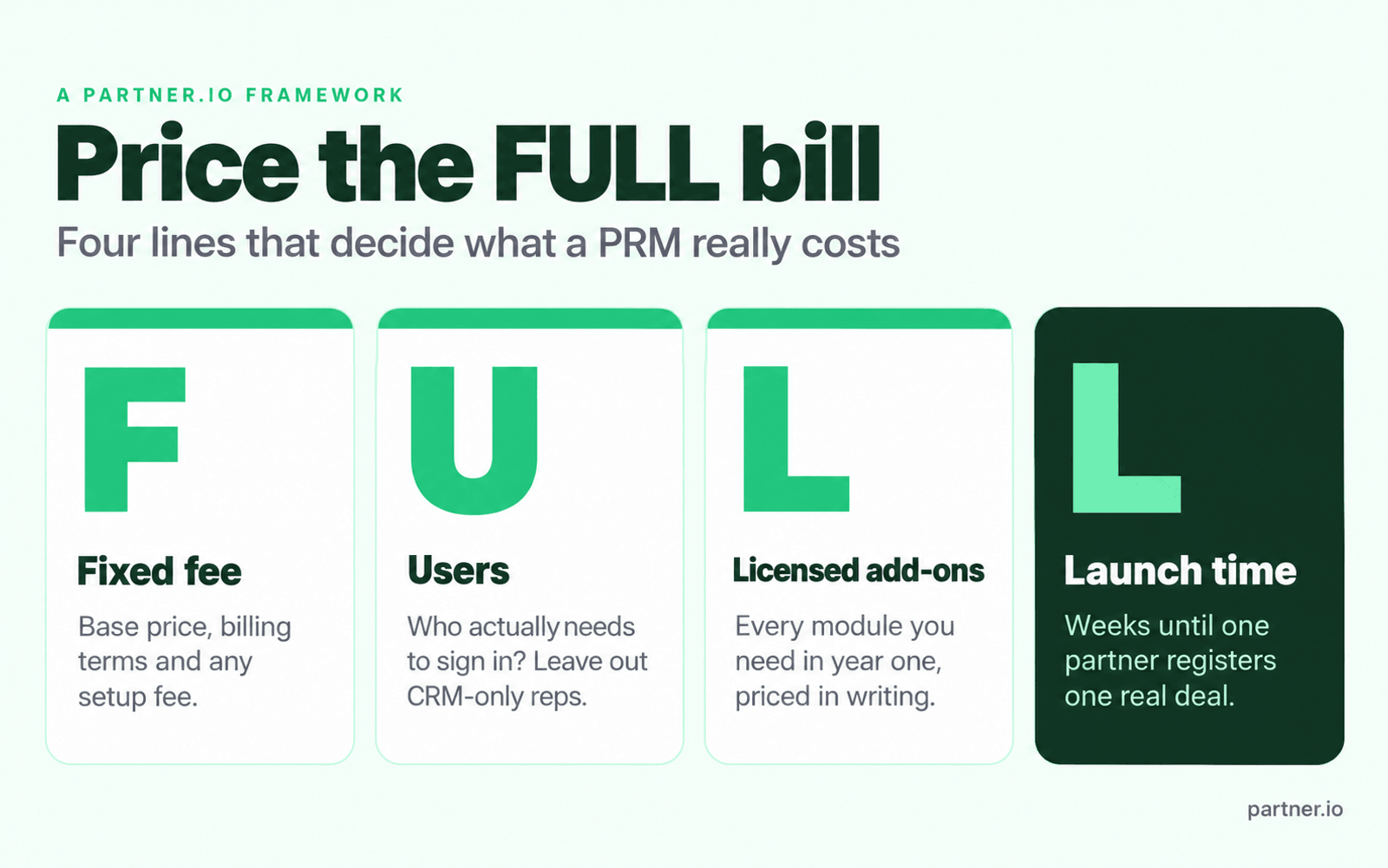
F: Fixed fee.
What's the base price per month, and is it monthly or annual only? Is there a setup or onboarding fee?
U: Users.
How many of your people need to sign in? Count properly, and leave out anyone who can work from the CRM.
L: Licensed add-ons.
Which modules are extra? List every one you'll need in the first year: training, discovery, API, SSO, MDF. Get prices in writing.
L: Launch time.
How many weeks until one real partner registers one real deal? Every week of setup is a week of salary with no partner pipeline.
Add F, U and L together, then put a cost on the last L. That's your real comparison.
Want to price Partner.io with your own numbers? Try Partner.io free for 7 days, no credit card needed.
What this looks like in the real world
Here's a composite of a situation we see a lot.
A 45-person SaaS company runs 25 partners: mostly agencies, plus a few consultants who refer. Two people run the program. The founder still approves commissions.
They shortlist Journeybee, and the pitch is good. Unlimited users. Partners can submit deals from Slack.
Then they price it. The base plan starts at $499 a month. They want partner training, because agencies keep selling the wrong package, so that's an add-on. They want account mapping for their two integration partners, which is another add-on.
Partner.io, with three seats, is $237 a month with training and account mapping included.
They start the Partner.io trial on a Monday. By Thursday, two agencies have finished a short course on the new pricing, and one has registered a deal that shows up in HubSpot with the partner attached.
The Slack submission point still matters to them. They decide that a branded portal on their own domain, plus automatic reminders, is enough to get agencies to log in. That's the trade-off they chose, with numbers in front of them.
Decision points
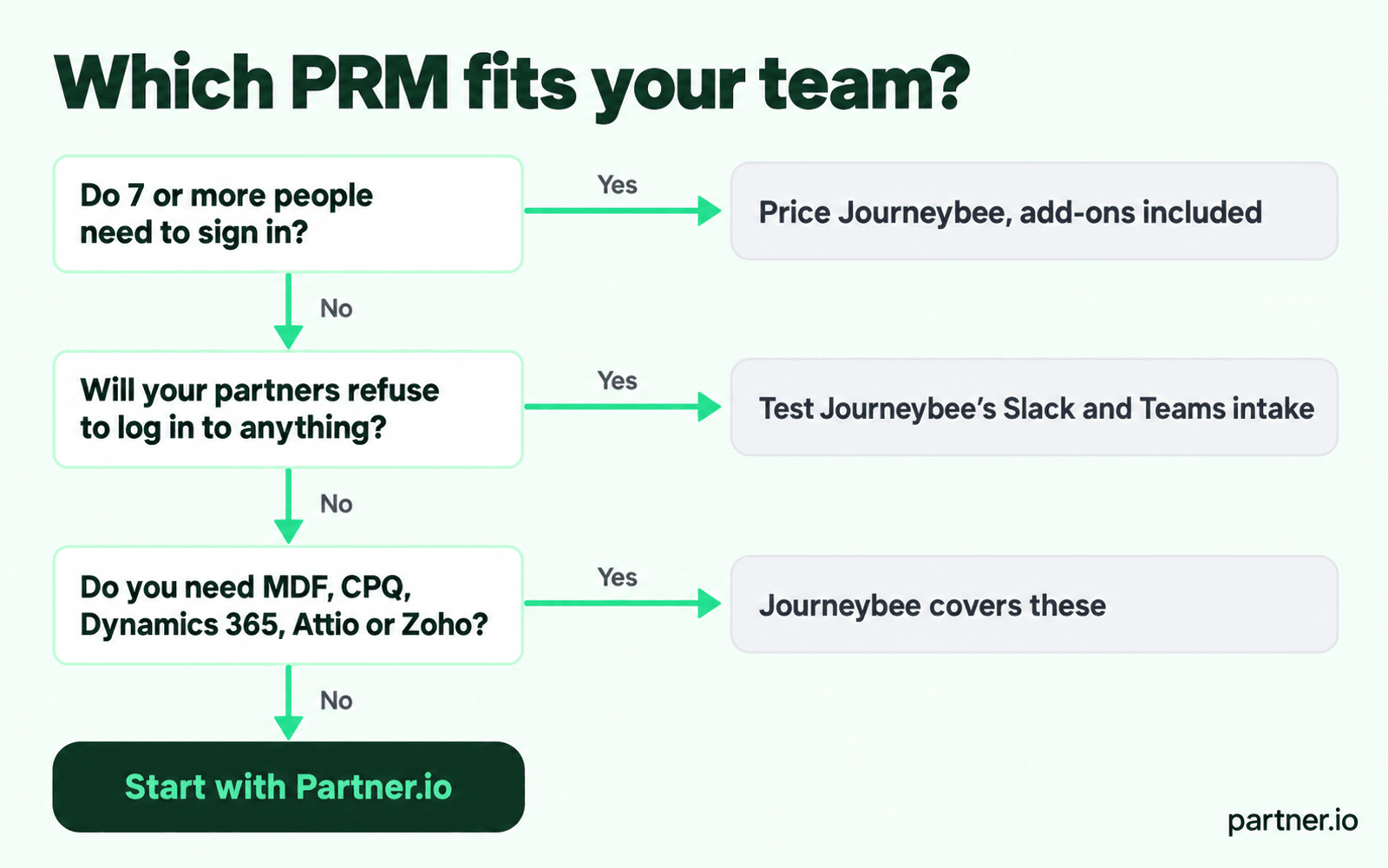
If seven or more of your people need to log in, Journeybee's unlimited users will likely beat per-seat pricing. Check how many add-ons you'll need first.
If your partners will never log in to anything, test Journeybee's Slack and Teams submission with three of your real partners.
If you need MDF, CPQ, distributor management, Dynamics 365, Attio or Zoho, Journeybee covers those and Partner.io doesn't.
If two to five people run the program and you need training and partner discovery, start with Partner.io. It will usually cost less and include more.
When the cost comparison goes wrong
If spreadsheets are still running part of your program, the hidden cost of managing partners in spreadsheets is worth five minutes. And if you're still deciding whether you need a PRM at all, start with what a PRM is and when you need one.
Before you sign anything
- Count the people who need to sign in, then count again without the sales reps.
- List every module you need in year one and get each price in writing.
- Ask whether billing is monthly or annual only, and whether there's a setup fee.
- Have one real partner register one real deal, and check it lands in your CRM with the partner attached.
- Follow one commission from closed-won to paid.
- Ask what leaving looks like: data export, notice period, contract length.
Comparing more than two vendors? Our Partner.io vs Channeltivity and Partner.io vs Channelscaler comparisons use the same approach.
Count the seats, then start the trial
Journeybee is a capable platform, and if your channel team is big or your partners won't log in to anything, its model makes sense.
But most SaaS partner teams are small. They need a portal, deal registration, commissions, training and a way to find the partner who can open a target account. They need all of it this quarter, at a price finance won't question.
Count your seats. If the number is under seven, the math is already done.
Try Partner.io free for 7 days → No credit card, no setup fee, cancel anytime.
Prefer a walkthrough first? Book a demo and we'll price it against your program.
- [prm]
- [comparisons]
Published 6 October 2026