
Every tool in the modern revenue stack is built for people on your payroll. Partners aren't. Here's the layer they need, and the four-part test any tool must pass to own it.
The Modern Revenue Stack Has a Hole Shaped Like Your Partners
Count the tools your company pays for to turn a stranger into revenue.
A CRM.
Marketing automation.
A sales engagement tool.
Call recording.
Billing.
A support desk.
A warehouse and a dashboard on top.
That's the modern revenue stack: the B2B SaaS tech stack that carries a lead all the way to renewal.
Now find where your partners live in it.
The agency that referred three deals last quarter is a picklist value in the CRM. What it's owed sits in a spreadsheet. The conversation about its next deal is in Slack. Its payout went out by hand from Stripe on a Friday afternoon.
Your partners show up in four different tools, and none of them was built for partners.
Every layer is built for someone on your payroll
Look at who each layer serves.
| Layer | Built for | Its core record |
|---|---|---|
| CRM | Your sales reps | The deal |
| Marketing automation | Your marketers | The contact |
| Sales engagement | Your SDRs | The sequence |
| Billing | Your finance team | The invoice |
| Support | Your support agents | The ticket |
Every row has the same thing in common. The main user works for you. They have a login, a manager, a comp plan and a reason to keep the data clean.
Partners have none of that inside your company. They don't log in to your CRM, nobody reviews their pipeline hygiene, and their pay doesn't run through payroll. Yet they source and influence deals your reps close.
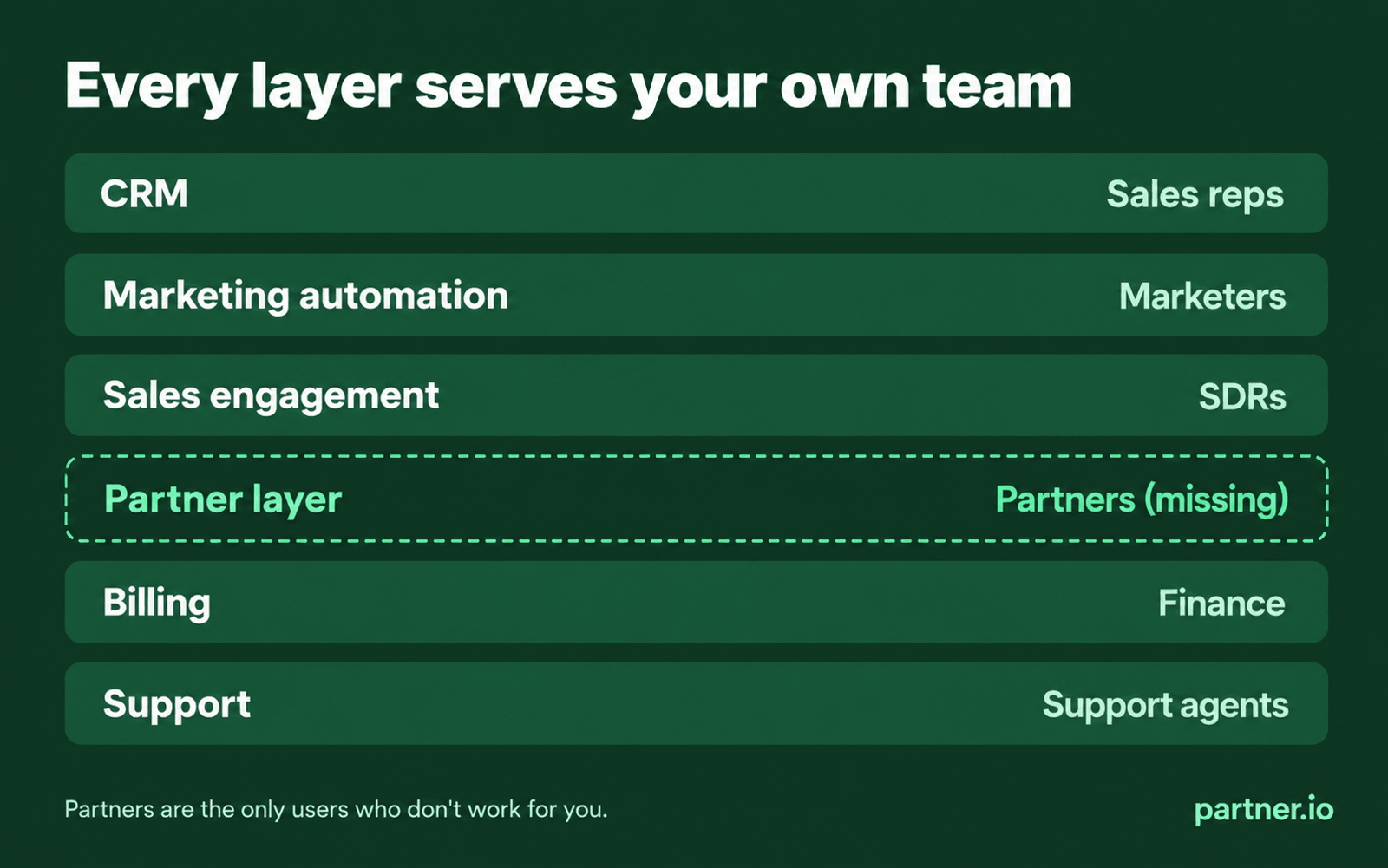
That makes the partner layer different in kind, not degree. It's the only layer in the revenue stack whose main user is an outsider.
Forrester's Jay McBain saw this coming years ago in a post on what partner relationship management has to become:
“Today, in an ecosystem model, PRM is being asked to manage in a non-linear fashion, with many more permutations than the past.
”
"We're consolidating tools, not adding them"
This is the strongest objection, and it's fair.
Salesforce's State of Sales research found sales teams use an average of 10 tools to close deals. 66% of reps said they're overwhelmed by the number of tools, and nine in ten sales organizations planned to consolidate their stack within a year.
So why add an eleventh?
Because partner work is already spread across five tools. You just aren't counting them as a partner stack:
- a custom field and a few reports in the CRM
- a commission spreadsheet with its own tab per quarter
- a Slack Connect channel per agency
- a shared drive of one-pagers and pricing decks
- manual transfers in Stripe or your bank
A dedicated partner layer replaces most of that. Done right, it's consolidation. The spreadsheet goes, the shared drive goes and the Friday payout routine goes.
What stays is the CRM, which is exactly where it should be.
Why your CRM can't own the partner layer
The CRM is the first place teams try to bolt partners on, and it gets surprisingly far. A "Partner" field, a "Source: Partner" picklist and a dashboard cover the first ten referrals.
Then the cracks show.
A consultant introduces a prospect by email.
The rep creates the deal and sets the source to "Outbound".
Six weeks later the deal closes, and nobody can prove the consultant was ever involved.
The field existed. Nobody owned it, because the person who cared about it (the partner) couldn't see it.
This is the real CRM vs PRM question. The CRM's structural limit is that it's designed for people inside your company. Partners can't register a deal in it, can't check where their deal stands, and can't see what they've earned. Some CRMs sell a partner portal add-on. Before you buy one, check whether it calculates commissions and pays partners, or only shows them records.
Why link-based affiliate tools can't either
Affiliate tools solve a real problem: who sent this click, and what do they get for it. For self-serve SaaS with a credit card checkout, that's often enough.
B2B deals don't arrive as clicks.
A reseller registers an opportunity it found at a trade show.
An integration partner mentions you on a joint customer call.
An agency brings you into a rebuild it's scoping for a client.
None of that starts with a link. The deal runs for months, with several people on the buying side. A cookie won't survive that, and it can't tell your rep that a reseller has already claimed the account.
For referral links in a user referral program, a link tool works. For deal registration and co-sell, it's the wrong shape.
Why billing and payments can't either
Stripe can pay a partner in minutes. That's the easy part.
The hard part is the sentence before the payment:
This partner is owed 20% of first-year revenue on this deal,
because they registered it before the opportunity existed,
at the Gold tier they reached last month,
minus the refund from March.
Billing knows the invoice. It doesn't know the partner, the tier or the rule. So someone rebuilds that logic in a spreadsheet every month, and if you pay US partners, someone also chases W-9s and works out who needs a 1099-NEC in January. The IRS guidance on Form 1099-NEC is clear on who has to file. The collecting and tracking are where the time goes.
The glue layer: spreadsheets and Slack
What actually holds the partner program together in most companies is a spreadsheet and a set of Slack channels.
They're flexible, everyone already has them, and they cost nothing. They also have no audit trail, no permissions worth the name, and no connection to the deal in the CRM. We've written about the hidden cost of managing partners in spreadsheets in detail.
The short version: the glue works until the person who built it goes on holiday.
The OWNS test for the partner layer in your revenue stack
If no existing layer can hold partners, what would a real partner layer have to do? We use a four-part check called the OWNS test. A tool owns the partner layer only if it passes all four.
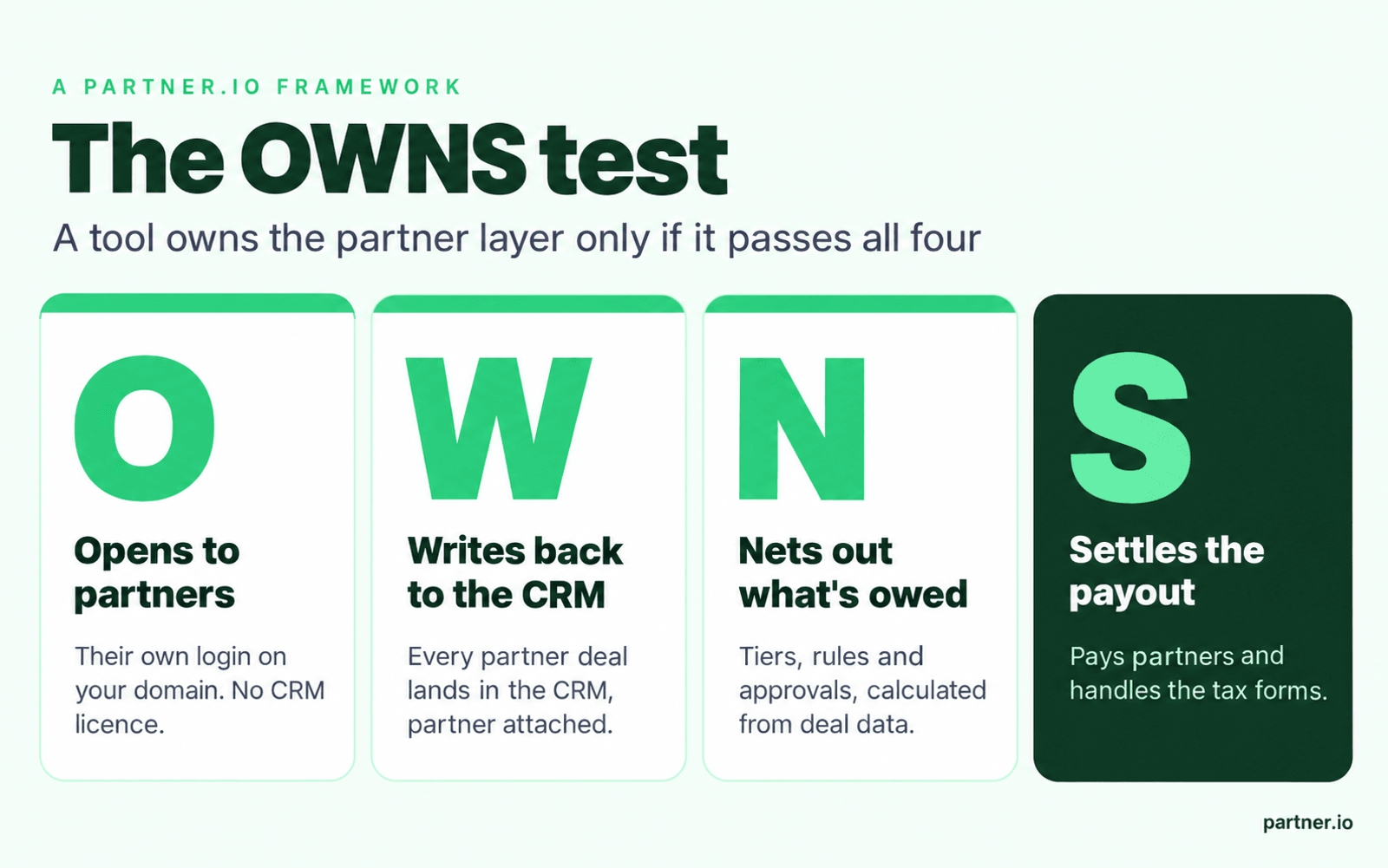
O: Opens to partners
Partners get their own login, on your domain, where they register deals, see status, pick up assets and finish training. No CRM licence, no shared spreadsheet link.
W: Writes back to the CRM
Every registered deal and referral lands in your CRM as a deal or lead with the partner attached, and status flows back the other way. Your reps never leave the CRM. Your partners never enter it.
N: Nets out what's owed
Tiers, commission rules, approvals and clawbacks live in one place, calculated from the deal data rather than retyped into a spreadsheet.
S: Settles the payout
The tool pays partners and handles the paperwork that comes with paying them, including tax forms for US partners. An approved commission becomes money in a partner's account without a separate manual process.
“Every other layer in your stack is built for people you employ. The partner layer is built for people you don't.
”
Want to see a partner layer that passes all four? Try Partner.io free for 7 days, no credit card needed.
Run the OWNS test on your own stack
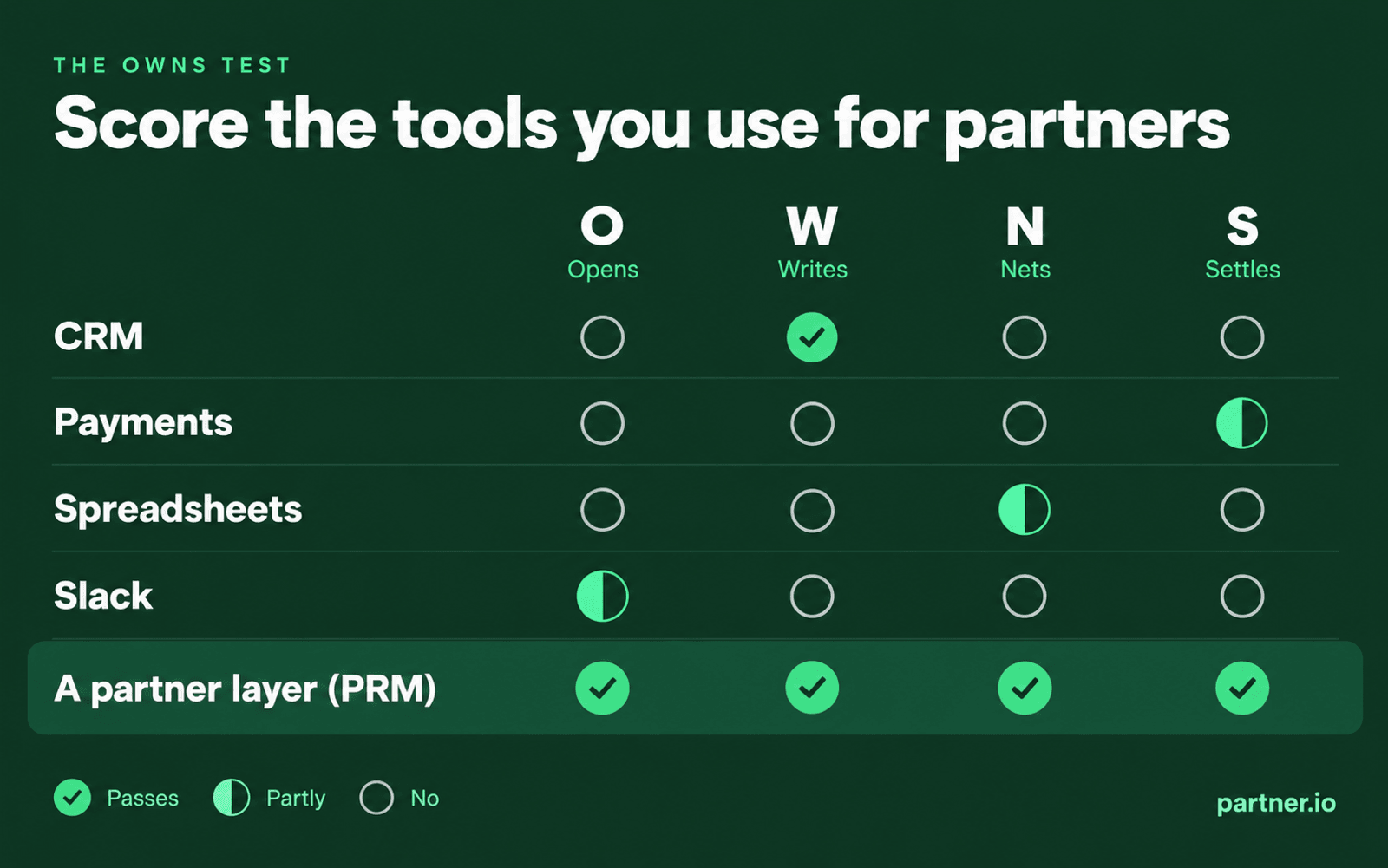
Score each tool you use for partner work today. A tick means it does the job without a developer or a spreadsheet beside it.
Most teams find the same pattern. The CRM gets W for free, because it is the CRM.
Payments pass half of S. Spreadsheets get half of N, as long as someone retypes the deal data every month. Slack opens a door to partners without giving them anything to do once they're inside.
Here's the decision rule.
If you have fewer than ten partners and one motion (say, a handful of referral consultants), a CRM field and a disciplined spreadsheet will hold. Revisit when you add a second motion.
If you have more than ten partners, or more than one motion (referral plus agencies, or resellers plus an integration partner), you need a real partner layer. The spreadsheet is already costing you deals you can't see.
The trade-off is real. A dedicated partner layer is one more contract, one more admin console and one more integration to keep healthy. In return you delete the spreadsheet, the manual payouts and most of the "where's my deal?" emails. Past ten partners, we'd take that trade every time.
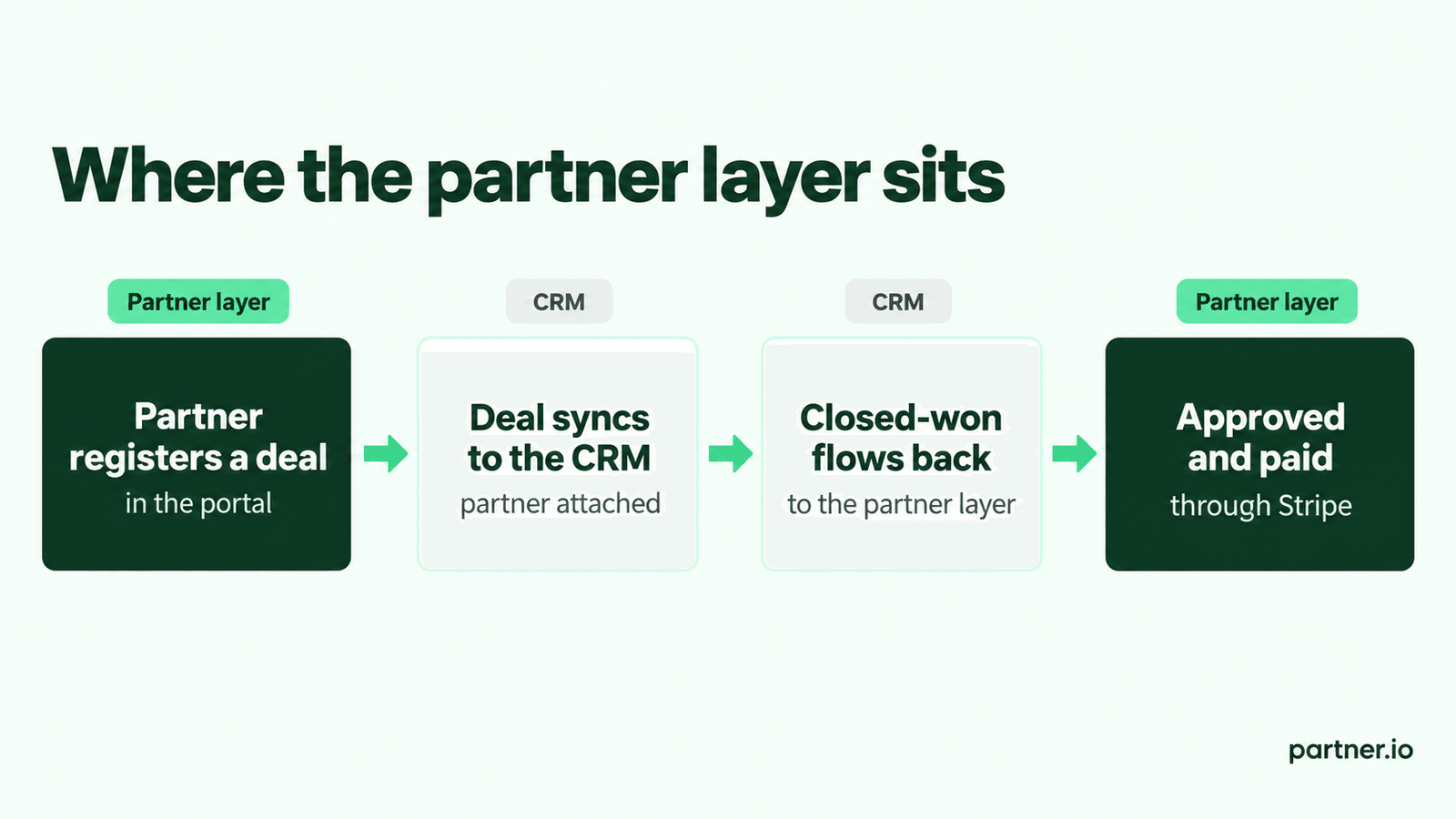
Where the partner layer sits
The partner layer doesn't replace anything above or below it. It sits between the CRM and payments, and it talks to both.
Getting it in place takes less time than most teams expect. Here's the order we'd use:
- Connect the CRM first. Map partner-registered deals to your existing pipeline so reps see them where they already work.
- Pick three partners, not thirty. Choose the ones already sending deals. They'll tell you within a week what's confusing.
- Write down one commission rule. One percentage, one trigger (closed-won), one payment window. Add tiers later.
- Launch the portal on your domain with deal registration, two assets and a short course on how to position you.
- Pay the first commission through the system, end to end, before you invite anyone else.
When one real partner has registered one real deal and been paid for it, the layer is live. Everything after that is expansion.
What this looks like in the real world
Here's an illustrative example of a pattern we see often.
A 60-person SaaS company sells to mid-market e-commerce brands. It has 18 partners: Shopify agencies who refer, two app partners who co-sell, and a handful of freelance consultants.
Two people run the program. Their week looks like this:
Monday, rebuild the commission sheet from a CRM export.
Tuesday, answer six "any update on that deal?" messages in Slack.
Wednesday, find out a rep logged an agency deal as inbound.
Friday, pay four partners by hand in Stripe.
They add a partner layer. Agencies register deals in a portal on the company's domain, and those deals land in HubSpot with the agency attached. Status updates go back automatically. Commissions are calculated when the deal closes and paid through Stripe after one approval click.
The Monday and Friday jobs disappear. Tuesday shrinks to one or two messages. Wednesday's fight stops happening, because the agency registered the deal before the rep touched it.
The CRM didn't change. The team stopped making it do a job it wasn't built for.
When it breaks
Why this matters more every year
Partners already sit in the middle of how B2B software gets bought. Forrester's buyer research put a number on it:
“nearly 70% of over 10,000 global B2B purchase influencers in the past 12 months purchased their offering from an indirect route to market or partner rather than directly from the supplier
”
And the companies running partner programs expect more from them. In Forrester's State of Partner Ecosystems 2025, two-thirds of respondents expected partner-influenced revenue to grow more than 30% on the previous year.
Revenue that size doesn't belong in a spreadsheet tab.
Where Partner.io fits in the modern revenue stack
Partner.io is built to be the partner layer and nothing else. It doesn't try to replace your CRM or your billing. It fills the gap between them and passes the OWNS test out of the box.
- Opens to partners: a white-label partner portal on your own domain, plus training and certification so new partners ramp without a call.
- Writes back to the CRM: referrals and deal registration sync with HubSpot, Salesforce and Pipedrive, with the partner attached to the deal.
- Nets out what's owed: tiers, commission rules and approvals in commissions and payouts, with automation for approvals and follow-ups.
- Settles the payout: Stripe payouts with no platform fee on partner payments, and tax compliance for W-9s and 1099-NEC forms.
It also covers the work around those four parts. Account mapping and Deal Surround show which partner can open a target account. A REST API, webhooks and an MCP server connect it to the rest of your stack.
Pricing is per seat for your team. Partners are free and unlimited, so the layer doesn't get more expensive as the program grows.
If you're still deciding whether you need a PRM at all, start with what a PRM is and when you need one. And if your CRM is carrying the whole partner program today, why sales ops built for reps fails partner teams and your tech stack was built for direct sales go deeper on why.
Before you add the partner layer
- List every tool that touches partner work today, including spreadsheets and Slack channels.
- Score each one against the OWNS test.
- Count your partners and your partner motions.
- Pick the three partners you'd launch with.
- Write down the one commission rule you'd start with.
- Decide who on your team needs a seat, and leave out reps who can work from the CRM.
Give the outsiders a system of their own
Sales got a CRM. Marketing got automation. Finance got billing. Each team got a system because its work mattered enough to deserve one.
Partners bring you deals your reps couldn't reach on their own. Yet they're the only part of the revenue engine still running on a spreadsheet and goodwill.
Give them a layer of their own, and connect it to everything else.
Try Partner.io free for 7 days → No credit card, no setup fee, cancel anytime.
Prefer a walkthrough first? Book a demo and we'll map it to your stack.
- [prm]
- [revops]
- [tech-stack]
Published 7 October 2026