

Most of your target accounts already trust someone you know. The WARM loop turns partner relationships into warm introductions you can run like a pipeline.
Your Target Accounts Already Trust Someone. It Just Isn't You.
Say your team sent 3,000 cold emails last month to 200 target accounts.
Eleven replied.
Four booked a call.
One of those four said, "Funny, our payroll provider mentioned you last quarter."
Somebody in your partner network was already inside that account, already trusted, already talking about you. Nobody asked them for an introduction, so your SDR went in cold.
Moving from cold outreach to warm introductions is an operating change, and a plain one: find who already knows the account, ask them properly, record what happens and pay for it. Most teams skip all four and wonder why "partner-sourced pipeline" is a rounding error.
Cold outreach is getting more expensive to be ignored
Buyers have been blunt about it.
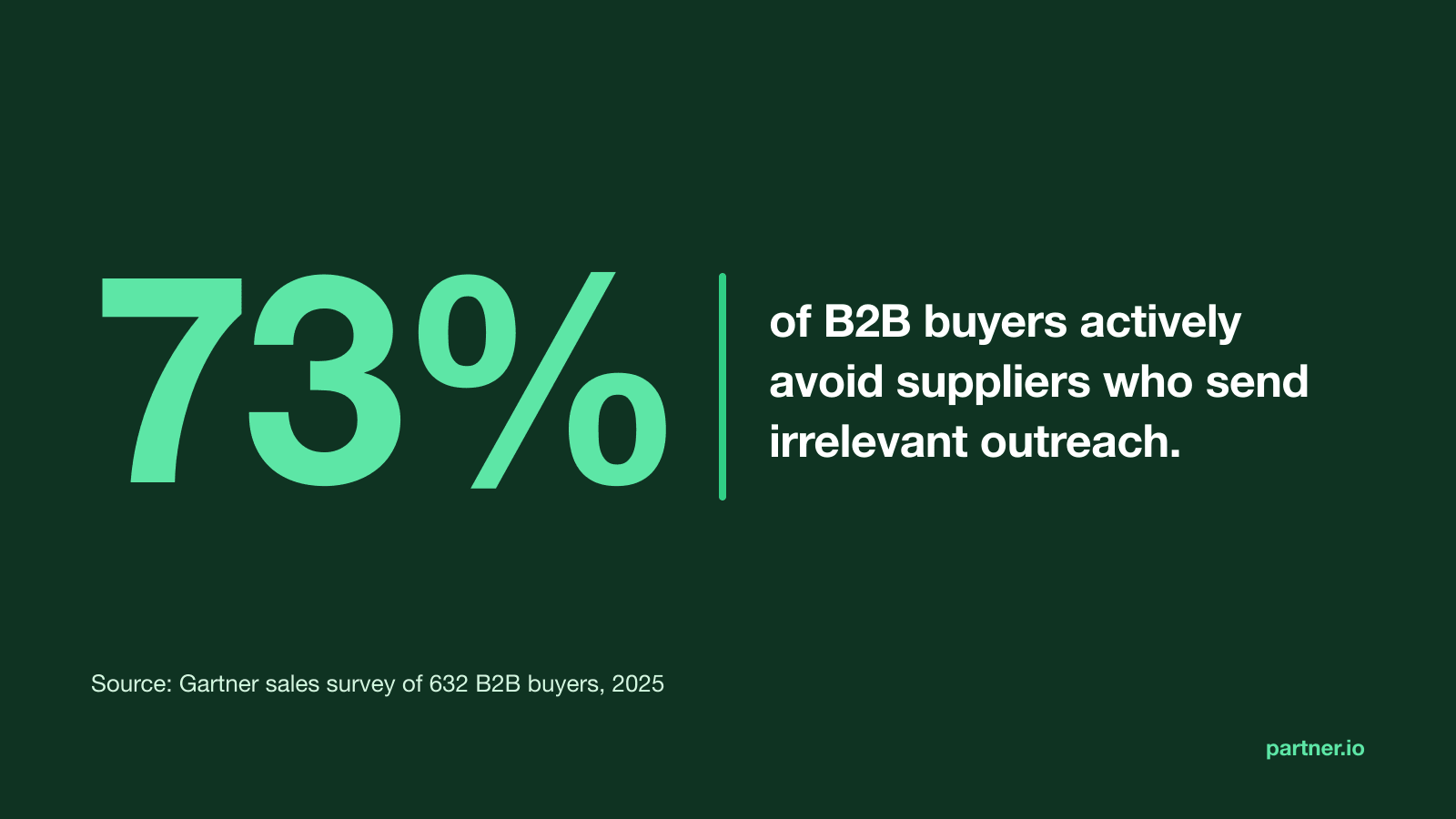
Gartner surveyed 632 B2B buyers and found that 73% actively avoid suppliers who send irrelevant outreach. Not ignore. Avoid. The same survey found 61% would rather buy without a sales rep at all, and by Gartner's 2026 survey that figure had climbed to 67%.
“Bad prospecting actively damages relationships with potential customers.
”
The inbox is getting harder to reach too. Gmail treats anyone sending close to 5,000 messages a day to its users as a bulk sender, and its sender guidelines say spam complaints should stay below 0.1% and never reach 0.3%. If you're a bulk sender, a sequence that one recipient in 300 marks as spam is already over that line.
None of this means cold outreach is dead. It means every cold touch now spends something: domain reputation, brand goodwill, a buyer who files you under "avoid".
A warm introduction spends something else. Somebody else's credibility.
"Warm introductions don't scale"
That's the strongest objection, and it's half right.
Warm introductions don't scale when they're favours. A founder pinging an investor, a partner manager sending "any chance you know someone at Acme?" in Slack, an agency owner who helps out when they remember. You can't forecast favours. You can't hire a team to run them.
But favours are a choice. The intro itself isn't the unscalable part; the missing system around it is.
Look at what the numbers say when partner referrals are tracked like any other channel. Ebsta and Pavilion's 2025 GTM Benchmarks Report, built on $48 billion of revenue, scored each lead source by win rate times deal size divided by sales cycle. Partner referrals came first at 1.3x. Outbound scored 1.05x and paid 0.68x.
The value holds after the deal closes, too. A Journal of Marketing study followed roughly 10,000 bank customers. Referred customers stayed longer, and the retention gap didn't fade:
“The average value of a referred customer is at least 16% higher than that of a nonreferred customer with similar demographics and time of acquisition.
”
The same paper adds a warning worth keeping: the advantage varies by segment, so be selective. That's the honest limit of warm introductions. You get fewer of them, and each one costs a partner some goodwill. Spend it on the accounts that matter.
Where warm introductions come from in a partner program
Most teams think "warm intro" means the founder's network. In a B2B SaaS partner program there are at least five better sources, and each one opens a different kind of door.
Integration partners who already sell to the account
Your scheduling tool integrates with a payroll platform. That payroll platform has an account manager who speaks to your target's finance lead every month. This is the classic co-sell intro, and it's usually the easiest yes, because the customer already uses a product that sits next to yours.
Agencies and consultants who are inside the account
An implementation agency running a CRM migration at your target knows the budget, the deadline and who signs. Their intro carries an opinion ("you'll need this before go-live"), which is worth more than a name. See how agency partners differ from pure referrers in how they want to be paid.
Resellers and MSPs who own the relationship
Here the intro often isn't an intro at all. The reseller owns the customer and wants to sell your product themselves. Treat it as a registered deal, not a referral, or you'll end up in a credit fight you started.
Customers and users who know the buyer
A happy customer whose former colleague now runs ops at your target account. These intros are rarer, and a user referral program gives people an easy way to make them.
Lost deals a partner is now winning
The account that chose a competitor 14 months ago? A partner might be working there today. That's a reason to talk again, with someone vouching for you this time.
The WARM loop: a framework for warm introductions at scale
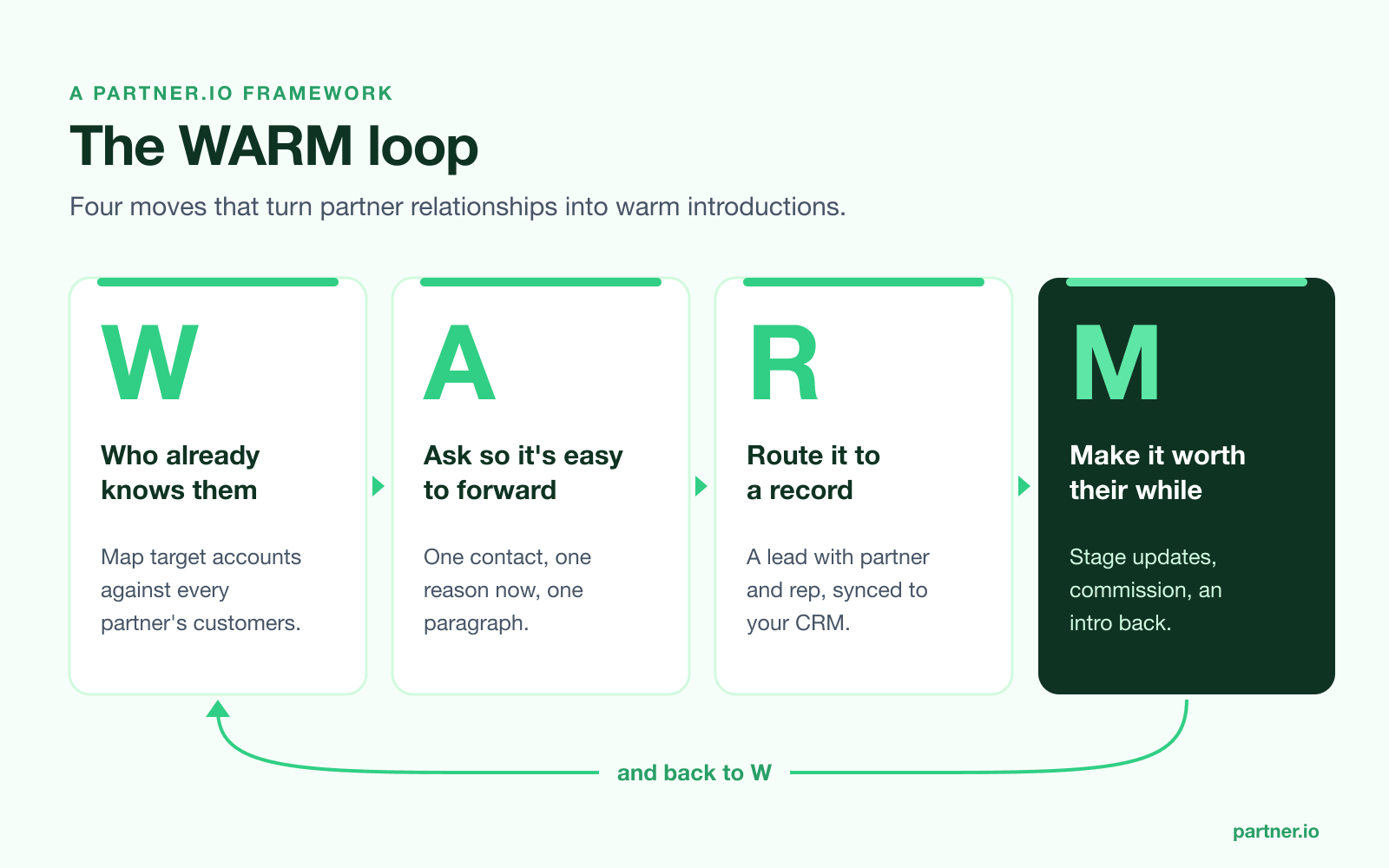
Every good partner intro we've seen follows the same four moves. Miss one and the intro dies quietly. We call it the WARM loop, because the last step feeds the first.
W: Who already knows them
Start from the account, not the partner. Take your target list and find which partners sell to, work with or have referred each account before. This is account mapping, and it beats asking partners to "send anything relevant" by a mile, because you're asking about one company, not their whole book.
A: Ask so it's easy to forward
A partner rep will make an intro if it takes them two minutes. They won't if it takes twenty. Give them the contact's name, the reason now, and a short paragraph they can paste or forward without editing.
R: Route it to a record
The moment an intro is agreed, it needs a home: a lead with the partner and the rep attached, synced to your CRM, owned by a named seller. An intro that lives in an email thread is an intro nobody can report on, follow up on or pay for.
M: Make it worth their while
Tell the partner what happened. Every stage, not just the close. Pay them when it lands, and send them an intro back when you can.
Partners who hear nothing stop introducing. Partners who get updates, credit and the occasional lead in return go looking for the next one, which takes you straight back to W.
Want to run the WARM loop in a real portal? Try Partner.io free for 7 days, no credit card needed.
How to ask a partner for an introduction
The ask is where most warm introductions fail. Here's the sequence that works.
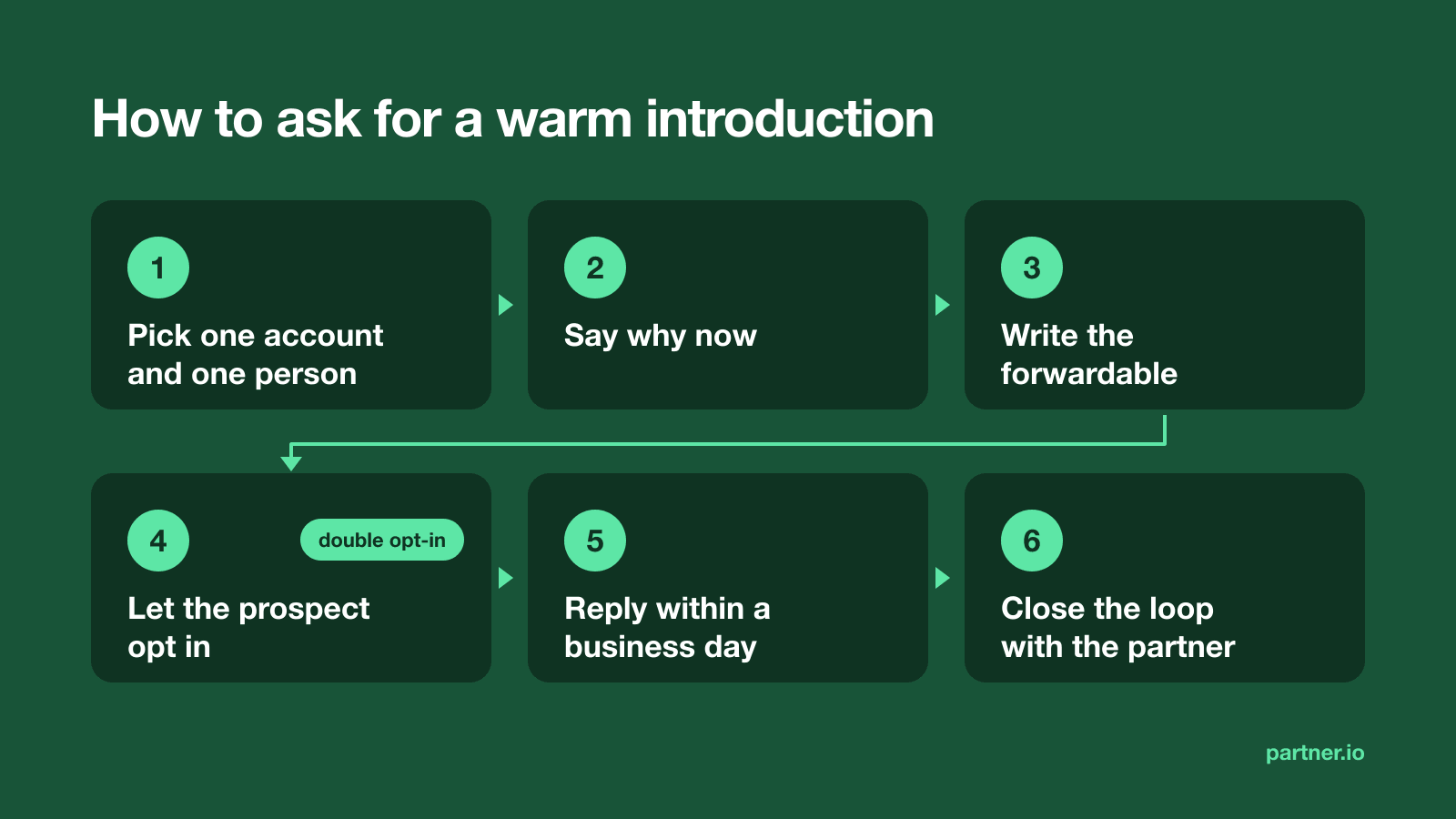
- Pick one account and one person. "Anyone at Acme" gets nothing. "Dana, Head of Finance at Acme" gets an answer.
- Say why now. A trigger the partner can repeat: a new office, a funding round, a system they're replacing, a contract renewing in March.
- Write the forwardable. Three or four sentences, written as if the partner wrote them, with no attachments.
- Let the prospect opt in. The partner checks with the prospect first, then connects you. Fred Wilson of Union Square Ventures argued for this double opt-in introduction back in 2009, and it works just as well for partners.
- Reply within a business day. A warm intro cools fast. If the prospect says yes and you take a week, you've wasted the partner's credibility.
- Close the loop with the partner. Meeting booked, outcome of the first call, deal stage changes.
“When introducing two people who don't know each other, ask each of them to opt-in to the introduction before making it.
”
A forwardable that works looks like this:
Hi Dana, you mentioned the new clinics are still on paper rotas. The team at [your company] fixed exactly that for two other dental groups we work with, and it plugs straight into the payroll we already run for you. Worth 20 minutes? Happy to connect you if so.
It names a pain the partner has heard firsthand. It links your product to the one the partner already sells. And it lets Dana say no to the partner, privately, without anyone losing face.
Intro, co-sell or cold? Pick the right motion per account
Warm introductions aren't the answer for every account. Use a simple rule.
If a partner sells to the account and has a named contact, ask for an intro.
If a partner is working an open opportunity there too, co-sell: agree who leads and register the deal.
No partner in the account? Go cold, but make it relevant, and look for a partner who sells to similar companies so the next account isn't cold.
The trade-off is real, and it's worth seeing side by side:
| Cold outreach | Warm introduction | |
|---|---|---|
| Volume | You control it | Partner controls it |
| First touch | Same day | Days |
| Reply odds | Low | High |
| What it costs | Domain and brand | Partner goodwill |
| Scales with | Headcount | Partners and process |
Cold outreach gives you control and speed. Warm introductions give you trust and better deals, and they ask for patience and a partner who still wants to help next quarter. Teams that win use both, and they stop using cold outreach on accounts a partner could have opened.
When warm introductions break
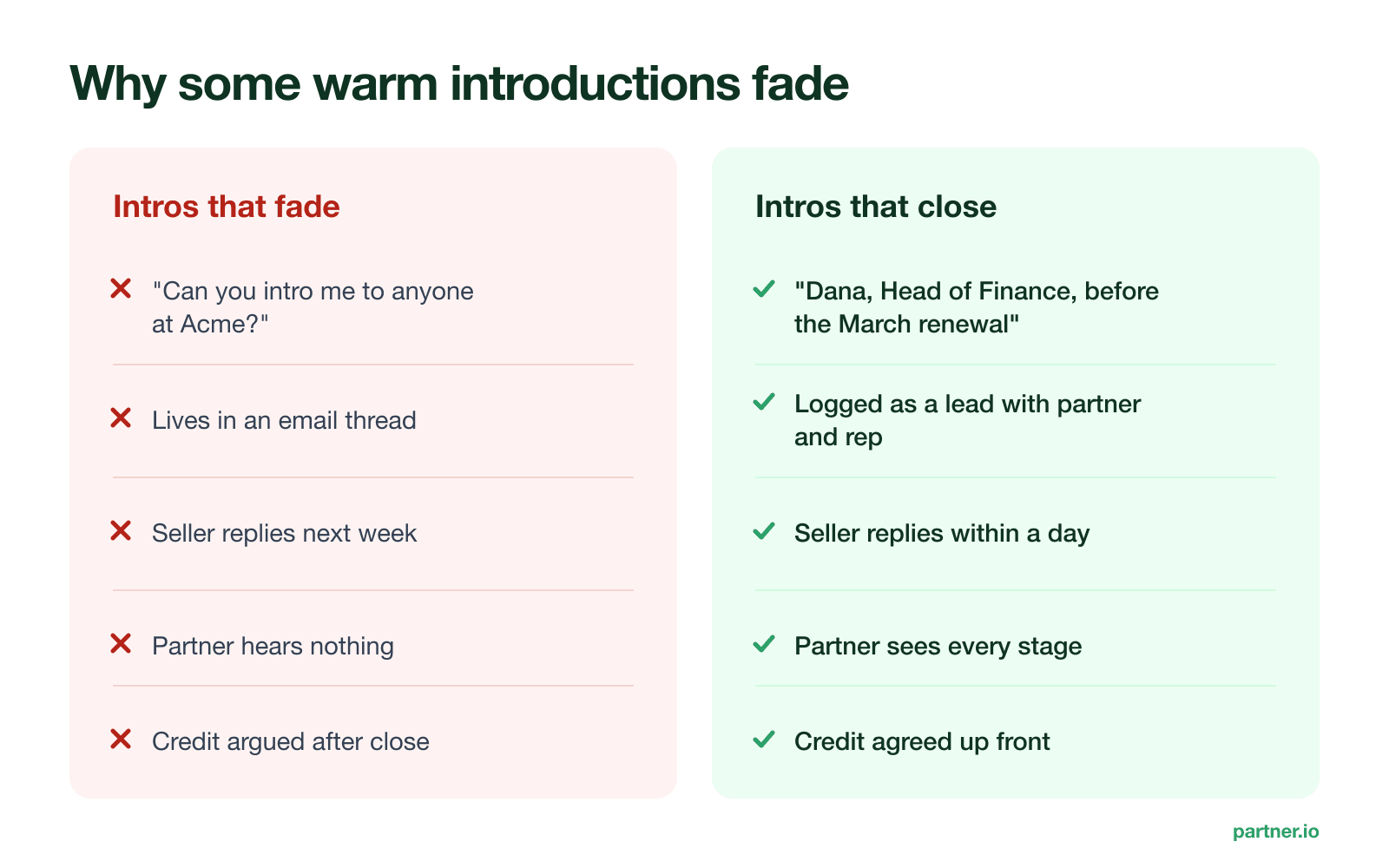
Most intro programs don't fail. They fade. Here are the three ways it happens.
Partners stop introducing
Symptom: a partner sent five intros in Q1 and none in Q3.
Cause: they never heard what happened to the first five.
Fix: share deal stage with the partner automatically, and tell them the outcome of every intro, including the ones that died.
Intros arrive but don't convert
Symptom: lots of "you two should talk" emails, few meetings.
Cause: the ask was vague, so the intro was too.
Fix: one account, one person, one reason now. Kill "anyone at" asks for good.
Credit fights after close
Symptom: a rep says they were already working the account.
Cause: nobody checked the CRM before accepting the intro, and nobody recorded it after.
Fix: log every intro as a lead the day it's agreed, check it against open opportunities, and settle sourced versus influenced credit before the deal closes, not after.
What this looks like in the real world
Here's an illustrative example, a composite of patterns we see often.
A 40-person company sells staff scheduling software to multi-site dental groups. Its SDRs have emailed one 30-clinic group four times this year. No reply.
The partner manager types the group's domain into an account-mapping tool. A payroll provider, already an integration partner, sells to the group. One of the payroll provider's account managers is on file with an email address.
The partner manager creates a lead for the payroll partner, pre-filled with the dental group, and sends the partner rep a forwardable paragraph about paper rotas and the payroll integration. The rep checks with the group's finance lead, who says yes. On Tuesday the introduction goes out, and by that afternoon the seller has a call booked for Thursday.
The lead syncs to the CRM with the partner and rep attached. The partner rep sees the stage move from their portal without asking. When the deal closes, commission is calculated on revenue recorded against that lead, and the partner manager sends the payroll team an intro back: a customer that's been asking about payroll.
Nothing heroic happened. Four ordinary steps happened in order, and none of them depended on someone remembering.
Where Partner.io fits
Partner.io is built to run the WARM loop as a system instead of a favour bank.
Who already knows them. Deal Surround takes a prospect's domain and ranks the partners, existing and new, most likely to have a relationship there. Each match comes with the signals behind it, such as "sells to the target" or "referred the target", and an Easy intro badge when a partner contact with an email or phone is on file. Account mapping shows your prospects against each partner's customers, with the partner choosing how much of their list to share. Deal Surround is switched on per account, and you can try it without signing up in the public demo.
Ask so it's easy to forward. From a Deal Surround match, create a lead for an existing partner pre-filled with the target account, so they earn on the introduction. With HubSpot connected, the recommendations sit on the company record and your reps can start a referral without leaving the CRM.
Route it to a record. Leads and deal registration give every intro one record with the partner and rep fixed at creation. Approved leads sync to HubSpot, Pipedrive or Salesforce, and automation can auto-approve leads that match your rules and alert your team in Slack.
Make it worth their while. Partners follow each deal and message your team from the partner portal. Commissions and payouts follow the revenue recorded on the lead. And when the map shows your customers sitting in a partner's pipeline, you can refer a lead to that partner, who accepts or declines from their portal. That's how you return the favour.
If you're still deciding how partner referrals should replace prospecting more broadly, start with how B2B SaaS replaces cold prospecting with referrals, then the revenue comparison of cold outreach and partnerships. For why referred deals punch above their pipeline share, read partner referrals: 10% of pipeline, 31% of revenue.
Stop emailing strangers your partners already know
Somewhere on your target list right now is an account a partner could open with one email.
You don't need more sequences to reach it. You need to know who's already inside, ask them properly and prove to them it was worth it. Do that for one account this week, then the next ten.
Try Partner.io free for 7 days → No credit card, no setup fee, cancel anytime.
Prefer a walkthrough first? Book a demo and we'll map it to your program.
- [partner-led-growth]
- [referrals]
- [prm]
Published November 20, 2026