Strategy
Partner.io vs Channelscaler: Choose the PRM Your Partners Will Actually Use

Your best agency partner has just sent you a prospect.
Sales is already talking to that account. Nobody is sure who gets the credit. The partner wants an update by Friday, and the commission agreement is sitting in someone's inbox from March.
A longer feature list will not settle any of that. I have sat through enough PRM demos to know that the slide with 400 checkboxes is the slide that tells you the least.
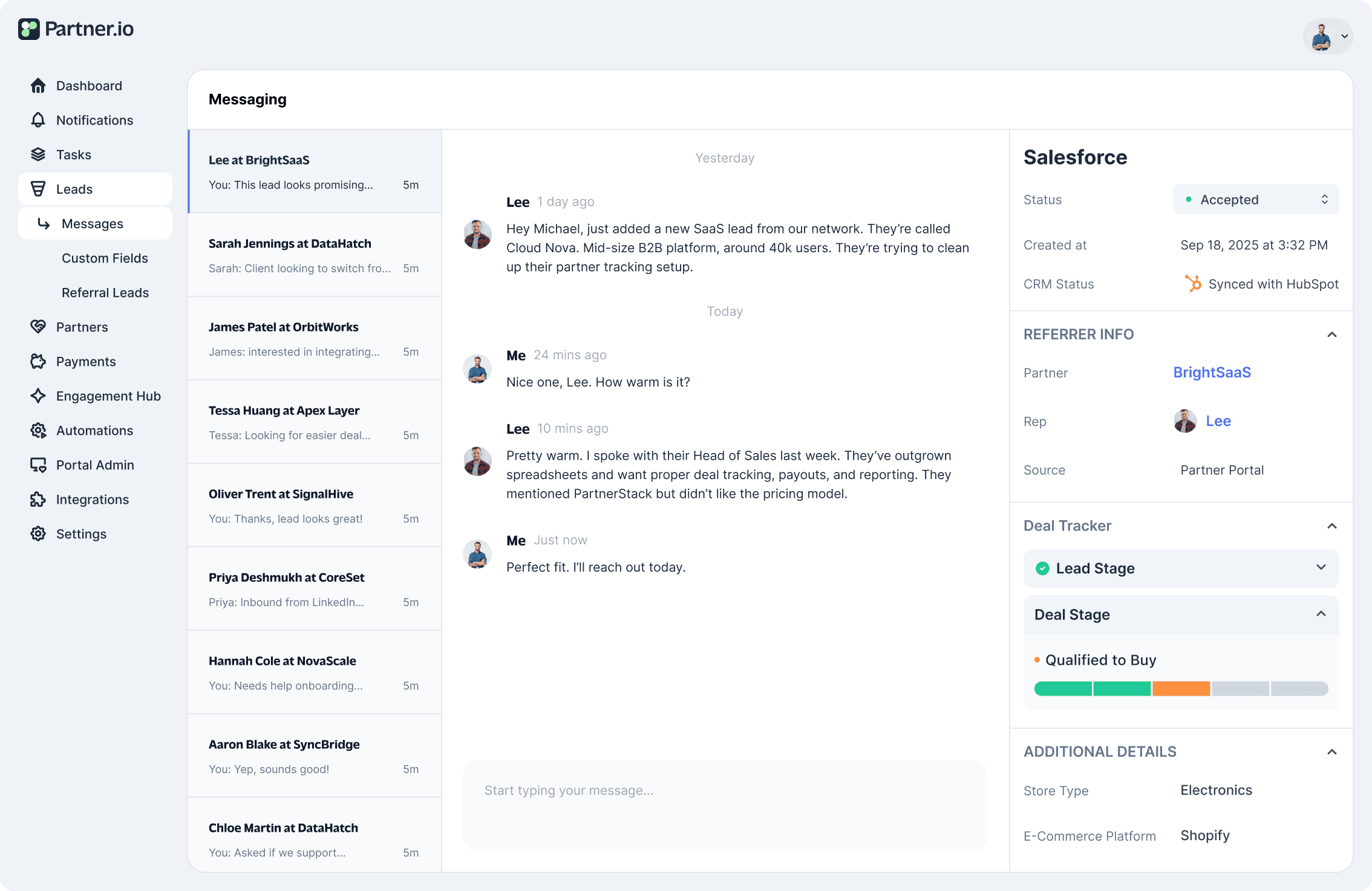
The Partner.io vs Channelscaler decision comes down to something narrower and more useful: how well each platform handles the work that earns the next referral. Accepting an opportunity. Keeping the partner informed. Recording what they contributed. Paying the right amount, on time, without three people reconstructing it from email.
If your partners cannot tell what happened to the last deal they sent you, they will stop sending you deals. Every other feature is downstream of that.
For programmes built on referrals, agencies and co-selling, Partner.io is the stronger place to start your evaluation. The published offer brings deal management, partner training, workflows, commissions and account mapping into one place, with a price you can read on the website and a trial you can start this afternoon.
Channelscaler deserves a serious look when distributor rebates, marketing fund claims and complex channel controls are driving your requirements. That is a real category of buyer, and it is not the same buyer.
Buy for the programme you actually have to run this year. Then make the software prove it can handle the awkward parts.
A note on where this comes from: I run sales at Partner.io, and I write this blog, so treat the recommendation accordingly. Everything below is checkable against both vendors' own published pages, which are linked throughout. Go and check it.
The differences that actually matter
First, some housekeeping, because this trips people up. Channelscaler is the merged Allbound and Channel Mechanics business. Its scope now covers both PRM and broader channel programme automation, which means older Allbound comparisons, including some still floating around on our own site, describe only part of what is on offer today. Worth knowing before you read a two-year-old G2 thread and draw conclusions from it. (Channelscaler)
Decision | Partner.io | Channelscaler |
|---|---|---|
Pricing | $79 per seat per month, metered by seat rather than by partner count `[VERIFY: "unlimited partners" is not stated anywhere on partner.io. Confirm with product before publishing, or leave as written.]` | Custom quote, priced per programme, fixed for the contract term |
Getting started | 7-day free trial, no credit card | Demo, then a scoped quotation |
Core capabilities | Partner portal, training academy, deals, custom tiers, workflows, commissions | Partner portal, enablement, deal registration, modular programme automation |
Co-selling | Account mapping to surface shared customers and warm paths | Opportunity matching and shared pipeline collaboration |
What to dig into | Your referral flow, agency rules, CRM handoffs, commission logic | Deal protection rules, MDF claims, rebates, distributor processes |
Those are published capabilities, not a verdict. The configuration and the scope still need testing against what you run.
Sources: Partner.io pricing, Partner.io account mapping, Channelscaler pricing, Channelscaler platform.
One correction worth making, because I have seen it repeated in comparison content and it is simply wrong. Channelscaler states that implementation, configuration, integrations, ongoing support, maintenance, platform updates and additional users are included in its programme pricing. Any comparison claiming it bolts on separate onboarding fees is not describing what the company publishes. If you are going to compete, compete against the real thing.
Partner.io's advantage here is narrower but easier to prove: you can see the number and start testing today. You do not need a speculative savings calculation to recognise the value of that.
Start with the partner's next action, not the feature list
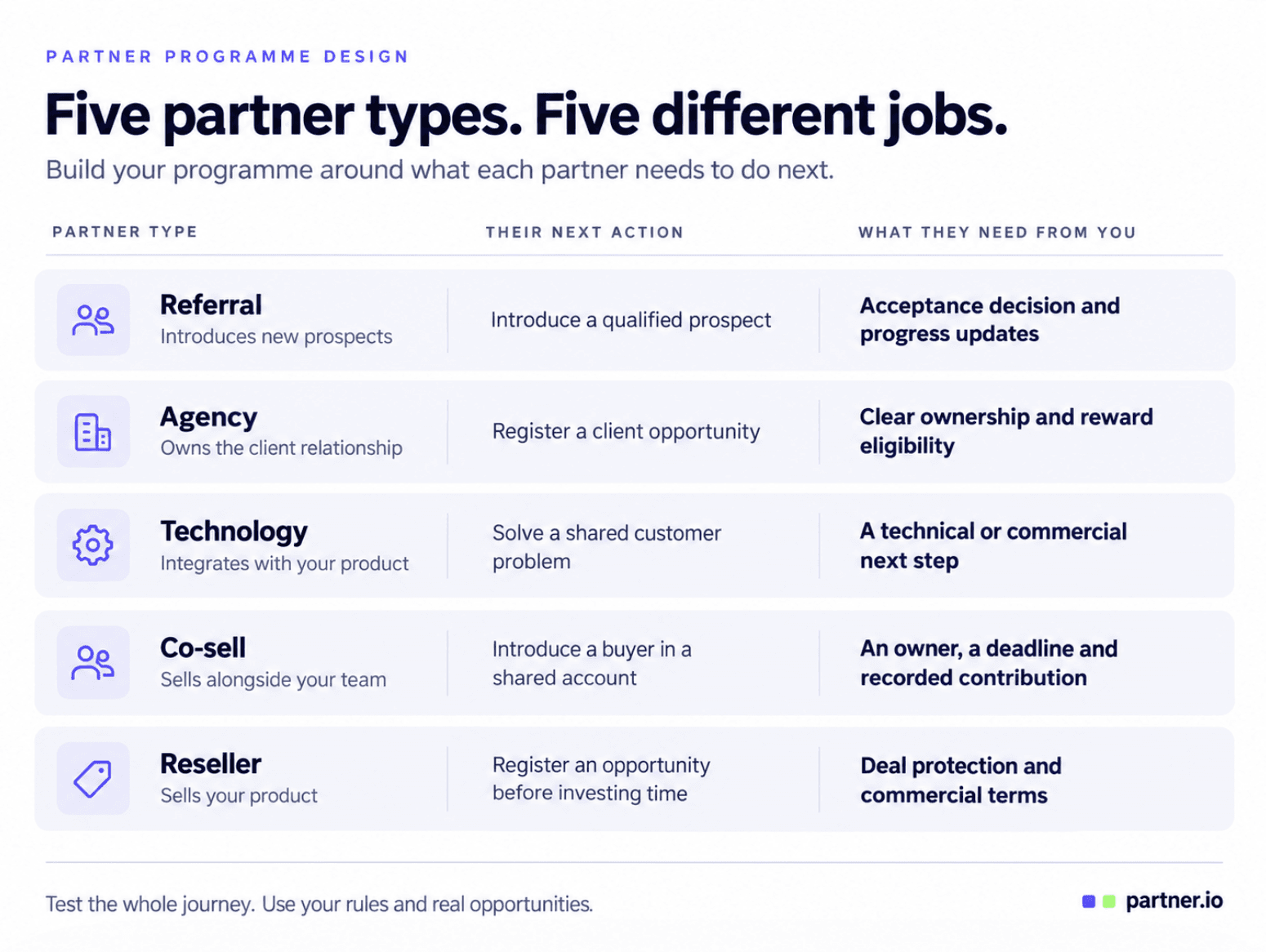
"Manage our partners" is five different jobs wearing one coat.
"We need to manage our partners better" is too vague to guide a purchase. It is the partnerships equivalent of "we need to do more marketing."
A referral partner needs to submit an introduction and find out whether you took it. An agency needs clarity on who owns the client and what they earn. An integration partner needs a way to help an existing deal move. A reseller may need protected registration and approved pricing before they will lift a finger.
Those are different jobs. A platform that is excellent at one can be genuinely mediocre at another.
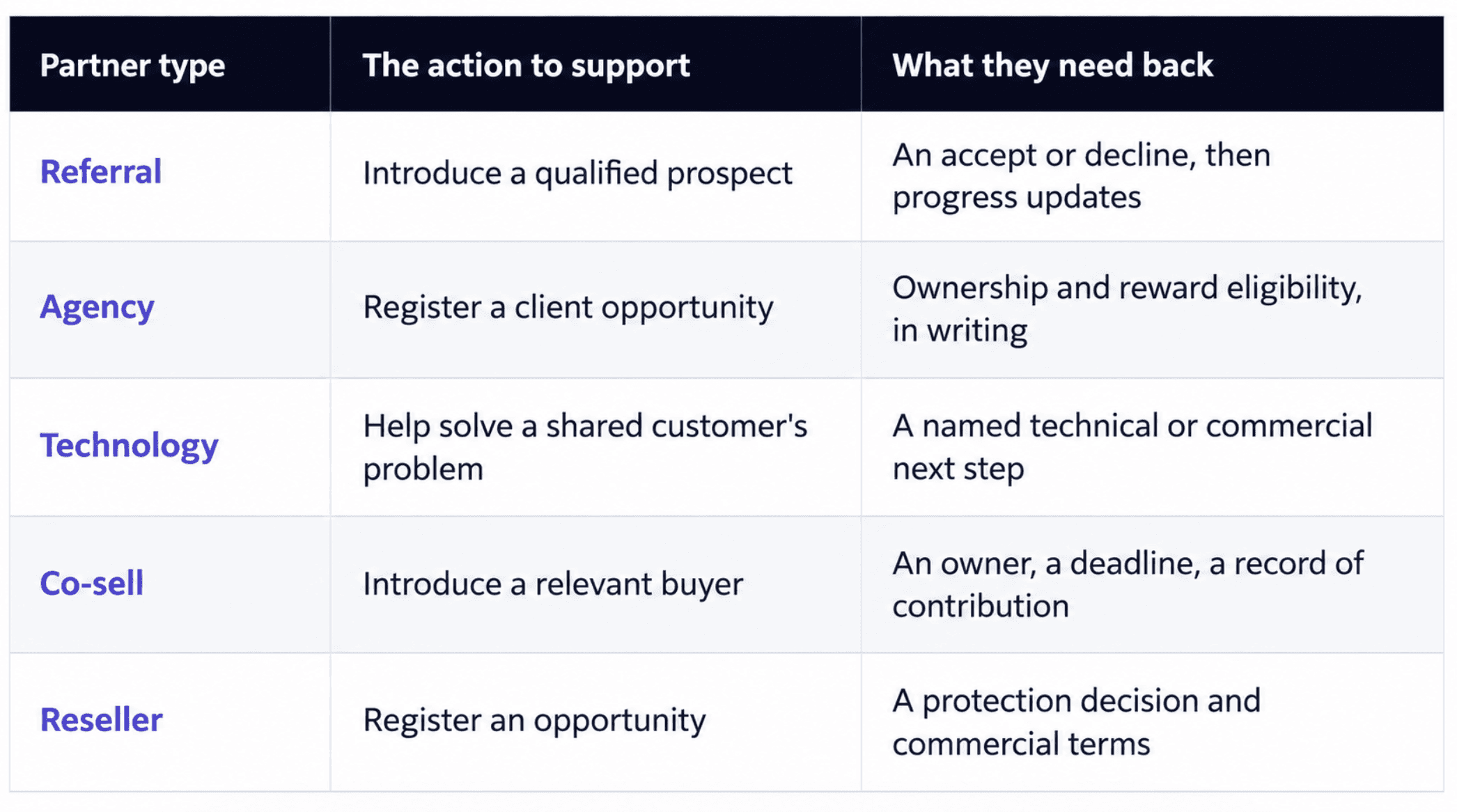
Use those actions to shape the evaluation. Ask each vendor to take you through one of them start to finish, with your rules, not their demo data.
A portal tour will not tell you what happens when two partners claim the same deal. That is the only thing you really need to find out.
Seven tests worth running before you sign anything
1. Can a brand new partner do something useful this week?
A completed training course does not put a referral in the pipeline. It puts a certificate in a folder.
Give an agency enough to recognise an opportunity when it walks past: the problem you solve, the signs of a good fit, an introduction template and somewhere to submit it. Then measure the only number that matters, which is how long it takes a new partner to produce an accepted referral.
An integration partner needs a different milestone, perhaps a joint discovery call. A reseller might need a first qualified registration.
Partner.io includes training and workflow tooling in the published offer, and Channelscaler documents milestone based partner journeys. Both will happily automate a reminder. Neither will write your brief for you, and the brief is the part that is usually broken. If partners finish onboarding and then do nothing, inspect the brief before you blame the software. Another email asking them to log in will not tell them who to introduce.
Related reading: The difference between having partners and running a partner program.
2. What happens when the prospect is already in your CRM?
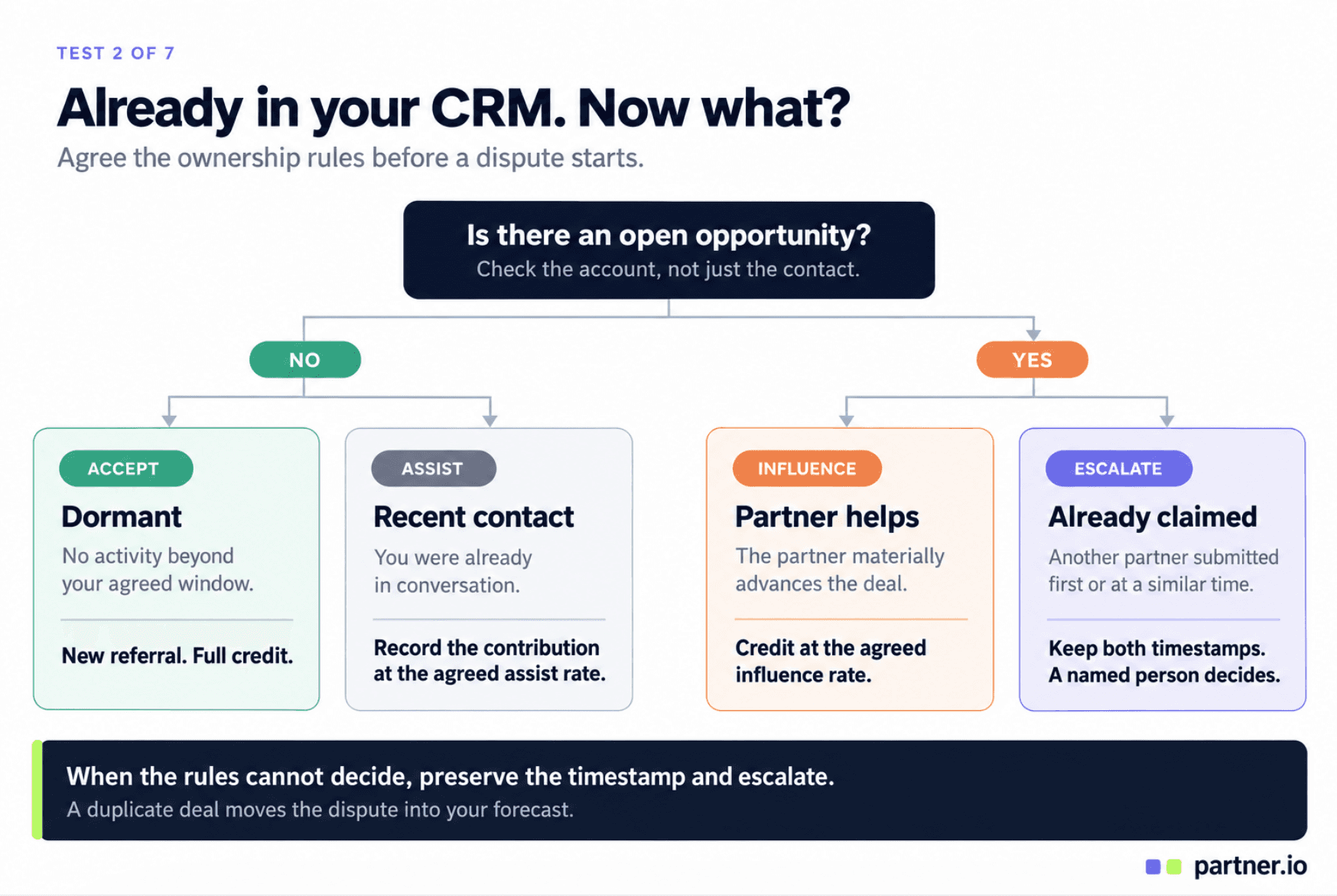
Write this down before the argument, not during it.
A dormant webinar contact from 2024 and an opportunity in legal review are not the same thing, and treating them the same way is how you lose good partners.
Reject both because "the account is already in the CRM" and you have punished a partner for a genuinely useful introduction. Accept both without review and you have manufactured an ownership dispute that will land on your desk in six weeks.
Write the rules before the dispute arrives. Specifically:
Does a dormant contact count as a new referral, and after how many months of no activity?
Can a partner earn credit for advancing an opportunity you already had?
What happens when two partners submit the same buying project in the same week?
Can separate projects inside one customer qualify independently?
When does deal protection expire, and who gets told?
Channelscaler documents duplicate detection, policy based approvals and deal protection, and those capabilities earn their keep where ownership conflicts are frequent. (Channelscaler deal registration)
Test your own policy in either platform. A CRM integration does not, on its own, prove anything about how existing opportunities get handled. It proves records can move.
Where the system cannot decide safely, keep the submission timestamp and send the case to a human. Creating a duplicate deal does not resolve the argument, it just relocates it into your forecast.
3. Does the CRM handoff survive a change?
Most evaluations stop the moment the first test lead appears in the CRM. Everybody claps. The integration is declared working.
That is roughly the halfway point. Now change the deal value. Reassign the owner. Reopen a closed won opportunity. Leave a required field blank on purpose. Then go and look at both the PRM and, more importantly, what the partner can see.
Partner.io's HubSpot integration describes partner attribution, automatic progress updates and synchronisation of deal stages and custom fields, which makes it a sensible starting point if your sales team already lives in HubSpot. There are equivalent pages for Salesforce and Pipedrive.
Agree which system owns which facts, and write it on a wall somewhere. Sales stages and opportunity ownership sit in the CRM. Receipts belong in billing. Reward terms need an approved programme record that nobody edits on a Friday afternoon.
And when a sync fails, it should fail loudly. Flag it, and pause any commission approval that depends on it. Missing data should produce a visible exception, not a plausible looking payment that nobody questions until the partner does.
4. Can you explain a commission without opening a spreadsheet?
"Ten per cent" is not a commission policy. It is a number in a slide.
You still have to define what it applies to, when it becomes payable, and what happens after a refund, a renewal or an expansion. Get that wrong and you will pay out on revenue you never collected.
Here is the arithmetic, using an illustrative £12,000 annual subscription billed monthly. If the partner earns 10% of collected subscription revenue, then three paid instalments of £1,000 create £300 of eligible commission. If instead you pay 10% of booked contract value at signature, that same deal pays £1,200 on day one, before the customer has paid you £11,000 of it.
Both are legitimate policies. They are not the same policy, and the gap is 4x. If revenue recognition is genuinely a factor in how you account for this, IFRS 15 is the standard your finance team will point at.
Partner.io documents commission tracking, approvals, statements and manual or automatic payouts through Stripe, which gives you the building blocks. (Partner.io payments, and Stripe's own payouts documentation if you want to understand the settlement timing you are inheriting.)
Now go and test the rule you actually use, including a partial receipt and a refund. Find out whether it needs a manual input or an external approval, because that is the step that will quietly eat your Tuesday every month.
Keep calculated, eligible, approved and paid as four distinct states in your process. A partner should always be able to see why an amount is waiting, and which of those four states it is waiting in.
5. Does account mapping produce an actual next step?
A list of shared accounts is not a co-selling plan. It is a spreadsheet with better branding.
Say an integration partner already serves one of your target customers. Fine. Do they know the buyer, or just the admin? Can they validate the use case? Will they make the introduction, and by when?
Both platforms will surface the overlap. Partner.io offers account mapping to identify shared customers and warm paths, and Channelscaler documents opportunity matching and shared pipeline collaboration. (Channelscaler co-selling)
The useful output is embarrassingly specific: one owner, one action, one deadline.
"Introduce us to whoever owns onboarding before Thursday's discovery call" gives the partnership something to do. "Explore the account together" leaves two companies waiting politely for each other.
One thing that rarely comes up in demos and should: mapping accounts means sharing customer data with another company. If you are in the UK or EU, the ICO's data sharing guidance is the thing to read before you upload a customer list, not after.
6. Can you separate marketing activity from actual contribution?
A joint webinar pulls 80 registrations. Some are existing customers. Some belong to opportunities that were already open. A handful are genuinely new.
Credit the campaign with every deal that touched it and you have not measured anything, you have just flattered it.
Keep the original opportunity source. Record the campaign interaction separately. Distinguish new demand from assistance on an existing deal. Then follow accepted opportunities and what happened next, which is the only version of this that survives contact with a CFO.
Funded partner marketing adds a whole extra layer: budget approval, proof of activity, claims, reimbursement. Channelscaler explicitly documents that MDF lifecycle, and if it is a standing requirement for you, that is a real point in its favour. (Channelscaler MDF management)
If you are running the occasional joint campaign, fix attribution first. You need to know which activities deserve another pound before you build a process for handing out pounds.
7. Who owns the exception?
Bring the awkward records to the demo. Not the clean ones.
Two partners claiming the same opportunity
A deal with no value on it
A partner who cannot complete payout setup
A partial customer refund
An opportunity reopened after commission was approved
For each one, ask four questions: who gets alerted, what stops, what does the partner see, and how does the record get corrected?
Some of these will always need human judgement, and that is fine. Give them an owner and a deadline anyway. The expensive failure is not the exception itself. It is the unresolved record that nobody knows they are responsible for, sitting there for a quarter.

Score it in the demo, not from memory afterwards.
Pull all seven tests together into four moments: Submit, Accept, Advance, Settle.
Each one is a change of responsibility. Each one needs evidence, not assurance.
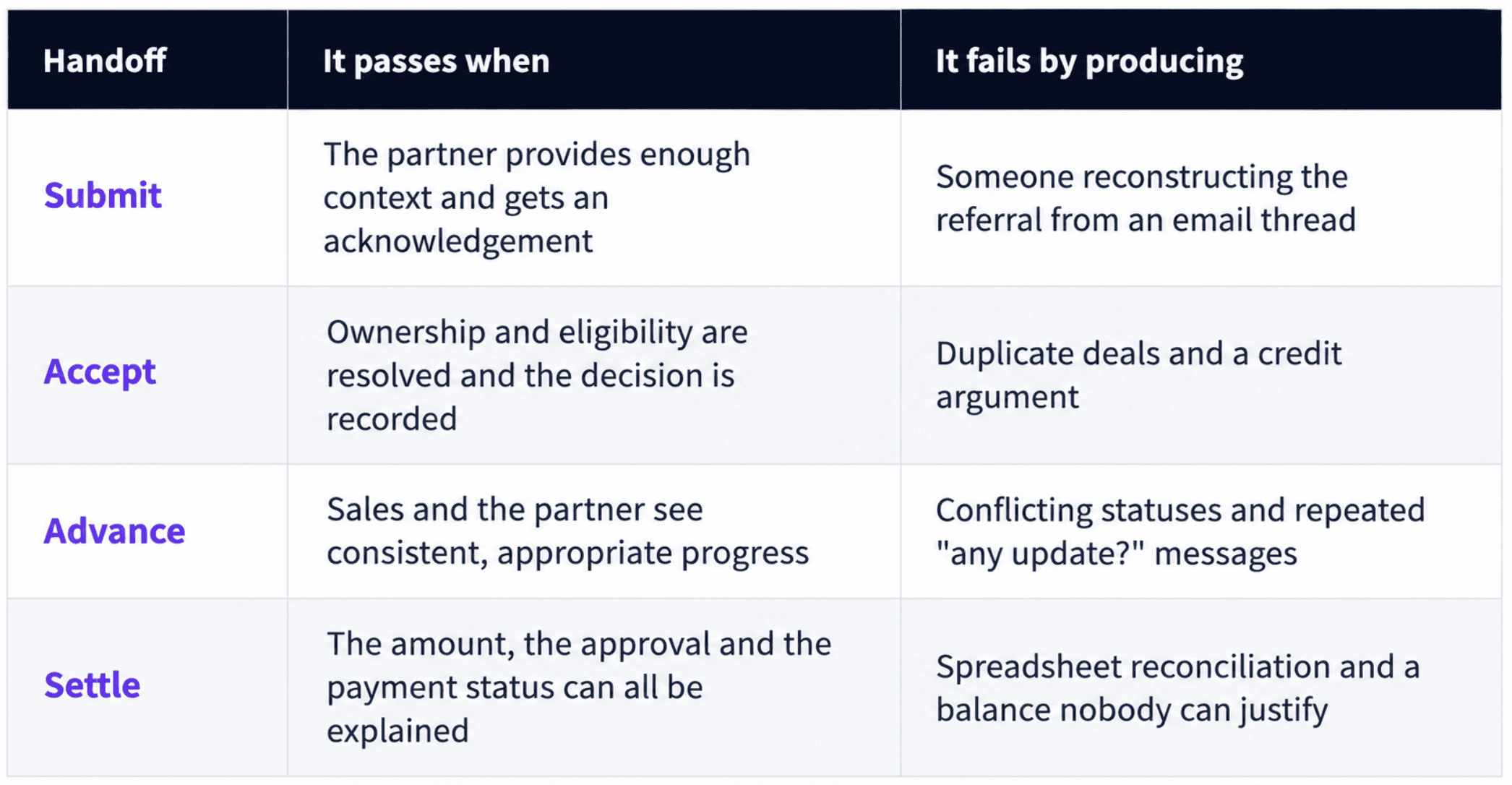
Run one referral, one agency deal and one co-sell opportunity through all four. Mark each handoff as native, configured, integrated or manual, then count the interventions your team has to make.
Context matters more than the count. A manual step that takes five minutes once a quarter is a rounding error. The same step repeated on every single referral is a part time job you have not hired for. Judge it against your actual volumes, not the volumes you hope to have by next year.
This is precisely where a PRM earns its licence fee: fewer broken handoffs, and enough control to resolve the ones that break anyway.
Why a £300 commission takes three people and a fortnight
Let me walk through the example properly, because it is the most common version of this I see.
The customer already exists in HubSpot. Their previous opportunity was closed lost eighteen months ago. An agency partner introduces a new buying conversation with a different sponsor. Sales agrees a £12,000 annual subscription billed monthly, and the agency earns 10% of collected subscription revenue.
Three invoices get paid. So far, so ordinary.
At quarter end the agency asks where its commission is. Someone exports the CRM. Someone else goes to check which invoices actually cleared. A third person hunts for the agreement to confirm the rate and the basis.
The amount is £300. Establishing why it is £300 costs more than the £300.
A defined workflow does three things here: it preserves the partner association through the closed lost record, it applies the ownership rule without a debate, and it checks receipts against the agreed commission basis. The partner gets a status that makes sense without anyone writing an email about it.
Take that exact scenario into a Partner.io trial. Verify the receipt input and the approval steps as carefully as you verify the referral form, because the referral form is the easy half. That tells you considerably more about fit than a dashboard full of sample revenue ever will.
If any of this sounds familiar, The hidden cost of managing partners in spreadsheets covers the same failure mode from the finance side.
Pricing: count what stays on your desk
At the published rate, three Partner.io seats cost $237 per month, or $2,844 across twelve months, before tax and anything separately chargeable. That is straightforward arithmetic at the monthly rate, not an annual plan quotation. (Partner.io pricing)
Channelscaler requires a scoped quote, and its per programme model means the comparison shifts as your internal user count grows rather than as your partner count grows. That can work strongly in its favour at scale. (Channelscaler pricing)
Compare five things, not one:
The subscription itself
Separately quoted services
Your own internal setup time, costed honestly at your salary rates
Ongoing administration, every month, forever
Payment processing costs where they apply
Then go back to the four handoffs and ask the question that decides it: what work still falls to your team?
A lower subscription stops being cheap the moment every payout has to be rebuilt by hand. A broader platform only earns its cost when its extra capability solves work you genuinely have, rather than work you can imagine having.
Do not let an imagined future channel dictate this year's purchase. Buy for the programme you are running in the next twelve months.
Where to start
For a programme built on referrals, agencies and co-selling, start your evaluation with Partner.io. The combination of programme tooling, CRM connected workflows and commission management addresses the work that determines whether partners keep sending you opportunities, which is the whole ballgame.
Channelscaler's specialist capability matters when funded marketing claims, rebates, distributor processes or complex protection rules are established, funded requirements. If that is you, put those requirements through exactly the same seven tests. The test is the valuable part, not my recommendation.
Here is what I would actually do this week.
Take one recent referral, its commission agreement and a test CRM opportunity into the trial. Run them through Submit, Accept, Advance and Settle. Then hand the result to someone who did not configure it and ask them three questions: who owns this deal, what happens next, and what is the partner owed?
If they can answer all three without opening a spreadsheet, you have found your PRM.
Try Partner.io free for 7 days
No credit card required, cancel anytime, no contracts. Start your free trial and run your own referral through all four handoffs, or book a demo if you would rather have someone walk it with you.
See the full pricing breakdown, or read more about referral and lead management, account mapping and partner payments.
Your next referral depends on getting this right.