Strategy
Partner-Led Growth: How SaaS CROs Can Turn Partnerships into a Revenue Engine (Under $25M ARR)

Partner-Led Growth: Changing the CRO Mindset to Embrace Partnerships
The Missed Revenue Engine: Many B2B SaaS CEOs and CROs at sub-$25M ARR companies still treat partnerships as a side project. They double down on direct sales and inbound marketing, while an untapped growth engine idles quietly. Consider this: at DigitalOcean, a sales rep struggled to close a deal until he brought in an external implementation partner to address the client’s migration roadblock. The result? The deal closed soon after, the rep was celebrated for accelerating the sale, and leadership shared the story company-wide[1][2]. That one win changed the team’s attitude toward partnerships. Account executives started inviting partners into deals earlier, hit their quotas faster, and even earned promotions[2][3]. In fact, a few salespeople were so impressed that they transitioned into partnership manager roles to further capitalize on this strategy[3]. This isn’t an isolated vignette or a feel-good anecdote; it’s a practical demonstration that partnering with referral, co-sell, agency, integration, or reseller allies can directly boost sales performance. Yet, despite such stories and data, many SaaS firms still underinvest in partnerships. It’s time to change that mindset and treat partnerships as a primary revenue source, not an afterthought. This post will show you how to build a partner-led revenue system with grounded evidence, real-world company outcomes, and a step-by-step framework.
Why Partner-Led Growth Accelerates Revenue and Profit
Trust Yields Faster, Bigger Deals: In B2B sales, trust is currency. A recommendation from a partner isn’t a cold outreach; it’s a warm introduction from a trusted advisor. That fundamentally changes the dynamics of the deal. Studies show that partner-sourced deals often convert faster, close at higher rates, and land larger contract values than purely direct deals[4]. The reason is simple: by the time a partner brings you in, the customer already believes your solution is relevant and credible. Instead of starting from zero, your sales team is confirming a known need. No wonder nearbound (partner-influenced) opportunities have a 41% higher win rate and, on average, 43% larger deal sizes [5]. The same dynamic leads to greater customer value over time. One report found that selling to partner-referred customers drove a 2× increase in the vendor's average revenue [5]. In short, partnerships inject hard-to-earn trust into the sales process from the outset, compressing sales cycles and boosting deal economics.

Lower Customer Acquisition Cost (Higher Profitability): Partnerships don’t just drive more revenue - they can drive more profitable revenue. When you consider the cost of acquisition, partner leads are extremely cost-effective. Instead of spending heavily on ads, cold outreach, or endless content to capture attention, partners already have the buyer’s attention. They bring you warm leads that are essentially pre-sold. According to PartnerStack’s data, every $1 of revenue generated through the partner channel costs only about $0.90 in go-to-market spend for B2B companies. Meanwhile, many SaaS firms spend $4-$5 to generate $1 in direct sales and marketing [6][7]. In other words, partnerships can be 4-5 times more efficient at reducing customer acquisition costs. That efficiency goes straight to the bottom line as higher profit. Partners shoulder some of the sales and marketing work (often in exchange for a commission only when a deal closes), meaning you pay for results, not attempts. Especially for resource-constrained SaaS teams, this partner revenue model yields a better ROI than hiring another sales rep or investing more in PPC campaigns.

Extended Reach Without Fixed Costs: The right mix of partners effectively expands your salesforce and market reach without adding fixed overhead. For example, signing with a regional reseller or consulting firm can open up a new geography or vertical without you having to open a new office or hire a full local team [8]. An agency or systems integrator that implements your software can bring you into deals at companies you didn’t even know were looking. A tech integration partner can include your product in a larger solution for enterprise accounts that would otherwise ignore a small vendor. In all these cases, you gain access to customers through someone else’s established relationships[9]. This is pure leverage. You’re not paying salary and benefits for that partner’s outreach; instead, you reward them with a cut of the revenue only if the business closes. It’s a variable-cost model that scales with success while protecting your downside.
Meanwhile, your partner ecosystem also makes your business more resilient. If the direct pipeline slows down one quarter, a strong channel can buffer the shortfall. If digital ads or webinars aren’t pulling in leads, your referral partners might be. This diversification of channels reduces risk to your growth strategy[10][11].

Proven Revenue Impact from SaaS Peers: Still unsure whether partnerships can realistically drive material revenue for a SaaS under $25M? Let’s look at some real examples. Glide, a no-code app company, launched a partner program for affiliates and agencies; within a short time, they reported that about 30% of their total revenue came from partnerships [12]. That’s nearly one-third of the business sourced outside the direct sales funnel. And Glide is not alone. In HubSpot’s 2022 data, HubSpot and a few other software companies reported that at least 26% of their revenue was driven by partners [13]. High-performing teams also see individual contributors thrive via partners. Highspot (a sales enablement SaaS) revealed that its top sales reps generated 58% of their revenue through partners, and those partner-attached deals were about 60% larger [14][15]. At Cypress.io, as noted earlier, involving an implementation partner turned a stalled deal into a win. It even increased the deal’s value, prompting the company’s leadership to highlight that win in an all-hands meeting [16][1]. The takeaway: partner-led growth isn’t a fluffy concept; it’s delivering real, significant revenue increments in SaaS companies today, including smaller and mid-sized ones. If your competitors aren’t leveraging this yet, you have an opportunity to gain an edge “hiding in plain sight”[17][18]. And if your competitors are building partner networks, you can’t afford to ignore this any longer.
Overcoming Common Objections (The Mindset Shift)
If partnerships are so beneficial, why haven’t all CROs embraced them as a core strategy? The hesitation usually comes down to three ingrained misconceptions, all of which can be addressed with a change in approach:
“It’s Too Hard to Measure.” Traditionally, partnerships have been seen as a fuzzy, untrackable channel. Unlike marketing or sales, which have clear attribution models and activity metrics, partner contributions often reside in spreadsheets and anecdotal stories [19]. This lack of visibility made CEOs skeptical and budget-shy. But today, that excuse is fading. Modern partner relationship management (PRM) tools and techniques now track referrals, deal registrations, and partner-influenced revenue with CRM-level precision. You can clearly see which partners brought which deals and the revenue impact of each[20]. With the right systems (more on that below), partnerships can be measured and forecasted just like any other revenue stream.
“No One Owns It.” In many organizations, partnerships have no dedicated champion. The responsibility gets sprinkled across biz dev, sales, or marketing as a part-time effort[21]. Without focused ownership, the program never gains momentum. The fix here is straightforward: treat partnerships as a first-class function. That means assigning a partnership manager or team with clear revenue targets, just as you would for sales managers. Give them executive support and cross-functional alignment. When 25-30% of revenue is expected from partners, you must resource it accordingly with the necessary headcount and budget [22]. By making one leader (or a small team) truly accountable for partner success, you ensure it doesn’t slip through the cracks.
“Partnerships Are Slow (or Nice-to-Have)” There’s a lingering myth that channel deals take forever to materialize or that they’re just bonus gravy on top of “real” sales. The reality: partnerships are only slow when they’re ad hoc and unmanaged[23]. A few random partners signing up and sending the occasional lead will indeed fizzle out (“most partnership programs fail quietly” as a result[24]). But when you structure and nurture the channel properly, it can become one of your fastest pipelines[23]. The DigitalOcean example proves that engaging a partner can accelerate a deal, not slow it. Furthermore, by embedding partners in a repeatable process (onboarding, co-selling cadence, clear rules of engagement), collaboration becomes routine rather than a heroic one-off effort [25]. The key is to stop treating partnerships as a casual experiment and start treating them as a strategic revenue operation[26]. In fact, ask yourself: If a meaningful portion of our revenue is influenced by partners, why wouldn’t we give the channel the same rigor and support as we do for direct sales or marketing?[27] This mindset shift from “partnerships are a side project” to “partnerships are core to our go-to-market” is the crucial first step.
Importantly, Sales and Marketing leaders themselves are coming around to this view. In a 2023 partner-led growth study, respondents overwhelmingly agreed that “people buyers trust” have the biggest impact on purchase decisions, yet they admitted that only a tiny percentage of their deals actually came via those trusted partner networks[28]. This is the gap we need to close. If your organization today sources, say, less than 10% of its leads from partners, you are likely leaving 90% of potential opportunities on the table[29]. Changing the mindset means recognizing partnerships not as a risky bet, but as a proven channel that, when managed, can deliver efficient, scalable growth. Now, let’s discuss how to operationalize that change.

Framework: Building a Partner-Led Revenue Engine
Making partnerships a primary revenue driver requires a deliberate plan. Here is a four-part framework that high-performing partner-led teams use to build and run successful partner programs in practice:
Commit to and Resource Properly (People & Ownership): Treat the partner motion as a core revenue engine from day one. Assign a partnership owner (or team) with the mandate to drive revenue, not just “manage relationships.” Make this someone senior enough to influence sales and marketing, leaders. Set clear KPIs (e.g., partner-sourced pipeline, partner-influenced bookings), so goals are explicit. Importantly, allocate resources proportional to the impact you expect. If you aim for, say, 20% of new revenue from partners, then roughly 20% of your go-to-market effort (headcount, budget) should align with that [22]. This may mean hiring a full-time partner manager instead of splitting duties among staff. It might involve dedicating marketing dollars to partner co-marketing campaigns or solution enablement. Leadership must also show visible support, e.g., mentioning partner strategy in all-hands meetings and pipeline reviews. When the team sees that “partner-led growth” is a top priority from the C-suite, they’ll give it the attention it deserves. In short, invest in people: skilled partner managers who recruit, enable, and advocate for partners internally.
Design a Structured Partner Program (Process & Alignment): Don’t wing it with your partners; put a clear process in place. High-performing partner programs tend to be “boring in the best way,” everyone knows how things work[25]. Define the partner journey step by step: How will you recruit the right partners (referral affiliates, resellers, tech integrators, etc.)? How will you onboard and train them on your product and value prop? How will partners register leads or deals (e.g., a simple deal registration form or portal) to avoid channel conflict? What are the rules of engagement between your direct sales team and partners (for instance, when to co-sell vs. when to pass a referral, how to share account information)? Also, plan how you’ll compensate or incentivize partners – whether through commission, revenue share, referral fees, or reciprocal leads. By mapping this out, you remove friction and prevent the common breakdowns that plague half-hearted programs (e.g., partners feeling ignored, or sales reps feeling blindsided)[30][31]. A well-defined process turns ad hoc efforts into a reliable system. Alignment is part of this: bring your sales and marketing teams into the program design so they understand how partners fit into the overall go-to-market strategy. For example, you might establish a routine in which partner-sourced opportunities are discussed in sales pipeline meetings, or in which marketing works with partners on co-branded content. The goal is to bake partnerships into your operating rhythm. When everyone knows the playbook for how a referral is handled and how a joint deal is pursued, partnering becomes a natural extension of your sales motion rather than a novelty.
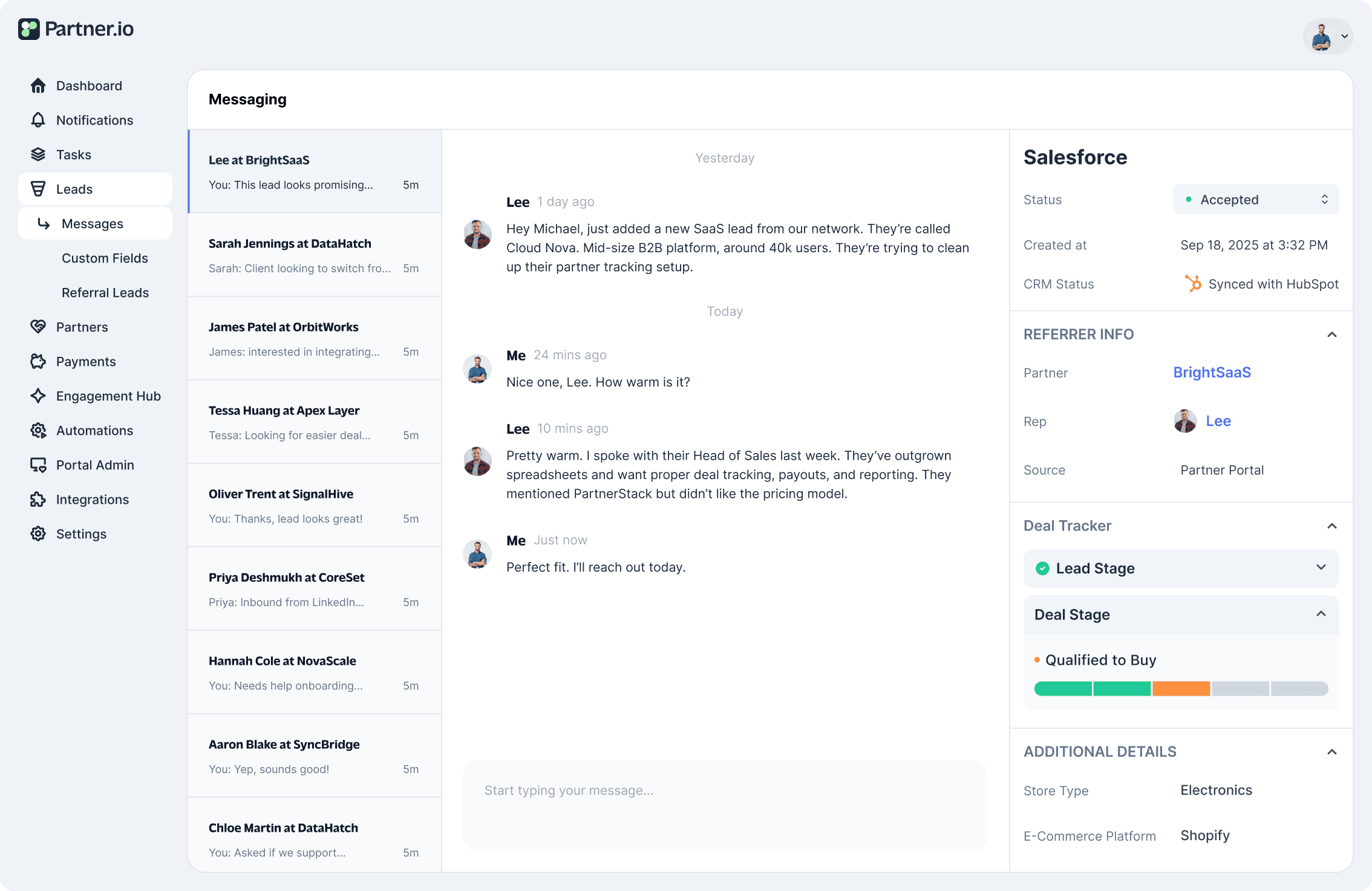
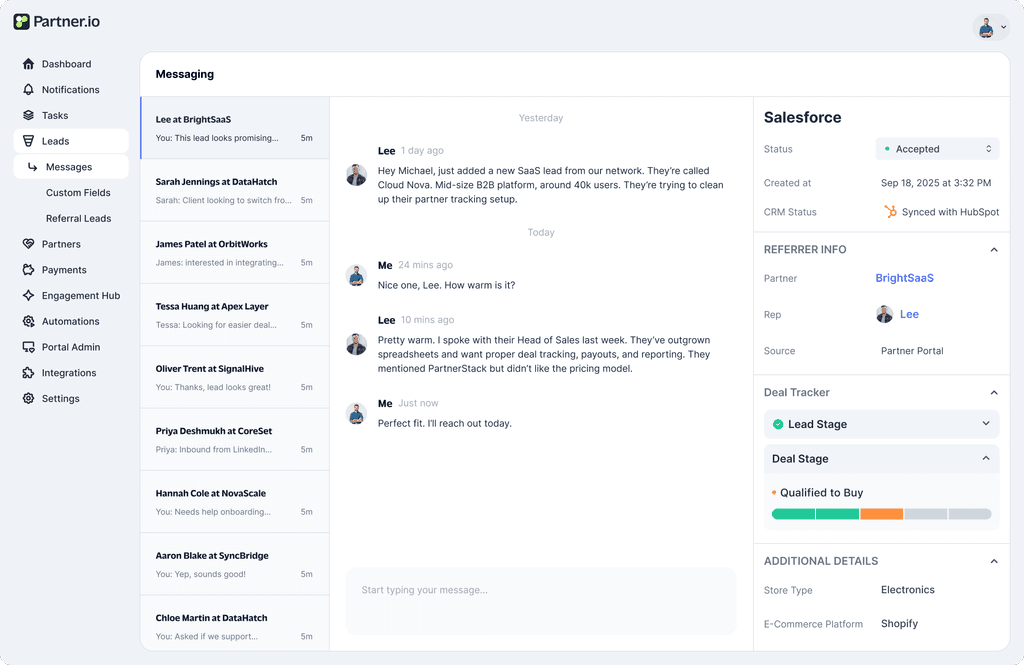
Equip with the Right Partner Tech (Platform & Tools): If you expect your partnerships to scale, don’t rely on spreadsheets and inboxes. That’s a recipe for lost leads and frustration. Just as your sales team has a CRM system, your partner team needs a Partner Relationship Management (PRM) platform. Modern PRMs (such as Partner.io) serve as the operating system for your partner program [32]. We centralize all partner data and activities: partner profiles, lead referrals, deal registrations, co-selling notes, training materials, and payout calculations - all in one place. This tech infrastructure is crucial for a few reasons. First, it gives you visibility and tracking. You can see exactly which partners are contributing what: how many leads, how much pipeline, where deals are in the funnel, and so on[20]. This addresses the measurability concern and lets you forecast partner-sourced revenue as you would for direct deals. Second, a PRM integrated with your CRM ensures that partner deals aren’t siloed your sales reps and partner managers stay on the same page. Third, it automates the grunt work: no more manual spreadsheets for tracking commissions or endless email threads to update deal status. Automation (for example, auto-notifying a partner when their lead progresses, or auto-calculating a referral payout once a deal closes) reduces errors and builds partner trust. Partners know they’ll be credited and paid accurately and on time[33]. The right platform essentially makes partnering efficient and scalable. Without it, even a promising partner program can stall due to operational bottlenecks. An old saying applies here: expecting a partnership team to scale revenue without proper systems is like asking a sales team to hit quota without a CRM [34]. So equip your team with tools purpose-built for the job.
Measure, Iterate, and Celebrate Wins (Continuous Improvement): To truly change the mindset at the leadership level, you need to prove impact and then amplify it. Start measuring and reporting on partnership contributions just as rigorously as you do for other channels. Track metrics such as partner-sourced ARR, % of deals with partner involvement, average deal size for partner vs non-partner deals, and partner-influenced pipeline. Often, you’ll uncover the asymmetric value we discussed (e.g., maybe only 15% of your leads came via partners, but they drove 25%+ of closed revenue)[35]. Share these numbers in management meetings. This data will convert skeptics over time. Additionally, celebrate the wins internally. When a partner helps close a big customer or refers a high-quality lead, broadcast it: give kudos to the partner and the internal team members involved. Nothing builds momentum like success. Salesforce famously scaled its AppExchange and reseller ecosystem by highlighting that partners drive significant deal flow. It created a virtuous cycle where more teams wanted to engage with partners because that’s where the big wins were. You can do the same on a smaller scale. Consider creating an internal newsletter or Slack channel for “Partner Wins” to keep the concept front of mind. On the flip side, iterate on the program by gathering feedback: ask your partners what could make it easier to send you business; ask your sales reps if they’re getting value from co-selling and what’s missing. Use that input to continuously refine your program structure, training, or incentives. Over time, these iterations will compound. Partnerships will go from experimental to predictable and repeatable. The channel will stop being anecdotal and start delivering a reliable contribution to the quota quarter after quarter [20][36]. That’s when you know the mindset shift is complete when partnerships are simply part of “how we hit the number” every quarter, embedded in your company’s DNA.

By following these steps, People, Process, Platform, and Continuous Improvement, even a lean SaaS company can build a partner program that consistently generates revenue. It transforms partnerships from a fuzzy concept into a structured partner revenue model and channel sales strategy that executives can depend on.
A New Era of Scalable Growth
It’s no coincidence that the best B2B SaaS teams run on three engines: Inbound, Outbound, and Partner-Led[37][38]. If your company has nailed product-market fit and is pushing hard with marketing and sales, partnerships might be the missing piece that propels you to the next level. And for smaller SaaS businesses under $25M in ARR, partner-led growth can be the force multiplier that closes the resource gap relative to bigger competitors. It allows you to punch above your weight by leveraging an extended network of allies. Crucially, partnership-driven revenue isn’t at odds with your direct sales; it amplifies them. Partners bring you into deals you’d otherwise miss, soften the ground with trust, and even make your direct reps more effective. This isn’t theory or wishful thinking, but what we see on the ground: companies that treat partnerships as core infrastructure can grow faster, more profitably, and more resiliently[39]. Meanwhile, those ignoring partnerships are increasingly at risk of falling behind.
If you’re a CEO or CRO ready to pivot to a partner-led growth strategy, the time to act is now. Start laying the groundwork, but don’t do it alone. Partner.io can help you operationalize everything discussed here. Partner.io is a modern PRM platform purpose-built for partner-led growth in B2B SaaS. It provides a unified portal for managing all your referral partnerships, co-sell deals, agency, and reseller relationships in one place. With real-time partner data, deal registration workflows, and seamless CRM integration, Partner.io gives you the visibility and control to scale a high-performing partner program[40][41]. The platform automates partner onboarding, tracking, and payouts, so your team can focus on closing deals instead of administrivia. The result? You and your partners drive more revenue, faster, with clear attribution and less friction. Don’t leave this growth lever idling on the side.
Use Partner.io to turn your partnerships into a primary revenue engine for your SaaS business. It’s time to get serious about partnerships and join the companies achieving outsized profit and sales through this powerful channel. Unlock the full potential of partner-led growth in your organization, and you’ll never look at “indirect” revenue the same way again.
Sources:
PartnerStack – SaaS Partnerships Awards 2024 (Glide case study)[12]
Partner.io – Inbound vs Outbound vs Partner-Led: B2B SaaS Revenue Engines[4][8]
Crossbeam – 2023 State of Partner-Led Growth Report (Key Takeaways)[28][13]
Crossbeam – “Partners contribute 58% of revenue of top performers” (Ecosystem-Led Sales article)[14]
Crossbeam – “6 Ways Sales Professionals Can Use Partnerships to Advance Their Careers” (DigitalOcean/Cypress story)[1][2]
PartnerStack – “Why Partnerships Are Key to Customer Acquisition” (Luke Swanek interview)[6]
[1] [2] [3] [16] 6 Ways Sales Professionals Can Use Partnerships to Advance Their Careers (and Get Promoted)
[4] [8] [9] [17] [18] [19] [20] [21] [22] [23] [24] [25] [26] [27] [30] [31] [32] [33] [34] [35] [36] [37] [38] [39] [40] [41] Inbound vs Outbound vs Partner-Led: B2B SaaS Revenue Engines - Partner.io
https://www.partner.io/blog/inbound-vs-outbound-vs-partner-led-b2b-saas-revenue-engines
[5] [13] [28] [29] Key Takeaways: The 2023 State of Partner-Led Growth Report
https://insider.crossbeam.com/entry/key-takeaways-the-2023-state-of-partner-led-growth-report
[6] [7] [10] [11] Why Partnerships Are Key to Customer Acquisition
https://partnerstack.com/articles/why-partnerships-are-key-to-customer-acquisition
[12] The 2024 SaaS Partnerships Awards: Celebrating Excellence in B2B SaaS Partnerships
https://partnerstack.com/articles/saas-partnerships-awards-2024-winners-share-learnings
[14] [15] Partners Contribute to 58% of the Revenue of Top Performers (And 5 Other Sales Stats)
https://insider.crossbeam.com/entry/partners-contribute-revenue-of-top-performers-sales-stats